
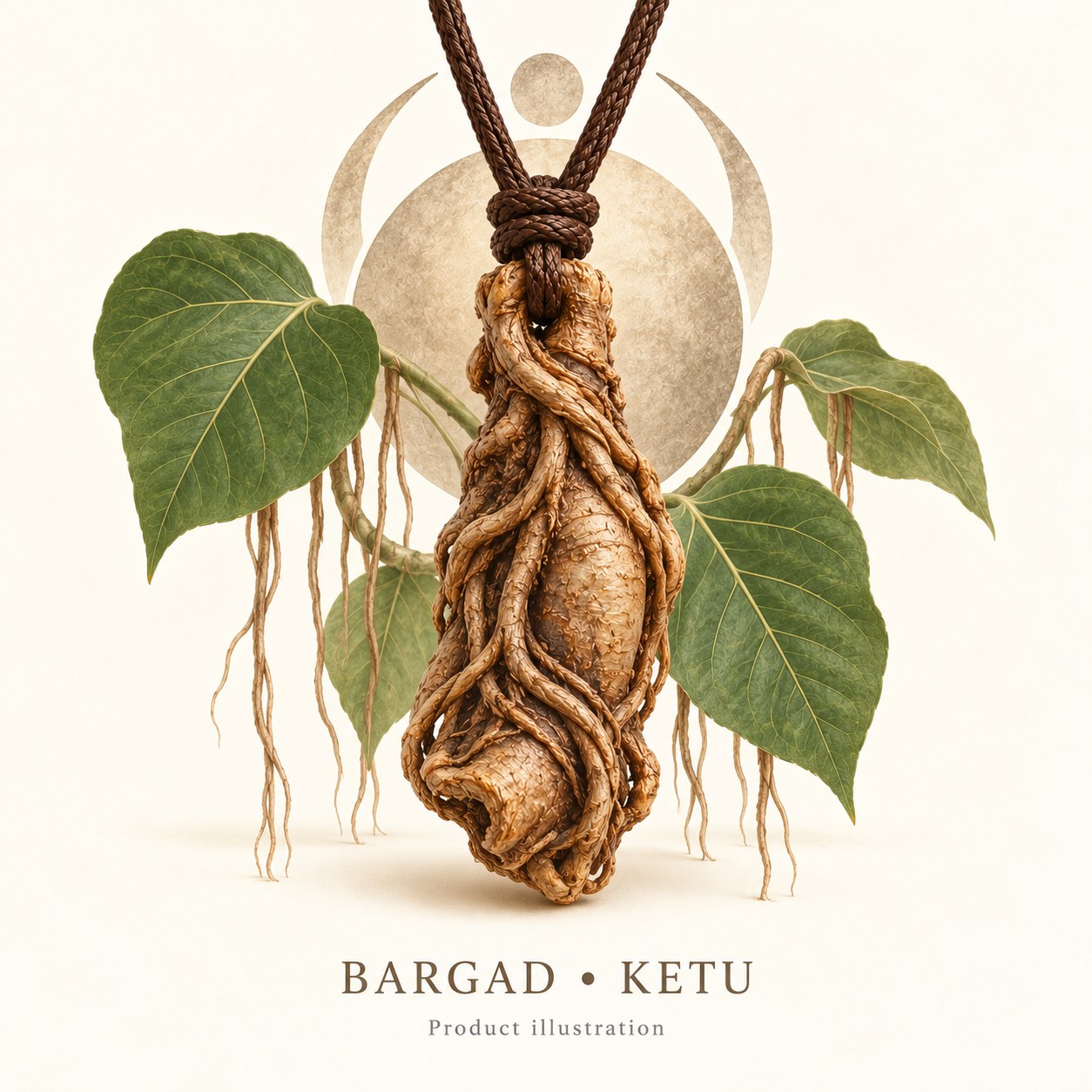
Understanding Bargad: a living tree before it becomes a sacred material
The Bargad or Banyan tree is one of the most recognisable trees in the Indian landscape. Its broad crown, descending aerial roots and many pillar-like supports allow a single tree to occupy an area that looks almost like a small grove. A mature Banyan can stand beside a temple, shade a village gathering place, dominate an old courtyard or become a landmark remembered across generations. That physical presence is part of the reason Vata, Nyagrodha and Bargad carry such deep meaning in Indian ritual, literature and everyday speech.
The botanical species discussed here is Ficus benghalensis L., a member of the fig family, Moraceae. Understanding its actual plant structure is especially important when an item is marketed as a Bargad root pendant. A root descending from a branch, a root already rooted in soil, trunk wood, stem bark and leaf are not interchangeable materials. They have different positions in the living tree and different characteristics once dried and used in an object.
There are two complementary ways to read this guide. First, it explains the living Banyan: how to recognise it, why its roots hang from branches, what its figs do and why people protect it. Second, it explains how the Banyan became a symbol of continuity and shelter, how traditions such as Vat Savitri are observed, and how the term Nyagrodha Jata helps specify material used in herbal or devotional jewellery. These subjects belong together, but they answer different questions.
| Question | Practical answer | Why it matters |
|---|---|---|
| What is Bargad? | The Banyan tree, normally Ficus benghalensis L. in this product context | Confirms the botanical candidate rather than a generic fig |
| What are its hanging strands? | Aerial roots developing from branches | Explains the tree's characteristic architecture |
| Can an aerial root become a trunk? | It can thicken into a pillar-like prop after reaching soil | Explains how one tree expands sideways |
| Is Bargad the same as Peepal? | No. Peepal is generally Ficus religiosa | Prevents plant-part and devotional-name confusion |
| What is Nyagrodha Jata? | A recognised name for Banyan aerial-root material | Useful when describing the actual botanical part |
| Why is Banyan sacred? | It is associated with endurance, shelter, auspiciousness and region-specific ritual traditions | Gives the cultural context without treating all customs as identical |
| Does a Banyan photograph prove pendant contents? | No. Identity and source of the finished piece require a separate material record | Protects accuracy in product descriptions |
Botanical identity: Ficus benghalensis and its Indian names
Kew's Plants of the World Online accepts Ficus benghalensis L. as the scientific name. The tree belongs to the genus Ficus, which also includes Peepal and other figs. The Indian Institute of Science's flora of Karnataka records Vata in Sanskrit, Bat or Bargad in Hindi and Aladamara or Goli mara in Kannada for this species. Regional names vary: a label that says only 'Vat', 'Bar' or 'Bargad' is a useful cultural clue, but an inventory description should still specify the scientific name when possible.
The tree is native to the Indian subcontinent. It grows in tropical climates and can become exceptionally broad because its branches produce aerial roots that may reach the ground and develop into additional supports. Its native ecology is not a promise that every planted specimen will achieve the same dimensions. A young Banyan on a roadside and an ancient tree with many prop roots may look almost like different plants until their leaves, figs and growth pattern are compared.
| Name or term | Language or context | Meaning in this article |
|---|---|---|
| Bargad / Bargat / Bar | Common north Indian usage | Banyan tree |
| Vata / Vat | Sanskrit and ritual usage | Banyan, especially in observances honouring the tree |
| Nyagrodha | Classical Sanskrit and traditional plant nomenclature | A recognised name for Banyan |
| Nyagrodha Jata | Traditional botanical-material terminology | Banyan aerial-root material, not automatically trunk bark |
| Vata Jata / Vatajata | Related material name | Used for Banyan aerial roots in traditional nomenclature |
| Aladamara | Kannada regional usage | Banyan tree |
| Ficus benghalensis L. | Botanical taxonomy | Accepted species name for the tree discussed here |
| Moraceae | Botanical family | The fig or mulberry family |
Why the species name matters: Banyan, Peepal, gular and several ornamental figs may all be described casually as 'ficus' or 'sacred fig'. That does not make them the same species or make their roots equivalent. If a pendant is advertised as Ficus benghalensis aerial root, the seller should be able to describe the material and the identification route behind that claim.
The architecture of a Banyan: canopy, aerial roots and living pillars
An established Banyan can extend its branches far beyond the original trunk. From some branches it produces slender roots that hang vertically. Where growth and environmental conditions favour it, a hanging root can descend far enough to meet the ground, develop a connection with soil and gradually thicken. Over time this root becomes a prop root, sometimes resembling an independent trunk. It remains part of the same Banyan organism.
That is why a mature Banyan may be described as a tree that looks like many trees. People walking beneath it can see an original trunk, branches bridging between pillars and a network of living supports. This is not merely picturesque architecture; it is how the plant extends and supports its heavy lateral crown. Kew's species account notes that some Banyans spread over exceptionally large areas, but an extraordinary specimen should not be treated as the size of an average tree.
The sequence is best understood as a gradual transformation, not an instant event. The hanging structures are living roots; they are not ropes, lianas, tendrils or detachable ornaments growing for human use. If a root has already become a supporting column, cutting it can affect the tree's structural stability. Even a slender descending root is part of the tree's growth system and should not be collected casually.
| Stage | What a visitor may see | Botanical significance | Material-description implication |
|---|---|---|---|
| Initiation | A small projection from a branch | An aerial root begins growing | Not the same as a woody trunk |
| Elongation | Narrow hanging cords below the canopy | Roots extend downward through air | 'Hanging root' describes its position, not confirmed species |
| Contact | A descending root touches soil | A chance to establish below-ground connections | A rooted prop differs from a free-hanging strand |
| Thickening | An increasingly firm upright column | The root becomes a support for spreading branches | Woody prop-root material can differ from young root tissue |
| Mature architecture | Many columns around the original trunk | Canopy expands with additional support | The appearance of a grove may come from one tree |
Aerial root, prop root, ordinary root and stem bark are different
A young aerial root has developed above ground and may still hang free. A prop root is an aerial root that has reached and established in the soil and thickened. Below-ground roots form a soil-based root system. Stem bark surrounds stems or trunks; it is not a root at all. Because all can appear brown and fibrous when cut or dried, a casual look at a small pendant component does not settle the question.
Traditional plant nomenclature itself recognises this distinction. Kew's Medicinal Plant Names Services maps nyagrodha jaṭā (aerial root) to Ficus benghalensis and records an aerial-root drug form in the Ayurvedic Pharmacopoeia of India. The same botanical species can also have separate records for stem bark and other parts. A buyer therefore needs more than a familiar tree name to understand the material supplied.
| Plant part | Where it occurs | Common appearance | What a seller should identify |
|---|---|---|---|
| Free-hanging aerial root | Descends from a branch above soil | Slender, cord-like, sometimes branching | Species, root status, drying and processing |
| Established prop root | Connects canopy to soil | Thickening, pillar-like, woody | Whether it was a rooted support and how obtained |
| Underground root | In or below soil | Variable, branching, often soil-stained | Actual source, part and processing |
| Trunk or branch wood | Structural stems | Woody growth rings or grain | Clearly described as wood, not aerial root |
| Stem bark | Outer covering of a stem | Layers or strips | Identified as bark, never silently renamed root |
| Leaf | On shoots | Broad, leathery and veined | Botanical reference only unless expressly supplied |
| Latex | Exudes from cuts | Milky sap | Not a jewellery component merely because it occurs in Banyan |
How to recognise a living Bargad tree
For most readers, the clearest field clue is the combination of broad lateral branches and aerial roots that can form pillars. The Indian Institute of Science's Karnataka flora describes grey-brown bark, leathery oval or elliptical leaves with prominent veins, milky latex when cut and small figs that often appear in pairs. Mature fruit may turn reddish. Kew also describes Banyan as a large tropical tree with prominent aerial-root architecture.
Do not damage a tree to identify it. Leaves already fallen naturally, clear photographs of leaves and branches, figs observed on the tree and its overall growth pattern can be useful. Latex is a botanical characteristic, not an invitation to cut the bark; contact may irritate sensitive skin. If identification matters commercially, a trained botanist or documented supplier determination is more reliable than photographs alone.
A Banyan may begin life as a young fig growing on another tree. In suitable environments its roots grow towards the ground, and the developing plant can eventually envelop its original support. Not every specimen follows an identical path. In cities, Banyans may be planted directly in the ground, and pruning, pavement, walls and overhead services can alter their form. Its characteristic capacity to generate prop roots remains central to recognising the species.
Bargad versus Peepal: two sacred figs, not one tree
Banyan and Peepal are both meaningful in Indian religious landscapes, and both are members of the genus Ficus. Yet **Banyan is generally *Ficus benghalensis, while **Peepal or Ashwattha is *Ficus religiosa. They should not be substituted for one another in botanical descriptions or jewellery material specifications.
| Feature | Bargad / Banyan | Peepal / Ashwattha |
|---|---|---|
| Scientific name | Ficus benghalensis | Ficus religiosa |
| Well-known Sanskrit name | Vata, Nyagrodha | Ashvattha / Ashwattha |
| Typical leaves | Thick, oval to elliptical, with prominent veins | Heart-shaped with a distinctive long, tapering tip |
| Architectural clue | Large spreading canopy; abundant prop roots on many mature specimens | Prominent leafy crown; not typically a network of Banyan-like prop trunks |
| Fruiting structure | Small figs, often paired | Small fig structures, differing in form and colour |
| Associated traditions | Vat Savitri, Banyan worship, shelter and continuity | Bodhi/Ashwattha traditions and distinct Hindu and Buddhist contexts |
| A jewellery claim | 'Banyan aerial root' requires F. benghalensis part evidence | A Peepal component requires separate F. religiosa identification |
A photograph showing only bark or a small piece of dried wood is rarely enough for a reliable distinction. Trees may share broadly similar bark colours, and an isolated root loses the leaf-and-fruit clues most people use outdoors. This is why botanical identity belongs in a supplier record, not solely in a devotional narrative.
What the figs and the surrounding life tell us
Banyan belongs to a remarkable group of trees whose flowers are enclosed within specialised fig structures known as syconia. What appears to be a small fruit is part of a specialised reproductive system. Fig wasps participate in the pollination of many Ficus species, and the relationships can be species-specific. Kew's account of Ficus benghalensis identifies a particular associated pollinator wasp. For a reader, this reveals a less visible aspect of the Banyan's value: its branches and figs support wider ecological relationships.
Banyan figs can be an important food resource for birds and other animals. Branches provide perches, nesting opportunities and shelter. Roots affect the ground beneath the canopy, while the extensive crown changes the local experience of sunlight and shade. A large mature tree can support many small forms of life simultaneously; that ecological function helps explain why protecting a long-established Banyan matters beyond its association with any particular ritual.
This ecology also gives a practical reason not to cut aerial roots casually. Those roots are part of a living system. Collecting material for an object should never be presented as automatically harmless merely because a tree produces numerous roots. Location, owner or custodian permission, the root's function and the tree's condition all matter. A devotional accessory should be discussed with respect for the living tree from which its material is said to come.
Why Bargad is sacred: Vata, Nyagrodha and the idea of continuity
In many Hindu traditions the Banyan expresses stability, long life, shelter, regeneration and continuity. A single living tree can extend through numerous supporting roots without losing its identity. That visible pattern provides a powerful image for family lineage, enduring commitments, learning transmitted between generations and a gathering place sustained over time. Kew's species profile describes the Banyan's importance in Hindu mythology and its historical function as a shaded meeting place.
The name Vata often appears in rituals and festivals; Nyagrodha appears in botanical and traditional Sanskrit contexts. Regional practice also brings distinct deities, local stories and calendrical customs into the picture. Some communities explain the Banyan through associations with the Trimurti—Brahma, Vishnu and Shiva—while others emphasize Savitri, familial continuity, a village deity or the auspicious qualities of the tree itself. It is more accurate to name the particular observance than to impose one universal meaning on all Banyan worship.
A living sacred tree is different from a privately owned object made of its material. Visiting, watering or circumambulating an established Vat tree is one kind of practice. Wearing a small herbal pendant is another. Both may have devotional significance to a person, but the existence of the first tradition does not automatically establish a mandatory wearing rule for the second.
Vat Savitri and Vat Purnima: a story of fidelity and resolve
One of the most familiar Banyan-associated observances is Vat Savitri, often connected with the story of Savitri and Satyavan. In the story, Savitri confronts the prospect of losing Satyavan, speaks with Yama and secures boons through her determination and intelligence. In regional retellings a Banyan tree features prominently as the setting and as an object of reverence. Maharashtra Tourism describes Vat Purnima celebrations, Banyan circumambulation and the Savitri–Satyavan narrative.
The observance is not identical in every region. The names Vat Savitri Amavasya and Vat Purnima reflect different calendar dates and practices in different communities. Married women in some traditions observe fasting, offerings, prayer and the tying or winding of thread around a Vat tree. Some families place greater emphasis on the vow, others on the story, family custom or local temple practice. Dates should follow the family's local panchanga and the observance actually followed, not a fixed date copied from another region.
The sacred tree matters in this account because it becomes a place of witness, continuity and prayer. It is neither necessary nor botanically sound to suggest that collecting a tree root recreates the full festival. The purpose of describing the story is to understand why Banyan reverence remains culturally prominent and why respect for the living tree is itself meaningful.
| Tradition or concept | Main idea | Connection with Banyan | What should not be conflated |
|---|---|---|---|
| Vat Savitri | Vow, prayer, Savitri–Satyavan narrative | Vat tree as a sacred focus | Festival worship versus wearing a pendant |
| Vat Purnima | Regional full-moon observance | Circumambulation, offerings, family customs | One community's date versus every community's date |
| Nyagrodha | Classical name of Banyan | Tree identified in plant and devotional contexts | A species name versus a verified jewellery component |
| Kalpavriksha imagery | Auspicious, wish-fulfilling tree symbolism | Some traditions compare great sacred trees with this ideal | Symbolic comparison versus a single universal identification |
| Trimurti associations | Brahma, Vishnu, Shiva in some devotional interpretations | Parts or functions of a tree may become symbolic metaphors | Local interpretation versus a documented botanical fact |
| Village gathering place | Shared shade and community memory | Social life beneath a large canopy | Cultural value versus harvesting rights |
Kalpavriksha and the wish-fulfilling tree image
Kalpavriksha or Kalpataru describes the auspicious wish-fulfilling tree in Indian religious and artistic imagination. The idea is older and broader than modern jewellery marketed as a gemstone tree or a planetary herbal accessory. Banyan's huge sheltering form is understandably associated with such imagery in some descriptions. Yet not every traditional Kalpavriksha representation names the Banyan, and different religious and regional sources may interpret the term differently.
For the reader, a useful distinction is between symbolism and identification. A Banyan can symbolise shelter and enduring abundance; a historical depiction of a wish-fulfilling tree can communicate prosperity; a pendant made of plant material may remind a person of these ideals. None of these ideas determines the botanical part supplied in the pendant. If a seller invokes Kalpavriksha, the exact traditional context should be explained rather than treating that word as a substitute for material information.
Temples, shrines, village spaces and ancestral memory
Many people encounter Banyan first as a place, not as a botanical specimen. A large tree marks a crossroads, temple boundary, schoolyard, old home or public square. Its branches may shelter conversations, market stalls, visitors resting from the sun, or an outdoor devotional area. With time, that location gathers stories: a grandfather recalls its shade, a neighbourhood recognises its silhouette, or a priest remembers festivals observed beneath it. The tree becomes a marker of community history.
These shared associations explain why conservation is part of respect for a sacred tree. Protection means allowing roots and branches adequate space, avoiding unnecessary injury, respecting the area around the trunk and seeking qualified arboricultural help when a tree conflicts with structures or wiring. Banyan is capable of tremendous growth, so planting it is not a casual choice for a tiny courtyard, boundary wall or apartment balcony. A sacred sentiment should be combined with realistic long-term planning for an urban landscape.
Banyan in Karnataka and Bengaluru: what visitors may notice
In Bengaluru and elsewhere in Karnataka, Banyan may be encountered as Aladamara or Goli mara. The Indian Institute of Science's flora records Ficus benghalensis across multiple Karnataka districts, including Bengaluru. Some specimens grow along older roads, near temples or in open community spaces, while younger planted trees may still have few visible roots. The most distinctive mature examples show descending roots progressively taking on the appearance of additional trunks.
If examining a Banyan in person, observe without pulling roots or cutting bark. Walk far enough back to see the relation between a root and the branch above it. Notice whether the hanging root is still free in air, whether it reaches the soil or whether it has thickened into a pillar. Check broad leaves, the paired small figs if present and the overall spreading form. These observations form a better botanical learning exercise than trying to judge a species from an anonymous strip of dried material.
A visit can also illustrate the practical meaning of Vriksha Puja and Vriksha Raksha—reverence and protection of trees—without prescribing a particular ritual. Public and temple trees have custodians, visitors and ecological roles. Leave materials where they are, follow the site's rules and respect people engaged in worship or maintenance. Taking an aerial root as a souvenir is not a normal extension of visiting a sacred tree.
From Banyan anatomy to Nyagrodha Jata: what an herbal material name means
The name Nyagrodha Jata is important precisely because it goes beyond the word 'Bargad'. Kew's Medicinal Plant Names Services maps the name to Ficus benghalensis, with an aerial-root plant-part designation from an Indian pharmacopoeial source. In this terminology, the jata reference concerns the tree's hanging root structure. The classification does not imply that a particular commercial pendant has been tested or that every product using the Bargad name contains the specified part.
A dried aerial root may look different according to its maturity, thickness, storage and processing. Slender young material can have different flexibility and surface texture from a mature woody prop. Some pieces are cut into short lengths; others may be shaped or enclosed in a cap. Colour, natural cracks, fibre, finishing, oil or sealant can all affect appearance. A pendant photograph may show the finished assembly but rarely provides botanical certainty by itself.
| Documentation item | Specific question to ask | Why it is useful |
|---|---|---|
| Botanical species | Is the material identified as Ficus benghalensis? | Distinguishes Banyan from other figs |
| Supplied plant part | Free-hanging aerial root, prop root, another root, bark or wood? | Makes 'Bargad root' materially precise |
| Source and permission | Where was it obtained, and was collection authorised? | Supports responsible sourcing |
| Collection stage | Mature, woody, dried or another stated form? | Helps explain physical characteristics |
| Drying and processing | Was it air-dried, heat-treated, coated or sealed? | Affects appearance and maintenance |
| Lot traceability | Can a batch be connected to its supplier record? | Separates a general species claim from actual stock |
| Assembly details | What holds the botanical piece in the setting? | Helps assess daily durability |
| Wear-contact materials | Cord, chain, metal caps, adhesive and coating? | Helps with fit and material preference |
| Dimensions | Length, width, weight and wearing drop? | Supports practical sizing decisions |
| Photography | Is the photograph a product image or an illustration? | Prevents confusion about the actual delivered item |
Why bark, wood and root should not be treated as synonyms
Even where a tree species is correctly identified, one plant can supply many different materials. Bark is outer stem tissue; wood is structural tissue; aerial root is a root produced from an above-ground part of the plant. They can appear similarly brown after drying. Calling all of them 'Banyan root' makes a product harder to compare and prevents a buyer from knowing what was purchased.
For an item said to contain Nyagrodha Jata, botanical documentation should specify dried aerial-root material. A general document showing that Banyan grows in India is not equivalent to evidence for a specific lot. If exact origin or part cannot be substantiated, the listing should state what is known, and the remaining uncertainty should be resolved before using more specific terminology.
What a living-tree picture can and cannot establish
A photograph of a large Banyan can show the canopy, roots and community context. A photograph of an aerial root attached to a branch can show anatomy. A photograph of the finished pendant can show its cap, chain, cord and general appearance. These are three different kinds of evidence. None automatically establishes that the pendant came from the photographed tree or that harvesting was lawful and sustainable.
For content editors, label contextual Banyan images as botanical illustrations or location photographs. Use product photographs for actual current inventory. Do not turn a stock tree image into a provenance claim. Keep image rights separate from botanical identification and supplier records. This approach gives an educational article credibility without burdening a customer with assumptions.
A sacred tree and the Ketu association: related but separate ideas
In the Planetary Herbal Jewellery collection, Bargad aerial-root material is associated with Ketu, the south or descending lunar node in Jyotish. Ketu is interpreted in different astrological traditions through themes such as vairagya (detachment), moksha (liberation), introspection, previous impressions, spiritual discipline and changes in attachment. Such terms belong to a traditional interpretive vocabulary; they are not botanical properties of Ficus benghalensis.
A personal Jyotish recommendation would usually require reading the relevant chart rather than selecting a root solely from a birth date or from the attractive name of the tree. Practitioners may consider Lagna, the placement and dispositors of Ketu, Rahu–Ketu axis, conjunctions, aspects as used in their system, nakshatra, Mahadasha and Antardasha, and the concern being discussed. A traditional recommendation is therefore a matter of interpretation, not a universal instruction to wear the same pendant for everyone.
Some people choose Bargad because of a family or devotional practice; others because a practitioner has recommended a particular graha upaya; still others appreciate the tree's symbolism. These motivations deserve clear description. The Banyan's sacred status does not itself prove that its root must be worn on a particular weekday, that every Ketu concern has the same prescribed accessory or that material differences no longer matter.
| Subject | What it describes | Relevant question |
|---|---|---|
| Bargad / Vata worship | Reverence for the living Banyan | Which community, festival or ritual tradition? |
| Nyagrodha Jata | A named Banyan aerial-root material | Which species and exact part are supplied? |
| Ketu in Jyotish | A traditional planetary-node interpretation | What chart factors inform the recommendation? |
| Graha Shanti | Traditional devotional or remedial practices | What practice and source does the practitioner follow? |
| Bargad pendant | A finished accessory with plant material and fittings | What is the actual composition, size and care method? |
| Cat's-eye gemstone | A gem showing a chatoyant optical effect | Which mineral, grading and treatment disclosure? |
| Navagraha herbal necklet | Multi-material accessory reflecting nine associations | Are all materials identified and assembled securely? |
A discussion of Bargad versus cat's eye (Lehsunia) also requires care. Cat's eye is an optical description, not a single mineral species: chrysoberyl cat's eye differs from quartz cat's eye and other chatoyant materials. The herbal pendant and a gemstone represent entirely different categories, with different durability, documentation and pricing considerations. They are alternatives within some traditional discussions, not material equivalents.
How a Bargad root pendant may be constructed
A pendant made with a natural botanical piece is a small multi-material assembly. The root or wood-like component may sit in a metal cap, be enclosed in a pendant cage, or attach to a cord through a fitted eyelet. Adhesive, coating, knots, jump rings and chains may be present even when they are not visible in a front-facing photograph. The correct care method depends on the whole assembly, not merely on the botanical name.
A responsible description should say whether the plant material is exposed, how it is retained, whether the surface is sealed and what the contact components are made from. Natural texture can be attractive, but loose fibres, an unsecured cap, a sharp metal edge or a compromised cord are construction problems rather than evidence of authenticity. A customer should be able to ask for current product photographs and dimensions before choosing a piece.
| Construction feature | What to inspect | Suitable product-detail information |
|---|---|---|
| Botanical insert | Visible cracks, loose fragments, surface finishing | Material, plant part, approximate size |
| Cap or enclosure | Smooth edges and a firm fit | Metal type and attachment method |
| Cord or chain | Abrasion, knots, closures and length | Fibre or metal, wearing length and adjustment |
| Coating | Flaking, colour transfer or unknown finish | Whether sealed, waxed, dyed or coated |
| Adhesive | Separation around the setting | Whether bonding materials are used |
| Weight and balance | Whether the pendant twists or pulls | Total weight and expected drape |
| Packaging | Protection from crushing or moisture | Storage and shipping instructions |
Wearing custom and handling practice
Wearing customs are not uniform. A family may follow a preferred weekday, mantra, prayer or sankalpa; a practitioner may provide a ritual sequence linked to a specific graha interpretation. If a recommendation is said to come from a classical source, it should be attributed accurately. The most reliable approach is to state the applicable tradition without presenting a local custom as a rule for all wearers.
Before wearing, confirm the fit, fastening and material contact. Remove the pendant during swimming, bathing or activities likely to catch the cord. Avoid immersing botanical components in oils, perfumes, cleaning solutions or water during ritual preparation unless the supplier has expressly confirmed that the assembly tolerates the method. Water, oils and heat can affect the fibres, coating or adhesive even where a ritual object has traditional significance.
Care of dried Banyan material: keep the whole object in mind
Dried plant material may respond to environmental changes. Repeated moisture exposure can alter colour, odour and texture; force can crack brittle sections; friction can loosen a surface finish. Metal parts can tarnish, cords can fray and adhesives can weaken. A basic routine uses a clean, dry, soft cloth for the metal enclosure and a careful inspection of the botanical portion. Do not scrape the insert to test whether it is 'real'.
Store the accessory separately from heavy jewellery, away from bathroom humidity and direct splashes. Keep perfume and household cleaning sprays off the material. If the root becomes wet, allow the item to dry in a ventilated place according to the manufacturer's directions rather than applying a hairdryer, strong sunlight or a heater. If there is mould-like growth, persistent odour, crumbling or an insecure setting, discontinue use and contact the seller for advice.
| Situation | Practical response | Avoid |
|---|---|---|
| Routine surface dust | Inspect, then gently wipe suitable external parts with a dry cloth | Soaking the botanical insert |
| Loose fibre or chip | Keep fragments together and contact the seller | Scraping, sanding or home drilling |
| Dull metal cap | Use the finish-specific method confirmed for that metal | Generic acid or jewellery dip |
| Damp storage | Move to a clean, ventilated dry area and inspect | Sealing damp plant material in plastic |
| Broken cord | Replace with a suitable fit or have the seller repair it | Pulling on the root to tighten the cord |
| Cracked insert | Photograph the condition and stop wearing until assessed | Applying unknown glue or oil |
| Contact irritation | Stop skin contact and identify the contact materials | Assuming all reactions come from the plant itself |
| Ritual use | Follow a custom compatible with the actual materials | Burning, grinding or consuming jewellery material |
Responsible sourcing and respect for the living tree
It is possible to appreciate Bargad symbolism and ask difficult sourcing questions at the same time. A mature Banyan may shelter people, birds and wildlife; its rooted aerial columns help support the crown. The fact that a root is visible and reachable does not make it a waste product. Public trees, temple trees and heritage trees may have custodians and rules that require permission before collection.
A seller describing responsibly sourced aerial-root material should know the source category, collection permissions where relevant, and whether the root was collected without damaging a valued living tree. The records need not expose a private supplier's personal details, but they should support any explicit claim such as 'temple-sourced', 'naturally shed', 'heritage tree' or 'sustainably harvested'. An ornamental root pendant should never be presented as having a special origin unless the evidence is available.
There are also practical manufacturing considerations. Botanical components can vary in length, shape, surface and shade. That natural variation may be expected, but it does not excuse inaccurate plant identification, poor finishing or missing dimensions. The product description can acknowledge variation while still specifying the plant part and assembly quality. This is an opportunity for clear craftsmanship rather than vague mystique.
A comparison of ways to honour the Banyan
A person interested in the Banyan may choose very different forms of engagement. One may learn the name of a neighbourhood tree and help protect it; another may observe Vat Savitri with family; another may keep a devotional image or seek a traditional Jyotish consultation; another may select a carefully described pendant. None of these is a universal substitute for the others.
| Choice | Central experience | What to verify or respect |
|---|---|---|
| Visit a living Banyan | Direct experience of shade, roots and sacred place | Local customs, access and conservation |
| Participate in Vat Savitri | Family or community ritual practice | Regional calendar and observance |
| Learn Banyan botany | Species, growth, ecology and aerial-root structure | Accurate plant identification |
| Wear a Bargad-root pendant | Portable botanical or devotional accessory | Species, plant part, fitting, size and care |
| Discuss Ketu with a practitioner | Individual Jyotish interpretation | Chart factors, rationale and particular tradition |
| Consider cat's-eye jewellery | Gemstone-oriented Ketu tradition in some schools | Specific mineral and gemstone documentation |
| Choose a Navagraha necklet | Multi-planet herbal association | Each botanical component and assembly |
A thoughtful choice begins by deciding the purpose. If the goal is learning, a tree visit or botanical study may be enough. If the goal is ritual participation, follow the community's established practice. If the goal is an accessory, judge the object by both its declared material and its construction. If the goal is an individual astrological recommendation, the relevant chart interpretation should be explicit.
Practical examples: how readers may use this knowledge
Example 1: A Bengaluru buyer comparing two 'Bargad root' listings
One listing shows a beautiful Banyan canopy and offers only the phrase 'original Banyan root'. Another names Ficus benghalensis, specifies a dried aerial-root segment, provides approximate dimensions and describes the cap and cord. The second listing makes the comparison easier because it tells the buyer what the finished object is supposed to contain. The canopy photograph in the first listing is still useful as educational context, but it cannot verify the item being sold.
The buyer can ask both sellers for current photographs of the actual stock and a statement of the supplied botanical part. They can compare comfort, durability and price without assigning value merely from claims of age or mystery. This is an ordinary purchasing process applied to a traditional material.
Example 2: A family observing Vat Savitri
A family follows its regional panchanga and honours a Banyan through prayer, a remembered story of Savitri and an established household practice. The tree's significance belongs to the observance itself. They need not collect roots or purchase a pendant to make the living-tree ritual meaningful. If a member independently chooses to wear botanical jewellery, that is a separate decision requiring product details and care instructions.
Example 3: A student learning tree anatomy
A student sees hanging strands on an old Banyan. Instead of calling all of them 'branches', they trace them upward and notice where they originate. They identify one free-hanging aerial root, one root reaching the soil and one thick column supporting a branch. They compare leaf shape with a nearby Peepal. In this simple observation, the student learns both why Banyans are distinctive and why the phrase 'root material' needs precision.
Example 4: A practitioner explaining Ketu herbal symbolism
A consultant discusses Ketu through the client's Jyotish chart, including the nodal axis, dispositors, house context and current dasha. They may describe a Bargad-root accessory within a particular remedial tradition. The botanical component remains Ficus benghalensis aerial-root material if that is what the product contains; the chart interpretation is a separate layer of advice. The practitioner can state the tradition, and the seller can state the object's identity. Each contributes something different.
Example 5: A shop preparing accurate product information
A jewellery shop checks the supplier's species and part descriptions, photographs the actual finished accessory, records dimensions and explains the fastening and care method. The educational article uses a Banyan photograph only to illustrate the living plant. The product page uses its actual stock image. The shop can present Ketu and Vata symbolism richly while keeping the underlying material claims consistent across the article, category and item listing.
The buyer's 15-point Bargad material and jewellery checklist
Use this list when evaluating a Bargad herbal pendant or documenting one for sale. It is intended to make a traditional product understandable, not to impose a new ritual rule.
- Record the accepted species name, Ficus benghalensis L., if that is the claimed material.
- Identify the exact plant part: aerial root, rooted prop, underground root, bark or wood.
- Ask how the supplied material was identified and whether a supplier batch record exists.
- Check whether any harvesting-origin or temple-origin statement is backed by records.
- Distinguish a real product photograph from botanical artwork or a representative illustration.
- Ask whether the insert is cut, polished, waxed, sealed, dyed or otherwise processed.
- Check that any surface coating is described and compatible with ordinary wear.
- Confirm pendant dimensions, insert size and total weight rather than judging from a close-up.
- Identify metal caps, rings and closures, especially where jewellery touches skin.
- Confirm cord or chain length and any adjustment system before ordering.
- Inspect available photographs for secure mounting, clean edges and sound knots.
- Ask for the recommended cleaning and storage routine for the entire assembly.
- If a weekday, mantra or sankalpa is recommended, identify the specific custom or adviser.
- Compare alternatives—single root, full Navagraha necklet or gemstone—by actual material and purpose.
- Keep purchase information and care instructions with the item for future reference.
A complete listing does not need to be complicated. A short but precise description such as 'dried Ficus benghalensis aerial-root component, enclosed in a metal cap, on an adjustable cord' tells the customer much more than 'powerful ancient root'. Exact wording should, of course, reflect the actual stock and records rather than merely copying an example.
Frequently asked questions about Bargad, Banyan aerial roots and sacred traditions
1. Are Bargad and Banyan the same tree?
In common north Indian usage, Bargad usually means the Banyan tree, Ficus benghalensis. The Sanskrit terms Vata and Nyagrodha also occur in this context. Regional languages use additional names. For an item sold as botanical jewellery, the scientific species should be stated when the supplier can support it.
2. Is Banyan the national tree of India?
Banyan is widely recognised as India's national tree. That cultural recognition does not identify the plant part in a pendant or give permission to collect roots from any public tree. The living tree's ecological and cultural importance is an additional reason for responsible sourcing.
3. Why does a Banyan have roots hanging from branches?
The descending strands are aerial roots. When conditions allow them to reach and establish in soil, they may thicken into prop roots that help support spreading branches. The process explains why one old Banyan can appear to be an entire grove.
4. Is a Banyan aerial root the same as a prop root?
A prop root begins as an aerial root but has developed into a supporting structure, usually after reaching soil. The terms describe related stages, not identical physical forms. A free-hanging young root and a thick woody support will not necessarily look or behave the same after drying.
5. What does Nyagrodha Jata mean?
Nyagrodha Jata is a named traditional material associated with Ficus benghalensis aerial roots. Kew's Medicinal Plant Names Services maps this name to the species and plant part. It is a useful identification term; it does not authenticate an untested commercial item by itself.
6. Can stem bark be sold as Banyan aerial root?
Stem bark and aerial root are distinct plant parts. A seller may offer Banyan bark as a separately identified material, but describing bark as aerial root would be inaccurate. The lot specification should state which part is actually supplied.
7. How do I distinguish Bargad from Peepal?
Look for the Banyan's broad spread, many aerial supports and thick oval leaves. Peepal generally has heart-shaped leaves ending in a long, narrow point. The accepted species names also differ: Ficus benghalensis for Bargad and Ficus religiosa for Peepal.
8. What are Banyan figs?
Banyan produces small fig structures containing flowers within a specialised enclosed structure. They are involved in the fig–wasp reproductive relationship and can support wildlife. Their presence is another sign that the tree is part of a living ecology, not simply a source of ornamental roots.
9. Why is Banyan worshipped during Vat Savitri?
The Banyan is associated with the Savitri–Satyavan narrative and ideas of fidelity, resolve and continuity. Ritual details and calendrical dates differ among communities. The living tree is often the focus of circumambulation or prayer; root jewellery is not automatically part of that festival.
10. Are Vat Savitri and Vat Purnima identical everywhere?
No. Local usage and calendars distinguish forms observed around Amavasya or Purnima, and the related rituals vary. Follow the relevant local panchanga, family practice or temple tradition rather than assuming one date or method is standard across India.
11. Is Bargad itself Kalpavriksha?
Banyan can evoke Kalpavriksha imagery because of its sheltering spread and longevity, but Kalpavriksha is a wider sacred-tree concept with different representations. It is best to identify the particular tradition making the comparison rather than turn an auspicious title into a fixed botanical equation.
12. Do all Banyan trees produce many aerial roots?
Aerial roots are characteristic of the species, but their abundance and development vary with tree age, climate, exposure and local conditions. A young or heavily pruned specimen may have far fewer visible pillars than a centuries-old tree in open ground.
13. Can I collect a hanging root from a temple Banyan?
Do not assume that a reachable root is available for collection. Temple and public trees may have custodians and rules, and the root may be part of the living tree's support system. Seek appropriate permission and avoid damaging the tree; responsible supply should not depend on casual cutting by visitors.
14. Does a Banyan tree photograph prove the pendant came from that tree?
No. A botanical photograph can illustrate the species; a product photograph shows the item; supplier documents establish any claimed source. A photograph of a famous Banyan alone is not proof of botanical identity, plant part, permission or origin for a particular pendant.
15. Is Bargad root associated with Ketu in Jyotish?
The Planetary Herbal Jewellery collection discusses Bargad with Ketu in a tradition-specific framework. Ketu is interpreted through the horoscope and associated remedial traditions. The pairing should not be described as a universal botanical fact or a requirement for everyone with a particular planetary placement.
16. Is a Bargad-root pendant the same as a cat's-eye gemstone?
No. One is a botanical-material accessory; the other is a mineral gemstone exhibiting chatoyancy. Even among gemstones, chrysoberyl cat's-eye and quartz cat's-eye differ. Choices should consider the traditional recommendation and the actual material being sold.
17. Must a Bargad pendant touch the skin to be meaningful?
That depends on the devotional or wearing custom being followed; it is not a botanical requirement. Comfort, suitable contact materials and a secure setting should guide everyday use. Avoid any fitting that causes irritation or repeated pulling on the botanical insert.
18. Can a Bargad-root pendant be washed, oiled or immersed during puja?
Do not assume so. Water, oils and heat can affect dried plant material, coating, adhesive and cord. Follow care instructions for the actual assembly and use non-immersive ritual methods where compatible with the wearer's tradition.
19. How long will a dried Banyan-root pendant last?
Its life depends on the material's condition, drying, processing, setting, wear and storage. A well-fitted dry component may remain serviceable for an extended period, while moisture, cracks, abrasion or poor mounting can shorten its life. Check condition periodically rather than relying on a universal lifespan claim.
20. What should I check before purchasing Bargad herbal jewellery?
Confirm the botanical species and part, documented source, photograph of current stock, insert size, cap and cord materials, overall dimensions, treatments and care instructions. If it is intended as a Ketu accessory, also ask which tradition or individual Jyotish interpretation supports that use. These questions make the purchase clear and personally appropriate.
Closing perspective: the living Banyan remains the central reference
A Banyan is a remarkably tangible lesson in continuity: branches extend, aerial roots descend, some become pillars, and one living organism can provide shelter for generations. Its names—Bargad, Vata, Nyagrodha—carry botanical identity and cultural memory together. Vat Savitri, Kalpavriksha imagery, village shade and local worship show how deeply the tree has entered Indian life.
When the subject turns to an herbal pendant, the right next step is precision. Identify Ficus benghalensis, name the aerial-root part if that is what is supplied, describe the setting and care, and keep the relevant devotional or Jyotish interpretation clear. This allows traditional meaning, botanical knowledge and responsible jewellery craftsmanship to reinforce each other without confusing one for another.
Explore the Bargad pendant and ask which plant part and fitting are described for the current piece. Read Bargad and Ketu for the devotional interpretation, and Bargad versus cat’s eye for a comparison with a different material category.
Explore the Bargad (Banyan) Root Pendant for Ketu, return to Planetary Herbal Jewellery, or visit the established For Planets collection. Botanical references explain plant names and background. Ask our team about the particular item, its fitting and care.Further reading
