
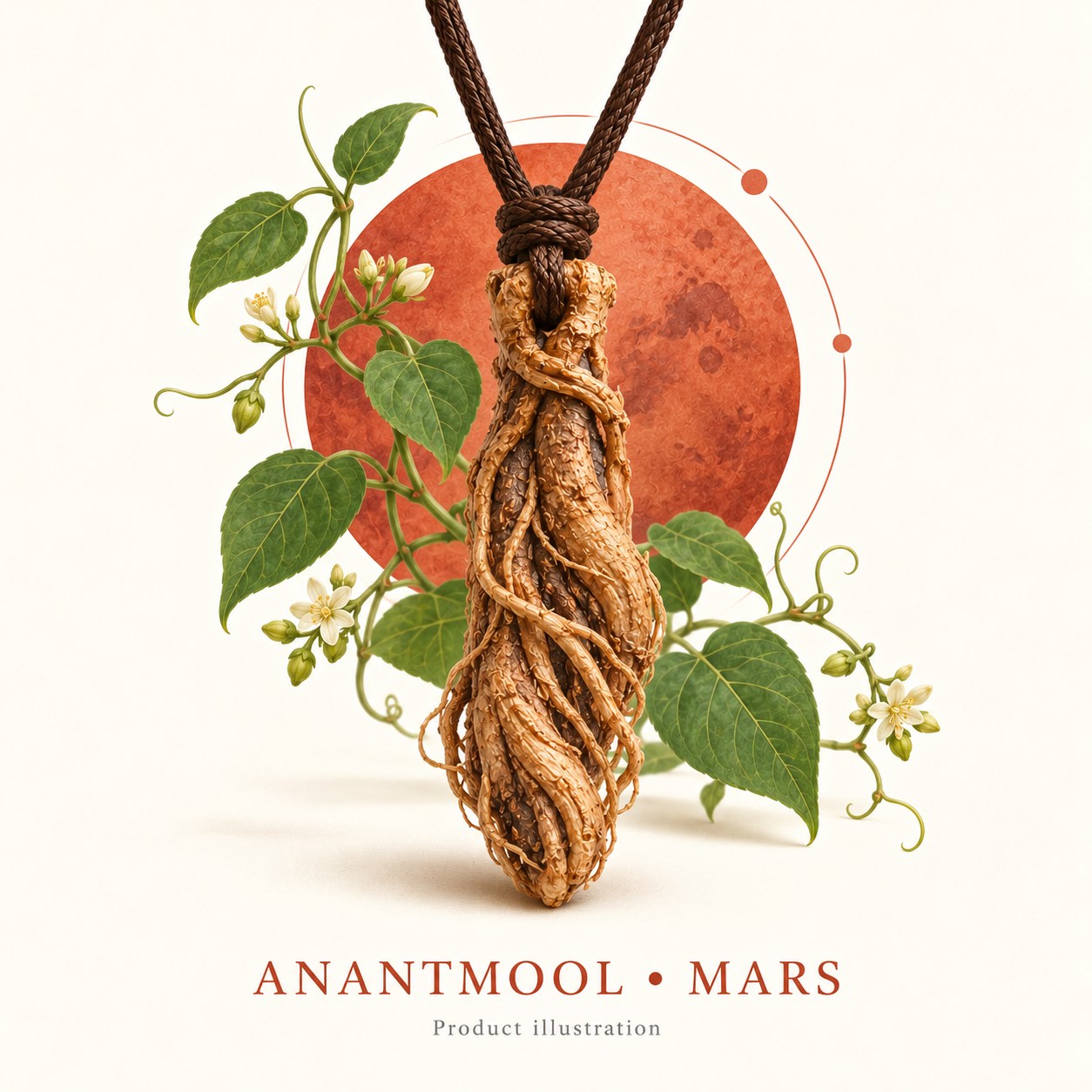
An Anantmool root pendant combines a natural botanical component with a practical piece of jewellery. Its place in Mangal (Mars) traditions may be the reason someone chooses it, but whether it can be worn comfortably depends on tangible details: the identity and condition of the root, the mounting, the cord or chain, the fastening, the finished dimensions and a sensible care routine. Those details deserve as much attention as the devotional meaning.
Anantmool—also written Anantamul, Anantamool or Anantmula—is commonly identified in botanical references as Hemidesmus indicus (L.) R.Br., a plant known as Indian sarsaparilla and Sariva. Traditional materia medica uses the plant in several contexts; a pendant, however, is a finished accessory containing botanical material, not a decoction, powder, dietary preparation or substitute for any such product. The distinction matters when someone sees the same plant name in an Ayurvedic description and on a jewellery listing.
This guide takes the complete pendant seriously. It explains what to inspect before purchase, how to select a wearable length, how to approach traditional observances without damaging the object, and what to do when a cord, cap or root component begins to deteriorate. It also explains why there is no single universal rule requiring every Anantmool pendant to sit at the same point on the body.
At a glance: the pendant-wearing essentials
| Question | Practical answer | Why it matters |
|---|---|---|
| What plant is usually meant? | Hemidesmus indicus, called Anantmool, Sariva or Indian sarsaparilla; verify the supplier's actual material. | A shared vernacular name is not a complete identification. |
| What is worn? | A selected piece of root in a corded, capped, drilled, enclosed or wire-held assembly. | The mounting often determines durability. |
| Is a specific length compulsory? | No single length fits every design, body or family tradition. | Comfort and catch hazards take precedence over a generic number. |
| Must the root touch bare skin? | Not inherently; follow the actual design and personal custom. | Tight contact can cause rubbing and moisture exposure. |
| Is Tuesday compulsory? | Tuesday is associated with Mangal in many observances; local customs vary. | Devotional timing and physical care are separate decisions. |
| Can it be bathed or soaked? | Treat the complete pendant as a dry-care item unless its maker supplies different verified instructions. | Water can affect root, adhesives, metal and cord. |
| What if it cracks or sheds? | Stop wearing it, document the change and ask the supplier about safe repair or replacement. | Improvised repairs can make the attachment less secure. |
| What records are helpful? | Material identity, approximate dimensions, fixing method, cord specification and care guidance. | They make later maintenance and replacement easier. |
1. What makes an Anantmool root pendant different?
Unlike a single-piece metal charm or a polished mineral bead, botanical jewellery starts with an irregular natural object. The root may be fibrous or woody, narrow at one end, uneven in texture and sensitive to friction, humidity and the way it is secured. A pendant maker must choose whether to leave the surface visible, cover it with a protective cap, enclose it or use another fitting. Those choices change its appearance and day-to-day handling.
A dried root segment need not look identical to a fresh plant part photographed in an identification guide. Cutting, drying, turning, sanding and finishing remove features that a botanist would normally use. Colour, pleasant scent or a seller's familiar label cannot independently prove a species. Good product information therefore separates the plant name stated by the supplier, the visible construction of the pendant and the strength of any provenance record. The plant-identification companion article covers this subject more deeply: Anantmool plant and root identification.
Anantmool's root is traditionally known for a distinctive aroma in botanical and Ayurvedic descriptions. That does not mean every finished pendant will retain a strong smell. Age, processing and sealing affect what a customer notices. Neither an overpowering fragrance nor its absence should be used as a simple authenticity test. If authentication matters for a purchase, ask for a traceable supplier description and, where available, documentation connecting the finished batch to identified material.
The physical assembly also matters. A naturally attractive root with a poorly attached bail or abrasive cord may be uncomfortable; a modest-looking piece with sound construction may be better suited to regular wear. A useful listing should show the entire pendant, not just a close-up of the botanical centre.
2. Anantmool, Sariva and the Mangal connection
In the Indian herbal tradition, Sariva and Anantmool are prominent names for Hemidesmus indicus. In some contemporary planetary-root practices, Anantmool is selected as a botanical accessory associated with Mangal or Bhauma, the graha called Mars in English. Mangal is discussed in Jyotish in relation to courage, initiative, resolve, land, siblings, action and the disciplined expression of force. This symbolic framework explains why a devotee may value the root pendant even though its everyday use is as jewellery.
A traditional association is not the same as a botanical taxonomic fact. Taxonomy asks which plant provided the material. A Jyotish recommendation asks how a particular object fits within a symbolic or ritual system, possibly taking into account a person's horoscope, family observance and teacher's instruction. One question cannot be answered by the other. Neither the root's appearance nor its botanical classification tells a buyer which personalised astrological recommendation is suitable.
Tuesday, known as Mangalvar, is commonly used for Mangal-related prayer and observance. Some households prefer to begin wearing a devotional article after bathing, offering prayer and making a short sankalpa (statement of intention). Others begin wearing it without an elaborate ceremony, or follow an instruction received from a guru or family elder. These are differences in customary practice, not evidence that one fastening or cord length is universally required.
For the astrological background rather than the fitting details, consult Anantmool and Mangal: the traditional Mars connection. This wearing guide keeps the central question practical: how to honour an object without subjecting it to cleaning agents, heat, immersion or physical strain that its construction cannot tolerate.
3. First decide how and when the pendant will be worn
Before considering a chain or cord length, picture the activity in which the pendant will actually be used. Is it for an occasional prayer at home, quiet desk work, travel, daily wear with traditional clothing, or a gift kept mostly on a puja shelf? Those uses place different demands on the same assembly. A small pendant resting outside a kurta during prayer is used differently from a pendant worn under a shirt during an active workday.
The buyer should be able to answer four questions: Will the piece be exposed to sweat or rain? Could it catch on machinery, a bag strap or another necklace? Does the intended wearer have a known sensitivity to certain metal or cord materials? Can the fastening be opened and closed without pulling directly on the root? If those questions are not answered, choosing a longer chain or more elaborate ritual does not resolve the practical problem.
A pendant does not have to be worn continuously for its meaning to be respected. Some devotees prefer to remove it during a bath or strenuous activity and return to it afterwards. A carefully stored piece can remain part of a personal observance when wearing it would be unsafe or inconvenient. Do not turn a customary preference into a requirement that the user ignore actual damage, discomfort or occupational restrictions.
4. Measuring the complete accessory correctly
A seller may describe the pendant as “3 cm,” “one-inch root” or “24-inch mala style,” but those measurements refer to different things. Root length does not equal finished drop, and chain circumference does not equal how far the pendant hangs from the neckline. Ask for measurements using labelled photographs with a ruler or a small scale reference. Do not rely on the apparent size of a tightly cropped product photo.
| Measurement | Exactly what to ask | Common source of misunderstanding |
|---|---|---|
| Root component length | The visible botanical portion, from its top to bottom. | The cap and bail may be excluded. |
| Root component width | The widest point, plus any irregular protrusion. | A narrow side-on photograph can conceal thickness. |
| Finished pendant drop | From the top of the bail or suspension point to the lowest edge. | The mounted pendant hangs lower than the root alone. |
| Chain or cord length | Whether the number is the full end-to-end length or half the loop when worn. | “Twenty-four inches” may be interpreted incorrectly. |
| Pendant weight | The weight of the complete assembly, not just the root. | Metal caps and large attachments alter comfort. |
| Adjustment range | The shortest and longest usable lengths after adjustment. | A decorative knot is not necessarily adjustable. |
| Fastening dimensions | Clasp opening, knot size, bail opening and any extender. | The pendant may not pass over an existing chain or clasp. |
For a closed loop laid flat and measured end to end, the full circumference is approximately twice the flat length. For a chain with a clasp, measure from end to end when fully extended, including the functional fastening. These are measurement conventions, not recommendations for what a particular person must wear. If the listing is unclear, request a diagram showing the measurement points.
A photograph next to a ruler is useful only if it shows the actual product or a truly representative model. A large digital zoom can make a lightweight root look like a heavy statement pendant. Ask for a second photograph worn over ordinary clothing, with permission from the model, or compare the dimensions with a necklace already comfortable for you. The goal is predictable fit, not simply a visually impressive listing.
5. Choosing a cord or chain length
The right length is the one that lets the pendant rest comfortably, remain accessible for removal and avoid interfering with daily movement. Body size, neckline, clothing thickness, hairstyle, existing necklaces and personal preference all matter. A length that rests high on one wearer can hang much lower on another. No catalogue can guarantee an exact resting position from a length number alone.
Shorter arrangements may keep a small pendant close to the upper chest, but they can rub against the neckline or feel restrictive when a wearer bends forward. Medium-length arrangements often give room for clothing layers without creating a long dangling loop. Longer arrangements can suit devotional wear over a kurta or sari blouse, but may swing, snag or strike a tabletop more easily. The important thing is to test the complete assembly in the positions in which it will be used.
If an adjustable cord is offered, inspect the mechanism rather than assuming that adjustment is always an advantage. A friction knot should slide deliberately without loosening by itself. Beads placed near the knot should not press into the neck. A chain extender should be smooth, with no open rings that can catch hair or fabric. Do not continuously tug the pendant's root to adjust the length; move the cord or clasp itself.
For someone buying online, a useful approach is to lay a soft piece of string around the intended neckline, mark the desired hanging point, and measure the string. This is an informal fitting aid; keep the loop loose and do not tighten it to establish skin contact. Compare the result against the seller's full-length measurement method. Account for the root's finished drop below the suspension point.
6. Cord, chain and mounting choices
| Construction | What it can offer | What deserves inspection |
|---|---|---|
| Soft braided cord | Flexible, lightweight, visually restrained. | Fraying, knot security, colour transfer, moisture retention. |
| Cotton or natural-fibre cord | Familiar devotional appearance and soft initial feel. | Absorbed sweat, shrinkage, stretching or damp storage. |
| Synthetic cord | May hold shape and tolerate occasional surface moisture better than some natural fibres. | Abrasion, heat sensitivity, rough cut ends and material disclosure. |
| Metal chain | Adjustable styles and conventional clasps may be available. | Metal composition, nickel sensitivity, exposed sharp rings and weight. |
| Capped root | Can hide and support a fragile end. | Adhesive, cap grip, moisture trapped under the fitting. |
| Drilled or threaded root | Compact construction with minimal external metal. | Cracks radiating from the hole, load-bearing weakness. |
| Wire-held root | A visible handmade aesthetic and removable mounting in some designs. | Pressure points, loose wire ends and possible scratching. |
| Enclosed or protected root | Limits direct rubbing of the botanical surface. | Accuracy of the materials description, trapped condensation and condition visibility. |
There is no universally superior configuration. A carefully made braided cord with a sound knot can be practical, while an expensive chain with a badly closed ring can fail. Equally, a fully sealed component may be easier to wipe externally but more difficult to inspect inside. Compare workmanship, not only material names or retail presentation.
When a product uses copper, brass, silver-coloured alloy, plated metal or stainless steel, the actual alloy and surface finish should be described accurately. A polished appearance does not identify the metal. If a customer has a known contact sensitivity, ask for information about the part touching the skin and select accordingly. A chain may touch the body even when the root hangs over clothing.
7. Inspect the point where root meets fitting
The highest mechanical stress often occurs where a light botanical segment meets a harder cap, bail, wire or cord. Examine this point from several angles. Look for splits that start at a drilled hole, movement between the root and cap, uneven glue residue, sharp metal edges or a fitting that presses into a weak section. Natural lines in wood or root are not automatically failures, but an opening crack that widens under gentle handling needs attention.
Do not test strength by hanging a heavy weight from the pendant or jerking the cord. A controlled inspection is better: hold the fitting rather than the root, rotate the pendant gently and look for visible looseness. If the seller describes a specific safe inspection technique, follow it. A hard pulling test can damage a sound but delicate piece, and it cannot authenticate the plant.
If the pendant arrives with a loose cap, a knot already opening or a visible gap in an adhesive joint, photograph the condition before altering it. Ask about replacement or repair under the seller's policy. Avoid drilling new holes, binding a cracked root with wire or applying household superglue. These interventions change the material, can introduce irritating residue and may transfer stress to a weaker point.
8. Metal contact, skin comfort and clothing friction
For comfortable use, consider every material in the assembly rather than only the botanical component. A pendant may have a brass cap, an unidentified plated bail, a synthetic loop and a dyed cord. Each surface can interact differently with sweat, perfume, soap or fabric. Ask the supplier what is known about the full assembly, particularly metal composition and coatings. “Natural root” does not mean the attached jewellery is entirely plant-based.
Begin wearing the pendant for a short, comfortable period and observe where it rests when sitting or moving. If a clasp scratches, a knot presses against the neck or a rough cut edge irritates the skin, adjust or replace the fitting. Discomfort is a useful signal, not a condition to endure to satisfy a devotional rule. A person who prefers to wear the root over clothing can still value the object in a traditional context.
Long hair may become caught in open rings or a rough cord. Silk and delicate woven fabrics may snag on exposed wire ends. An oily or perfumed scarf can deposit residue on an unsealed root. These are ordinary jewellery interactions, but they matter more when the central material is irregular and less easily cleaned than a plain metal charm.
9. A sensible first-wearing routine
When the pendant arrives, inspect it before performing any ritual. Confirm that the item matches the listing, note its root and fitting dimensions, check the cord and clasp and retain the order details. If a pendant has been stored in a damp parcel, allow it to equilibrate in a clean, dry, ventilated place according to supplier guidance before putting it against clothing. Do not use a heater or direct sunlight to speed the process.
Next, decide where the pendant will rest. Put it on carefully and check the neckline while standing, seated and bending slightly forward. Make sure the root does not pull on the bail during removal. If the piece slides excessively, choose a safer length or a more secure construction. If the knot cannot be adjusted without force, ask the maker for assistance rather than pulling repeatedly.
Finally, if your family tradition associates this Anantmool accessory with Mangal, you may incorporate a simple, respectful first-wearing observance. Some people choose a Tuesday after their usual bath and prayer, hold the pendant briefly during a sankalpa, and then wear it. The exact mantras, offerings, direction of prayer and timing can differ by lineage or personal instruction. The physical object itself should be kept away from oils, flames, vermilion paste, excess water and other materials unless its maker confirms compatibility.
A symbolic gesture can be performed near an object without putting substances on it. For example, one may keep the pendant on a clean dry cloth while lighting a lamp at a safe distance, then put it on after the prayer is finished. This approach preserves the distinction between the devotional practice and the care needs of botanical jewellery.
10. Tuesday worship, sankalpa and respectful observance
Mangalvar is a familiar day for practices connected with Hanuman, Mangal and household vows in different traditions. There is no reason to impose one ceremonial sequence on all readers. A household may prefer a simple salutation and prayer, while another follows guidance from its priest or astrologer. Where a mantra is part of the tradition, accurate recitation and the practitioner's own lineage matter more than a generic instruction printed alongside a retail product.
A sankalpa can express an intention such as steadiness in action, courage joined with restraint, or disciplined effort. In Jyotish symbolism, Mangal is not only about force; it is also associated with the direction of energy and responsibility in action. This gives a thoughtful devotional context without requiring claims that a root pendant produces a guaranteed external event.
Traditions about the hand used to wear an item, specific quantities of mantra repetition, auspicious hours or a required metal may vary considerably. A site describing one product should not silently turn a regional or commercial convention into a universal classical rule. If someone has a personal recommendation based on a horoscope, they should compare the details with that recommendation rather than combine several unrelated instructions from the internet.
After observance, check that no liquid or residue has reached the root or fitting. Allow any nearby incense smoke to disperse rather than repeatedly exposing a botanical accessory to hot ash or concentrated fumes. Store the item safely if it is not being worn. A well-maintained pendant can be part of a long-standing devotional routine without being continuously exposed to ritual substances.
11. Skin contact is not a universal requirement
Some sellers describe a planetary-root pendant as needing direct skin contact. Others show it worn over clothing, inside a protective capsule or on a cord that leaves the botanical material exposed. These are different designs and traditions. The physical facts are that bare skin supplies moisture, oils, sweat and friction; a cotton layer or protective case can reduce some contact while changing the way the article is presented.
If a specific wearing method was recommended to you, ask whether that method makes sense for the actual object. If the root has a coating or an unidentified adhesive, continuous skin contact may not be the best default. If the cord or metal causes irritation, changing the fit or wearing it over clothing is a practical option. Do not force a fragile root into direct contact by tightening the necklace.
The choice is also affected by climate. During a warm, humid Bengaluru afternoon, a pendant worn beneath a collar may remain in contact with perspiration for hours; the same pendant over a dry garment in a quiet room has a different exposure pattern. Care instructions must describe the complete assembly and realistic conditions rather than a single rule divorced from use.
12. Activities: when to wear and when to remove it
| Situation | Generally sensible approach | Main reason |
|---|---|---|
| Quiet prayer, reading or seated work | Wear if comfortable and the cord is secure. | Low risk of impact or entanglement. |
| Walking or ordinary errands | Check swing, clothing and clasp before leaving. | Repeated movement can loosen a poor fitting. |
| Bathing and swimming | Remove and keep dry. | Soaking may affect root, fibre, plating and adhesive. |
| Gym, sport or strenuous exercise | Remove, especially around equipment. | Sweat, impact and snagging. |
| Cooking or work near a flame | Keep away from heat and splashes. | Root, cord and coatings are heat-sensitive to differing degrees. |
| Sleeping | Remove unless a qualified maker has specifically designed the item for that use. | Pulling, tangling or pressure on the neck. |
| Factory, machinery or rotating tools | Follow workplace jewellery restrictions; remove where snagging is possible. | Entanglement hazards. |
| Medical imaging or procedures | Follow the facility's requirements for jewellery removal. | Metal and other attached materials may be present. |
| Heavy rain or humid storage | Protect from wetting; dry the storage area. | Persistent moisture can degrade materials. |
| Travel or crowded transport | Secure the piece or carry it in a pouch where appropriate. | Loss, pulling and accidental impact. |
These are practical scenarios, not spiritual prohibitions. A wearer who takes the piece off before exercise or bathing is caring for an accessory; they are not necessarily ending a personal observance. If the pendant was given as a gift or part of a ceremony, explain this distinction kindly rather than pressuring someone to wear it in unsuitable circumstances.
13. Cleaning: dry-first care for root jewellery
Begin with the least aggressive method. Remove loose dust from the exterior with a soft, clean, dry cloth, supporting the pendant under its fitting. A very soft brush may help around a cap, but only if it does not dislodge root fibres or abrade a fragile surface. Never scrub a rough botanical piece merely to make it match a polished product photograph.
Do not soak the pendant, place it under a tap, boil it, run it through an ultrasonic jewellery cleaner or expose it to steam. Avoid lemon juice, vinegar, saltwater, bleach, detergents, hand-sanitiser residue, abrasive powders and concentrated essential oils. These can affect not just the root but also glue, plating, dyes, knots and metal surfaces. If the maker confirms a particular wipe method for a sealed construction, follow that specific instruction rather than applying it to every root pendant.
Clean the chain or cord only according to its own material instructions. It may be possible to replace a dirty cord without wetting the root, but disassembly should be performed by someone who understands how the root is attached. A removable chain can sometimes be maintained separately; an integrated braided cord cannot safely be detached by cutting a load-bearing knot without a plan to reassemble it.
If a perfume or cosmetic spill occurs, blot any wet surface gently with a dry, absorbent cloth without rubbing material into cracks. Do not attempt to neutralise the spill with another household chemical. Keep the pendant off the body while you seek advice about the affected material. In some cases replacement of the cord or mounting will be safer than aggressive cleaning of the root.
14. Why ritual cleansing methods need material-specific judgment
Words such as shuddhi, purification, abhisheka and consecration are used in different religious contexts. Their meaning cannot be reduced to the same physical washing procedure for every object. A metal bell, a stone Shiva linga, a Rudraksha mala and an Anantmool root pendant have different material properties. A practice appropriate for one should not be copied mechanically to another.
Pouring milk, honey, water, oil or panchamrita onto the pendant may leave residue in the root surface, cap or cord. Even when the ritual intention is respectful, sticky residues and trapped moisture create a care problem. Fire, incense ash and direct heat introduce further risks. If a family custom calls for a particular material offering, discuss a non-contact alternative with the person guiding the observance.
A useful separation is to perform the prayers, mantras or offerings in the puja space while the pendant rests clean and dry beside the arrangement. An optional cloth wrap can protect the jewellery from powder and spatter. Afterwards, the item may be worn or stored. This is a practical care strategy, not a judgment about the spiritual value of any ritual.
15. Storage, packaging and travel
Store the root pendant clean and fully dry in a breathable, protective pouch or a separate compartment where it will not be crushed. Keep it away from prolonged direct sunlight, damp bathroom shelves, wet flowers, strong fragrances and household chemicals. Avoid placing it directly under heavy gemstone jewellery, sharp chains or objects that can abrade its edges.
A soft pouch protects against scratches but should not become a sealed container for a damp pendant. If the accessory has been exposed to high humidity, allow it to dry naturally in a suitable room according to the manufacturer's advice before closing the pouch. Do not pack it with a hot hairdryer or bake it near a heater. Check that the pouch itself has no loose dye that transfers onto a pale cord.
For travel, coil a cord loosely rather than making tight sharp bends near the attachment. Keep the root in a small protective compartment so that the clasp or chain cannot strike it repeatedly. Record or photograph the original configuration before taking a long trip; this helps if a knot or cap needs professional attention later.
A small labelled card can preserve the item name, supplier, purchase date, approximate measurements, mounting material and care instructions. This information is especially useful for gifts because the next person may not have access to the original listing or seller conversation.
16. Inspecting and maintaining the accessory over time
Set a habit of looking at the pendant before wear and during occasional deeper inspections. Check whether the root has developed a new opening split, loose fibres or a strong unexpected odour. Check whether the cap sits firmly, whether a wire end protrudes, and whether the bail ring closes properly. Run the cord through your fingers gently to identify fraying, weakened areas or knots that are migrating.
Do not use the root itself as a handle while putting on the necklace. Hold the chain ends or clasp. When removing it, support the suspended component rather than allowing it to strike a table. The less a delicate natural piece is used as a point of leverage, the less avoidable mechanical stress it receives.
Metal components may tarnish independently of the root. Tarnish is not necessarily proof that the botanical component has deteriorated, and a change in root colour does not automatically mean the metal is defective. Diagnose the part that has changed before choosing a treatment. Polishing paste applied to a cap can transfer onto an unsealed root and become difficult to remove.
If the pendant begins to behave differently—its drop shifts, the cap rotates, the clasp opens more easily or the cord stretches—do not assume it is merely cosmetic. An apparently small change may affect retention of the root. Repair the assembly at an appropriate stage rather than waiting for the botanical piece to fall out.
17. Troubleshooting: symptoms, likely causes and next steps
| What you notice | Possible explanation | What to do before wearing again |
|---|---|---|
| The pendant hangs at a new angle. | The knot, bail, cap or cord may have shifted. | Compare with earlier photographs; check the joint and ask the seller if the movement is normal. |
| A crack appears beside the drilling. | Mechanical tension, impact or natural weakness at the hole. | Stop pulling the cord through the root and seek a fitting assessment. |
| A metallic part darkens. | Surface oxidation, contact with cosmetics or changes in plating. | Identify the metal and clean only as permitted; keep polish away from root. |
| The cord sheds fibres. | Abrasion, age or a cut edge rubbing on a fitting. | Replace the cord through a competent jeweller or maker. |
| The knot slips easily. | Wear or an unsuitable adjustment design. | Stop wearing until the fastening is secured; do not depend on the root for tension. |
| The root feels persistently damp. | Sweat, rain exposure or inadequate storage. | Remove, set aside in a suitable dry area and ask for care guidance. |
| An unusual musty smell appears. | The component or storage material may have retained moisture. | Inspect for deterioration; do not perfume, oil or soak to conceal the problem. |
| A sharp point catches fabric. | A metal burr, loose wire or exposed fragment. | Stop use, protect the piece and seek repair or replacement. |
| Skin becomes uncomfortable. | Friction, material contact, sweat or other local causes. | Remove immediately; inspect the assembly and avoid repeating the irritating contact. |
| The root falls out of its cap. | Retention failure in the mounting. | Keep both parts; do not attempt a quick glue repair while wearing it. |
The table is a decision aid, not a method for diagnosing the plant from appearance alone. A change that seems minor in a product photo can be serious when the entire accessory is suspended from a small fixing point. Keep the object off the body when its condition is uncertain.
18. Botanical authenticity and honest product descriptions
Kew's Plants of the World Online recognises Hemidesmus indicus as an accepted species in Apocynaceae. Indian herbal and plant resources record Anantmool, Sariva, Nannari and related regional names for this plant. These references are useful when checking a supplier's terminology, but they do not identify a finished root pendant automatically. Species identification generally depends on traceable material, meaningful plant characters or appropriate specialist examination.
There is a difference between a seller stating “commonly sold as Anantmool,” a supplier supplying a botanical certificate linked to the batch, and independent authentication of the actual cut root. A trustworthy listing should not quietly present the first as if it were the third. If the botanical identity is important to you, request the basis for the claim: collection or cultivation source, supplier declaration, batch records, photographs of the material before processing, and any relevant professional assessment.
Botanical authenticity is also separate from the quality of construction. Even a correctly identified root can be badly mounted; an impeccably mounted piece can still carry insufficient provenance. Evaluate both. The plant identity and traditional uses guide is a useful companion when comparing common plant names with the finished material.
| Claim on a product page | What it actually establishes | Useful follow-up question |
|---|---|---|
| “Original Anantmool root” | A commercial description unless evidence is supplied. | Who identified it, and how is the batch traced? |
| “Sariva / Hemidesmus indicus” | A stated plant name, potentially correct. | Is the scientific name linked to the actual material used? |
| “Natural, handmade” | A process or material description. | Which parts are natural; what metal, glue or coating is present? |
| “Unpolished root” | A surface-treatment description. | Was it dried, cleaned, sealed, drilled or otherwise processed? |
| “For Mangal” | A traditional association or product positioning. | Is this a general practice or a personal Jyotish recommendation? |
| “Water resistant” | A performance claim requiring conditions. | Does it apply to the root, cord, fitting and adhesive together? |
| “Adjustable” | A mechanical feature. | What is the secure adjustment range and fastening mechanism? |
| “Energised” or “consecrated” | A ritual-service assertion. | Which observable steps and service details accompany that claim? |
The seller should distinguish what was witnessed or documented from what is offered as tradition. Customers need not reject spiritual significance to ask practical questions about the material they are purchasing.
19. Differences from gemstones, Rudraksha and herbal preparations
Anantmool root jewellery is sometimes displayed next to Mangal-associated red coral, gemstones and Rudraksha products. They may share a shopping context, but they are not the same material or type of object. Red coral is an organic gem material formed by marine organisms, Rudraksha is a seed-derived bead, and Anantmool here is a processed plant-root component. Each has different sourcing, identification, construction and cleaning considerations.
A hard gemstone can sometimes be mounted securely in a prong or bezel and cleaned under a gem-specific routine. A porous root component cannot automatically follow that routine. A Rudraksha bead often has a through-hole and characteristic structure; a cut root pendant may instead be capped, wrapped or enclosed. It is not correct to extrapolate from one item's customary bathing, oiling or threading practices to the others.
| Attribute | Anantmool root pendant | Gemstone or coral jewellery | Rudraksha bead accessory |
|---|---|---|---|
| Core material | Dried, selected botanical root. | Mineral or organic gem, depending on product. | Seed-derived botanical bead. |
| Identification approach | Plant provenance and appropriate botanical records. | Gemological identification and treatment disclosure. | Species/source assessment and bead morphology. |
| Frequent construction | Cap, cord, wire, enclosure or drilled component. | Bezel, prongs, threading or drilled setting. | Threaded, capped or strung bead. |
| Biggest care risk | Moisture retention, abrasion, fragile root and fitting failure. | Depends strongly on gem, treatment and setting. | Depends on bead condition, thread and any treatment. |
| Traditional meaning | Mangal-related planetary-root practice in some traditions. | Material-specific Jyotish or devotional use. | Mukhi- and tradition-specific practice. |
| Buying priority | Authentic identity, sound mounting and honest care instructions. | Identity, treatment and setting quality. | Genuine bead, condition, mukhi assessment and thread quality. |
There is no universal rule that one of these must replace another, and they should not be sold as if they were mechanically or materially equivalent. Selection may follow a family custom, individual guidance, aesthetics, budget and suitability for daily wear. The wider For Planets collection shows the range of devotional objects without removing the need to understand each item's construction.
20. Buying an Anantmool pendant online: the inspection checklist
A well-structured product listing should be useful even to someone unfamiliar with natural-root jewellery. Begin with the exact product photographs, full measurements and a description of the fitting. Ask whether the photograph depicts the item supplied or a representative sample. Natural variation is expected, but a variation notice should not conceal a change in basic construction or a different stated material.
A good checklist includes: (1) the declared botanical name and how the supplier arrived at it; (2) clear front, back and attachment photographs; (3) finished root, cap and chain measurements; (4) metal and cord materials; (5) whether coating or adhesive is used; (6) the actual fastening style; (7) whether the accessory is adjustable; (8) a care description for all components; (9) the policy for a damaged-on-arrival item; and (10) realistic expectations about variation in grain, colour and shape.
Do not let a ritual description substitute for normal commercial information. The buyer should know what arrives in the packet and how to use it. If a seller says “wear on Tuesday” but cannot explain the clasp, cord material or treatment, essential purchase information is missing. Conversely, a simple pendant can have real merit when its material, craftsmanship and care are communicated clearly.
Compare two options on the details that affect your own use: their finished drop, weight, mechanism and support. A lower-priced accessory with a secure replacement cord may be more practical than a highly decorated piece with an exposed and difficult-to-maintain joint. Price alone is not proof of botanical identity, ritual status or longevity.
21. Gifting, children and special circumstances
If the pendant is a gift, include the maker's care instructions and the product identity. The recipient may not know that the root must be protected from immersion or that the fastening should be held rather than the root when adjusting the cord. Gifting a devotional item does not oblige the recipient to wear it continuously; comfort and personal choice remain important.
For young children, loose cords, small detachable components and neckwear can introduce risks of entanglement or choking. A gift intended for a child may be better kept as a supervised devotional keepsake rather than worn as ordinary jewellery. Jewellery worn during sport, workshop activity or care work must be assessed against the actual environment, not against a generic “wear daily” label.
Someone with a history of jewellery-related skin irritation should inspect the materials and avoid unknown coatings or close-fitting neckwear that causes friction. The plant name alone does not establish that every metal, adhesive and textile component will suit the wearer. If the pendant causes discomfort or develops a rough edge, remove it and resolve the practical issue before returning to the customary wearing routine.
22. Responsible sourcing and long-term stewardship
A natural-root pendant should come with reasonable clarity about sourcing. Buyers can ask whether the material was cultivated, sourced through a licensed or established herbal supply chain, or collected from the wild; how the supplier identifies batches; and whether the item was made by a local craftsperson. There may be supply-chain variation, and a brief marketing statement is not a substitute for documentation when provenance matters.
A durable pendant can be maintained without unnecessary replacement. Keeping the original packaging card, avoiding harsh cleaning, replacing a worn cord promptly and taking the piece off during risky activities may significantly extend practical usability. If the root is permanently damaged, ask the maker whether the component can be safely remounted or whether a new piece is the sensible choice. Avoid presenting an unsafe repair as a ritual requirement.
23. Common mistakes to avoid
A frequent mistake is assuming the plant name tells you everything about the finished accessory. Another is buying by an isolated close-up without checking complete measurements. Some buyers choose a very long loose cord and discover it knocks against work surfaces; others tighten it in the belief that skin contact is compulsory and then experience rubbing. Both problems are avoided by realistic fitting checks.
Treating natural botanical material like a stone pendant is another error. Washing, polishing, oiling, soaking or heating can affect the root and its mounting in ways that are not obvious immediately. Applying a gemstone-care tip to a root pendant without checking the parts is not careful maintenance. Keep cleaning specific to the complete construction.
Finally, avoid confusing symbolic explanation with personalised prediction. The Anantmool–Mangal pairing belongs to a traditional context. A person seeking detailed Jyotish guidance may have specific family or chart-based considerations, while a customer choosing attractive, meaningful spiritual jewellery may simply want a well-made pendant. Both deserve accurate information. Neither requires an assertion that a single object guarantees a particular personal result.
Frequently asked questions about Anantmool root pendants
1. What is Anantmool root called in botanical references?
The name Anantmool or Anantamul is commonly associated with Hemidesmus indicus (L.) R.Br., also known as Sariva and Indian sarsaparilla. Kew accepts this botanical species, and Indian medicinal-plant records list Anantmool among its traditional names. The scientific name is a useful first step when checking a listing, but it does not prove that a particular cut, dried and mounted root was correctly identified by its seller.
2. Is Anantmool the same thing as Nannari?
Nannari is a familiar regional name associated with Hemidesmus indicus, especially in South Indian contexts. The name may appear in discussions of traditional beverages and herbal supplies. A necklace sold as Anantmool is still a different type of product from a beverage ingredient. Check the species claim and the actual material before assuming two goods with related trade names are interchangeable.
3. Which graha is Anantmool associated with?
In some planetary-root traditions, Anantmool is associated with Mangal or Bhauma, known as Mars. That pairing belongs to traditional Jyotish and devotional practice rather than botanical classification. The meaning of Mangal, the relevance of a particular observance and the suitability of a personal remedy can depend on the lineage or consultation. See the Mangal association guide for the symbolic context.
4. On which day should an Anantmool pendant first be worn?
Tuesday is a widely recognised day for Mangal-related observances, and some people prefer their first wearing to coincide with Tuesday prayer. Others follow a family custom or the advice of a teacher. The day does not replace the ordinary pre-wear checks: the pendant should have an intact root, a secure fastening, a comfortable length and dry, clean surfaces before it goes around the neck.
5. Is there one fixed auspicious time for everybody?
No single clock time can properly describe every family's tradition, location and personal guidance. Some customs use the time of household morning prayer, while others consult a muhurta or astrologer. A retail description should not claim that one timing is universally mandatory. If timing is personally important, obtain it through the relevant traditional source and plan the practical fitting and maintenance separately.
6. Must the root touch my skin to have traditional meaning?
A universal skin-contact rule should not be assumed. Some designs keep the root exposed and others place it in a cap or enclosure. Traditional instructions may differ, and direct contact increases exposure to sweat, oils and friction. If bare-skin wear causes discomfort or the construction is unsuitable, wearing it over clothing or selecting a better fitting is often the more practical approach.
7. Can I wear the pendant under a shirt or kurta?
Yes, if it rests comfortably and does not trap excessive moisture or rub against an abrasive seam. Wearing it beneath clothing may keep it unobtrusive, but fabric can also press the piece against the skin. Check the pendant's position when seated and bending. Avoid rough inner seams and keep the accessory away from perfume or lotion applied immediately before dressing.
8. Can I wear Anantmool with a Rudraksha mala?
Some people choose to wear several devotional items together. Physically, the issue is whether the pieces strike each other, tangle or put pressure on a fragile root mounting. Inspect the cords and spacing. Tradition-specific combinations are best discussed within the practitioner's own custom; a safe mechanical arrangement is still necessary whatever symbolic pairing has been chosen.
9. Can I wear Anantmool alongside red coral or another Mangal gemstone?
A gemstone and a root pendant are different categories of jewellery with different identification and care requirements. There is no automatic requirement to wear both or to substitute one for the other. If a personal Jyotish recommendation involves a combination, clarify it with the adviser. For everyday care, avoid letting a hard stone edge repeatedly strike a softer botanical piece.
10. What is the best necklace length for this pendant?
The best length is the one that positions the complete pendant safely for the wearer's body, clothing and activities. Ask for the full chain or cord length and the finished pendant drop. Compare with an accessory already comfortable for you, then check how the root moves while standing, sitting and bending. Avoid buying solely from a standard length chart or an apparently oversized photo.
11. What is the difference between root length and pendant drop?
Root length describes the botanical component itself. Pendant drop is measured from the top of its suspension point—often the bail or cap—to the lowest point of the completed object. A metal cap, knot or decorative ring can add to the total drop. When ordering online, ask the seller to label both dimensions on a photograph rather than describing them with one ambiguous number.
12. Is cotton cord better than a metal chain?
Neither is always superior. Cotton can be comfortable and traditionally styled but may absorb moisture and show fraying. A metal chain may be easier to fasten and adjust, but its alloy, finish and weight need to be known. Evaluate the finished assembly, attachment method, skin-contact materials and intended use. A sound fastening is more important than a generic claim that one material is spiritually preferable.
13. How do I know the root is secured properly?
Look at the cap, drilled hole, wire wrap or closure from more than one angle. There should be no obvious opening split, sharp wire end, loose suspension ring or fastening that slides off under ordinary handling. Do not prove its strength by forcefully pulling the root. If there is uncertainty, photograph the connection and ask the maker to demonstrate or explain how the item is retained.
14. Can I wear it while bathing or swimming?
The safest default is to remove it. Immersion can affect the botanical material and the other parts—cord, dye, plating, adhesive and metal. A seller who describes a product as water resistant should specify which components and conditions are covered. Bathing is not an appropriate time to test an unverified care claim, especially when a piece includes hidden fittings.
15. Can the pendant be washed with Ganga jal, milk or panchamrita?
Customary religious uses of these substances have their own significance, but botanical jewellery may be damaged or left with residue if immersed or coated. A practical alternative is to perform the devotional observance in the pendant's presence, keeping the object clean and dry. If an individual lineage calls for contact with a substance, check the assembly's compatibility before proceeding.
16. Can I apply oil to Anantmool root to preserve it?
Do not apply oil by default. An oil that is useful for one type of wood, bead or ritual object may stain another material, loosen an adhesive, alter a coating or attract dust. If the seller has a documented treatment for this exact construction, ask for its ingredients and application method. Otherwise a dry, low-friction care routine is the better starting point.
17. How often should I clean my pendant?
Inspect it briefly before wearing and remove visible loose dust when needed with a soft dry cloth. More thorough checks can be occasional rather than routine scrubbing. The frequency depends on exposure to dust, humidity, cosmetics and activity. Regular aggressive cleaning is not a sign of better maintenance; it can accelerate wear around knots, drill holes and delicate root surfaces.
18. What should I do if the cord becomes loose or frayed?
Take the pendant off and protect the root from falling. If the cord is replaceable, a competent maker or jeweller can assess the correct size and method without stressing the botanical component. Do not cut through a load-bearing knot and then attempt to rethread a fragile hole without knowing its construction. Preserve the old cord as a reference if it shows how the pendant was originally mounted.
19. Why has my Anantmool root changed colour?
Natural materials may vary in colour from batch to batch, and finishes may change with age or exposure. A change can also reflect absorbed cosmetics, humidity, contact with metal or a coating issue. Colour alone is not a reliable species test or a spiritual indicator. Compare the condition with the purchase photograph; if the surface becomes sticky, mould-like, cracked or unusually soft, stop wearing it and seek supplier advice.
20. Can I use perfume or hand sanitiser near the pendant?
Keep perfume, deodorant, sanitiser, strong soap and household sprays away from the root and its fittings. Alcohols, oils, fragrance ingredients and other chemicals can interact with coatings, dyes and adhesives. Allow cosmetic products applied to skin or clothing to dry fully before dressing, and position the pendant where it is less likely to receive direct spray. Do not clean a contaminated pendant by adding more chemicals.
21. Is it safe to wear during sleep or exercise?
For typical pendant designs, removal is prudent during sleep, strenuous exercise and activities involving equipment or possible entanglement. A cord can catch, and the root or cap can be pressed or struck. The item's devotional meaning does not remove these mechanical hazards. If the wearer requires a symbol present during those activities, consider keeping the pendant safely nearby instead of on the body.
22. How should it be stored when I am not wearing it?
Use a dry, clean, protective pouch or separate jewellery compartment. Coil the cord loosely, keep the root away from harder items and avoid damp, sealed storage. Do not leave it on a wet puja plate, bathroom shelf or a surface exposed to cleaning agents. A small card recording the material and care details is helpful if the piece will be stored for a long period or passed on as a gift.
23. Does a fragrance prove that my pendant is genuine?
No. Traditional descriptions mention aromatic roots, but the smell of a finished pendant can be affected by age, coating, storage and other materials. Strong added fragrance can mislead just as easily as an absent scent can raise questions. Look for a credible supplier trail, relevant plant records and honest descriptions. Do not scrape, burn or taste the root to test its identity.
24. May I repair a cracked root with glue?
A visible crack should first be assessed to see whether the root is still capable of holding its fitting. Household glue can alter the surface, cause irritation or simply relocate the stress to a different point. Stop wearing the item until a competent maker advises whether the affected part can be safely secured. In some cases replacing the component is preferable to a repair that cannot be inspected later.
25. Can an Anantmool pendant be given as a gift?
Yes, a carefully selected pendant may be a meaningful devotional or cultural gift. Include the full material description, measurements, care notes and any relevant background on the traditional association. Check the recipient's preferences and suitability for neckwear. For a child or someone whose activities create entanglement risks, a keepsake presentation may be better than an expectation of continuous wearing.
26. What should I ask OmmRudraksha before ordering?
Ask which botanical material is stated for the actual piece, what evidence supports the name, which photographs represent the item, the root and finished dimensions, the cord and metal materials, and how the root is held in place. Confirm adjustment range, cleaning method, storage advice and the procedure if a fitting arrives damaged. These questions make the purchase more informed regardless of the buyer's devotional purpose.
Final guidance: respectful tradition and careful craftsmanship
An Anantmool pendant is easiest to enjoy when the intended wearing practice matches its real construction. Start with the supplier's botanical description and photographs, verify the complete dimensions, choose a secure and comfortable cord or chain, and keep the root protected from unnecessary moisture and stress. Tuesday or Mangal-related observance can be meaningful within one's tradition, while inspection and maintenance remain ordinary parts of owning natural-material jewellery.
For further context, read Anantmool plant and root identification and Anantmool's traditional Mangal connection. To compare the actual accessory, see the Anantmool Root Pendant for Mars, explore Planetary Herbal Jewellery within Spiritual Jewellery, or browse Rudraksha for Planets. Each material deserves its own selection and care instructions.
Original botanical reference retained: Kew — Hemidesmus indicus. This reference establishes botanical nomenclature and background; evidence for any particular pendant still comes from the product's own supply chain.
