
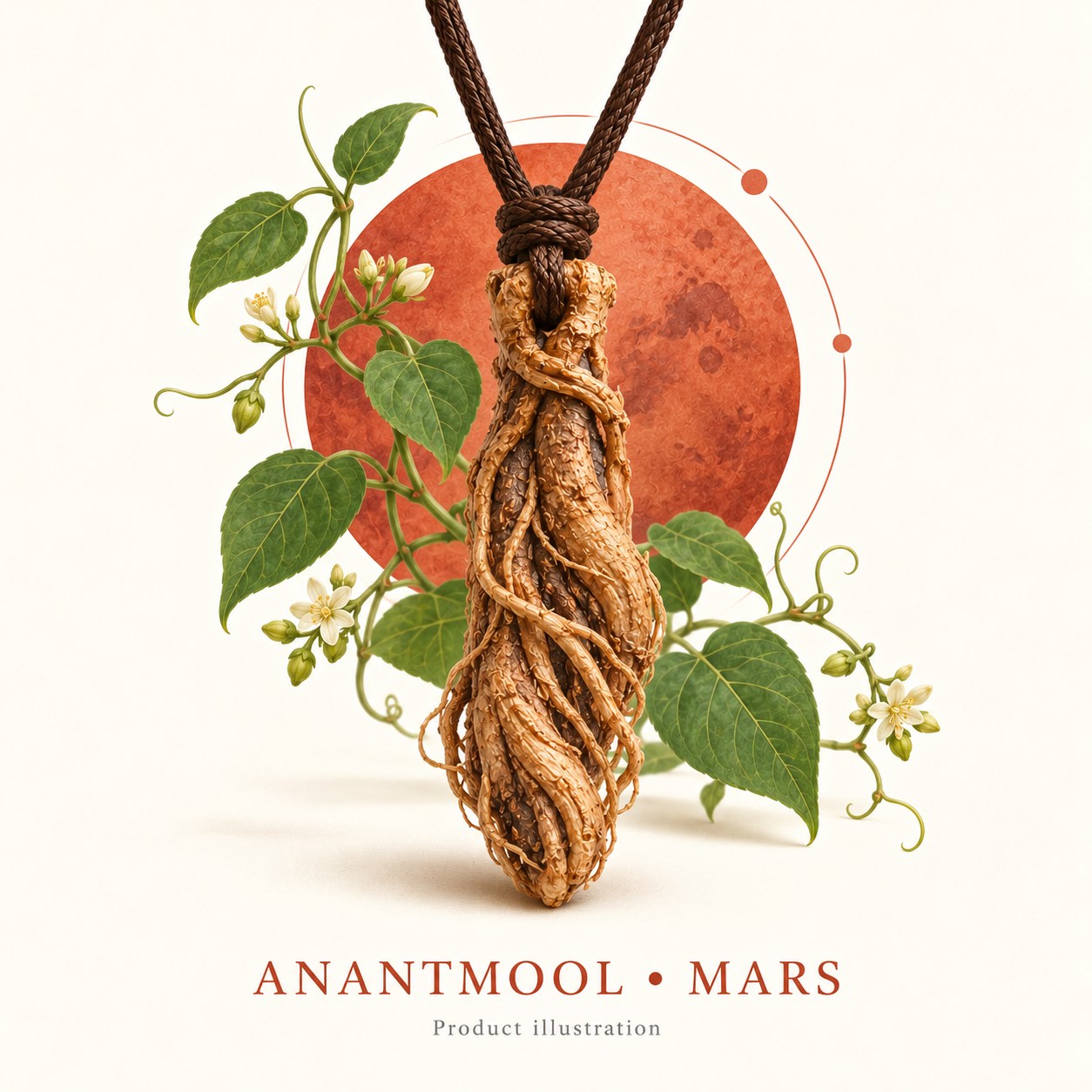
Anantmool, also written Anantamul, Anantmul or Anantamool, is an important name in Indian botanical, Ayurvedic and devotional vocabulary. In the context of a genuine botanical ingredient, it most commonly points to Hemidesmus indicus (L.) R.Br., a slender climbing or twining shrub of the family Apocynaceae. The root is associated with Sariva, Sveta Sariva, Indian sarsaparilla and regional names such as Nannari. A root pendant sold as Anantmool belongs to a different product category from a medicinal preparation: its identity, source, size, processing, fitting and care must be established independently.
The most important difficulty is not remembering a Latin spelling. It is establishing whether the actual dried material in a finished pendant came from the claimed plant. Trade names travel across regions; roots of unrelated or differently classified plants can resemble one another; and a small cut section cannot always be identified reliably by sight. Botanical records describe a species, whereas a supplier's batch record connects that species to merchandise. Both are needed when a seller presents a specific identification as fact.
This guide explains the living plant, root structure, names, historical Ayurvedic context, differences from commercial substitutes, and professional identification techniques. It then translates those findings into a realistic checklist for planetary herbal jewellery, without confusing laboratory evidence, traditional interpretation and the mechanical safety of an accessory. For the dedicated devotional context, see Anantmool and Mangal in the traditional Mars connection; for wearing length, fastening and upkeep, see Anantmool root pendant fit and care.
1. Anantmool at a glance
| Question | Reliable starting point | What still requires checking |
|---|---|---|
| What plant is commonly intended? | Hemidesmus indicus (L.) R.Br. | The actual supplier batch and plant part |
| Accepted modern family | Apocynaceae | Older Ayurvedic and botanical books may list Asclepiadaceae or Periplocaceae |
| Form of the living plant | Slender perennial twining or climbing shrub | Do not describe every product as a tree root |
| Common Indian names | Anantmool, Anantamul, Sariva, Sveta Sariva, Nannari | Vernacular use varies by region and trade |
| English trade name | Indian sarsaparilla | Not identical to every plant sold simply as “sarsaparilla” |
| Traditionally used plant part | Root | Confirm root rather than stem, bark, powder or mixed material |
| Common substitution concern | Decalepis hamiltonii and other Sariva-market roots | Species may need microscopy or laboratory confirmation |
| Jewellery relevance | Prepared root piece with mounting and cord or chain | Finish, treatment, adhesion, wearability and skin contact |
| Traditional planetary association | Anantmool is linked with Mangal in some planetary-root practices | A botanical record does not prove a universal classical prescription |
2. What is Hemidesmus indicus?
Hemidesmus indicus is a flowering plant, not a stone, resin, metal or tree. Kew's Plants of the World Online accepts the name Hemidesmus indicus (L.) R.Br., places it in Apocynaceae, and describes its native range broadly from the Indian subcontinent through parts of mainland Southeast Asia to Peninsular Malaysia. It is recorded as a climbing shrub, a useful correction to advertisements that casually describe every sacred root as having been taken from a large tree.
The plant commonly produces thin, twining or trailing stems and opposite leaves that may vary considerably in shape. Published floristic descriptions describe elliptical to lance-shaped leaves, sometimes with a pale central pattern, and small greenish to purplish flowers in groups near the leaf axils. Like other plants in related lineages, its structural details matter to botanists: the arrangement of leaves, flowers, fruits and the anatomy of root tissue are more useful than a single isolated photograph of brown dried material.
A fully documented plant photograph with attached field collection information may be helpful for identification. A generic internet photograph captioned “Anantmool” is not proof that the supplier of a particular pendant used that species. The evidence becomes weaker at each processing stage: freshly collected whole plant, separated root, dried root, small cut piece, polished or coated pendant. By the final stage, decisive characters such as flowers, leaf arrangement and fruit can be missing entirely.
For a buyer, therefore, the scientifically correct sentence is often “The plant traditionally identified with this name is Hemidesmus indicus; the identity of this particular batch should be supported by the supplier.” The stronger claim “each piece is confirmed Hemidesmus indicus” is appropriate only when the seller actually possesses the records needed to substantiate it.
3. Why the botanical family sometimes changes between books
Older botanical, pharmacopoeial and Ayurvedic publications often place Hemidesmus indicus in Asclepiadaceae; some other descriptions use Periplocaceae. Modern widely used taxonomy groups these lineages within the expanded Apocynaceae. This is a change in systematic classification, not evidence that a single accepted plant has secretly become three different ingredients.
A historical book can still be relevant for morphology or trade history even if its family placement is outdated. A reliable catalogue should state the currently accepted name and, where useful, explain an earlier family term in a short note. It should not silently treat every old classification as a separate commercial species or invent a novel root type simply because two reference works use different family labels.
Plant names also include author abbreviations. The form (L.) R.Br. records botanical authorship and belongs to formal nomenclature; the L. and R.Br. are not product grades, origin stamps or certifications. The historical combination Periploca indica appears among the synonyms in Kew's accepted record. Synonymy is about the history of plant naming, not the presence of one herb inside another.
Table: Reading a botanical label correctly
| Label expression | Interpretation | Appropriate use in a product record |
|---|---|---|
| Hemidesmus indicus (L.) R.Br. | Accepted species name in Kew | Primary botanical identification, if supported for the batch |
| Apocynaceae | Modern family placement | Current taxonomic context |
| Asclepiadaceae | Older family placement commonly seen in texts | Historical terminology, not a second species |
| Periploca indica L. | Historical botanical synonym | Explain old records; do not market as an unrelated product |
| Sariva / Sveta Sariva | Traditional medicinal-plant names | Give botanical name and regional context alongside |
| “100% original Anantmool” | Commercial claim without a specified test | Request documented identification, batch and plant part |
| “Lab tested” | Incomplete description of a possible test | Ask which test, which specimen, result, date and laboratory |
4. Anantmool, Anantamul, Sariva and Nannari: names and language
Indian customers may encounter the spellings Anantmool, Anantmul, Anantamul, Anantamool and Anantmula. Transliteration often changes when a term passes between Sanskrit, Hindi, English and local scripts. These spelling differences should be incorporated into search terms and a short glossary rather than turned into separate claims about different herbs. Sariva is a particularly important traditional name, while Sveta Sariva or Shweta Sariva may be used to specify the familiar white Sariva identity in herbal literature. Nannari, especially in Tamil usage, is another familiar market name; Kew's economic botany entries record Indian sarsaparilla and a form of nannairi-ver among names for the species.
A common name is not a universally controlled scientific designation. A reader asking for “sarsaparilla” might encounter Indian sarsaparilla (Hemidesmus) or roots of Smilax species used elsewhere under the wider English name. A trader asking for “Sariva” may be offered an identified Hemidesmus batch or a plant used as a regional substitute. The word helps begin an enquiry, not finish one.
For product titles, an intelligible combination works best: Anantmool Root Pendant (Sariva / Hemidesmus indicus)—but only when the last part is substantiated for the item being sold. If the material is not yet authenticated, the listing should not convert a research candidate into an unqualified species guarantee. An editorial article can explain the likely botanical reference without implying that a particular shop has already performed an investigation it has not performed.
Table: Names encountered in records and trade
| Name or spelling | Context | Identification caution |
|---|---|---|
| Anantmool / Anantmul / Anantamul | Hindi and regional trading spellings | Use the species and source data to resolve ambiguity |
| Anantamool / Anantmula | Extended transliteration | Spelling length does not prove plant identity |
| Sariva | Ayurvedic and herbal usage | Different plants have entered Sariva markets |
| Sveta / Shweta Sariva | Traditional differentiated naming | Confirm which botanical source a text or product means |
| Nannari / Nannari-ver | Familiar South Indian common naming | A drink or syrup label and a root pendant are different products |
| Indian sarsaparilla | English name used for Hemidesmus indicus | Not automatically equivalent to all Smilax species |
| Ushba / related Unani names | Historical Unani and commercial sources | Document botanical correspondence for the cited source |
| Mangal root / Mars root | Planetary-herbal marketing | An astrological tag is not a botanical diagnosis |
5. What the living plant looks like
Understanding the living plant is the strongest foundation for recognising why a detached root is challenging. Botanical and Indian governmental reference descriptions portray Anantmool as a slender, perennial, twining or trailing undershrub, with numerous thin stems, simple opposite leaves and a woody aromatic rootstock. Some specimens show pale or variegated areas on the leaf surface. Small greenish-purple flowers may occur in clusters at leaf axils, followed by relatively slender follicles. Seasonal appearance varies with climate and site; cultivated photographs may look different from plants growing through scrub vegetation.
A botanist will examine a combination of traits. Leaf arrangement alone is not sufficient, because numerous Indian vines have opposite leaves. A fragrant root alone is not sufficient, because different aromatic-root species circulate in regional markets. Neither the presence of a milky plant latex nor a leaf's central pale band, viewed in isolation, determines the identity of a product. Characters must be interpreted together, ideally using a verified herbarium specimen and an appropriate flora.
The rootstock is economically important in herbal trade, but a root is not a ready-made pendant. It may be cleaned, dried, cut, drilled, bound with thread, capped with metal, coated or inserted into resin. Each process can remove diagnostic surface features and affect care needs. Before relying on colour, diameter or aroma, ask what treatment was applied and whether the person who identified the plant did so before the material was processed.
A good article illustration can show the living plant and a root specimen as two separately identified views. The existing OmmRudraksha pendant illustration on this page is useful for understanding the jewellery format; it is not offered as a voucher specimen proving botanical identity.
6. Root appearance: what descriptions can and cannot establish
A published government pharmacopoeial monograph describes Hemidesmus roots as relatively slender, cylindrical, hard and somewhat twisted, with brownish outer cork, surface fissures and a harder yellowish woody central portion. In one reference, root specimens are described around 3–6 mm thick, although natural material varies and that range must not be turned into a universal rule for every harvested root. A professional observer may also assess the relation between outer bark, cortex, woody core, rootlets and fracture surfaces.
These are reference characters, not a reliable smartphone authentication recipe. A thicker piece could come from a different part, an older plant or another species; a thin piece could be mislabelled. Soil staining, drying time, polishing, oiling and lighting can change apparent colour. A cut edge may reveal structure, but it can also be concealed beneath a cap or adhesive. Descriptions of distinctive aroma and historical taste tests are found in pharmacognostic literature; consumers should not lick, chew or taste unverified jewellery material.
If a piece smells strongly of perfume, this does not prove that it is fresh Anantmool; fragrance can be applied. If it lacks an obvious scent, that alone is not proof of substitution, because processing and storage influence odour. A retailer should describe what is observed, such as “natural brown cork-like exterior, visible central core, clear cap and dry finish,” separately from a species identification that needs records.
Table: Visible clues versus reliable evidence
| Observed feature | What it may help describe | What it cannot prove on its own |
|---|---|---|
| Thin cylindrical piece | Size and broad appearance | Hemidesmus indicus species |
| Brown cork-like surface | Outer root texture and condition | Geographic origin or authenticity |
| Pale/yellowish interior | Some root anatomy visible at a cut edge | Botanical identification without context |
| Aromatic smell | Sensory condition of an untreated specimen | Absence of substitutes or added fragrance |
| Drill hole and fitted cap | Construction technique | Correct species or safe extraction |
| Transparent coating | Surface finish and possible moisture barrier | Uncoated authenticity or suitability for immersion |
| Original harvesting photograph | Context of a claimed batch | Traceability unless linked to the particular lot |
| Voucher-backed species report | Substantial evidence for the tested collection | Automatic proof for unrelated batches or individual pieces |
7. Why dried-root substitution is a genuine issue
The commercial problem is documented, not hypothetical. Studies of Indian medicinal-plant markets have reported other plants sold as Sariva, including Decalepis hamiltonii and, in some regional contexts, Ichnocarpus frutescens and Cryptolepis buchanani. A substitute may have its own legitimate botanical and cultural uses. The problem arises when a buyer is told that it is a specific other species without disclosure or verification.
Decalepis hamiltonii, often called swallow root, has larger fleshy aromatic roots that can be economically attractive for processing. In botanical research, its root morphology and underlying DNA differ from Hemidesmus indicus. A 2026 study using ITS2 DNA barcoding demonstrated clear sequence-based differentiation between authenticated Hemidesmus and Decalepis samples. This is useful research evidence about how identity can be assessed upstream; it is not a claim that every shop has tested its products, or that DNA analysis is always practical for a coated and highly processed pendant.
The reason for substitution is not reducible to fraud alone. Local naming, scarcity, cultivation, availability and historical substitution practices all influence trade. Therefore the strongest buyer question is “What species was supplied, and how do you know?” rather than assuming that a similar aroma is proof of deception or authenticity. If a seller identifies the species as Decalepis, it should be described honestly as that species, not relabelled as Hemidesmus solely to fit a familiar product title.
Table: Common identity confusions
| Material or group | Why the name can be confused | The responsible distinction |
|---|---|---|
| Hemidesmus indicus | Primary botanical reference for Anantmool/Sveta Sariva | Accepted species should be linked to the actual sourced batch |
| Decalepis hamiltonii | Aromatic root used as substitute in some Sariva supply chains | Different plant; distinguish by source records, microscopy and/or appropriate tests |
| Ichnocarpus frutescens | Identified in historical regional Sariva trade reports | Distinct species; do not equate on common name alone |
| Cryptolepis buchanani | Also reported in older Sariva market studies | Distinct species and material characteristics |
| Smilax species | English “sarsaparilla” overlaps other root traditions | Indian sarsaparilla is not every botanical sarsaparilla |
| Decorative wood or resin | Can be made into a similar pendant shape | Ask whether it is plant root, wood, composite or moulded imitation |
| Unspecified mixed roots | Combination products can use a broad label | Require identification and proportions for each actual ingredient |
8. Authenticating a living plant, raw root and finished pendant
Evidence should be proportionate to the claim. To identify a living plant, a qualified botanist may examine whole specimens, reproductive structures, locality and a reference herbarium. To identify dried whole roots, a pharmacognosy laboratory may assess macroscopic and microscopic anatomy against a monograph, while considering known substitutes. When material has become powdered, heavily processed or unrecognisable, appropriate chemical or molecular approaches may support a conclusion if validated for that sample type and the available reference library.
A voucher specimen is a preserved and documented plant specimen linked to a collection and identification. It may carry collection date, locality, collector name, identifier and herbarium number. A batch record connects incoming roots with a supplier lot, and a finished-goods record connects that lot to a pendant production run. These are different documents: a beautiful voucher from an unrelated region is not evidence that a new shipment came from the same species.
A test report must be interpreted for its actual scope. A generic “passed quality control” line might refer to moisture, microbial quality or packaging rather than species. HPLC, TLC or other chemical fingerprints can provide useful comparators under a defined method, but there is no universal magical peak proving every commercial root's identity. DNA barcoding can be informative on suitable material with an appropriate sequence reference; however, a treatment that degrades recoverable DNA can complicate interpretation. The report should identify the specimen tested, methodology and result rather than merely display the word “lab”.
No customer needs to destroy an expensive finished accessory to perform kitchen tests. Scratching, burning, tasting, heating, boiling or soaking the pendant risks damage and may create exposure to unknown additives. Material authentication belongs with competent suppliers and qualified laboratories, not with sensational home-authentication challenges.
9. A traceable chain of custody for Anantmool jewellery
The best evidence comes from continuity, not an isolated certificate. The chain begins with botanical sourcing and continues through collection or purchase, drying, sorting, cutting, jewellery assembly, packaging and sale. A seller may identify a taxon correctly in a general article while lacking evidence that a specific pendant used it. The product page should not obscure that gap.
At intake, record the declared scientific name, local name, plant part, supplier, batch reference, date, approximate quantity and any supporting identification. During processing, note whether the material was cleaned, heat-treated, coated, dyed, lacquered or glued. During assembly, record how many pieces were made from each lot and whether multiple suppliers were mixed. A small label or invoice that preserves the batch identity helps answer a later customer question about an exchanged cord or replacement fitting.
Photographs strengthen documentation when they show the same lot through successive stages, with scales and consistent labels. Images are weaker when reused as generic decoration or edited so heavily that natural texture disappears. There is no reason to publish sensitive supplier details, but the retailer can retain an internal record and disclose the level of verification honestly.
Table: Minimum documents in a practical traceability file
| Stage | Useful internal record | Customer-facing statement it may support |
|---|---|---|
| Source | Supplier name, location and purchase date | Where the batch was purchased or collected, if disclosure is appropriate |
| Botanical identity | Identified material, examiner and supporting specimen/test | Species claim with a defined evidentiary basis |
| Plant part | Root versus stem, bark or other ingredient | Accurate “root pendant” wording |
| Processing | Drying, coatings, colours, adhesives and treatments | Care and construction description |
| Assembly | Root batch mapped to fittings and quantity | A particular production lot used the declared material |
| Photography | Lot-linked images of actual goods | Representative appearance and finish |
| Dispatch | Product code, batch and care insert | Traceability for repairs, questions or returns |
| Claims review | Record of terminology and reference basis | Clear separation of botanical, customary and commercial assertions |
10. Natural collection, cultivation and responsible sourcing
Anantmool grows in a range of Indian environments, and its root is the part of traditional commercial interest. Root collection can damage or kill plants when done destructively. The National Medicinal Plants Board has published agro-techniques for Hemidesmus indicus, including propagation from stem or rootstock material, site conditions and cultivation practices. The significance for jewellery is straightforward: sourcing practices matter, even when the finished product is a small pendant.
Demand for aromatic medicinal roots has historically encouraged harvest and substitution. A responsible business should ask whether a source is cultivated, legally collected or otherwise documented, and should not use unsupported language such as “rare Himalayan wild original” merely to increase perceived value. The species' broad regional distribution does not authenticate a specific claim of origin. A supplier's location also need not be the plant's collection location.
Where cultivation is viable, traceable cultivated material may improve consistency and reduce pressure on unmanaged collections. Wild harvesting, when applicable, should follow relevant permissions and sustainable methods. No one should collect from a protected area or private property without authorization, and no vague claim of “traditional gathering” replaces a reliable supply record.
A small jewellery business can start with modest documentation: purchase invoice, declared species, lot number, harvest or cultivation description, material photographs, and supplier clarification about processing. These records often add more real value than decorative claims about energetic purity or an unspecified country of origin.
11. Sariva in Ayurveda: classical terminology and context
Sariva occupies an established place in Ayurveda's Dravyaguna and herbal-formulation vocabulary. Terms found in traditional descriptions include madhura rasa, sheetala or sheeta virya, dahaprashamana, raktaprasadana and raktashodhana, although the exact terminology and grouping differ among books, commentators and regional materia medica. These are concepts within a traditional medical framework. Presenting them respectfully does not require claiming that modern clinical trials have established every listed effect, and it does not turn a wearable root into a medicinal dose.
The word rasa in this context refers to taste classification in Ayurvedic pharmacology; virya refers to the traditional heating or cooling potency; guna to attributes; and vipaka to the post-digestive classification. A single commercial statement such as “Anantmool cures all heat disorders” obscures the difference between a historically described property, a professional assessment of a patient, a formulated preparation and a decorative pendant. A more useful historical article explains the classical language, specifies which part was traditionally discussed, and avoids transferring formulation claims to an object worn on a cord.
Historically, references discuss the root in settings ranging from preparation of herbal ingredients to drinks and household practices. Nannari syrup and related regional beverages demonstrate how familiar a root name may be outside jewellery, but the ingredient, manufacturing method, dose, ingredients and intended use of a prepared drink are entirely different from a jewellery assembly. Neither the presence of Anantmool in traditional recipes nor its fragrance means that a pendant should be brewed, sucked, scraped or soaked.
Old descriptions may use phrases translated as “blood purifier,” “cooling,” “skin-related,” or “supportive” in traditional classifications. Those translations should be understood as historical Ayurvedic language, not advertisements that a pendant treats anemia, infections, fever, hormonal problems or skin diseases. When discussing health terminology, accuracy means giving the actual term and its historical context; it does not mean stripping the article of its cultural subject or inflating that subject into an unverified modern treatment claim.
12. Sveta Sariva, Krishna Sariva and variation across texts
The pairing Sveta Sariva (white Sariva) and Krishna Sariva (black Sariva) appears in discussions of classical and regional herbal identities. These should not be simplified into the false rule that a pale root must always be one species and a dark root must always be another. Colour changes with maturity, drying, soil contact, bark loss and finishing, while the names may have their own textual or trade history.
Some later books and market discussions connect different taxa with the names used for Sariva groups. This makes a named source and a botanically grounded reference especially important. A catalogue claiming Hemidesmus indicus should say so; a botanical discussion may describe other historically used plants without implying that all of them qualify for a single specific product listing.
For individual product inventory, the best approach is to keep one botanical identity per correctly documented ingredient lot. If two genuine species are offered, give each its proper material description, not simply “white Anantmool” and “black Anantmool” based on appearance. If identity is unresolved, say that the material is not confirmed at species level rather than creating a misleading certification from a surface colour.
13. Historical use is not the same as a contemporary product claim
There are three distinct evidence questions: What do historical Ayurvedic or regional sources say? What does botanical or laboratory research show? What can be demonstrated about this particular pendant? They may overlap, but they are not the same inquiry. A government monograph can document the root traditionally used in formulations and still have nothing to say about the specific jewellery lot on a retailer's shelf. A molecular study can distinguish two plant species without telling the reader whether a planetary-root ritual is effective.
For example, it is appropriate to explain that Sariva has been discussed in traditional applications involving cooling concepts, skin and digestive contexts, or aromatic-root preparations. It would be inappropriate to imply that a pendant made from any brown root reproduces an ingested preparation's effects. Similarly, the presence of active molecules or research interest in extracts does not imply that passive contact with a sealed piece delivers a clinically meaningful dose.
This separation helps preserve the significance of both traditions. Ayurveda deserves accurate terms, botanical documentation and historical context. Jyotish deserves properly identified symbolism and the language of graha practice. Material jewellery deserves honest construction and care details. Mixing all three into a single unqualified claim weakens customer understanding and creates avoidable disputes.
14. Anantmool and Mangal (Mars): the planetary-root interpretation
In one stream of Navagraha herbal-root jewellery, Anantmool is associated with Mangal, Mangala, Kuja, Bhauma or Angaraka—names used for Mars in Jyotish and devotional contexts. Mangal is conventionally linked with courage, initiative, disciplined effort, younger siblings, property, technical activity and the management of conflict. A person may choose a root as a reminder of a devotional sankalpa, but the historical existence of this interpretation is not a botanical fact about the root's tissue.
Astrological practice is not uniform. Some families emphasize Mangalvar prayer; others give importance to Hanuman, Subrahmanya/Kartikeya, Mangal Deva or a family deity. Astrologers may examine lagna, house lordship, dignity, conjunctions, graha drishti, nakshatra, Vimshottari dasha, Navamsha and the relevant gochara before making an individual suggestion. A generic Mars root label cannot replace a complete interpretation, and a person should not be told that a single rashi automatically makes an accessory necessary.
A pendant can be treated respectfully according to household custom without imposing a universal commercial ritual. Its natural root and adhesives may be damaged by repeated immersion, incense embers, ghee or flames. Devotional intent can be maintained while protecting the physical object. For the focused examination of Mesha, Vrishchika, Mars-ruled nakshatras, Mangal Dosha, Tuesday practices and mantra vocabulary, see Anantmool and Mangal: the traditional Mars connection. This identification article is deliberately concerned with the plant first.
15. Root, bark, stem and powder: why plant part must be explicit
The term plant part is not a minor technicality. A seller might have a verified specimen of Hemidesmus indicus, but the raw material used for a product might be a root, a woody underground stem, bark stripped from a root, or an assemblage of fragments. The distinction affects botanical description, expected structure, cutting behaviour and care. If the item is advertised as a root pendant, documentation should support the use of root material, not merely the presence of plant-derived matter.
A botanical identification based on leaves and flowers establishes which species supplied a collection only when the material chain is intact. Once small segments have been mixed in a warehouse, the original evidence can be lost. Pieces cut from different lots should not be grouped under one certificate with no supporting record. Powdered ingredients are even harder for a consumer to examine and make less sense as a conventional drilled root accessory unless the final object is explicitly described as a sealed composite or capsule.
Photographs should show both the whole pendant and the actual visible root, with a scale. If a metal case encloses the entire ingredient, state whether the root is loose, glued, coated or fully encapsulated. The material is not “raw” merely because it is natural in origin; polishing, fumigation, bleaching, oiling and gluing are all forms of processing, some harmless when correctly disclosed and some capable of affecting surface appearance or skin suitability.
16. A buying checklist for a genuine Anantmool pendant
Before choosing an item, separate identity questions from construction questions and devotional preference. Ask for the declared scientific name, supplier's plant-part description, whether batch-level authentication exists, and whether the image shows the item or a representative sample. Ask separately about its length, total pendant size, cord, cap, bail, fastener, surface coating and maintenance. If the purpose is a traditional Mangal association, ask what practice is being followed rather than accepting a promise that the item is automatically suited to everyone.
A shop may be able to say truthfully “the supplier declared the material to be Anantmool/Sariva; botanical documentation is available on request.” Another shop may only have the commercial name with no species-level evidence. Those are different levels of verification, even if the pieces look alike. The price should not be treated as evidence of scientific authentication; an expensive piece can still be misidentified.
Table: Questions to ask before buying
| Your question | A useful answer includes | A weak answer sounds like |
|---|---|---|
| Which plant is it? | Declared scientific name and basis for identification | “Pure original, guaranteed by look” |
| Which part is used? | Root confirmed in the lot description | “Natural herb” without part |
| Is it authenticated? | Specific lot report, specimen record or qualified examination | “Lab tested” without scope |
| Where did it come from? | Supplier or collection/cultivation explanation | Unsupported “rare mountain source” |
| What is the actual size? | Root length, width and total pendant dimensions | Only a glamour photograph |
| What holds it together? | Cord/chain, metal cap, adhesive or attachment method | No close-up of the fitting |
| What treatments were used? | Honest note on varnish, resin, polish or dye | “Untouched” despite visible coating |
| How should it be maintained? | Dry-care guidance appropriate to the whole object | “Safe in every liquid and ritual” |
| Why a Mars association? | Description of the specific custom or recommendation | “Works for all horoscopes” |
| What if a fitting fails? | Repair, replacement or return procedure | No support for fragile assemblies |
17. How to inspect the finished piece without damaging it
Begin with indirect natural light and a clean, dry surface. Examine the root piece for severe cracks, loose fibres, protruding splinters, obvious surface flaking and signs of dampness. Check the fitting at both ends, particularly whether the cap grips the root, whether a drilled point has enough material around it and whether the loop can move without pulling the assembly apart. A magnifying glass can help spot workmanship problems; it does not transform a home inspection into species identification.
Then inspect the cord, chain or thread: knot quality, connector opening, friction points and length. Test the closure gently over a padded table, not by yanking it. A decorative object meant for occasional prayer may require different construction from an accessory intended for all-day wear, travel or exercise. The right advice depends on the actual item, not an abstract description of a sacred root.
Look for evidence of artificial colouring or sealants around joints. Such treatment is not inherently unacceptable if disclosed, but it may require different cleaning. Ask the seller if skin-facing metal contains nickel or other potentially irritating components, if relevant to the purchaser. If the surface causes irritation, remove the accessory and review its construction; there is no reason to continue uncomfortable contact because of a ritual deadline.
18. Drying, storage, humidity and long-term root care
A natural dried root is hygroscopic to some degree, and organic materials can be affected by prolonged dampness and heat. Exact behaviour depends on the root, degree of drying, exposed ends, finishes and adhesives. A conservative default is to store the pendant dry, wipe it with a soft cloth and avoid soaking or spraying it with cleaners. Remove it before bathing, swimming, prolonged exercise involving sweat, detergent work or direct application of perfume and hair products.
For storage, choose a small breathable pouch or a clean dry box rather than leaving it against a damp bathroom shelf. Keep it away from direct sun over long periods and do not place weight on a fragile carved or drilled piece. A silica-gel packet may help in a humid storage environment if kept separate from the pendant and used according to its packaging; it is not a substitute for fixing an actively wet storage area.
Where a root piece appears moldy, unusually soft, foul-smelling or persistently damp, set it aside and contact the seller rather than heat-drying it in an oven or immersing it in an aggressive disinfectant. A damaged metal cap or cord should be repaired before wearing. Oil baths, saltwater cleansing, milk immersion and repeated ritual washing are not appropriate as generic instructions for a mixed organic-and-metal assembly. A household can honour its devotional practice through prayer and a clean cloth while keeping the physical piece intact.
Table: Common condition problems and sensible responses
| What you notice | Possible practical cause | Sensible next step |
|---|---|---|
| Surface looks unusually dark after a wet day | Moisture, oil or surface finish change | Dry in ordinary ventilated conditions; do not heat or rub aggressively |
| Cap wiggles | Worn adhesive, mechanical stress or poor fit | Stop wearing and ask for fitting repair |
| Cord is fraying | Friction, age or contact with sharp edges | Replace the cord before it breaks |
| Finish is peeling | Coating deterioration | Avoid solvents; contact the maker |
| Root has a fresh crack | Impact, drying stress or weak drilled section | Do not force the loop; inspect repair options |
| Persistent musty odour | Poor storage or moisture exposure | Isolate the item; request guidance before reuse |
| Metal touches skin uncomfortably | Tightness or material sensitivity | Remove, inspect fitting and choose suitable materials |
| Dust around carved grooves | Ordinary accumulation | Gently lift with dry soft brush, without immersing |
19. Anantmool as a gift: what information should accompany it
Anantmool jewellery may be selected as a Mangal-themed devotional gift, a personal reminder of discipline, or a simple natural-material accessory. A gift card should explain the declared plant identity, source-verification level, finished size, material treatment, customary association, fastening and care. A recipient should not have to infer that a Latin species name is a guarantee of a particular ritual outcome, nor be left with a fragile object and no maintenance instructions.
When a piece is given to someone who follows a different family or devotional tradition, avoid imposing a mandatory mantra, fasting practice or wearing date. A short optional note on how the gift is understood in a particular custom is more respectful. Where the buyer wants a personalized Jyotish recommendation, the explanation can be obtained separately; the object's botanical identity remains the same regardless of who wears it.
A care insert should also mention what is not intended: the root is not for consumption, and the pendant is not meant to be boiled to prepare Nannari syrup or medicinal decoction. The distinction is especially important when a household already knows Anantmool from herbal drinks or Ayurveda. Keep small fittings and detachable parts away from young children who might put them in the mouth.
20. How to photograph natural roots honestly for an online listing
Clear product images serve three different purposes: appearance, construction and documentation. A front view shows the overall pendant, a side or close view shows surface texture and the fitting, and an in-hand or measured view communicates size. Where several pieces vary naturally, state that grain, bark colour, diameter and tiny irregularities will differ. Avoid smoothing every surface so perfectly that the buyer cannot judge the actual material.
A photograph of the living plant can be useful in an educational article only when correctly labelled as botanical reference imagery. It should not silently stand in for the specific commercial lot. Likewise, a macro image of a fragrant root from a separate source should not be used as proof that the shop's finished pendant has identical plant identity. Natural lighting and accurate alt text improve both trust and accessibility.
For this article, the existing Anantmool pendant illustration remains the original visual reference. Its alt text should describe the product format, not invent harvest locality, laboratory certification or medicinal performance. A future additional photograph could show an actual store-stock piece alongside a ruler and its documented material note, without changing the current image's URL or the blog's permanent address.
21. Comparison with red coral, Rudraksha and other planetary objects
Readers sometimes encounter Anantmool alongside Moonga (red coral), Rudraksha beads and Navagraha devotional objects. These are different materials and traditions. Red coral is an organic marine gem material requiring its own identity and treatment assessment. Rudraksha beads are traditionally seed-derived, with separate mukhi-identification and workmanship questions. Anantmool is a botanical-root material whose identity should be examined through botanical supply evidence.
A marketplace may offer a Mars-related root, an associated gemstone, a mantra card and a metal yantra in one category. That does not make the items interchangeable in material, care or traditional interpretation. A person considering a gemstone may care about grading, treatments and mounting; a person considering Rudraksha may care about mukhi structure, bead condition and stringing; and a person considering Anantmool should especially care about plant identity, part used, drying and attachment.
The Rudraksha for Planets collection can provide another point of comparison, while the Anantmool root pendant represents the botanical accessory discussed here. Neither a gemstone listing nor a root description should promise an automatic correction of every astrological condition. The article's purpose is informed selection, not ranking all spiritual practices on one invented scale.
Table: Material-specific questions for Mars-themed choices
| Choice | What it is | Primary verification | Everyday concern |
|---|---|---|---|
| Anantmool root pendant | Dried botanical root in jewellery | Species, source lot, plant part and assembly | Moisture, caps, cords and surface condition |
| Red coral (Moonga) | Organic marine jewellery material | Natural versus imitation/treated material; source and workmanship | Impact, heat, chemicals and mounting |
| Rudraksha bead | Seed-derived devotional bead | Bead origin, mukhi structure and condition | Cracks, thread and cleaning |
| Mangal yantra | Crafted ritual symbol | Material, inscription and source of design | Placement and care appropriate to material |
| Mantra or stotra | Spoken or written devotional practice | Appropriate text and tradition | Consistent personal practice rather than purchase claims |
| Tuesday worship or seva | Devotional observance or service | Household or teacher guidance | Practical, respectful participation |
22. What an accurate product description should say
A high-quality product page does not need an exaggerated claim to be informative. It can say: “Anantmool root pendant, traditionally associated with Mangal in selected Navagraha root-jewellery practices. Declared botanical material: Hemidesmus indicus (Sariva), subject to the stated batch-identification documentation. Please review the actual size, finish, cord and dry-care instructions.” The evidence level should be adapted to the specific item: if no batch identification exists, do not silently retain the species-level guarantee as if it did.
The page should include an easy-to-read material specification, dimensions, assembly, photographs, variations and post-purchase care. It may explain the cultural or devotional context without presenting astrological symbolism as a property tested by Kew. It can also link to companion guides about the Mars association and about wearing and care, reducing unnecessary repetition while giving readers a path to relevant details.
SEO metadata should use words real customers understand—Anantmool, Anantamul, Sariva, Nannari, Indian sarsaparilla, Hemidesmus indicus, root identification and Mangal—but should not pile unrelated disease names into a jewellery page. Accurate search coverage comes from coherent headings and useful explanations, not from claiming that a pendant is a treatment for every condition named in old materia medica.
23. An efficient verification workflow for small retailers
A small retailer can improve reliability without building a laboratory. Start by requesting a clear species declaration, plant part and lot reference from the upstream supplier. Compare the declaration with a reliable accepted taxonomic resource such as Kew, then ask whether any independent botanical or pharmacognostic identification exists. If trade uncertainty is material, seek competent specialist review rather than making a species-level guarantee based on a photograph.
Next map the lot into the actual pieces assembled, noting whether material from different shipments is mixed. Photograph finished examples, record fittings and treatments, and create an easy care card. Finally audit the marketing language: does the product title imply a documented plant identity? Does a source reference discuss the species in general or the lot actually sold? Does the devotional explanation properly identify its traditional context? Are all image captions truthful?
This is a practical quality-control workflow rather than a ritual test. It can be used again whenever a new batch arrives, a jewellery fitting changes or a customer asks for verification. The goal is not to create paperwork for its own sake; it is to prevent one unsupported word on a label from spreading through product pages, blog posts and customer messages as if it were established fact.
24. Summary: plant identity first, tradition and care alongside it
Anantmool is a culturally familiar and botanically meaningful name whose principal reference is Hemidesmus indicus, a slender climbing shrub with traditionally used roots. The same familiar names also circulate in markets where substitutes and regional variants have been documented. This makes source-to-batch identification more valuable than colour, fragrance, a generic plant photograph or a decorative certificate.
Traditional Sariva vocabulary, regional Nannari usage and Mangal-associated planetary-root customs can be explained accurately without conflating them. A root worn as jewellery should be evaluated as an identified plant material in a finished construction, not as an oral herbal preparation and not as a guaranteed horoscope intervention. Before buying, ask for the precise material, identification basis, plant part, treatments, fastening and care. For an overview of available items, visit Planetary Herbal Jewellery or Spiritual Jewellery; for daily use, refer to the Anantmool wearing and care guide.
Frequently asked questions about Anantmool root
1. What is the scientific name of Anantmool?
The accepted scientific name most commonly meant by Anantmool is ***Hemidesmus indicus* (L.) R.Br.** Kew places it in Apocynaceae. This establishes the botanical reference for the name, not the identity of every root offered in trade. For a particular pendant, ask which supplier lot was used and how its identity was assessed.
2. Is Anantmool the same as Sariva?
Anantmool and Sariva are commonly connected in Indian medicinal-plant terminology, especially with Hemidesmus indicus. The name Sariva has also been applied to other botanical materials in some markets and traditional classifications. Use the scientific name and plant-part evidence when precision matters; do not assume that one common word authenticates a purchased object.
3. What is Sveta Sariva or Shweta Sariva?
Sveta or Shweta Sariva is a traditional qualifying name often associated with Hemidesmus indicus. The qualifier belongs to a historical classification and should not be turned into an at-home colour test. A darkened specimen of an identified plant does not automatically change species, while a pale root from an unrelated plant does not become genuine Sveta Sariva by appearance alone.
4. Is Nannari the same plant as Anantmool?
Nannari is a familiar South Indian name associated with Indian sarsaparilla and Hemidesmus indicus. However, common-name practice can vary in trade. Nannari syrups are prepared food or beverage products and should not be confused with a dry botanical pendant. Confirm both the plant identity and the intended finished-product category.
5. Is Indian sarsaparilla the same as every sarsaparilla root?
No. Indian sarsaparilla is a familiar English common name for Hemidesmus indicus. Other plants, especially some Smilax species, may be sold under the broader name sarsaparilla in different places. They belong to different botanical groups. The complete scientific name is much clearer than the English trading term alone.
6. Is Anantmool a tree root?
Not in the usual botanical sense. Hemidesmus indicus is described as a slender twining or climbing shrub. Calling it a “sacred tree root” is a loose commercial description and should be corrected when botanical accuracy is the topic. A root pendant can still have devotional value within a tradition without being sourced from a tree.
7. What does the living Anantmool plant look like?
Botanical descriptions mention slender twining stems, opposite variable leaves, small greenish-purple flowers and a woody aromatic rootstock. A professional identification weighs several features together and compares them with reliable botanical material. A photograph of foliage is valuable background but does not establish that a particular small dried pendant came from that plant.
8. Can I identify genuine Anantmool by smell?
Smell is not sufficient. Historical descriptions mention a characteristic aromatic root, but more than one traded species can be fragrant, while drying and surface treatments can change aroma. Artificial fragrance can also be applied. Do not rub, burn, boil or taste the accessory to test it. Ask for an identification record linked to the lot instead.
9. Can root colour prove authenticity?
No. Soil, bark, age, drying, light exposure and coating influence root colour. Brown, grey and yellowish areas may be useful descriptive details, but are not species-level proof. A close-up photograph can reveal surface condition or flaws; it cannot replace a verified botanical identification. Beware of “guaranteed genuine because it is this shade” explanations.
10. Why is Decalepis hamiltonii sometimes mentioned with Anantmool?
Decalepis hamiltonii is an aromatic-root plant documented in Indian Sariva-related supply chains as a substitute for Hemidesmus indicus. The plants are taxonomically distinct. Research, including a 2026 ITS2 DNA-barcoding study, illustrates ways laboratories can differentiate them. Their historical trade overlap is a reason to check suppliers, not a reason to assume every offered pendant is incorrectly labelled.
11. Are different Sariva species always deliberate counterfeits?
Not necessarily. Regional naming, older substitution practices, availability and genuine misunderstanding can all contribute to mixed trade labels. Nevertheless, when a product specifies Hemidesmus indicus, customers deserve evidence for that particular claim. A supplier should disclose a different known species rather than use a familiar name to hide a material difference.
12. What is a botanical voucher specimen?
A voucher is an identified, preserved plant specimen with collection data, often held in a herbarium. It helps document what species a collector or researcher actually examined. The voucher becomes strong evidence for commercial goods only if the supplier can trace the collected or cultivated batch to the corresponding material. A voucher from an unrelated collection cannot certify every future shipment.
13. What is pharmacognostic identification?
Pharmacognosy examines natural medicinal raw materials through features such as external morphology and microscopic anatomy. For roots, trained specialists may compare bark, cork, internal tissues, vessels and other diagnostic structures with authenticated reference material. The technique can support identity, but its quality depends on sample condition, method, expertise and known substitutes; it is not the same as a phone-camera appraisal.
14. Can DNA barcoding identify the plant?
DNA barcoding can help when suitable material and validated sequence references are available. Researchers have used ITS2 to distinguish authenticated Hemidesmus indicus from Decalepis hamiltonii. A finished pendant that has been heated, coated, glued or otherwise treated may be less suitable for testing. Ask what sample was tested and whether the reported result belongs to the supplied lot.
15. Does a “lab tested” label always mean botanical authenticity?
No. Laboratory testing may address moisture, microbial count, contaminants, chemical composition or other qualities without confirming the species. A meaningful identity report should name the plant, sample, lot, method, reference standard and result. A laboratory logo on a generic brochure is not the same as a batch-specific report.
16. Which plant part is used for Anantmool jewellery?
A root pendant is intended to contain root material. In traditional descriptions, the root is an important part of the Hemidesmus plant. Finished goods may also contain a metal cap, glue, lacquer and cord. Ask whether the actual botanical component is root, rootstock, stem, bark or a composite, and whether its plant identity is traceable.
17. What is Anantmool used for in Ayurveda?
Sariva or Anantmool occurs in traditional Ayurvedic and regional herbal literature, including terminology involving cooling properties and other Dravyaguna concepts. These describe a distinct system of traditional preparations and interpretation. The presence of that historical vocabulary does not establish that wearing a root pendant delivers a medicinal effect or substitutes for a prescribed treatment.
18. Is an Anantmool pendant the same as Nannari syrup or herbal powder?
No. A pendant is a finished wearable object containing a dried botanical piece and fittings. A syrup, powder or formulated medicine has a different preparation, intended use, ingredient quality specification and exposure route. Never turn a pendant into a drink, chew it, or treat its surface material as food merely because the plant name is familiar from beverages.
19. Why is Anantmool associated with Mangal or Mars?
Some Navagraha herbal-root traditions associate Anantmool with Mangal, also called Mangala, Kuja or Bhauma. That is a devotional or astrological association, separate from the botanical description. Whether a wearer follows it, and whether an astrologer recommends a particular practice, depends on the relevant family, teacher and Jyotish interpretation. Read the dedicated Mangal tradition guide for those details.
20. Must an Anantmool pendant be worn only on Tuesday?
Tuesday, or Mangalvar, is a familiar day for Mars-related worship, but households and teachers differ. There is no single universal commercial rule that every piece must be worn at one prescribed hour. Use the custom appropriate to the wearer, and protect the root, mounting and cord from immersion, oil, heat and other handling that could damage them.
21. How do I check the fitting before wearing it?
Inspect the cap or drilled connection, bail, knot and closure over a soft surface. Ensure the fitting does not pull at a fragile root edge or catch on clothing. The necklace should feel comfortable and should not be so tight that it catches or irritates. The separate wearing and care guide explains practical fit questions in more detail.
22. Can I wash or soak an Anantmool pendant?
Avoid immersion as a generic practice. Water can affect natural root, varnish, glue, thread and metal fittings differently. Use a dry soft cloth or brush and follow any more specific instructions from the maker. If the pendant becomes wet, allow ordinary gentle ventilation; do not try to restore it with an oven, high heat or aggressive household solvent.
23. Is a coated or polished root necessarily inauthentic?
No. A real root can be finished with a protective coating, although that should be disclosed because it changes appearance and care. A coating also does not establish that the underlying material is a specific species. Ask what was applied and whether the botanical identity was documented before the surface was sealed.
24. What should I ask a supplier to provide?
Ask for the declared botanical name, plant part, supplier or lot reference, basis of identification, processing details, dimensions and fitting description. If an external laboratory is mentioned, request its method and tested sample information. A good supplier can clearly distinguish information known for the particular item from general facts in an educational article.
25. Does every Anantmool pendant look identical?
No. Natural roots vary in length, shape, bark pattern, surface irregularities and colour. Cutting, drying and finishes also change appearance. Product photographs should show representative natural variation and the actual attachment method. Variation is not in itself a proof of authenticity, and a perfectly uniform batch may reflect sorting or finishing rather than an automatically different species.
26. What is the most important test before purchasing?
The most useful first test is documentary consistency: does the stated species match the source record, does that source record match the lot, and does the lot match the finished item being sold? Follow with a workmanship check for the cap, cord and care instructions. No simple home scratch, smell or colour test can replace that combination.
Further reading and related OmmRudraksha guides
The accepted scientific name and modern plant family can be checked in the existing Kew Plants of the World Online entry for Hemidesmus indicus. For research context, the National Medicinal Plants Board's Agro-techniques of Selected Medicinal Plants describes Anantmool/Sveta Sariva, and published Indian pharmacognostic and 2026 ITS2 studies examine the differences between Hemidesmus and aromatic-root substitutes. Those are scientific or technical references for the plant, not certificates for this product.
For related shopping and educational information, read Anantmool and Mangal traditions, Anantmool wearing, fit and care, Anantmool Root Pendant for Mars, Planetary Herbal Jewellery and Rudraksha for Planets. Ask for batch-specific botanical information if exact species identity is material to your purchase.
