
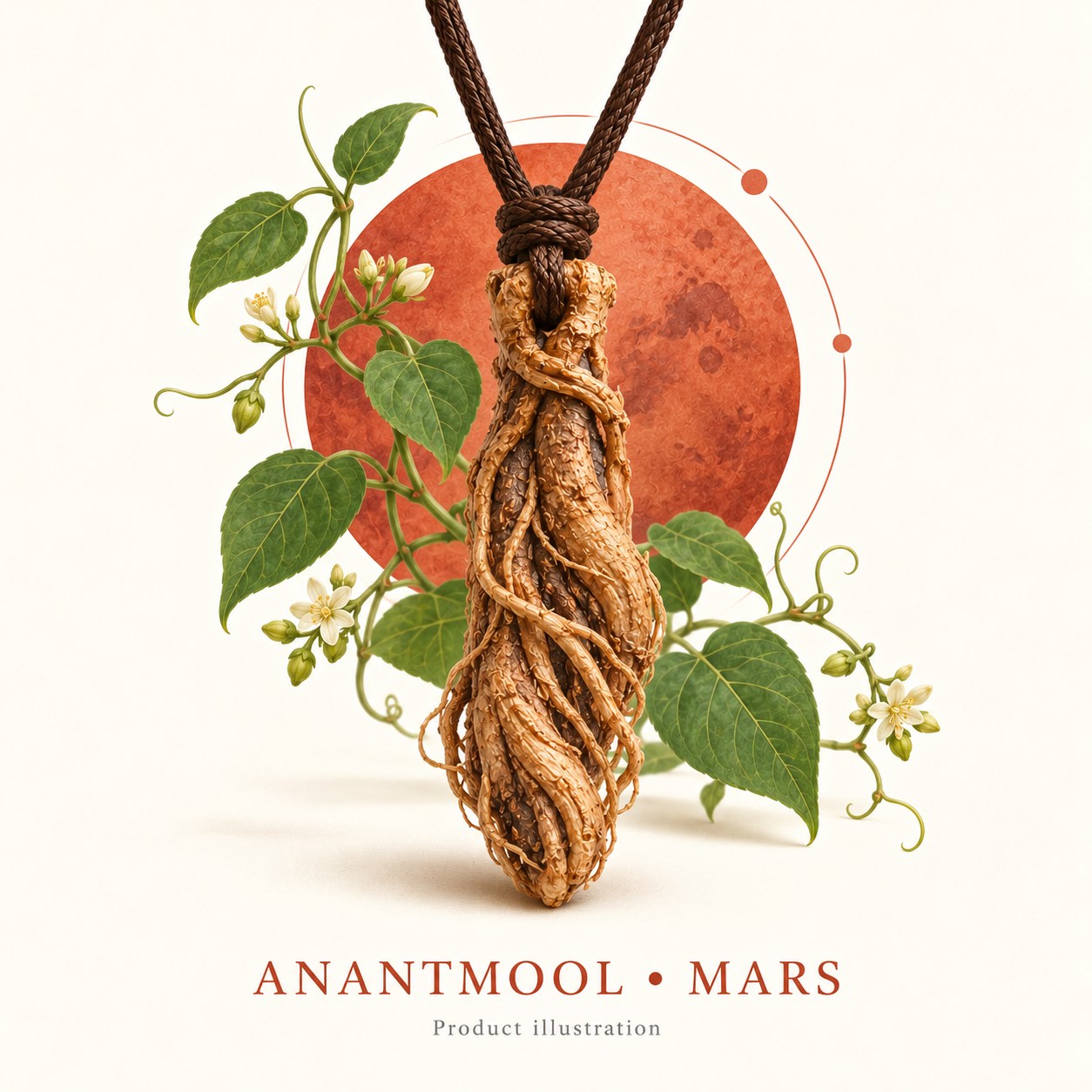
Anantmool and Mangal are connected in a contemporary strand of Indian planetary herbal jewellery: a prepared piece of Anantmool root is worn as a devotional or symbolic accessory associated with Mangala, Kuja, Bhauma or Angaraka, the graha called Mars. The subject becomes much clearer when three related but different questions are answered separately. What does Mangal signify in Jyotish? What plant is actually meant by Anantmool? And what is the specific custom behind wearing a root pendant?
Mangal has an established position in the Navagraha system and a well-developed vocabulary in Vedic astrology, including Mesha and Vrishchika rashi, Mars-ruled nakshatras, Mangal Mahadasha, graha drishti, Kuja Dosha, Mangalvar and associated devotional observances. Anantmool, in botanical and Ayurvedic material, commonly refers to Hemidesmus indicus, also called Sariva, Anantamul, Nannari or Indian sarsaparilla. The traditional vocabulary of each subject is worth preserving. But a botanical name by itself does not prove that a particular root was used in a pendant; nor does an association in a planetary-root practice mean that every classical Jyotish text prescribes that precise accessory for every birth chart.
This guide explores the devotional significance without reducing it to a generic product slogan. It explains Mars in the horoscope, the place of root jewellery alongside prayer and gemstone practices, what Tuesday worship may involve, how a personalised recommendation is considered, and how to examine the physical pendant before buying or wearing it. For construction and daily-wear instructions, see Anantmool root pendant: wearing customs, fit and care. For the plant itself, read Anantmool plant and root identification.
1. Anantmool and Mangal at a glance
| Topic | Traditional or practical explanation | Important distinction |
|---|---|---|
| Graha | Mangal, Mangala, Kuja, Bhauma, Angaraka; called Mars in English | A graha interpretation belongs to Jyotish, not botanical taxonomy. |
| Common planetary attributes | Courage, initiative, strength, land, younger siblings, determination, conflict and disciplined action | Outcomes depend on an entire chart in astrology; attributes are not product promises. |
| Rashis governed | Mesha (Aries) and Vrishchika (Scorpio) in mainstream Parashari Jyotish | Being born under one sign is not a universal instruction to buy a root. |
| Nakshatras in Vimshottari | Mrigashira, Chitra and Dhanishtha | Nakshatra lordship and the condition of natal Mars are different factors. |
| Weekday | Mangalvar, Tuesday | A customary day of devotion is not a material-authentication test. |
| Botanical name usually meant | Hemidesmus indicus (L.) R.Br., family Apocynaceae | A loose cut root cannot be authenticated by a label or colour alone. |
| Familiar plant names | Anantmool, Anantamul, Sariva, Nannari, Indian sarsaparilla | Regional names must be checked against a scientific identification. |
| Root pendant | Finished botanical jewellery, with a mounting and cord or chain | Dry-care and fitting instructions depend on the whole assembly. |
| Other Mangal-associated items | Mantra, Tuesday worship, charitable acts, red coral, and devotional objects in particular traditions | Alternatives are not automatically interchangeable or appropriate for everyone. |
2. Who is Mangal in the Navagraha tradition?
The nine-graha arrangement places Mangal among Surya, Chandra, Budha, Guru, Shukra, Shani, Rahu and Ketu. The Sanskrit term graha has a broader traditional meaning than the modern astronomical category of planet; the Navagraha system includes Surya and Chandra as luminaries and Rahu and Ketu as lunar nodes. In a horoscope, a graha is interpreted through sign, house, lordship, aspects, conjunctions, strength, avasthas, divisional charts and dasha timing rather than through its name alone.
Mangal is also known as Bhauma, referring to his association with Bhumi or the Earth, and as Kuja and Angaraka in different textual and devotional settings. Traditional iconography may show the deity with red colouring, a weapon or a vehicle, while the associated emphasis is on capacity for action. Such iconographic descriptions are best understood in their religious context, not as technical specifications for a root pendant.
The energy associated with Mangal is often described as tejas, parakrama or forceful initiative. In balanced expression, devotees may contemplate bravery joined with restraint, persistence joined with judgment, and the willingness to defend what is right without needless hostility. In a difficult expression, Jyotish discussions refer to impatience, quarrels, haste or aggression. A serious article should contain both sides of this symbolism: Mars is not merely a promise of money or power, nor is it inherently a reason for fear.
Traditions differ in which deity receives special prominence during Mangal-oriented practice. Some worship Mangal Deva directly; others invoke Hanuman, Kartikeya or Subrahmanya, Narasimha, or their family deity according to lineage and locality. A reader should follow an established family or teacher-led practice where relevant rather than assume one retailer's procedure overrides all others.
3. What Mars signifies in Jyotish
The word karakatva refers to the matters for which a graha serves as a significator. Mangal is conventionally discussed with initiative, courage, younger siblings, competition, tools, fire, technical work, land and property, construction, capacity to confront difficulty, physical exertion and the management of conflict. Certain medical and body correspondences also appear in classical or later astrological traditions; they are symbolic interpretive categories and should not be used to diagnose a condition or choose treatment.
The symbolism is not uniformly positive or negative. The same Mars-related inclination that appears as perseverance in one reading may be examined as overreaction in another. Astrologers look at the whole chart, functional house ownership and the periods in force before giving advice. A strong Mars may be constructive in one horoscope; strengthening Mars indiscriminately is not a universally sensible interpretation. A weak, combust, retrograde, afflicted or neecha Mars likewise cannot be judged by a single adjective outside its complete context.
For a person choosing a devotional root, the practical value of this framework may be an opportunity to set an intention: act with steadiness, speak after reflection, use strength responsibly and complete demanding work. This is a meaning the wearer assigns within a tradition. It is not proof that the root changes a graha's position, alters human physiology or guarantees litigation, career, marriage or property outcomes.
Table: Mangal keywords and responsible interpretation
| Traditional keyword | How it appears in Jyotish discussions | Constructive devotional reflection | Avoid claiming |
|---|---|---|---|
| Parakrama (valour/enterprise) | Initiative, competitive drive and determination | Choose courage with preparation | Guaranteed victory in disputes or examinations |
| Bhoomi (land) | Land, immovable assets and property questions | Maintain careful records and responsibilities | Automatic approval of a property transaction |
| Bhratru (siblings) | Sibling relationships, especially younger siblings | Practise fair communication and support | A root repairs every family disagreement |
| Agni and tools | Heat, machinery, technical activity and force | Respect training and physical safety | Protection from injury or accidents |
| Krodha and impulse | Anger, impatience, confrontation | Pause, listen and respond deliberately | Instant control of emotions |
| Shakti and discipline | Strength joined to structured action | Set a clear, attainable sankalpa | Supernatural increase in strength or health |
4. Mesha, Vrishchika, exaltation, debilitation and drishti
In the widely used Parashari framework, Mangal rules Mesha (Aries) and Vrishchika (Scorpio). It is traditionally described as uccha (exalted) in Makara (Capricorn) and neecha (debilitated) in Karka (Cancer). These associations are often listed in introductory graha charts, but their interpretation is not exhausted by a single row. A graha may be strong by one measure while challenged by another, and conditions such as neecha-bhanga require analysis rather than assumption.
In the same framework, Mangal has special graha drishti to the fourth, seventh and eighth houses from its position, counted inclusively in the classical way. These are aspects used by astrologers to discuss the influence of Mars on houses and planets. They are not geographical directions for placing a pendant and have no bearing on the chemical identity of a root.
For example, a person with Mars in Mesha does not automatically need a Mars-associated accessory: one must first ask which houses Mars owns for the particular lagna, where it sits, what it aspects, which conjunctions it forms and which dasha periods are active. Similarly, a Mars placement in Cancer does not, on its own, prove that a purchased root is necessary. Where a practitioner recommends Anantmool, ask for the precise reasoning in that horoscope, including whether the object is being offered as a devotional reminder or as part of a documented customary practice.
Table: Key Mars correspondences in Jyotish
| Jyotish term | Conventional Mars correspondence | Why it matters |
|---|---|---|
| Adhipatya (sign lordship) | Mesha and Vrishchika | Used to determine functional house lordship from lagna. |
| Uccha | Makara | One element in assessing dignity; not a standalone outcome forecast. |
| Neecha | Karka | Must be read with aspects, conjunctions and cancellation conditions. |
| Special drishti | Fourth and eighth, in addition to the seventh | Part of a formal horoscope reading. |
| Vimshottari Mahadasha | Seven years | Period lordship needs the complete dasha sequence and natal context. |
| Vimshottari nakshatra lordship | Mrigashira, Chitra, Dhanishtha | Used in timing calculations based on the Moon's birth nakshatra. |
| Vara | Mangalvar (Tuesday) | Common day for Mars-oriented vrata, puja or japa. |
| Associated colour | Red in many traditions | A symbolic association, not evidence of plant authenticity. |
| Associated gemstone | Red coral (Moonga), according to commonly used Jyotish gemstone practice | A coral purchase has separate authentication and ethical-sourcing questions. |
5. Mrigashira, Chitra and Dhanishtha: the Mars-ruled nakshatras
Three nakshatras fall under Mangal's lordship within the Vimshottari dasha scheme: Mrigashira, Chitra and Dhanishtha. The word lordship here refers to a defined timing system. It is not a statement that every person whose Moon falls in one of those stars should wear Anantmool, red coral or any other object.
Mrigashira spans the latter part of Vrishabha and the opening part of Mithuna. Its traditional image of a deer's head and its associations with seeking, curiosity and movement are encountered in nakshatra literature. Chitra spans the end of Kanya and the beginning of Tula, with the theme of craftsmanship and form frequently discussed. Dhanishtha crosses Makara and Kumbha and is associated with rhythm, collective activity and the Vasus in many descriptions. These nakshatras have their own deities, symbols, padas and detailed interpretations; describing them only as 'Mars stars' loses much of the material.
In dasha calculations, the Moon's location within the birth nakshatra determines the starting balance of the Mahadasha; subsequent periods follow the established sequence. The reference to a seven-year Mangal Mahadasha describes the full period duration in the Vimshottari scheme, not a seven-year guarantee of a uniform experience. Antardashas, natal placements and other chart factors change the interpretation. A root pendant is not a substitute for this work.
If a customer is told that a nakshatra 'requires' the root, a productive follow-up question is whether the recommendation arises from an established family custom, a specific Jyotish assessment or a general retail chart. Those are different kinds of guidance, and the customer deserves to know which is being offered.
6. Mangal Mahadasha, Antardasha and transits
A Mahadasha is a major planetary period, an Antardasha a subperiod, and a gochara is a transit. Mars can become a focus of discussion in any of these contexts. However, a common mistake is to treat every Mangal-related event as an automatic demand to purchase a Mars-labelled accessory. Actual astrological interpretation takes the ascendant, house placement, aspects, sign ownership, strength, dasha sequence and current transits into account.
During an astrologically significant Mars period, a practitioner may suggest reflection on disciplined action, responsibilities, devotional practice or practical decisions. Different traditions also place importance on prayer, charity, vrata, service or temple worship. Wearing a root pendant is one possible expression in certain planetary-herbal practices, but is not a universal condition for successfully passing through a dasha.
An online transit date, even if accurately calculated for a specified ayanamsha, is not enough to justify a personalised recommendation. Do not confuse a live transit calendar with an analysis of an individual birth chart. A recommendation should name the chart factors considered and should be presented without threats about what will happen if the user declines a product.
7. Mangal Dosha (Kuja Dosha): why context matters
Mangal Dosha, Kuja Dosha or Manglik Dosha is frequently discussed in Indian marriage matching. Different schools evaluate Mars in certain houses from the lagna, Moon or Venus and apply rules about exceptions, cancellation and strength. Because the rules differ and the subject concerns personal relationships, a one-line internet description does not amount to a complete matching analysis.
It is especially important not to turn a dosha label into a fear-based sales message. A person's relationship prospects cannot be responsibly reduced to the presence of one symbol in a chart or to a promise that buying a root eliminates a marital difficulty. A root is also not a legally or scientifically verified treatment for relationship problems. If someone chooses an Anantmool pendant as part of a familiar devotional practice, the choice should remain voluntary and clearly separate from claims about guaranteed marriage outcomes.
A thoughtful consultation will explain which house rules were used, which exceptions apply, whether the charts were examined as a whole, and what devotional options exist apart from purchasing jewellery. Readers who want to understand Anantmool as a plant rather than through the dosha discussion can consult the Anantmool identification guide.
8. Why is Anantmool associated with Mars?
The Anantmool–Mangal pairing appears in some Navgraha herbal root and planetary-pendant traditions. It treats a specific plant-root accessory as a symbol linked with the Mars graha, much as other traditions associate colours, metals, flowers, mantras, gemstones or forms of worship with different grahas. The root may be chosen because a family has practised such wearing, because a practitioner follows a particular root-correspondence scheme, or because a devotee values the meaning.
There is an important distinction between a traditional association and a claim of universal scriptural prescription. Classical Jyotish offers extensive teachings about Mars, but identifying a particular planetary-root chart with a named plant does not automatically establish that every version of that pairing appears in the Brihat Parashara Hora Shastra, Brihat Jataka or every regional ritual manual. If a seller claims an exact ancient Sanskrit source, it is reasonable to ask for the text, chapter and verse instead of repeating an unspecified authority.
A useful devotional explanation can remain rich without overclaiming. In the Mars framework, the wearer may associate Anantmool with perseverance, thoughtful courage, self-discipline or an intention to act without hostility. It may be worn after customary prayer, carried as an accessory or kept as a reminder. None of these uses requires the article to claim measurable physical effects from the root. The meaning arises through the person's chosen practice and interpretation.
Anantmool is distinct from red coral, an iron talisman, a metal yantra and a Rudraksha bead. These objects have different histories, materials, methods of care and degrees of attribution. They should not be described as identical substitutes merely because they appear in the same Navgraha catalogue.
9. Botanical identity: what plant is Anantmool?
For the plant usually sold as Anantmool, Anantamul or Sariva, authoritative botanical and medicinal-plant references identify <em>Hemidesmus indicus</em> (L.) R.Br. The accepted modern family placement is Apocynaceae; some older Ayurvedic or flora literature uses Asclepiadaceae because of earlier classification systems. Kew's Plants of the World Online treats H. indicus as an accepted species and describes it as a climbing shrub native across parts of the Indian subcontinent and adjoining Asian regions.
The names Nannari in Tamil and Sogade beru/Sugandhi beru in Kannada are among regional names recorded in Indian flora literature. The National Medicinal Plants Board also uses Anantmool and Sariva for the root in cultivation and medicinal-plant documentation. These references are useful for recognizing the trade name, but regional variation can create confusion. A supplier should identify the actual plant rather than relying on a label shared by multiple local markets.
The root material is traditionally described as aromatic and woody. Its appearance can change when it is harvested, dried, cut, polished, capped or sealed. A finished pendant may lack the leaves, flowers, latex and growth habit required for normal botanical identification. Therefore a photo, fragrance, redness, colour of the cord or 'Mars' branding does not independently authenticate a root. A transparent seller describes the available material evidence and avoids claiming laboratory confirmation where none exists.
The botanical source is also not an instruction to take an herbal preparation internally. Ayurveda and medicinal-plant literature discuss Sariva root as a materia-medica material, but the jewellery being discussed here is a finished wearable accessory. Its purpose, preparation, risks and handling are different. For the full physical and historical background, see Anantmool plant and root identification.
Table: Distinguishing plant identity from astrological symbolism
| Question | What can support an answer? | What cannot establish the answer? |
|---|---|---|
| Is the taxon Hemidesmus indicus? | Traceable harvest/supplier records, identified plant specimen, appropriate expert verification | Red thread, product title, smell alone or a ritual label |
| Is it genuinely root material? | Construction details, clear macro photographs, process and provenance notes | A single heavily edited product photograph |
| Is the object a comfortable pendant? | Measurements, weight, bail, cord and fastening photographs | Botanical Latin name alone |
| Why does it have a Mars association? | A named family, practitioner or published tradition of planetary-root use | A claim that Kew scientifically classified the plant as 'Mars' |
| Does a chart support wearing it? | An explained Jyotish consultation using relevant chart factors | One social-media line about a rashi or dosha |
| Is the product easy to maintain? | Material-specific dry-care and assembly instructions | A promise that consecration makes it indestructible |
10. Tuesday worship: Mangalvar, sankalpa and respectful observance
Mangalvar is the weekday associated with Mangal in common Navagraha practice. Devotees may offer prayer to Mangal Deva, Hanuman or another deity according to their family practice, perform japa, read a stotra or observe a vrata. The term sankalpa refers to an articulated intention made in the course of worship. It need not be treated as a commercial activation code for an accessory.
A simple practice may involve bathing, preparing a clean prayer space, lighting a lamp where safe, offering flowers according to local custom and reciting a familiar name or mantra. Some households use red flowers or red cloth because of Mars's symbolic colour; others emphasize Hanuman worship, seva or donation. Customs differ. The crucial distinction is between what is undertaken as devotion and what a finished root pendant can physically tolerate. Do not expose a glued, dyed, drilled, capped or strung natural root to flame, incense embers, ghee, oil, prolonged immersion or strong cleansing liquids unless its maker has expressly confirmed compatibility.
There is no need to tell every wearer that Tuesday is the only permitted day, that a particular number of repetitions must be performed, or that failure to do a ceremony will cause harm. A person may follow instructions received from a trusted teacher or family elder. Where no such rule exists, a clear and respectful approach is to keep the pendant clean and dry, make a calm intention and wear it safely.
The Hanuman Chalisa, Mangal stotras and Navagraha prayers are familiar to many devotees, but their use varies. Some people distinguish Mangal Deva worship from Hanuman devotion even when both occur on Tuesday. No article should merge all regional customs into a single compulsory ritual. Readers seeking the everyday technical details can use the pendant wearing and care guide.
11. Mantra, japa and the boundaries of instruction
Several names are used for the deity: Mangala, Bhauma, Kuja and Angaraka. In a simple devotional setting, a person may recite “Om Bhaumaya Namah” or “Om Mangalaya Namah”. A familiar longer bija form is transliterated “Om Kraam Kreem Kraum Sah Bhaumaya Namah”; spelling and pronunciation conventions differ among teachers and regional scripts. Those words belong to the devotional tradition, not to the product's botanical certificate.
For mantra recitation, regularity and an appropriate teacher or family custom are more meaningful than a retailer's demand for a universal count. A practice of 11, 21, 27 or 108 repetitions may be encountered, but no single count should be imposed on all readers without attribution. A beginner may prefer a short prayer familiar from their household rather than undertaking a complex practice from a shopping page.
The root itself need not be rubbed, heated, smoked or submerged during japa. It can remain on a clean cloth or be worn according to the actual fitting. The objective is to avoid confusing reverence for the accessory with potentially damaging handling. If an observance conflicts with the maker's care information, ask for an alternative procedure that preserves both devotional intent and physical safety.
Table: A flexible Tuesday observance framework
| Stage | Possible customary action | What to check |
|---|---|---|
| Preparation | Clean a prayer space, bathe and make time for worship | No requirement to expose the pendant to water |
| Deity or focus | Mangal Deva, Hanuman, Subrahmanya or family deity | Follow the practice actually known to the household |
| Sankalpa | State an intention for disciplined action and responsibility | Avoid fear-based vows or product-dependent outcomes |
| Mantra or reading | Recite a familiar Mangal name, stotra or other devotional text | Choose language and count consistent with one's tradition |
| Offerings | Flowers, lamp, food offering or service where customary | Keep heat, oil and smoke away from the finished pendant |
| Wearing | Put on the accessory when comfortable and properly secured | Inspect cord, cap, bail and exposed surfaces |
| Continuing practice | Keep the object clean; remember the intention in daily conduct | Do not imply that the object guarantees a result |
12. Anantmool, Moonga and Rudraksha: different objects in a Mars conversation
A person exploring Mars-related devotional items may encounter Anantmool root jewellery, Moonga (red coral), Rudraksha, a yantra, a metal token, and puja materials. Although these may appear in a single Navagraha section, they are not interchangeable products and cannot be evaluated by one identical checklist.
Red coral is an organic gem material formed by marine organisms, not a mineral crystal and not a root. Its identity, colour treatment, condition, sourcing and fitting have their own considerations. GIA notes that coral can be dyed or stabilized and that hard materials, chemicals and heat can harm it. Planetary-root jewellery is usually more sensitive to moisture at seams and can contain adhesive, wood-like fibres and cord. A Rudraksha bead is a seed-derived devotional object; traditional mukhi interpretations and the article's construction are separate questions. The existing Rudraksha for Planets collection can help readers compare devotional categories, but a product list is not an individual horoscope assessment.
A Mangal yantra or a mantra is different again: it may function as a focus for worship without being worn at all. A Tuesday offering or seva has no physical pendant to authenticate. Some families combine practices, while others follow only one. The right question is not 'Which object is always strongest?' but 'Which practice is actually being recommended, by whom, and for what reason?' A person may also choose not to buy an object.
Table: Comparison of Mangal-related devotional options
| Option | Material or activity | Traditional context | Buying or handling question |
|---|---|---|---|
| Anantmool root pendant | Prepared botanical root, fitting and cord/chain | A Mars association in some planetary-herbal practices | Is the plant identity traceable and the assembly wearable? |
| Red coral (Moonga) | Organic marine gem material | Gemstone tradition associated with Mangal | Is it natural, treated, imitation or reconstructed; is sourcing documented? |
| Rudraksha | Seed-derived bead or mala | Shaiva and other devotional practices, with various planetary interpretations | Is mukhi identification and workmanship appropriate? |
| Mangal mantra or stotra | Spoken, sung or read devotional text | Direct graha worship or family prayer | Is the text and pronunciation appropriate to the tradition? |
| Tuesday vrata or seva | Personal observance or service | Mangalvar worship in many households | Can it be observed responsibly without strain or pressure? |
| Yantra or puja item | Printed, engraved or crafted ritual symbol | Worship according to a specific tradition | Does the user understand its customary placement and handling? |
13. How an astrologer may assess a Mars-related recommendation
A responsible personalised assessment begins with reliable birth details and the requested school of calculation. A Jyotish practitioner may examine lagna, planetary longitude, rashi and bhava placements, functional lordship, graha drishti, conjunctions, nakshatra, shadbala or other strength measures, Navamsha and relevant divisional charts, Vimshottari periods and gochara. Not every technique is used by every school, and an interpretation should state its method where it affects a recommendation.
An approach that treats all Mars positions as a defect, or prescribes the same root based only on a person's sun sign, omits too much context. For example, Mangal as an important house lord for one lagna can be judged differently from Mangal for another. A practitioner may also advise devotional conduct, reflection, mantra or charitable activity rather than a purchase. Some consider whether a gemstone recommendation should strengthen a functional graha; others distinguish pacification from strengthening. These are interpretive differences, not material properties of the root.
If Anantmool is recommended, ask whether the advice is personalised Jyotish guidance, a family devotional custom, or a general cultural association. Request an explanation of the Mars factor considered and whether the object is optional. Avoid handing over sensitive personal information to an unknown seller simply to receive a sales message. The purpose of a sound consultation is to clarify choices, not to create urgency.
14. Choosing the actual Anantmool pendant
A Mars-themed devotional reason does not excuse poor materials. A buyer should see the precise root piece or an accurately representative unit, the mounting, the cord or chain, and a scale or dimension reference. Useful product information includes the stated plant name, the root's approximate length and width, a note on drying and finishing, the method of attachment, any adhesives or coatings, the metal's stated composition, and what happens if the string or fitting fails.
A cut and dried root may show natural grooves and uneven colour. These are not automatically defects, but severe splitting, loose fibres or an unstable cap warrant attention. A charming rustic look and secure construction can coexist. Watch for stock photos that are not representative, unusually vague botanical claims, and descriptions that promise miraculous results while omitting dimensions. If material identity is uncertain, a seller should disclose that uncertainty rather than relabeling it as rarity.
For frequent wear, consider whether the pendant snags on clothing, touches damp skin, rests below a work lanyard or could catch on tools. A thin cord may require periodic replacement. A child-safe product requires different mechanical considerations from an adult's accessory. Don't attempt an aggressive smell, flame, scratch, taste or boiling-water test on the finished piece; such tests are destructive or unreliable and may damage the mounting.
Read the Anantmool pendant fitting and care guide before choosing a length or cleaning routine. The Anantmool Root Pendant for Mars page may show the specific item available, while the present article explains the spiritual and astrological context of choosing it.
15. Questions to ask a supplier before ordering
A useful product conversation should be about the actual article, not only general planetary meanings. Ask for the botanical name used by the supplier and any traceability information. Request unfiltered close-ups of the root, the back of the fitting and the attachment point. Confirm the current dimensions and whether the depicted pendant is the item shipped or an illustrative example. Ask whether colour, polish, coatings or added fragrance are involved and whether the material is finished with adhesives or metal parts requiring special care.
Check price, delivery, returns, availability and whether a damaged component can be repaired or replaced. If a devotional process is offered, ask what will actually be done, whether any liquids or heat touch the finished root, and whether the process is optional. A written explanation of a traditional association is more useful than an untraceable claim that only one seller possesses a particular sacred root.
Finally, do not confuse a botanical identity document, a gemstone laboratory report, an astrological consultation, and a retail invoice. Each records different information. An invoice establishes a purchase; a photo may show the item; a plant identification can support its biological name; a Jyotish explanation outlines a traditional interpretation. None substitutes automatically for all the others.
16. Practical protection of a Mars-associated root pendant
A root pendant is not a polished gemstone with a single predictable hardness. Its fibres, edges, coatings, string and fittings may react differently to use. Dry-care first is a useful default: remove loose dust with a clean soft brush or cloth, keep it away from prolonged water exposure, and dry any accidental moisture promptly according to the maker's instructions. Do not assume that a bathing ritual suitable for stone, metal or a temple idol is safe for a botanical centre with glue or a cord.
Store the pendant separately from hard gemstones, especially if it is an irregular piece with exposed edges. Avoid leaving it on a humid bathroom shelf or a hot dashboard. Perfume, hair oil, cleaning liquid and perspiration can affect appearance and fittings. If the cord frays, the bail loosens or the root develops a spreading crack, stop wearing it until a competent person assesses the assembly. Ritual significance does not make worn fastenings mechanically safe.
For a family that uses holy water, sandal paste or oil during worship, the simplest adaptation may be to offer the substance separately, leaving the finished root untouched. A clean cloth, a prayer or a respectful place on the altar can serve the devotional purpose without forcing a vulnerable accessory into a damaging process. No specific physical treatment should be presented as necessary to keep the spiritual intention valid across all traditions.
17. Responsible sourcing, conservation and honest labels
Because Anantmool jewellery begins as a plant material, responsible harvesting matters. Roots are not identical to fallen leaves: careless collection can damage or kill plants and reduce local populations. The product description should not invent an origin, wild-harvesting permit, sustainability certificate or laboratory test. Where sourcing information is available, it is useful to know whether the material was cultivated or collected, who supplied it, and how batches were identified before cutting and assembling pendants.
An attractive root segment can be sold honestly without declaring that its exact location is 'secret' or that its power is proportionate to scarcity. If plant identity is a selling point, it should have support. In trade, some vernacular names travel between regions; Sariva has distinctions in Ayurvedic terminology, including discussions of Shveta and Krishna Sariva that may refer to different plants. Therefore a statement that a root is Hemidesmus indicus is more precise than a vague claim that every form of 'sarsaparilla' is the same botanical material.
Documentation can be modest but meaningful: the supplier's stated taxon, a batch reference, dated photographs of the material before processing, and a plain description of the mounting. The label should describe the material actually sold, not simply copy the botanical description of a mature flowering plant. The Anantmool botanical identification article explains how to separate identification evidence from regional plant names.
18. Ayurvedic Sariva and Jyotish Mangal: two traditions, different questions
Anantmool is discussed in Dravyaguna and Ayurvedic literature under names including Sariva and Anantamula. Those discussions concern materia medica, properties attributed to plant preparations in traditional systems, species distinctions and methods of processing. The modern botanical name Hemidesmus indicus helps scholars and consumers identify what plant is meant; it does not translate a medicinal formula into instructions for jewellery.
The Mangal association, by contrast, concerns a graha, cultural correspondences and a form of devotional wearing. A root pendant is not the same item as a powder, decoction, syrup, supplement, medicated oil or practitioner-prescribed Ayurvedic preparation. One should not infer a dosage, an internal use or a therapeutic result from a jewellery product page. In particular, an aromatic root mounted under metal or adhesive should never be treated as a ready-to-ingest ingredient.
The two traditions can be discussed respectfully on the same page without collapsing them. A customer might appreciate Sariva's place in classical medicinal-plant vocabulary while choosing the finished object for a Mars-oriented family custom. Proper scholarship identifies where the botanical record ends, where Ayurveda's traditional terminology begins, and where the specific Jyotish-root association is being interpreted.
19. Three examples of how people approach the Mars association
A family-observance example. Someone inherits a Tuesday prayer tradition and wants to wear a small Anantmool pendant as a reminder of it. The most useful advice may be to choose a comfortable fitting, avoid damaging ritual handling and maintain the family practice without treating the accessory as the entire observance. The object expresses devotion; its dimensions and material need independent attention.
A horoscope-consultation example. A reader has been told 'Mars is weak' but has not seen the method behind that conclusion. The next step is to ask for an explanation of lagna, relevant house ownership, sign, aspects and dasha rather than immediately purchase a Mars product. A specific root may or may not be suggested. If the result is an optional devotional choice, the person can compare it with prayer or other practices and make a considered decision.
A product-research example. A buyer is attracted by the rustic appearance of a root pendant but has no personal astrological recommendation. They may choose the item as botanical or devotional jewellery. The honest listing should still identify the plant as precisely as possible, show the real construction and provide care instructions. A customer does not need an invented horoscope problem to appreciate traditional craftsmanship.
These examples are not fixed categories; the same person may have more than one reason. The principle is to keep the user's intention, the tradition's vocabulary and the item's physical qualities all visible.
20. Common misunderstandings about Anantmool and Mangal
| Common statement | More careful explanation |
|---|---|
| “Every Manglik person must wear Anantmool.” | Kuja Dosha interpretations differ; wearing a particular root is not a universal rule. |
| “Mangal rules Aries and Scorpio, therefore everybody in those signs needs Mars products.” | Sign lordship is only one part of a chart, and sun sign alone is insufficient for a Vedic assessment. |
| “Anantmool root is scientifically a Mars plant.” | Botanical science identifies species and plant material; the Mars pairing is a spiritual-cultural attribution. |
| “Every Sariva plant name is interchangeable.” | Common names and Ayurvedic varieties require botanical context. |
| “A red string proves it is a Mars root.” | String colour is symbolic packaging, not evidence of species identity. |
| “The root must be dipped in oil or milk to activate it.” | Some rituals use offerings, but wet treatment may damage a finished root assembly. |
| “Red coral, Rudraksha and Anantmool are the same remedy.” | They differ in material, interpretation, price, authentication and care. |
| “If the pendant breaks, something bad must happen.” | Cords, glue and dried natural materials can fail through normal wear and mechanical stress. |
| “A price or certificate proves astrological results.” | Purchase records and material checks have separate purposes; neither guarantees life outcomes. |
21. Where to go next in the Anantmool collection
The strongest article collection avoids forcing one post to answer every question. This page is chiefly about Mangal's Jyotish meanings, devotional observance and the cultural root association. For plant morphology, accepted names, traditional botanical references and root-verification principles, read Anantmool: plant identity, traditional uses and root identification. For attachment construction, cord measurements, skin comfort, routine inspection and storage, use Anantmool Root Pendant: Wearing Customs, Fit and Care.
If you are comparing specific catalogue items, visit the Anantmool Root Pendant for Mars. To browse botanical accessories associated with other grahas, use Planetary Herbal Jewellery in the Spiritual Jewellery category. For a different material and devotional tradition, the Rudraksha for Planets collection is a separate starting point. Compare on identified materials, intended devotional use, accurate photographs and practical care rather than a promise that every object offers the same result.
A final source distinction is worth keeping: Kew's Hemidesmus indicus botanical record establishes the accepted scientific name and plant background. It does not authenticate a particular manufactured pendant or certify the Anantmool–Mars association. For a purchase, ask for that item's traceable details; for personal astrological interpretation, ask for the method used.
Frequently asked questions about Anantmool and Mangal
1. What is the connection between Anantmool and Mars?
Some Indian planetary-herbal traditions associate an Anantmool root accessory with Mangal, the Mars graha of Jyotish. It may be worn as a symbol of disciplined action, courage or devotion. The plant itself is a botanical material and the association belongs to a specific traditional practice. It does not mean that every classical Jyotish text mandates this root for every person or that a root changes planetary positions.
2. What is the correct scientific name of Anantmool?
The plant commonly called Anantmool or Sariva in Indian medicinal-plant references is Hemidesmus indicus (L.) R.Br., in the family Apocynaceae. Kew lists it as an accepted species, and Indian flora sources record regional names such as Nannari and Sogade beru. The scientific name is a useful target for supplier verification, but the species of a particular finished root pendant still needs traceability.
3. Is Anantmool the same as Sariva or Nannari?
The names are commonly connected to Hemidesmus indicus, although regional trade and classical Ayurvedic discussions can distinguish forms of Sariva and use additional plant names. A seller should identify the botanical species offered rather than assume every vernacular label is an exact synonym in all places. The complete plant-identification guide explores these naming questions.
4. Which graha does Anantmool represent in this collection?
In OmmRudraksha's planetary-herbal collection, Anantmool is presented with the traditional Mangal (Mars) association. That label describes the devotional framework for the product, not a modern botanical classification. Other lineages may give different emphasis or use other ritual items for the same graha. It is useful to ask a practitioner which correspondence system is being followed.
5. What does Mangal signify in Vedic astrology?
Mangal is associated in Jyotish with courage, initiative, determination, land, siblings, force, action, competition and the management of conflict. Its interpretation depends on its position in the horoscope, the houses it governs, aspects, conjunctions and planetary periods. An explanation of Mars should include the possibility of constructive and difficult expression rather than treating the graha as uniformly beneficial or harmful.
6. What other Sanskrit names are used for Mangal?
Common names include Mangala, Kuja, Bhauma and Angaraka. Bhauma evokes the traditional connection with Bhumi, the Earth. These names appear in varying ritual and astrological contexts. A root pendant carrying one of these labels does not become botanically distinct from a pendant labelled with another name; both identity and product construction require their own evidence.
7. Which rashis are ruled by Mars?
In mainstream Parashari Jyotish, Mars governs Mesha (Aries) and Vrishchika (Scorpio). This is a factor in assessing house lordship for different ascendants. It does not mean that every person with an Aries or Scorpio Sun, Moon or ascendant must buy a Mars-associated pendant. The complete horoscope and intended tradition matter.
8. In which signs is Mars exalted and debilitated?
Mangal is traditionally exalted in Makara (Capricorn) and debilitated in Karka (Cancer). These dignities are parts of Jyotish's interpretive structure, not automatic declarations about life events. A practitioner may also examine neecha-bhanga, aspects, house lordship, divisional charts and other conditions before reaching a view. A retailer should not infer a universal product prescription from one dignity label.
9. Which nakshatras are ruled by Mangal?
Mrigashira, Chitra and Dhanishtha are assigned to Mars in the widely used Vimshottari dasha system. Their padas lie across more than one rashi and each nakshatra has a separate traditional identity. Nakshatra lordship helps establish dasha timing; it is not proof that all people born under these stars require Anantmool jewellery.
10. How long is Mangal Mahadasha?
The full Mangal Mahadasha lasts seven years in Vimshottari dasha. The period's interpretation depends on the natal chart, antardasha, placements and the school of Jyotish used. Seven years is a calculation within a traditional planetary-period system, not a guaranteed span of either good or bad outcomes and not a fixed timetable for wearing a pendant.
11. Is Anantmool prescribed for Mangal Dosha or Manglik Dosha?
Some practitioners may discuss Mars-related devotional observances when addressing Kuja Dosha. But the placement rules and exceptions used for Manglik assessments differ among traditions, and a planetary root is not a universally mandated correction. A complete consultation should explain the relevant house calculations, cancellation factors and options without pressuring anyone with marriage fears.
12. Must an Anantmool pendant be worn on Tuesday?
Tuesday, or Mangalvar, is customarily associated with Mars and may be preferred for beginning an observance. Yet there is no single mandatory wearing-day rule for every family, teacher and product. If you have a specific ritual instruction, follow it in a way that also protects the material. Otherwise, secure construction and a comfortable fit matter whenever the pendant is worn.
13. Which deity is worshipped for Mangal?
Traditions may honour Mangal Deva directly and may also emphasize Hanuman, Subrahmanya/Kartikeya or a family deity. Regional and lineage practice matters. It is better to identify the devotional custom being followed than to impose one worship sequence on all households. The deity chosen for prayer is not a test of the botanical authenticity of the accessory.
14. What Mangal mantra may be recited?
Examples encountered in common practice include “Om Bhaumaya Namah”, “Om Mangalaya Namah” and the longer form “Om Kraam Kreem Kraum Sah Bhaumaya Namah.” Pronunciation and preferred forms can vary. If you have received a mantra from a teacher or family tradition, give that instruction priority. Recitation does not require immersing or heating the pendant.
15. Is a particular number of mantra repetitions compulsory?
Some traditions use short counts and others use one mala of 108 repetitions or more extensive japa. No count should be sold as a universal condition attached to a piece of root jewellery. Choose a prayer practice you understand and can observe sincerely. The product's material care instructions remain the same regardless of the number of repetitions.
16. Can Anantmool be worn without a birth-chart consultation?
A person may choose the accessory for botanical interest, cultural heritage or devotion without claiming a personalised Jyotish recommendation. If the goal is astrological suitability, however, a chart-based opinion should consider actual birth details and relevant Mars factors. Purchasing a symbolic item and receiving an individual astrological assessment are different services; neither should be represented as the other.
17. Is Anantmool the same as red coral for Mars?
No. Anantmool is plant-root material, while Moonga is an organic marine gemstone used in particular Jyotish gemstone traditions. Their origin, authenticity tests, treatment disclosures, wearing constructions, prices and care needs differ. Even where both have Mars associations, they should not be assumed to have identical traditional indications or to suit the same horoscope automatically.
18. Can I wear Rudraksha with an Anantmool pendant?
Some devotees combine devotional objects, while others follow a lineage-specific rule about particular beads or arrangements. There is no universal mechanical obstacle to two separate pieces of jewellery, but physical comfort and the safety of the chains or cords matter. For any personalised astrological claim about combining materials, ask the relevant practitioner. See the Rudraksha for Planets collection for a different devotional category.
19. Does the root need to touch my skin?
Not necessarily. That depends on the design and the wearing custom. Prolonged friction or moisture from perspiration can affect comfort and a natural root's finish. A properly mounted pendant can be worn over clothing if suitable for the design and the person's practice. Inspect for sharp edges, exposed adhesive and an unstable cap. The fit and care article covers these details.
20. Can I put the root pendant in milk, water, oil or perfume?
Do not assume that a traditional offering procedure is suitable for a finished piece of botanical jewellery. Liquids may affect dried root, coatings, adhesives, cords or metal. Follow the specific maker's care guidance. If the family ritual includes a liquid offering, it may be made separately, with the accessory placed on a clean dry cloth rather than submerged.
21. How do I know whether the root is genuine?
Ask for the stated scientific name, traceable supplier or batch information, accurate photographs and a clear account of the finishing process. A pleasant aroma, an attractive brown surface or a red string cannot prove the species. If a seller offers a certificate, check what it actually verifies. The documented history of the plant source is distinct from the workmanship of the finished pendant.
22. Can a broken Anantmool pendant be repaired?
Sometimes a cord, clasp or separate metal component can be repaired or replaced, depending on the design. A split, crumbling or structurally damaged root may not be safely repairable. Stop wearing a piece that might detach or snag; consult the supplier about replacement or a qualified jeweller about a fitting. Do not interpret an ordinary mechanical break as a reliable prediction of future events.
23. Is Anantmool jewellery the same as an Ayurvedic herbal preparation?
No. A pendant is a finished wearable object, which may include adhesives, finishes and metal parts. Classical Ayurvedic references to Sariva concern plant material within a different practice. Such references do not provide directions to ingest or medically use jewellery. Keep discussions of botanical identity, traditional materia medica and planetary symbolism separate so each remains accurate.
24. Can the pendant guarantee courage, success, property or marriage results?
Mangal's traditional themes include initiative, discipline, property and conflict, and a person may use devotional jewellery to remember those themes. A product cannot responsibly promise a specific legal, financial, relationship or personal outcome. Practical decisions still require ordinary judgment, documentation, communication and professional assistance where relevant. Traditional significance is best expressed without turning symbolic meanings into unconditional guarantees.
25. What should I ask before buying the Mars root pendant?
Ask which plant the seller states it contains, how the material was sourced and finished, the dimensions and weight, how the bail and cord are attached, what photographs represent the actual product, and what care and returns arrangements apply. If an astrological recommendation is claimed, request its basis. Compare the Anantmool product with the wearing guide rather than relying only on a short headline.
26. Which related articles should I read next?
For the biological side, use Anantmool plant and root identification. For daily wear, cord length, mounting, care and storage, choose Anantmool root pendant: how to wear and care. To compare other materials, browse Planetary Herbal Jewellery and the Rudraksha for Planets collection. Each page answers a different question, allowing you to consider traditional meaning alongside practical product facts.
Conclusion: honour the Mangal tradition with informed choice
Anantmool's Mangal association is best understood as a specific devotional and Jyotish-related tradition, not as a substitute for plant identification or a guaranteed astrological outcome. Mangal's established vocabulary includes courage, initiative, Mesha and Vrishchika, Mrigashira–Chitra–Dhanishtha, Mangal Mahadasha, Tuesday worship and the need for thoughtful chart interpretation. The botanical counterpart is a root generally identified as Hemidesmus indicus, prepared as a wearable object whose provenance, construction and care need independent attention.
If the symbolism is meaningful, choose the practice freely and with enough detail to understand what is being followed. If you are making a purchase, ask for clear material and fitting information. If you are seeking a personal Jyotish recommendation, ask how it was derived rather than relying on a generic Mars label. You can then explore the Anantmool Root Pendant for Mars or return to Spiritual Jewellery with a balanced understanding of tradition and the actual item.
