
A Diwali altar can be simple and carefully arranged. The useful starting point is the worship your household actually follows, the space available and the things you already have. A long online list is a reference to read, not automatically an order to buy everything on it.

Even the phrase “Diwali puja items” can cover different observances across several days. Establish which ceremony you are preparing for before comparing lists.
What a published list is describing
Drik Panchang's Lakshmi Puja materials list includes deity images, cloths, lamps, flowers, offerings and account books. It also includes items for a more elaborate ritual arrangement. Those details belong to the practice that list describes.
It is reasonable to take that reference to the person guiding your puja and ask what applies. Do not quietly replace an unfamiliar item with something suggested by an unrelated shopping page. If an adaptation is needed, that is a ritual question for your household, priest or teacher.
Give each group of items a clear place
The devotional focus. Begin with the image or object your household worships. Place it securely, where an offering or movement nearby will not knock it over. A decorative product photograph is not a reliable guide to the stability of your own arrangement.
Offerings. Keep flowers and food in suitable containers. Put liquids where they can be handled without passing over books, electrical lights or jewellery. If several people will participate, leave enough room for the actual movements involved.
Reading and records. A prayer book or account book needs a dry, accessible place. The association of account books with some Lakshmi Puja practices does not mean everyone needs to purchase a new set of business materials.
Lighting. Give an open-flame lamp a stable, heat-resistant position clear of loose cloth, paper, tassels and the route where hands will reach. Keep it attended. An arrangement that looks attractive in a still photograph may be awkward once people begin using it.
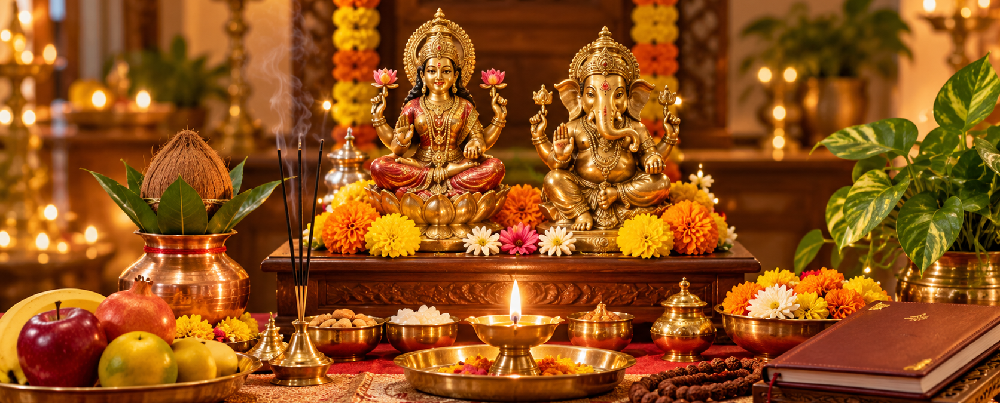
A small-space example
Suppose you have one shelf and a separate table. The shelf can hold the stable devotional focus while the table supports the book and offerings. The lamp needs its own appropriate position; it should not be squeezed against fabric just to keep everything inside a photograph.
This is a layout example, not a prescribed ritual plan. Check the placement your practice requires and then make the physical arrangement workable. A smaller number of well-placed items is easier to handle than a crowded display whose edges you cannot reach.
Where a mala or gemstone belongs
A personal mala may be used for a familiar prayer or kept separately while you take part. It is not automatically a required altar item. If you place one nearby, protect it from oil, water, heat and food residues. Do not assume that soaking an assembled strand is necessary or suitable for its materials.
The mala collection offers different constructions, but a product purchase is separate from deciding what your puja needs. The same applies to a gemstone ring or pendant you already own: a devotional occasion does not remove its care requirements.
Before buying anything extra
- Write the name of the observance you are preparing for.
- Mark which items you already have and can safely use.
- Ask about unfamiliar ritual requirements.
- Check the dimensions of any new object against the actual shelf or table.
- Confirm availability and delivery before relying on a festival deadline.
A seller should describe the item being offered. It should not present a costly bead, a particular gemstone or an extra paid service as a guaranteed way to secure wealth.
When should the arrangement be ready?
Prepare the practical layout early enough to notice a wobbly stand, a missing container or an unreadable prayer book. Use a current local calendar for the observance itself. This article supplies no universal puja time; city, year and the selected ritual matter.
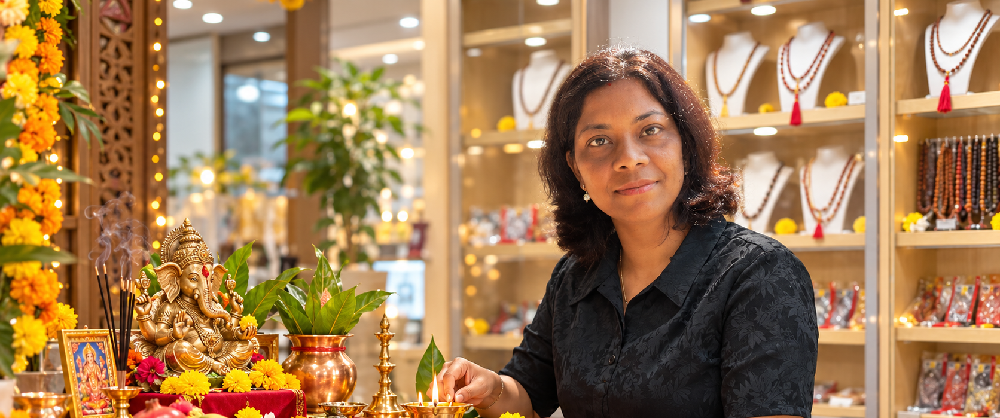
Once the celebration ends, separate food and flowers from objects you will store. The care guide helps with that final practical step. A home Diwali puja altar is a place for worship, not a contest to display the most objects. Its central purpose is to make the chosen observance practical, respectful and comfortable for those taking part. In many households the principal evening worship centres on Mahalakshmi and Shri Ganesha; others include the family deity, Saraswati, Kubera, a kalasha, family account books, or inherited regional customs. Some families worship at a permanent mandir and use a temporary table only for offerings. Others clear a shelf, arrange a low chowki, or prepare a space at their business premises. The appropriate arrangement begins with this actual practice. The original article above explains why published shopping lists should be read with discernment. This expanded guide goes further: it identifies each familiar item, explains what role it might serve, sets out several physically workable altar layouts, distinguishes essential materials from optional embellishments, and supplies inspection and aftercare checklists. Its aim is to help a household prepare thoroughly without assuming that every tradition requires the same quantity, placement or sequence. A priest or family elder can confirm tradition-specific requirements, while a seller can confirm materials, dimensions and care. One useful approach is to write three headings before arranging anything: devotional focus, offerings and ritual implements, and lighting and movement. Keep devotional objects stable, put food or water in containers, and prevent people from having to reach across a flame. The visible beauty of an altar should support the act of puja rather than obstruct it. “Diwali puja” can refer to different events within the festival period. Dhanteras/Dhantrayodashi, Naraka Chaturdashi, Lakshmi Puja on Amavasya, Govardhan Puja/Annakut, and Bhai Dooj may all appear in regional calendars, and individual families may celebrate only some of them. In Bengal, Kali Puja is especially prominent around the new-moon observance; in many western and northern business communities, account books and the start of a business year receive attention. A southern Indian family may place particular emphasis on dawn observances and a different household sequence. Confirm the intended festival day and deity before collecting items. Diwali's calendar date and Lakshmi Puja timing depend on the location, lunar tithi and local panchang. A decorative calendar card or last year's screenshot is not an adequate basis for calculating a new year's muhurta. The arrangement can be prepared earlier in the day, but timing for a formal ritual should come from a current locality-specific panchang or the person conducting it. An image or murti establishes the devotional focus. The chowki or platform provides stable support and a visually defined place. Vastra, a clean cloth, may be spread over that platform or ceremonially offered as the custom directs. Pushpa (flowers), gandha (fragrant or sandal paste where appropriate), akshata (unbroken grains of rice), dhupa (incense), dipa/deepa (light) and naivedya (food offering) belong to a broad vocabulary of household worship. A kalasha may symbolize auspicious presence and is arranged according to the chosen vidhi; it is not merely a vase placed wherever space remains. Kumkum/roli, haldi, chandan and akshata are commonly grouped on a puja thali, but their usage and suitability differ by deity and family custom. Durva is familiar in Ganesha worship, while lotus, seasonal flowers and fruits appear in many Lakshmi-associated arrangements. Some published materials lists include paan, supari, coconut, panchamrita, panch pallava, darbha or sacred thread, as well as many less familiar materials. These should be interpreted in context: they are not a universal demand to acquire rare leaves, herbs or soil samples. The diya represents a devotional offering of light and is a familiar symbol of Diwali. It also generates real heat. Keep its spiritual role and physical safety in view at the same time. A prayer book or account book has a different material profile: it belongs on a dry, clean surface, where an oil spill or burning wick cannot reach it. A bell may be included in the customary sequence, and an aarti thali provides a controlled vessel for the lamp when appropriate. A decorative bell, bowl or conch should not be represented as indispensable to every family ceremony. The following table is a planning classification, not a claim that all the listed objects must be used. “Core” means common to many simple Lakshmi Puja settings; it is not a prescribed minimum for every denomination, region or household. An item listed as “conditional” may be important for a particular family vidhi. Ask for the ritual sequence first and then complete the inventory. A compact household need not display every prepared item simultaneously. A staging tray can hold things that will be used later. Put replenishment supplies, extra flowers and unused packets on a nearby table, out of the path of worshippers. This reduces crowding while leaving the correct articles available when requested. Divide the surface into a stable devotional zone, a dry reading/records zone, a food-and-water offering zone, and a separate lamp zone. These are functional descriptions, not religiously prescribed compass directions. The formal location and orientation of a deity should be guided by the household's practice; the zones simply ensure objects can be handled without collisions, splashes or burns. Avoid copying an appealing picture without considering the dimensions of your own wall, shelf, cloth and lamp. For a small one-metre table, one reasonable example is to use a stable rear platform for the image; set flowers and a modest naivedya plate in front; keep a book on a side stand; and place the diya on an adequately separated heat-resistant stand where it can be watched. If that separation is not achievable, move the open-flame lamp to a distinct nearby safe surface or use an approved flameless alternative when appropriate. Do not squeeze an open flame between cloth, paper and garlands to imitate a festive photograph. For a permanent home mandir, verify the actual depth of the shelf and whether smoke or lamp heat will collect beneath an overhead panel. For a business reception desk, keep visitors' movement away from the fire and give paperwork a dedicated dry location. In a shared family setting, allow children and elderly participants to reach the prayer area comfortably while keeping hot implements out of accidental contact. The lamp has an honoured place in many Diwali rituals, yet both flame and hot oil can ignite nearby material. A sturdy diya or candleholder belongs on a level, noncombustible and heat-resistant base. The United States Fire Administration's household candle-safety guidance recommends keeping lit candles at least 12 inches (approximately 30 centimetres) from anything that burns, and never leaving them unattended. The same practical separation principle is relevant to a burning oil lamp. Do not place a flame near paper books, silk cloth, cotton tassels, artificial flowers, wall decorations or curtain edges. Identify one responsible adult to monitor the flame. Keep a match or lighter in a designated place, use the appropriate wick and fuel for the lamp, and avoid overfilling a small vessel. Never move a burning or hot lamp across the altar to make space for another object. Before concluding worship or leaving the room, ensure the flame is properly extinguished in accordance with household ritual practice and basic fire precautions. Do not leave a lit diya burning overnight without supervision on the assumption that devotion removes fire risk. Incense has similar placement concerns. A stable holder should catch ash, and smoke should not be directed at paper, plastic flowers, enclosed shelves or people who find it uncomfortable. If the household uses camphor for aarti, treat the burner or plate as an active flame and keep appropriate controls in place. A battery-operated lamp can provide decoration or a safer light source in spaces where open flame is not permitted, while the religious acceptability of a substitute is a question for the family or officiant. A household may worship a familiar photograph, an inherited metal representation, a clay image or another authorised form. Ensure that its base is clean and steady, that any frame stands upright, and that it will not slide when a thali is moved. Place a clean altar cloth only where it is supported and cannot drop across a lamp. If the devotional focus includes more than one murti, follow the orientation and order taught in the household rather than copying a commercial stock image. Shri Ganesha is widely invoked at the beginning of worship as Vighneshvara, the remover of obstacles. Mahalakshmi is associated with auspiciousness, Sri, prosperity, beauty and flourishing. Their worship at Diwali is embedded in family and regional traditions. The altar may therefore contain separate images or a combined representation, flowers, sweets and other offerings as prescribed. No particular gemstone, silver coin or rare Rudraksha is an obligatory replacement for devotion or ritual observance. The decision between a new murti and a familiar existing image deserves care. Published lists sometimes name “new idols” for a certain vidhi. Some families deliberately acquire new clay images; others worship longstanding family images. Neither a shop display nor a long list can settle a household's established rule. If purchasing a fresh representation, check its material, approximate height, base footprint, stability and whether painted surfaces tolerate handling. Kalasha/kalash typically refers to a vessel used in auspicious rituals; the details of its filling, decoration and worship vary across traditions. In a common arrangement, a vessel can hold water and be decorated with leaves and a coconut. Other kalasha rites use different contents, threads, grains, coins or mantras. Do not assume that a decorative brass pot equals a fully prepared ritual kalasha before the actual worship has been performed. The physical design matters. A filled vessel is heavy. Set it on a level, secure tray where a spill will not reach electrical lights, paper books, jewellery or a floor outlet. Measure the vessel height with the coconut and leaves in place, not merely the empty pot. A small altar may be too low to support an elaborately assembled arrangement; choose a separate stable platform rather than creating an unstable tower. Use clean water and containers according to the family practice. If the contents are later distributed or respectfully disposed of, follow the household's established custom and ordinary cleanliness. Keep household chemicals and decorative floral preservatives out of water meant for ritual use. Never pour panchamrita or scented water over a material merely because a ritual article elsewhere was designed for an abhisheka. Pushpa or flowers are offered with devotion; garlands also lend the altar a festive appearance. Select clean, reasonably fresh flowers that are available and permitted by the relevant custom. Some worship traditions specify particular leaves or flowers for particular deities. Where that applies, ask the family elder or priest rather than substituting based only on colour. A small number of suitable offerings can be preferable to an oversized arrangement that drops petals into the flame. Akshata generally refers to unbroken grains of rice, sometimes prepared with turmeric or another ritual treatment. Kumkum, roli, haldi and chandan are distinct materials with different use cases. Do not pour several powders into one large plate if the ritual requires them separately. Put them in small stable bowls and reserve a clean spoon or fingertip method as appropriate. Not every powder is suitable for application to a painted image, a polished gemstone or an organic bead. Naivedya is food offered during worship; it may include fruits, sweets or preparations made according to family tradition. Keep offerings on food-safe plates and separate them from incense ash, loose pigments and oil. If sweets contain nuts, dairy or other common allergens, communicate that when sharing prasada. Food that has been exposed to smoke or extended heat should be handled with ordinary food safety in mind. Designating one person to manage the offering table helps prevent confusion when several relatives bring different plates. An aarti thali is not merely ornamental; it must safely support whatever the selected rite uses, whether a lamp, flowers, incense container or other items. Check that its rim and handles are suitable for the intended objects and that an attendant can lift it without touching a hot surface. Copper, brass, steel and silver implements differ in maintenance, weight and interaction with wet offerings. A decorative plated tray should not be described as solid silver unless its material is documented. For a small home ceremony, several modest labelled bowls are often more usable than one crowded tray. Place clean water in a vessel whose spout or spoon can be handled accurately, and provide a separate plate for wet offerings. If a bell or conch is part of the ceremony, keep it accessible without stretching over a flame. When passing a tray between people, check the path and ask someone else to move books or loose cloth out of the way first. The layout should accommodate the hands of the participant, not just the lens of the photographer. A useful rehearsal is to reach for each item in the expected order before lighting the lamp. If your hand crosses the lamp, adjust the position while all items are still cool. This simple exercise catches many problems that product photographs cannot show. Some Diwali observances include bahi-khata (account books), a pen, ledger or business records. Traditionally this may relate to an auspicious accounting or business beginning, but the actual content differs by locality and community. A household that has no such practice need not purchase a new accounting book merely because it appears on a comprehensive samagri page. For a shop or office puja, verify which records the participants intend to bring and where they will remain dry and readable. Coins or ornaments can be included symbolically according to the family custom. Keep small valuable items in a dedicated closed bowl or marked cloth pouch and assign someone to account for them after worship. Do not place loose coins so close to the lamp that they become hot. A Bhagavad Gita, Lakshmi prayer collection or other devotional book should be handled with clean dry hands and supported rather than balanced against a vessel. A devotional text can be significant even if only a short prayer is read. If a participant uses a phone or tablet for a mantra, position it outside the spill zone and make sure charging cables do not cross the walking path. Traditional practice determines the prayer; safe placement determines whether the reading material stays protected. A Rudraksha mala may be worn or used for japa as part of a devotee's personal practice. It need not be placed on a Diwali altar simply to make the setting appear complete. For people who do use a mala, separate the mantra and ritual choice from the care of the actual strand. A 108-count japa mala may have an additional meru/guru bead; shorter 54- and 27-bead formats exist. These are counting arrangements, not indicators that a certain design must be purchased for Lakshmi Puja. Rudraksha is an organic material, and a finished mala may also include cotton or silk thread, elastic, spacer beads, metal caps, knots or adhesives. The devotional offering made to an appropriate murti is not automatically a safe cleaning procedure for such a mixed-material article. Keep the mala away from direct flame, oil, sugary food, staining pigments and pooled water. If the household includes a prayer over personal objects, ask whether a dry presentation is acceptable rather than assuming immersion. A gemstone ring or pendant similarly remains a piece of jewellery with treatment-dependent care requirements. Some stones are porous, dyed, filled, coated or heat sensitive. Verify the gemstone identity and treatment separately from any prayer or blessing. There is no universal Diwali rule that requires wearing a particular stone or buying a special face-count Rudraksha, and no product should be sold as a guaranteed source of wealth. For devotional purchasing, the questions are concrete: what is the material, size, construction, bead count or laboratory documentation, and does it suit the user's intended practice? A truthful product description serves the household better than presenting extra items as obligations. Sankalpa refers to stating an intention or resolve within the ritual framework. Avahana is invocation; asana, padya, arghya, achamana, snana, vastra, gandha, pushpa, dhupa, dipa, naivedya and namaskara are examples of familiar ritual terms appearing in sequences of offerings. Panchopachara is a compact five-offering worship format; shodashopachara generally refers to sixteen offerings or honours, though enumerations can differ by source. A simple home puja and a priest-led elaborate ceremony may therefore need quite different amounts of material. It is useful to keep religious sequence distinct from logistical preparation. A checklist can tell you that the lamp, water, flowers and naivedya are ready. It cannot determine by itself which mantras are appropriate, when an invocation should occur or whether a kalasha is mandatory for a given tradition. If an officiant gives an item list, preserve that list and clarify it directly rather than replacing unfamiliar Sanskrit terms with unverified shopping products. Likewise, the muhurta should be based on a current local calendar and the specific observance. The daily time when a householder is free to arrange objects is not necessarily the selected Lakshmi Puja time. Avoid including a fixed all-India time or presuming that a previous year's timing applies to the present year. The preparation schedule helps prevent festival-day stress without dictating a liturgical timetable. Early work should focus on household choices, dimensions and availability; later work should focus on fresh offerings and safe arrangement. Treat the timings below as organisation milestones, not as religiously auspicious times. A family with a small space can rehearse the arrangement with empty trays. Someone with a larger altar can similarly label vessels or write an inventory. These small organisational steps prevent searching for an item while the ceremony is in progress. Imagine an apartment with a secure shelf, a small folding table and two adults conducting a familiar Lakshmi–Ganesha prayer. Start by retaining the images already worshipped. Put them on a stable surface with a clean cloth whose edges do not hang into the lamp zone. On the side table, arrange two small offering plates, a bowl for flowers, clean water and a short prayer book. Keep the diya on a separate heat-resistant tray at sufficient clearance from cloth and books. One adult can lead the recitation while the other handles offerings and supervises the lamp. A large copper kalasha, a dozen decorative lamps and a new expensive mala are not necessary merely to make the picture feel complete. If the family's ritual explicitly uses a kalasha, make space for it safely; if it does not, a decorative vase is not a requirement. Put surplus sweets and flowers away from the active puja surface and bring them forward only when needed. A child joining the ceremony can stand beside an adult without carrying a burning thali. This example illustrates one approach to space management; it is not a substitute for the family's prescribed placement or sequence. The best layout is one where participants can make every intended offering without moving unstable objects or stepping around open flame. A business setting may contain a shop shrine, a counter with inventory, customer seating, a cash drawer and shelves of Rudraksha and gemstone jewellery. A Diwali observance should not mix oily offerings with the saleable articles. Prepare the shrine or dedicated table separately from customer-facing displays. Keep account books, payment records, devices and jewellery certificates on a dry surface. If shop staff or customers participate, agree who will hold the aarti thali and who monitors the flame and movement. A photograph of a shop's festive arrangement may show flower garlands, lamps and devotional objects, but it cannot by itself tell another business how wide the walkways are, whether nearby stock is flammable, or which rituals are being performed. The two shop photographs retained in this article document real celebratory settings; they should be regarded as visual context rather than a template for all altars. Physical measurements and local fire rules govern your own space. After worship, inspect stock near the shrine for ash, oil splashes or moisture. Store loose Rudraksha beads and malas according to their construction, avoiding residual dampness or rough contact with metal tools. Protect product cards and lab reports from liquids. Clear offerings from the counter before normal business activity resumes. Buying a diya, kalasha, metal thali, deity image, Rudraksha mala or gemstone ornament involves ordinary merchandise checks. For metal objects, verify whether the listing says brass, copper, steel, silver, silver-plated or another finish. For framed images, measure the height with the stand or frame. For lamps, check a level base and safe capacity. For a kalasha, check both the vessel's height and its full assembled height. For a mala, ask for bead count, bead diameter, stringing method and finished length. The label “pure,” “original,” “handmade,” “energized,” “traditional” or “temple quality” is not a substitute for specific material details. A shop can accurately describe the article and, if a named puja or blessing was performed, state the rite separately. For gemstones and Rudraksha, any report should correspond to the actual specimen and its identification or face count; it should not be presented as proof of a religious result. Crowding: Putting the murti, books, food, kalasha and all supplies on one small platform makes offerings awkward. Move supplies to a separate staging tray. Unstable height: Stacking cloth, a box and a bowl to elevate a heavy image creates tipping risk. Use a properly sized support. Mixed wet and dry items: A kalasha near a book or a gemstone report can cause avoidable water damage. Separate the zones. Placing lamps beneath garlands or cabinets: A beautiful photograph can hide a dangerous heat path. Use adequate clearance and an attended, stable lamp. Assuming every online list is obligatory: A list for an elaborate puja may mention many specialised herbs and vessels. Confirm the relevant vidhi. Replacing ritual materials without checking: Ask an officiant about acceptable substitutions. Using jewellery as a ritual prop: A string, plated finish or filled gemstone may not tolerate oil, water or pigment; do not soak it automatically. Forgetting post-puja cleanup: Lamps stay hot, bowls remain damp, flowers wilt and papers absorb spills. Make a short plan for extinguishing, cooling, separating, drying and storing. Ignoring reachability: A shelf can be perfectly symmetrical but impossible to use without moving a flaming plate. Test the reach sequence before lighting. The ritual conclusion follows household tradition; the physical cleanup can begin after the lamps and utensils are safe to handle. Separate prasada meant for consumption from materials intended for respectful disposal or composting where suitable. Remove flowers before they leave moisture on cloth or wood. Wipe trays, dry bowls and check the shelf for oil residue. Avoid aggressive scraping on painted or lacquered devotional representations. If a mala was used, inspect whether its cord is dry, whether knots remain intact and whether any residue collected around spacer beads. A gemstone pendant or ring may need gentle cleaning according to its material and treatment; the safest method is not automatically an immersion bath. Books and account records should be stored fully dry and flat, away from wax and oil. A shop should reconcile and secure any coins, silver ornaments and business records included in the observance. A well-maintained altar can be reused next year. Photograph the final safe unlit layout, note sizes of missing vessels and write down genuine replacements needed. This creates a reliable family checklist grounded in actual experience, not an ever-growing inventory of supposed festival requirements. A simple setting often contains a stable image or murti of the worshipped deity, a clean platform or cloth, suitable flowers or offerings, a diya where safe, water and the prayer materials used by the household. Some traditions add akshata, kumkum, kalasha, fruits and naivedya. The exact list is determined by the family vidhi; “basic” is not identical across all regions. No universal rule applies. Some family ceremonies deliberately use newly acquired images or clay murtis; others worship an established home shrine. Follow the household's instruction, and if buying a new image check its material, stability, size and suitability for the intended practice rather than relying on a generic shopping claim. In many traditions Mahalakshmi represents auspiciousness and prosperity, while Shri Ganesha is invoked as Vighneshvara at the beginning of worship. The precise prayers and arrangement differ between families. The pair is widely familiar but does not replace or override regional forms such as Kali Puja or a family's Kuladevata tradition. The lamp is a devotional offering of light and a highly visible symbol of the festival. Its religious meaning does not eliminate the need for a stable, heat-resistant holder, suitable fuel and constant supervision while lit. A lit lamp belongs away from loose cloth, papers, garlands and walkways. Where fire is prohibited or unsafe, a flameless light may be a practical alternative for decoration and illumination. Whether it satisfies a specific worship requirement depends on the household's tradition; ask the officiant if needed. Never place a real diya in an unsafe location solely to reproduce an online photograph. Fire-safety guidance for candles recommends at least 12 inches, roughly 30 centimetres, from materials that can burn. For a diya, use a stable heat-resistant base and additional separation whenever its flame, heat or oil can affect nearby material. Never leave it unattended, even if the altar is in a closed room. A kalasha is important in many formal ritual sequences, but not every household observes the same vidhi. Check the procedure being followed. If used, allow space for its complete assembled height, including leaves or coconut, and prevent the water from spilling onto documents, electricity or jewellery. Lotus and other seasonal flowers appear in many Lakshmi-associated customs, but family and regional traditions may specify different offerings. Choose clean flowers that are acceptable in the chosen practice; avoid treating a colour-based commercial chart as the final authority. Keep garlands away from burning lamps. Akshata is usually unbroken rice used in Hindu offering traditions, sometimes prepared with turmeric or other customary ingredients. Its particular ritual role depends on the sequence. Keep the grains in a small clean container, separate from oil and powders, and verify local practices before substituting it for another item. Some elaborate puja sequences use panchamrita as part of a bathing or offering act, but a household's simpler observance may not. Ask which ingredients and vessels are required if it is specified. Do not pour the mixture over Rudraksha, painted images, plated metal, gemstones or books without knowing their material compatibility. The religious orientation and position follow the household's tradition. Physically, the base must be level, stable, visible and reachable for the intended offerings. Put it where no one must lean across an open flame or move a heavy water vessel to access the image. Avoid claiming that a single online layout is mandatory for everyone. Keep the devotional focus on the secure shelf, move food, water and books to a nearby table, and place the open-flame lamp on a separate safe stand if sufficient clearance cannot be obtained. A crowded altar is not automatically more complete. Rehearse access to each item before lighting anything. Yes, when appropriate to your devotional practice, provided the book remains dry and protected. Use a stable book stand or side table, keep it away from a flame and liquid offerings, and handle it respectfully with clean dry hands. Its presence does not create an obligation to buy a new copy. Some business and regional traditions include bahi-khata or account-book worship to mark an auspicious business period or opening. This is not common to every household. Keep actual records safe from oil, food, wet offerings and flame, and do not assume an accountant's ledger must be replaced each year. Some households include coins, ornaments or business assets according to their tradition. Treat them as valuables: keep them identifiable, away from hot lamps and liquids, and secure them promptly after the observance. Their presence is a household custom, not proof that acquiring expensive metal is necessary for a successful puja. Not universally. A devotee may use a Rudraksha mala for a familiar prayer or keep one nearby, but the mala is not a compulsory decorative purchase for a Lakshmi Puja altar. Choose a mala according to your actual mantra practice, bead count, material and fit, rather than treating the occasion as a mandate to buy one. The permitted religious practice should be discussed with the family or officiant, while physical care depends on the bead and its fittings. A finished strand may contain absorbent thread, adhesives, metal parts or dyed components. Avoid extended soaking or applying oil and sweet offerings indiscriminately; a dry presentation may be preferable. A common full japa mala has 108 counting beads, often with an additional guru or meru bead. Shorter 54- and 27-bead formats can support 108 repetitions through two or four passes respectively. The number of mukhis on an individual Rudraksha bead is a different characteristic from the total number of beads on a mala. Personal jewellery may be worn or included according to your tradition. Verify the stone and treatment, avoid direct contact with oil or powders when unsuitable, and do not assume a festival ceremony substitutes for material identification. A gemstone's colour or commercial astrological label alone does not document its authenticity. Later devotional and commercial traditions sometimes associate seven-mukhi Rudraksha with Mahalakshmi, while older textual attributions may differ. That association does not establish a universal requirement for Lakshmi Puja. If selecting a bead, distinguish the tradition being followed from its physical mukhi identification and accompanying documentation. Detailed published samagri lists may refer to elaborate ceremonies with specific ritual ingredients. They are not necessarily intended for every modern household or every regional Diwali observance. Take unfamiliar items to the priest or knowledgeable family elder for clarification, including what substitutions the chosen vidhi permits. Not necessarily. A large plate can help organise aarti materials, but several stable labelled bowls can make powders, water, food and flowers easier to handle without spilling. Select the arrangement by the steps of the ritual, the surface area and the participants' reach, not by appearance alone. It is better to keep burning incense away from paper, plastic frames, paint and other heat-sensitive surfaces. Use a steady ash-catching holder and ventilation, and avoid smoky buildup on images and books. The correct placement should still accommodate the family's worship custom and safe access. Test the platform and layout in advance, collect durable implements beforehand, and add fresh flowers and food closer to the ceremony. Prepare early enough to check stability and missing containers. The religious start time is a separate matter requiring the relevant current-year local panchang or the priest conducting the worship. Use a panchang for your city and the specific year, with the actual observance and local tithi taken into account. Published times for another city or prior Diwali are not reliable substitutes. The altar can be set out earlier; its readiness is a logistical decision, not the same thing as the ceremony's muhurta. No. Photographs do not reveal hidden instability, flame clearance, material identity, complete dimensions or the specific ritual behind the arrangement. Use a picture for visual ideas only, then check your own shelf, participants, offerings, wiring, lamp and household tradition before adopting any detail. A kit may be convenient if it matches the intended ceremony. Ask for an explicit contents list, quantities, material specifications, exclusions, substitutions and delivery timing. Do not rely solely on its photograph or the word “complete”; a kit for one ritual may omit items needed by another household. Use a separate devotional space away from customer pathways, saleable Rudraksha and gemstones, lab documents, cash drawers and electrical equipment. Assign responsibility for the lamp and reconcile valuables afterward. Ensure that oily or wet offerings cannot reach product stock or customer paperwork. First extinguish and cool all lamps, then separate food, flowers and used water according to custom. Dry vessels, inspect the shelf for oil and moisture, clean cloths appropriately and store books and malas fully dry. Do not wash every gemstone or devotional article with the same liquid or method. Clarify the actual worship, follow the household's devotional instructions, and arrange a clean, stable and workable space. Have appropriate offerings ready, protect participants and materials from heat and spills, and keep the focus on prayer rather than needless purchases. A thoughtful arrangement is one that supports the ceremony safely and respectfully from beginning to end.Diwali Puja altar items: a complete plan for meaning, placement and preparation
Part 1: Decide which Diwali observance you are preparing
Observance or household emphasis Possible focus Planning implication Do not automatically assume Lakshmi–Ganesha Puja Lakshmi, Ganesha, light, offerings, blessings for an auspicious life Clear place for images or murtis and practical access for offerings Every elaborate published samagri item is mandatory Business or account-book worship Bahi-khata, pen, working records, shop shrine Keep paper dry and well away from flame and oil New account books or valuable jewellery must be purchased Kali Puja Maa Kali and a household or temple-specific tradition Follow the relevant regional practice and priestly guidance A Lakshmi Puja sequence can simply be copied Dhanteras household preparation Cleaning, lamps, family customs and offerings Check which day or ceremony you actually mean Buying metal or a gemstone guarantees a result Family-deity worship Kuladevata/Kuladevi, inherited prayers Retain the family's established arrangement Every altar must look the same in every home Shared or community puja Multiple participants, one prepared setting Confirm access, standing room, lamp supervision and storage A photographed festival altar is an installation specification Part 2: Understand what the principal objects represent
Part 3: The practical Diwali Puja samagri checklist
Item or group Ordinary role Planning priority Placement and handling note Lakshmi–Ganesha image or murti; or chosen deity Devotional centre Core for that chosen worship Stable, visible and protected from accidental tipping Chowki, platform or steady shelf Supports the devotional focus Core if a separate platform is needed Check weight capacity, level and accessibility Clean altar cloth and optional deity vastra Covering and traditional offering Common; details vary Keep fabric away from flame and oil Fresh flowers, garland, leaves Floral offering and decoration Common; type follows custom Keep moist foliage off electrical components and paper Fruits, sweets and naivedya vessels Food offering Common Use food-safe vessels; cover until ready Akshata, haldi, kumkum/roli, chandan Familiar ritual substances Common or conditional Divide into small labelled containers Diya or deepam, oil/ghee and appropriate wick Lamp offering Common where flame is permitted Stable, heat-resistant separate zone; adult supervision Dhupa or agarbatti with holder Incense offering Conditional Use a fireproof ash-catching holder and ventilation Kalasha, coconut, leaves, water Kalasha-related ritual Conditional Protect shelf, fabric and books from spills Panchapatra, spoon, small water bowls Water offerings and serving Conditional Put on a tray with a clean absorbent cloth nearby Aarti thali, bell Aarti and ritual support Conditional Keep handles and hot surfaces accessible Prayer or mantra book Reading and recitation When used Dry side table or stand; away from liquids Bahi-khata, pen, coins or records Business or family tradition When used Keep in a separate document zone Rudraksha or Tulsi mala Japa or personal devotion Optional, based on practice Keep off oil, flowers and flame; do not soak automatically Decorative toran, rangoli, lights Decoration and welcome Optional No blocked exits, dangling wiring or unstable candles Part 4: Plan an altar as physical zones, not merely a photograph
Layout situation Useful arrangement Most common mistake Better decision Narrow apartment shelf Image and limited flowers; offerings on a separate small table Lamp pressed against cloth below a cabinet Move diya to a dedicated stable, ventilated stand One folding table Central focus, side trays for offerings, separate book rest Heavy kalasha placed on weak edge Put liquid vessel over strongest support, with a spill-catching tray Existing wooden mandir Retain primary shrine; prepare items outside Too many lamps under a low wooden canopy Use a safe adjacent supervised lamp location Shop counter Worship focus away from customer traffic Coins, receipts and oil crowded on same tray Create a dry record zone and keep access clear Family gathering Single clear ritual lead, accessible trays Participants reaching across the flame Plan entry and movement before lighting Child or pet in home Stable raised objects; close supervision Burning lamp left near fabric at floor level Relocate or use a suitable flameless alternative Part 5: Diya, incense and aarti: devotional light with a safety plan
Part 6: Lakshmi and Ganesha: preparing the devotional focus
Part 7: Kalasha, coconut, water and leaf arrangements
Part 8: Flowers, akshata, kumkum and naivedya: what the offerings do
Part 9: Aarti thali and ritual utensils: dimensions and handling
Part 10: Account books, pen, coins and devotional reading
Part 11: Where Rudraksha, a japa mala or gemstone jewellery belongs
Part 12: Traditional language: sankalpa, avahana, upachara and naivedya
Part 13: What to do one week, one day and one hour before puja
Preparation stage Actions What to verify before advancing About one week before Agree on observance, deity, family vidhi, participants; check images and platform Local calendar, altar location, ordered items and actual dimensions Several days before Clean and inspect diya, bowls, lamp stand, wiring and shelves Nothing cracked, unstable or incompatible with heat One day before Lay out clean cloth, prepare labelled containers, separate books and jewellery Enough space and an emergency-clear route Earlier on the festival day Collect fresh flowers, fruit and naivedya; prepare kalasha components if required Food freshness, adequate water and proper containers Before participants gather Test the arrangement while lamps are unlit; place each item in use order No reaching across flame or fragile objects Just before the chosen ceremony Check the local puja schedule and final materials against family instructions A responsible adult is assigned to supervise open flame After worship Extinguish flame, cool utensils, separate food and flowers, dry used vessels No hot lamp or damp mala is packed away Following day Inspect textiles, books, lamps, gemstone settings and cords Everything is clean, dry and stored appropriately Part 14: A small-apartment example using what is already available
Part 15: An OmmRudraksha shop or business puja example
Part 16: Buying a puja item: distinguish authenticity, size and ritual suitability
Purchase type Ask the seller Common omission Why it matters Diya or lamp Material, base diameter, capacity and intended fuel Only decorative dimensions are shown Stability and heat management Kalasha Material, empty height, brim diameter and assembled height Coconut/leaves excluded from measurements Safe placement on shelf Chowki or platform Width, depth, weight capacity and finish No load-bearing specification Stability under offerings Deity image or murti Material, base footprint, height, cleaning guidance Only a close-up is displayed Fit and care Rudraksha mala Counting-bead number, meru, bead size, cord and total length “108” without explaining construction Correct japa use and fit Gemstone or pendant Gem identity, treatments, dimensions, fitting and documentation Colour alone presented as proof Informed material choice Thali or bowls Metal composition, actual diameter and capacity “Silver look” mistaken for silver Value and maintenance Gift or samagri kit Explicit item count, substitutions and delivery date Photo used instead of inventory Avoid missed items on festival day Part 17: Common altar mistakes and their remedies
Part 18: After the celebration: respectful closure and item care
Frequently asked questions about Diwali altar items and arrangements
1. What are the basic items for a simple Diwali Lakshmi Puja at home?
2. Is it necessary to buy new Lakshmi and Ganesha idols every Diwali?
3. Why are Lakshmi and Ganesha worshipped together at Diwali?
4. What does a diya symbolize in Diwali worship?
5. Can I perform puja without an open-flame lamp in my apartment?
6. How far should a burning diya be kept from books and decorations?
7. Is a kalasha compulsory for every Diwali puja?
8. Which flowers are used for Lakshmi Puja?
9. What is akshata, and why is it kept on the thali?
10. Is panchamrita required for a home Lakshmi Puja?
11. Where should the Lakshmi and Ganesha images be placed?
12. What if my home has only a narrow shelf for puja?
13. Can I place my Bhagavad Gita or prayer book on the altar?
14. Why are account books or a pen included in some Diwali rituals?
15. Should I put money or gold jewellery on the altar?
16. Is a Rudraksha mala necessary for Lakshmi Puja?
17. Can Rudraksha beads be sprinkled with water during puja?
18. How many beads should a japa mala have?
19. Can I use a gemstone pendant during Diwali worship?
20. Do I need a particular seven-mukhi Rudraksha for Mahalakshmi worship?
21. Why do some lists contain many rare herbs and tree leaves?
22. Is a large puja thali better than several small bowls?
23. Can incense be placed next to a framed deity photograph?
24. How early should I arrange the Diwali altar?
25. How do I know the correct Lakshmi Puja muhurta?
26. Should everything shown in an altar photograph be copied?
27. Can I buy a pre-packed Diwali puja kit instead of individual items?
28. How should an altar be arranged in a jewellery shop?
29. What is the correct way to clean the altar afterward?
30. What is the most important preparation for a meaningful Diwali puja?
