
Natural Mineral Specimens

New

Rose Quartz Rough Specimen

Rough rose quartz features soft pink, cloudy translucent mineral material and irregular fracture surfaces for Vastu-inspired interiors, meditation spaces and c…
Out of stock
Call for pricing
New

Apophyllite Crystal Specimen

Apophyllite crystal specimens feature glassy, square-looking mineral faces and natural matrix associations for contemplative display and mineral collections.
Out of stock
Call for pricing
New

Apophyllite with Stilbite Specimen

Glassy apophyllite crystals and delicate stilbite sheaves form a distinctive natural mineral association for contemplative display and geological collections.
Out of stock
Call for pricing
New

Stilbite Bow-Tie Specimen

Stilbite bow-tie specimens feature delicate radiating crystal blades, often in peach or cream, for protected mineral collections and contemplative displays.
Out of stock
Call for pricing
New

Scolecite Spray Cluster

Scolecite spray clusters feature delicate radiating white or translucent zeolite needles on natural growth surfaces, suited to protected mineral displays.
Out of stock
Call for pricing
New

Heulandite Mineral Specimen

Heulandite mineral specimens feature broad tabular crystal faces and pearly reflections, often on contrasting matrix, for protected displays and mineral collec…
Out of stock
Call for pricing
New

Apophyllite with Scolecite Specimen

Apophyllite-group crystals and scolecite needles may share a natural matrix. Both identities, growth contacts and availability require confirmation.
Out of stock
Call for pricing
New

Cavansite on Matrix Specimen

Cavansite on matrix features vivid blue radiating crystal groups contrasting with natural host rock, suited to protected mineral displays and contemplative spa…
Out of stock
Call for pricing
New

Calcite Crystal on Matrix

Calcite crystals on matrix display distinctive sloping faces or pointed growth on natural host rock, suited to protected mineral collections and contemplative…
Out of stock
Call for pricing
New

Pyrite Cube Cluster

Pyrite cube clusters feature brassy metallic crystal faces, natural geometric growth and varied matrix contacts for dry interior displays and mineral collectio…
Out of stock
Call for pricing
New

Pyrite on Matrix

Pyrite on matrix may show metallic crystals and natural host-rock contacts. Identity, matrix-led form, condition and availability require confirmation.
Out of stock
Call for pricing
New

Hematite Rose Specimen

Natural hematite iron-rose specimen with overlapping metallic crystal plates. Explore its distinctive growth, symbolic grounding and careful display requiremen…
Out of stock
Call for pricing
New

Magnetite Crystal Specimen

Magnetite may form dark octahedral crystals. Mineral identity, magnetic properties, specimen condition and availability must be confirmed before ordering.
Out of stock
Call for pricing
New

Fluorite Crystal Cluster

Natural fluorite crystal cluster with cubic growth, varied colour and delicate cleavage edges. Explore specimen selection, shaded display and careful handling.
Out of stock
Call for pricing
New

Aragonite Crystal Cluster

Explore natural aragonite crystal clusters, radiating sprays and cyclic twins, with Vastu-inspired display ideas, specimen selection and gentle carbonate care.
Out of stock
Call for pricing
New

Gypsum Desert Rose Specimen

Natural gypsum desert rose with sandy, petal-like crystal plates. Explore its mineral growth, individual specimen features, Vastu-inspired display and dry care.
Out of stock
Call for pricing
New

Malachite Botryoidal Specimen

Natural botryoidal malachite specimen with rounded green copper-mineral growths, distinct from polished forms. Select by verified identity, condition and safe…
Out of stock
Call for pricing
About this collection
mineral specimens category feature

A mineral specimen is collected and displayed for its natural crystal habit, matrix, mineral association or educational significance. It may be a single mineral, a rough mass, a cluster or an assemblage containing two or more species. Unlike a polished decorative shape, the original growth contacts and host rock may be part of its distinguishing value.

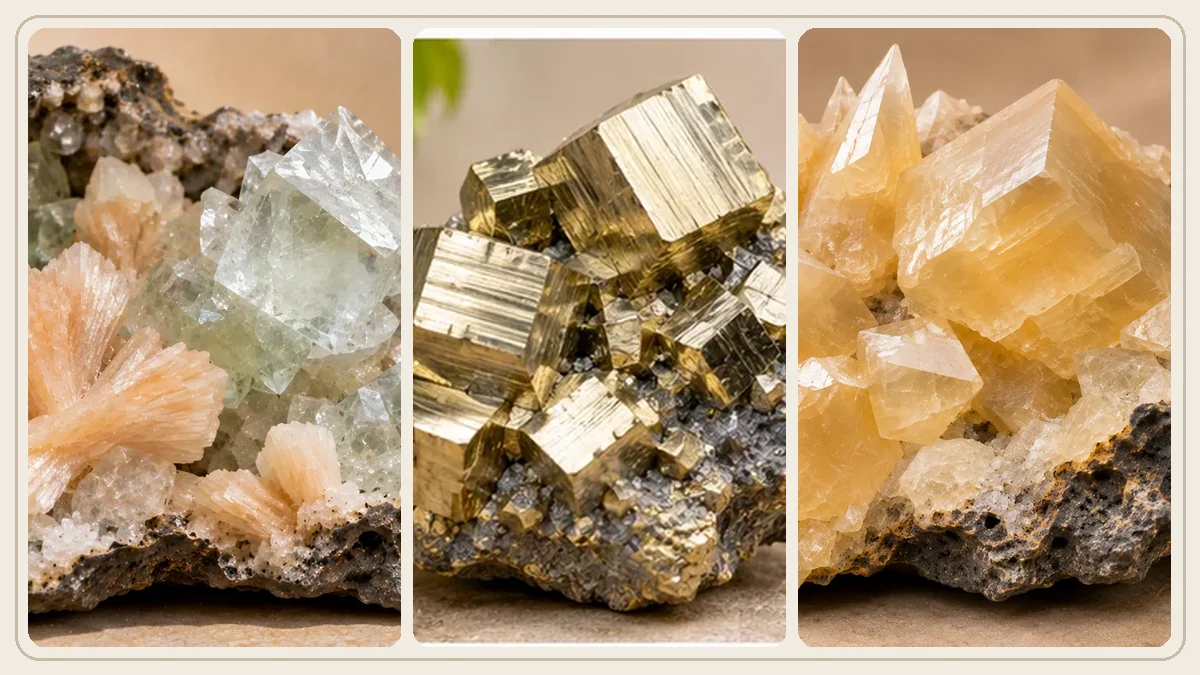
This proposed category covers natural collector-style material such as apophyllite on basalt, stilbite and other zeolites, pyrite cubes, calcite on matrix, fluorite, hematite roses and other distinctive mineral forms. The listing for each actual object must identify its material and condition accurately; descriptive pictures or general geological resemblance are insufficient for authentication.

Indian basalt-pocket associations and zeolite terminology

Deccan basalt cavities may host several associated minerals, including apophyllite-group crystals, stilbite, scolecite and other cavity growths. Apophyllite is a distinct mineral group, not itself a zeolite; stilbite, scolecite and heulandite are different zeolite minerals with different characteristic habits.

A collector specimen may show square-looking apophyllite faces, peach blade-like stilbite sheaves or slender white scolecite needles. Species identification and locality should be supported by supplier information and appropriate tests when necessary, not inferred only from generated artwork.

Distinct mineral habits and different care needs

Pyrite commonly forms brass-coloured metallic cubes; hematite may produce overlapping iron-rose plates; magnetite may show octahedral crystals; calcite can show rhombohedral or pointed habits. Fluorite commonly forms cubic crystals, while other mineral species present sprays, rosettes or tabular growth. This visual diversity is why a generic “natural crystal rock” description is not enough.

Care varies sharply. Calcite is vulnerable to acids and abrasive treatment; pyrite may be susceptible to moisture-related degradation; gypsum is soft and water-sensitive; some fine zeolite needles and okenite fibres are particularly vulnerable to physical contact. Mixed-mineral specimens must be managed according to their most sensitive component.

Cultural placement and educational collecting

Within modern Vastu-inspired spaces, mineral specimens may be chosen for colour, texture, symbolic associations, contemplation and a sense of natural order. Any specific spiritual correspondence should be described as a traditional or contemporary practice rather than a guaranteed material effect or a claim about an exact classical Sanskrit verse.

Specimens can also support geology education: a simple labelled collection showing crystal habit, species confidence, condition and locality evidence is more informative than one sorted solely by colour. Keep labels separate from fragile surfaces and preserve an identification record with photographs.

Safe purchase, packing and inventory control

Request multiple actual-item photographs, including underside and matrix attachments, a scale reference, the full dimensions and weight, and disclosures of repair or treatment. For rare or fragile forms, use specialist handling and packing. Some concepts in this project—particularly okenite, marcasite and a fixed mixed-mineral kit—are held from routine sales until their risk and identity can be assessed.

No candidate is automatically available just because its description appears in a draft collection. Publication requires physically verified stock, truthful species and locality information, suitable photographs, packing approval and a checked Smartstore URL/slug.

Frequently asked questions

Is apophyllite a zeolite?

No. Apophyllite is its own mineral group, although it often occurs alongside zeolites in basalt cavities.

How can I identify a natural mineral specimen?

Crystal habit, cleavage, association, matrix and testing may provide clues. Photos alone do not always establish exact mineral identity.

Can all minerals be stored together?

Not necessarily. Humidity, dust, acidity, light and mechanical fragility vary by species and mixed specimens.

Why are some collector pieces held from checkout?

Extreme fragility, stability concerns or incomplete provenance and packing evidence may require specialist enquiry first.

What is useful on a specimen label?

Record a unique identifier, the proposed mineral name and confidence, locality evidence, condition and matching photographic record.

Related reading

Recently viewed products

Astrology Showroom WhatsApp Specialist