

Natural mineral specimens are not ordinary decorative stones. A smooth tumbled pebble may survive rubbing against another pebble, while the same mineral growing as thin, exposed points on a rough matrix can lose crystals from a single knock. A geode can look solid enough to lift with one hand, yet a tall specimen may tip, a sawn edge may abrade other materials, and the tiny crystals inside its cavity can break when cushioning is pushed into them.
Safe packing begins by supporting the specimen, not by wrapping its most attractive face as tightly as possible. The weight should be carried by a sound portion of the rock or a purpose-made cradle. Delicate terminations need protected space. The specimen must remain unable to slide, rotate, strike a box wall or bear the weight of other items. A properly fitted inner enclosure is then cushioned inside a strong outer container.
This guide explains an evidence-informed method for packing natural quartz clusters, amethyst geodes, Indian mineral assemblages, pyrite and other fragile specimens for shipping or careful relocation. It is intended for collectors, OmmRudraksha product preparation, and buyers receiving a one-of-a-kind mineral. Extremely brittle or hazardous pieces may require a specialist conservator, custom crate or collection in person; no single carton design guarantees safe transit.
Why a crystal cluster can break even when its mineral is hard
Hardness describes resistance to scratching; it is not the same as resistance to impact, cleavage or breakage. Quartz is relatively hard, but a long narrow quartz point can still snap when a parcel falls. Calcite can cleave along preferred planes. Gypsum is comparatively soft, and fine sprays of scolecite or other needle-like minerals can be damaged merely by snagging a fibre. An intact-looking matrix can also contain hidden fractures or previous repairs.
In a shipment, damage usually arises from one or more of four forces:
- A direct blow: the specimen touches a wall, another rock or a hard packing object during a drop.
- Concentrated pressure: foam or tightly wound wrap presses directly onto a crystal tip, fine blade or vulnerable overhang.
- Repetitive movement: the piece rubs, rocks or rotates inside a loosely filled box; vibration loosens already weak attachments.
- Unsupported weight: a heavy host rock or geode rests on a narrow rim, delicate mineral growth, protruding point or fragile mount.
Effective packaging controls all four. Cushioning absorbs part of an impact, but it cannot rescue a specimen whose tips are being used as load-bearing supports. The Canadian Conservation Institute's natural-history guidance emphasizes individual padded supports, non-snagging contact materials, and lifting specimens from beneath their stable portions. Similar museum packing guidance recommends supports that leave clearance around fragile projections.
First inspect and record the exact specimen
Do the condition check before any wrapping makes a feature hard to see. If the material is unidentified or appears dusty, powdery, fibrous or potentially hazardous, stop handling until its safety is assessed. Some natural mineral collections contain lead-, arsenic- or other hazardous constituents; a generic gemstone label is not sufficient to establish safe handling.
Make a short condition record
Photograph the exact piece from the front, back, left, right, above and underneath if it can be turned safely. Include close-ups of its most delicate terminations, any cracked junction, repaired point, detached fragment, stand attachment and fragile secondary mineral. Place a ruler alongside the object—not against exposed crystals—for scale. Record the actual dimensions and mass; the intended shipping weight includes padding, inner box and outer carton.
A useful condition note distinguishes natural growth contacts from fresh chips. If a piece was sold with a cut flat base, an adhesive repair or a detachable display stand, record those facts. For a unique collector's specimen, save its stable GR/lot reference and corresponding photographs together. Never substitute a generic reference image as evidence of the specific item packed.
Find the safe lifting and bearing surfaces
Identify the part of the specimen capable of supporting its own mass. That may be a broad basalt matrix, sawn back of a geode, stable bottom surface or suitably secured display mount. It is rarely a quartz termination or a thin fan of stilbite. A large, heavy piece may require two people, a padded tray or mechanical handling; avoid lifting by a glued stand without confirming the bond.
Mark the no-contact zones on a packing sketch or condition image: fine sprays, hollow pockets, sharp crystalline rims, loose-looking overhangs and projecting crystals. These markings guide the next person packing or unpacking the item without putting tape or labels on the mineral itself.
Choose packing materials by function
A reliable package uses distinct materials for surface isolation, mechanical support, shock absorption and the external shipping shell. More layers do not necessarily mean more protection: extra material pressed into a cavity can produce the very breakage it was intended to prevent.
| Material or component | Suitable role | Important limitation |
|---|---|---|
| Smooth, clean non-snagging interleaf such as conservation-grade polyethylene non-woven sheet | Separates a sound contact point from support material | Do not drag it across needle crystals or wrap it tightly over raised points |
| Clean, unbuffered or otherwise suitable archival tissue | Light surface separation on compatible specimens | Tissue fibres can catch delicate tips; identify surface sensitivity first |
| Cut-to-fit polyethylene foam, appropriate density | Cradle around a strong base or matrix; form a protective recess | Foam must carry load on robust parts and leave fragile points clear |
| Smooth foam blocks, pads or braces | Prevent shifting and isolate surfaces within a rigid inner enclosure | Do not wedge blocks directly against a vulnerable crystal face |
| Corrugated inner carton or a rigid specimen container | Contains one supported specimen and its protective mount | A flexible inner box can collapse onto high points |
| Sturdy double-wall corrugated outer carton, or a fitted crate for heavy pieces | Absorbs handling and stacking forces with intervening cushioning | An oversized box without suitable bracing permits movement |
| Cushioning between inner and outer containers | Provides shock isolation from handling and vibration | Too compressed or inadequate cushioning transfers impact |
| Packing tape, paperwork and labels | Secure carton closures and identify orientation/handling | Keep tape, adhesive and labels off the mineral and fragile surfaces |
Clean household materials may work for a robust, low-value sample on a short local trip, but a fragile collector specimen should be matched to better controlled, stable materials. Newspaper ink, coarse fabric, sticky tape, loose plastic beads or a rough bubble surface should not touch fine crystal growth. Bubble wrap is useful outside a protected specimen container, not as a tight bandage on needle clusters. Foam selection must also suit the piece's mass: a soft block that compresses completely beneath a large geode does not provide adequate support.
The essential packing principle: support the base and protect the points
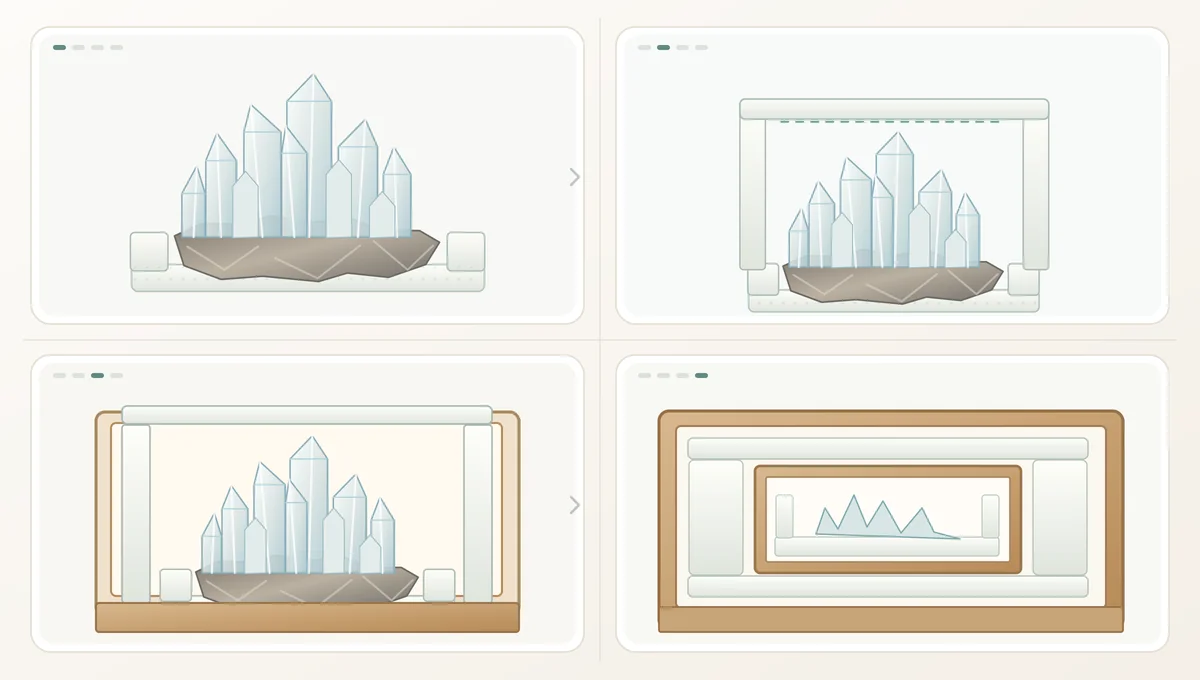
Imagine placing a clear quartz cluster in a box. If its highest points are pressed into foam while the rough base is left loose, an impact forces the tips to carry the specimen's weight. Instead, cut or assemble a cradle that contacts stable matrix regions. Use a fitted bottom support and side braces, and if necessary a rigid bridge or lid support positioned above, not on, the crystal points. The resulting arrangement contains a protected air gap over the delicate faces.
For an amethyst geode half, support the sawn back or stable outer shell rather than filling the purple crystal cavity with packing paper. A removable protective cover may span the rim only where the rim is structurally sound, without bearing down on the crystal lining. If the geode stands on a detachable metal stand, assess the stand separately: never assume the stand is strong enough to hold the rock during an accidental fall.
For needle-like scolecite or fragile associated minerals, individual non-contact recesses and careful handling matter more than ordinary bubble wrapping. Some pieces should travel in a fitted rigid mount or specialist crate. A photograph of a delicate specimen does not tell you how strong the attachment actually is.
Step-by-step: packing a fragile mineral specimen for dispatch
The sequence below is a general workflow. Modify it according to the documented condition of the exact piece, the chosen courier's rules and the weight of the object.
Step 1 — Prepare a clean work area and the right-sized boxes
Work on a stable table with a smooth, padded work surface and enough space to turn the specimen safely. Remove unrelated jewellery, loose tools and any packing debris that can scratch or catch the crystals. Have the complete set of supports ready before lifting the piece. If the specimen has uncertain or hazardous mineral constituents, obtain appropriate handling guidance instead of proceeding as an ordinary home packing job.
Choose an inner container that accommodates the full specimen plus a fitted support system. Choose an outer carton with room for shock-absorbing material on every face. UPS India recommends an outer box about 15 cm larger in each overall dimension than the inner box, permitting approximately 7.6 cm of cushion around it; this is carrier guidance for the two-box method, not a universal formula for every mineral. High-mass, sharp-edged or very delicate specimens may need a custom design or crate.
Step 2 — Verify identity, condition and loose parts
Match the actual piece to its product or collector record. Confirm mineral type to the extent supported, dimensions, mass, treatments and known repairs. Photograph and record existing chips or fractures. Separately bag any genuinely detached pieces, with a label referring to the main specimen; do not press fragments back into a fragile cavity or try to repair them hurriedly for shipping.
If a rock has active flaking, crumbly pyrite decay, suspicious powder, unstable glued sections or uncertain toxicity, pause. Isolate it as appropriate and seek specialist advice. Sending an actively deteriorating or unidentified hazardous object through routine parcel services without assessment is inappropriate.
Step 3 — Cradle the stable part of the object
Place the specimen on a suitably dense padded platform or shaped insert. Cut the support to fit beneath its sound base, not around exposed points. Add foam side stops against robust edges to prevent sliding and turning. If touching the specimen with a barrier is appropriate, choose a smooth, non-snagging material. Ensure it can be lifted out without tugging through crystals.
Check weight distribution: there should be no rocking, no unsupported overhang that can snap under a shock and no tall point touching the top. For an irregular specimen, more than one protected load-bearing location may be needed. If you cannot define safe support surfaces, obtain specialist packing rather than improvising pressure on crystals.
Step 4 — Build clearance around delicate projections
Add a protective frame, spacer or bridge fixed to the inner container or mount, not to a crystal tip. The frame should prevent a lid, paper or outer cushion from collapsing into the fragile face. A delicate spray may need a custom cavity mount; the cavity must be large enough that the tips remain untouched even during reasonable movement of the packing assembly.
For a tall amethyst geode or heavy matrix specimen, do not allow the upper part to swing as the box moves. Brace sound surfaces to restrict rotation while keeping crystal faces clear. Protection requires both immobilization and a path for impact forces around the fragile areas.
Step 5 — Add a compatible interleaf, if one is needed
If the specimen has sound, stable contact areas, use a clean protective interleaf between those areas and the fitted cradle. Do not wrap cloth, cotton wool, tissue or bubble film tightly around fine scolecite needles, cavansite balls or fragile drusy linings. Tape should hold an outer wrap or protective frame in position, never stick to the specimen itself.
The correct protection for an especially delicate surface may be no direct wrap at all, with an adequately spaced rigid cover and a secure base mount. Recording how this support was assembled is particularly important for safe unpacking.
Step 6 — Immobilize the specimen inside the inner box
Seat the supported mount in a rigid inner container. Fill remaining voids around the mount or support, not into the mineral cavity. Add braces so the assembly cannot slide forward, backward, sideways or upward. A secured lid or protective spacer must remain above every exposed tip.
Before closing, look for hard objects that could strike the mineral: a stand leg, label card, spare crystal, tape dispenser or metal fitting. Pack stands, tools and accessories in separately cushioned compartments. Do not stack a second specimen on top of a first unless an engineered divider carries all the load independently.
Step 7 — Float the inner box in a stronger outer carton
Line the bottom of the outer box with suitable cushioning. Centre the sealed inner box, then cushion its sides and top with material matched to the shipment's weight. The goal is not a rigid, rock-solid transfer of shock; the surrounding material should provide measured cushioning while keeping the inner box from shifting into the carton walls.
For routine fragile shipments, the UPS India two-box guidance describes approximately 7.6 cm cushioning around the inner box, while other carriers may specify their own dimensions. A tall, dense cathedral geode should not be assumed suitable for ordinary small-parcel packaging merely because two cartons fit around it. Check dimensional limits, mass, stacking risk and courier service conditions.
Step 8 — Close, document and identify the package
Take photographs of the mounted specimen, the open inner container, the cushioned closed inner box placed in the outer carton, and the final sealed package. Record the tracking or consignment identifier with the actual specimen's GR/lot code. Include a duplicate identifying note and unpacking sequence inside the package, away from mineral surfaces. If a stand or accessory is separately enclosed, list it.
Seal the outer carton using appropriate packing tape across the principal seams. Handling arrows and a Fragile label may alert a carrier, but they do not replace proper protection against drops, inversion and stacking. Do not rely on the parcel remaining upright throughout its journey.
Step 9 — Perform a safe, non-destructive final check
Confirm the weight is comfortably within the chosen carton's rating and the courier's permitted service. Inspect the closed carton for bulging and gaps. Gently check for obvious loose movement; do not violently shake a fragile mineral parcel as a test. If movement is detected, reopen and improve the engineered support. Do not drop-test an original collector piece to prove the packaging method.
For repeat commercial shipments, validate a packing design with harmless representative mock-ups, test weights or an approved packing provider, not irreplaceable minerals. Only then adopt it as a repeatable warehouse procedure.
Step 10 — Select an appropriate route and keep the record
Confirm the carrier accepts the item and packaging, whether insurance is available, whether the declared value is subject to limitations and whether transit conditions are suitable. Very heavy or fragile geodes may require collection, pallet transport or specialist handling. Keep packing photos and the specimen's condition notes until delivery has been confirmed and any damage window has closed.
How packing changes for different specimen types
These are handling distinctions, not promises that all examples of one mineral can be packed identically.
| Specimen form | Main risk | More suitable approach |
|---|---|---|
| Clear quartz cluster on robust matrix | Broken points from direct contact; rocking base | Support matrix on fitted foam, protect tips with clearance, double box |
| Amethyst geode half | Abraded drusy interior, fractured shell or rim | Support shell/back; shield cavity without filling crystals; protect cut edges |
| Tall amethyst cathedral | High weight, toppling, stress at base or stand | Assess centre of mass; fitted cradle and braces; specialist freight if necessary |
| Apophyllite with stilbite | Brittle projecting faces and mixed weak attachments | Rigid mount on sound matrix; no tight wrap across both mineral types |
| Scolecite spray or delicate associated zeolites | Fine needles snag and snap | Non-contact protective cavity; often specialist packing; minimize handling |
| Cavansite or other very delicate aggregates | Fragile attached spheres/tufts, loose host pieces | Individual support, no surface pressure, strong consider-defer shipping gate |
| Pyrite specimen on matrix | Physical chipping and potential humidity deterioration | Dry, clean protective packing; assess existing decay before dispatch; climate advice if needed |
| Celestite or calcite on matrix | Cleavage, weak tabular/pointed crystals, matrix | Firm stable-base support, isolated crystals, no heavy compressive wrap |
| Gypsum desert rose or selenite form | Soft edges, cleavage and possible moisture sensitivity | Dry, cushioned fitted cradle; no water-based packing or damp tissue |
| Fluorite cluster | Cleavage and delicate projecting crystals | Multiple stable support points, no pressure on faces or protrusions |
A supplier's assertion that a specimen is "natural" or "hard" does not remove these risks. A naturally formed group of crystals can be a far more difficult shipping item than a polished pyramid of the same mineral.
Packing a heavy amethyst cathedral or large geode
Heavy geodes deserve a specific pre-dispatch decision. Photograph the base and shell, measure the stone rather than the display prop, and verify whether the steel or wooden stand is detachable. A tall geode has substantial leverage if it tips. Even a very strong cardboard box cannot make an unstable rock safe if the weight is carried through a narrow projecting section.
Use a wide, shaped base support that carries the shell and prevents sideways rotation. Separate the geode from the stand unless the approved transit mount is specifically designed to ship them together. Provide protected clearance around the entire crystalline interior and rim. Inspect cuts, joins, repairs and mounting points for stress. Heavy stones may need a rigid crate, pallet and an experienced carrier rather than a consumer parcel service; the shipping option should be decided before the item is listed as eligible for routine delivery.
Neither the cost of the stone nor a decorative premium product description should determine whether parcel delivery is offered. Mechanical risk, actual mass, shape and verified packaging capacity should determine it.
Packing fine sprays and unusually fragile collectors' minerals
Some mineral specimens should never be casually touched with paper or loose fibre. Scolecite needles, fragile secondary apophyllite associations, okenite-like tufts and delicate cavansite-bearing pieces need inspection by someone who understands their attachment points. The goal is to secure the sound matrix and form a separate protective enclosure around the fragile growth.
A custom cavity mount can hold the host rock in a shallow recess while preserving open space over and around the projecting parts. A smooth removable protective frame and an externally marked opening sequence reduce the risk that the recipient accidentally drags packing material across a spray. The specimen should not be wedged down by pressing foam onto the crystals. If no suitable protected mount can be created, record not suitable for routine shipment and offer local collection or specialist transport instead.
For OmmRudraksha's proposed GR18 Scolecite Spray and GR21 Cavansite on Matrix, this packaging assessment must be completed for the actual piece, not inferred from a comparable example found in research. An approved product concept is not an approved shipping method.
Humidity, temperature and uncertain minerals
Packing is usually short-term, but a parcel may encounter damp warehouses, monsoon rain, heat and changing temperatures. Use a clean, dry packing environment and keep wet or condensation-bearing specimens out of sealed packaging until evaluated. Water-sensitive or deteriorating minerals deserve extra precautions. If a carefully designed dry microclimate is appropriate, it should be chosen for that mineral and enclosure; a sachet of desiccant thrown against the crystals is not a universal remedy. The moisture-control material must be secured away from the object and evaluated for the shipment conditions.
Do not add salt, perfume, camphor, incense, oil or herb powder inside the mineral's packing. Such substances can stain surfaces, change moisture conditions, damage a porous matrix or leave deposits. Particularly for pyrite, a record of existing deterioration or powder is more important than a generic label claiming the parcel is "energized." If you encounter unknown fibrous minerals, suspect arsenic or lead-bearing dust, visible alteration or potentially radioactive material, stop and obtain a qualified identification and carrier-compliance review.
A commercial shipping process cannot verify environmental safety simply from a photograph. Hazard classification, declarations and applicable transport restrictions must be decided on documented material identity and the destination's requirements.
Shipping several specimens in one order
Two stones sharing an outer carton must not touch each other or load one another. Give each specimen its own mounted, supported inner box; arrange the inner boxes with cushioning and structural separation, not as loose objects in a bag. Dense pieces belong in engineered positions that do not crush lighter fragile pieces. Avoid stacking heavy mineral containers over a needle-cluster container unless a load-bearing divider completely prevents force transfer.
For mixed orders, record which label goes with which specimen and avoid packing sharp rock edges near jewellery or finished surfaces. Maintain a separate packing list for stands, specimen labels and removable accessories. If a set contains several minerals with different humidity requirements, do not automatically seal them all into the same microclimate. Each sensitive item may need its own material and condition assessment.
A visually impressive "mineral gift set" is not ready for shipping until each included piece and its exact protective arrangement have been checked. This is especially relevant to a proposed reference collection with a bill of materials that may still be subject to supplier confirmation.
Handling, spiritual context and gift presentation
Collectors and households may choose natural quartz, amethyst geodes or other minerals for a Vastu-inspired home setting, an altar arrangement, a study or a gift. Such uses carry genuine personal and cultural significance. But the specimen should be protected as a physical mineral object throughout transport: prayers, symbols or auspicious packaging do not replace a stable support or engineered cushioning.
If a buyer wishes to perform a traditional cleansing or placement ritual after delivery, provide the relevant traditional context without encouraging the use of water, salt, oils or smoke on minerals that can be damaged by those materials. For a home shrine, confirm that the geode is stable and does not obstruct movement or sit where lamps can heat fragile stone or packing remnants. Gift wrapping can be added outside the fully protective carton; it must not compress the mineral itself.
How recipients should unpack a mineral parcel
The recipient should use a broad, clear, stable work surface. Photograph the exterior before opening if the carton is visibly crushed, wet or punctured. Open the outer box without inserting a blade deeply into the cushioning. Remove the protected inner container as a unit and follow the numbered instructions or image diagram supplied with it.
Release securing blocks and the protective frame in the indicated order, then lift the specimen by its documented stable base. Do not pull the rock by the highest crystal tip, invert a delicate spray into a hand, or tug at material caught around the crystals. Set the specimen on a padded surface and compare it with the exact-item condition photographs and labels. Keep the packaging until condition is verified and the seller's claim or return procedure is clear.
If a fragment has detached, save it separately, photograph the affected area and contact the seller before attempting glue, washing or polishing. A loose piece is not a reason to assume dishonesty, but it is a condition that must be examined and addressed openly.
Common packing mistakes and how to prevent them
Wrapping crystal tips tightly in bubble wrap. Direct pressure and snagging can break small points. Use a firm support on the matrix and a non-contact protective frame for delicate growth.
Filling a geode cavity with crumpled paper. Paper can abrade drusy crystals or become tightly wedged during impact. Support the outside shell and shield the cavity.
Using a loose inner box. Empty space allows rocking and repeated impacts. Secure the supported mount against movement without pressing on fragile faces.
Using a single thin carton for a heavy specimen. Corrugate can puncture or collapse. Choose a weight-rated outer shell and a cushioned container-within-container design, or specialist freight.
Trusting a decorative stand. A stand may be suitable for display but not shipping. Verify whether it is structurally secure and whether the specimen needs independent support.
Treating every mineral like polished quartz. Scolecite, celestite, calcite, fluorite and gypsum have different weaknesses. A mixed-mineral matrix needs an appropriate plan.
Assuming a Fragile label guarantees careful handling. Labels assist identification but cannot prevent a parcel being tilted or dropped. The package must provide mechanical protection.
Omitting condition photographs. A buyer cannot reliably distinguish old chips, natural growth contacts and transit damage without before-and-after evidence.
Packing a suspect mineral without identification. Hazardous dust, friable minerals or unstable pyrite can require a specialist assessment and sometimes should not be shipped in ordinary commerce.
OmmRudraksha warehouse checklist for one-of-a-kind specimens
For a future Smartstore shipment, the packer should complete a short record linked to the exact stock/lot code, not only the broad product family name:
- Identity: GR/lot code, current material label, actual measured weight and dimensions.
- Condition: six-side photographs or documented safe views, close-ups of chips, repairs and vulnerable areas.
- Shipping decision: ordinary supported parcel, specialist packaging, local collection, or hold; record the reason.
- Support design: base contact points, no-contact crystal zones, inner cradle and enclosure photographs.
- Outer packaging: carton strength, clear cushioning on all sides, seal and movement verification.
- Tracking: carrier/service, declared value and applicable restrictions/insurance terms.
- Recipient guide: exact unpacking order, material-specific handling and damage-reporting instructions.
- Records: final photographs, packer sign-off and connection to the customer order.
A page should not advertise nationwide delivery merely because the mineral concept exists in the proposed catalogue. In the current Gemstone Rocks plan, the final physical-item photographs, stock confirmation and specimen-specific shipping sign-off remain owner-controlled checks before any sale.
Frequently asked questions
Can I ship an amethyst geode in bubble wrap alone?
Not safely as a general rule. Bubble wrap can cushion a protected inner box, but direct tight wrapping can damage a geode's crystals, and the heavy shell may break through insufficient packing. Protect the interior and stabilize the outer shell before double boxing; heavier pieces may need a crate.
How much space should I leave between the inner and outer box?
The UPS India guidance for fragile two-box shipments specifies an outer carton approximately 15 cm larger in each total dimension than the inner one, enabling about 7.6 cm cushioning on each side. Treat that as a carrier method, not a universal engineering rule. Choose a specialist design where size, shape and mass demand it.
Should I put cotton wool or tissue directly between crystal points?
Not as a general method for fragile sprays. Fibres can catch and pressure can snap fine points. Use a cradle that supports the stable base and a non-contact protective enclosure around delicate growth. Any direct interleaf must be suitable for that exact mineral surface.
Can a crystal cluster be packed together with a stand?
Only if the stand is part of a verified protective mount and cannot create stress, impact or movement. Ordinary display stands should usually be packed in a separate, cushioned compartment. Never assume a decorative attachment makes a geode safe to ship.
Should pyrite be put in an airtight plastic bag with silica gel?
There is no universal rule for all pyrite specimens. The issue is the specimen's condition and surrounding moisture; conservation practice sometimes uses a designed dry microclimate. Avoid improvising moisture treatments or sealing a damp or actively deteriorating piece. Obtain mineral-specific conservation and shipping advice where needed.
Can I ship scolecite or cavansite by normal courier?
Some actual specimens can be transported using a suitable custom mount and protected container; others are too fragile for ordinary parcel service. Assess the precise shape, matrix, condition, packaging method and available carrier. A generic product listing alone cannot establish safe shipping.
Is a Fragile sticker enough to protect crystals?
No. It is a handling cue, not an impact-absorbing component. A protected base, safe clearance, fitted inner enclosure, cushioning and a suitable outer carton matter more.
Should I clean a geode before packing it?
Only if its minerals and condition permit an appropriate treatment. Avoid rushed washing, brushing or chemical cleaning immediately before dispatch. Unknown matrix materials, repairs, soluble minerals or loose crystals call for conservative handling and specialist advice.
What should I do if a crystal point arrives broken?
Photograph the external package, its packing arrangement, the specimen and any detached piece. Keep fragments and packaging, and contact the seller under the stated damage-reporting process. Do not attempt an adhesive repair before the seller or qualified conservator has evaluated the condition.
Can a Vastu crystal be wrapped with salt, camphor or fragrant herbs?
Keep physical packing clean and chemically compatible. Traditional devotional practices can be respected without placing reactive or contaminating materials against natural minerals. Any later household practice should be considered separately with the particular mineral's sensitivity in mind.
Final pre-dispatch check
Before the parcel leaves, ask three questions: What is carrying the specimen's weight? What prevents its delicate points from being touched? What absorbs a shock before it reaches the inner box? If those questions cannot be answered from the packing record, the shipment should be paused and repacked. The result should protect the actual mineral, preserve its identity and condition, and allow the recipient to remove it without damaging the very crystal structure they chose to buy.
For additional reading within OmmRudraksha, explore the Vastu collection. Detailed natural crystal formation, geode identification and mineral-specific care articles are prepared separately; their links can be added only after their public Smartstore routes have been verified.
Related reading
- What Is a Crystal Cluster? Crystal Growth and Natural Forms
- Geodes, Druzy Specimens and Agate Nodules: What Is Different?
- How to Buy a Natural Mineral Specimen Online
- Natural Crystal Clusters and Geodes in Vastu: Traditional Placement and Meaning
- Cleaning and Storing Natural Crystal Clusters and Geodes
- Amethyst Crystal Clusters and Geodes: Formation, Vastu Traditions and Care
- Indian Mineral Specimens: Apophyllite, Stilbite and Associated Minerals
- Stilbite, Scolecite and Heulandite: Comparing Crystal Habits
- Cavansite and Okenite: Why Some Mineral Specimens Are Fragile


