

A natural calcite specimen can look like a cluster of sharply pointed teeth, a group of leaning transparent rhombs, a pale honey-coloured crystal on dark volcanic rock or a thin layer of mineral growth inside a cavity. Such pieces are not simply rough versions of carved calcite pyramids. They preserve part of the mineral's original growth history: crystal faces, attachments, surrounding rock, occasional neighbouring minerals and sometimes traces of older growth stages.
The most useful way to appreciate or buy calcite crystals on matrix is to examine the entire specimen. What is actually calcite? Which part is the host rock? Are the pointed crystals intact? Is that flat surface a natural face, a cleavage break or a cut base? Could the material be aragonite or quartz instead? And how can a display piece be cleaned without dissolving or scratching the very features that make it valuable?
This guide answers those questions with mineralogy, collection practice and practical care. It also explains how natural calcite specimens can be displayed respectfully in an Indian home or Vastu-oriented setting without confusing contemporary placement preferences with ancient prescriptions for a particular mineral.
What is calcite, and what does “on matrix” mean?
Calcite is calcium carbonate, with the chemical formula CaCO₃ . It belongs to the carbonate mineral class and crystallizes in the trigonal crystal system. It occurs in sedimentary rocks such as limestone, in metamorphic rocks such as marble, in hydrothermal veins and in cavities where mineral-bearing fluids have deposited crystals. It is a mineral species, not a generic trade name for any pale-coloured or translucent stone.
The word matrix means the supporting rock or earlier mineral material to which a collector crystal is attached. A specimen described as calcite on basalt should have calcite crystals supported by basaltic rock; calcite on quartz means calcite associated with a quartz surface, provided that identification is supported. A single loose rhombohedral cleavage fragment is still calcite but is not necessarily a natural on-matrix specimen.
Sometimes the visible “base” is not exposed host rock. Earlier coatings of chalcedony, zeolites or other secondary minerals can cover a former cavity wall before calcite grows across them. The item may therefore have more than one mineral even when a single crystal species dominates the display. Photographs should show this relationship rather than crop away the supporting matrix.
A cut or flattened rear surface is not automatically evidence that the crystals were manufactured. Collectors sometimes trim excess host rock to make a specimen safer to stand or display. However, a prepared base, added support, adhesive repair, surface coating or assembled crystal group should be distinguished from undisturbed natural growth.
Recognising calcite through its physical properties
Calcite has distinctive cleavage and modest hardness
Calcite has a Mohs hardness of 3 , much lower than quartz at 7. It can therefore be scratched by many common harder materials. Rubbing a crystal with a rough cloth, a jewellery brush or the grit trapped under a display stand can leave permanent marks. A collector should not perform a scratch test on a valuable piece.
Calcite also has perfect rhombohedral cleavage . This means its internal structure contains preferred planes along which it can split. A cleavage fragment may look like a neat tilted block, with flat smooth surfaces that resemble deliberate cuts. Not every smooth face is a complete natural growth face. In a specimen photograph, inspect changes in sheen, a fresh edge, interrupted growth patterns and any associated loose fragments.
The pointed end of a dogtooth crystal can chip; a broad rhombohedral crystal can lose a corner. These are distinct condition issues, even when the mineral identity remains correct. Because cleavage is a structural property, it cannot be removed through polishing or gentle cleaning.
A transparent crystal can show double refraction
Transparent calcite has strong birefringence , also called double refraction. When a suitable clear crystal is placed over printed text, the letters can appear doubled. This is an interesting optical property, but it is not a reliable do-it-yourself authentication test for every mineral specimen. A rough matrix specimen, a cloudy crystal, the direction of viewing, or an irregular surface may prevent an obvious effect.
Clear optical-grade material sometimes appears under the trade term Iceland spar . A display specimen does not become Iceland spar merely because a seller photographs a translucent crystal over a label. Do not detach a crystal from its matrix or press it into a book to try the test.
Calcite reacts with acids: a fact, not a care instruction
Calcite reacts with dilute acids and can release carbon dioxide bubbles. This property helps trained mineralogists distinguish carbonate minerals. It is not a recommended test for a finished display specimen. Vinegar, lemon juice, acidic descalers and other common household products can etch or dissolve calcite surfaces, leaving cloudy, pitted or uneven areas. A brief test can damage a sharp natural face or a transparent crystal.
When an identification needs confirmation, obtain supplier documentation or professional assessment instead of making an acid mark on an item for sale. Avoid describing any home acid test as harmless simply because calcite is commonly identified that way in classroom geology.
How calcite crystal habits differ
The word habit describes the external way crystals develop. Calcite is especially variable, so appearance alone cannot confirm the mineral species. A specimen can also combine several habits or show growth modifications within a single cluster.
| Calcite form or habit | What you may see | What to check on a specimen |
|---|---|---|
| Rhombohedral | Slanting block-like forms, broad planar faces and tilted angles | Which faces are original and which might be cleavage breaks |
| Scalenohedral or “dogtooth” | Long, tapered, pointed crystals, often in groups | Whether sharp ends are intact and how they attach to the base |
| Prismatic | Elongated crystals with multiple side faces | Natural terminations, any damaged sides and support points |
| Tabular or plate-like | Broad relatively thin crystals, sometimes overlapping | Thin edges, unstable projections, contact between plates |
| Drusy or fine-crystalline coating | Many small calcite crystals covering a surface | Whether crystals are calcite or another drusy mineral such as quartz |
| Massive, banded or fibrous | Aggregates without individually prominent crystal faces | Whether it is appropriate to sell as a crystal cluster at all |
Rhombohedral crystals and rhombohedral cleavage are related, not identical
Calcite's rhombohedral shape is familiar, but an important distinction exists between growth form and breakage along cleavage . An intact natural rhombohedron may carry growth markings and undisturbed edges. A recently broken piece can also show rhombohedral outlines because of the way calcite cleaves. Sellers should not treat the mere presence of a tilted block shape as proof that every face is a naturally grown termination.
A cluster of overlapping rhombs can be attractive even when partly intergrown. Natural contacts between crystals are not defects by themselves. A snapped corner, glue join or newly exposed fracture should still be recorded separately.
Dogtooth or scalenohedral calcite
The popular name dogtooth calcite usually refers to scalenohedral crystals that taper to steep points. Some have multiple faces or slightly different terminal forms. The name describes appearance, not a different mineral species. A good image of a dogtooth cluster reveals the side profile and tip condition; a frontal image alone may hide broken ends.
Scalenohedral crystals can form in open cavities, veins and other mineral-growing spaces. The sharpest terminations are often the first to suffer shipping damage. Their vulnerability is why packing should secure the whole matrix and leave a protected clearance around every exposed point.
Colour, transparency and crystal condition
Calcite may be clear, white, cream, honey yellow, orange, pink, green, grey or other colours. Trace constituents, mineral inclusions, coatings and structural conditions can affect appearance. A named colour such as honey calcite or orange calcite is a descriptive trade term, not an independent species designation or proof of a locality.
Uniformity is not the only sign of value. A natural specimen may have colour zoning, internal fractures, cloudy portions and areas of varying lustre. Some effects reflect natural growth; others may come from staining, surface deposits, handling or treatments. Seller photographs under even neutral lighting are more useful than dramatically saturated images.
If a specimen fluoresces under ultraviolet light, record the actual observed behaviour and lighting conditions. Fluorescence is variable and does not establish identity or natural colour on its own. Do not imply all calcite is fluorescent or that a vivid colour proves rarity.
Calcite in Indian basalt cavities and mineral associations
The Deccan volcanic province of western India is known for mineral-filled cavities in basaltic rocks. Research on Maharashtra material has documented different generations of calcite along with chalcedony, zeolites and apophyllite-group minerals. That makes calcite a meaningful part of the Indian mineral-specimen story, not merely a pale decorative stone.
In a former gas cavity or a later fracture, mineral-bearing fluids can deposit successive layers. A piece might show dark basalt, an earlier silica coating, a zeolite group, later calcite and other overgrowths. The actual sequence depends on the locality and specimen , not a universal rule that every calcite crystal always formed last. Detailed studies at the Savda quarry complex near Jalgaon illustrate multi-stage mineralization, but they are not origin certificates for visually similar specimens offered online.
A locality description should follow available evidence. Calcite on basalt, India — exact quarry not confirmed is preferable to a confident claim of Pune, Nashik or Jalgaon that comes only from a familiar colour combination. Retain original collection labels, supplier records and any photograph showing a piece before trimming, when available.
Some calcite collectors prize isolated crystals; others prefer a multi-mineral assemblage showing calcite beside stilbite or apophyllite. The second type has special interest because the matrix and contacts preserve natural relationships. Describe the visible species with appropriate identification confidence rather than calling every pale plate “stilbite” or every glassy cube “quartz.”
Calcite, quartz, aragonite and other lookalikes
Calcite can resemble several common display minerals in photographs, particularly when the photographs show colour but not crystal faces or attachments.
| Material | Mineral chemistry and habit | Practical distinction for buyers |
|---|---|---|
| Calcite | Calcium carbonate, CaCO₃; commonly rhombohedra or scalenohedra | Hardness 3, perfect rhombohedral cleavage, acid-sensitive |
| Quartz or Sphatik | Silicon dioxide, SiO₂; often hexagonal prisms and points | Hardness 7 and a different fracture/cleavage behaviour; do not rename calcite as quartz |
| Aragonite | Also CaCO₃, but a different crystal structure | Frequently prismatic or needle-like aggregates; requires its own species label |
| Dolomite | Calcium magnesium carbonate; can form rhombohedral-looking crystals | Not identified as calcite merely from a rhomb or pale colour |
| Gypsum | Hydrated calcium sulfate; varied clear, bladed and fibrous habits | Softer and water-sensitive; care and identity differ from calcite |
| Apophyllite group | Hydrated silicate-group minerals, often glassy square-looking crystals | Distinct cleavage and chemistry; not calcite, quartz or a zeolite species |
Calcite and aragonite are polymorphs. They share the formula CaCO₃ but have different crystal structures and are separate minerals. A carbonate-rich specimen cannot safely be called calcite if aragonite remains a plausible identification. Especially with slender radiating crystals, a seller should investigate further before final labelling.
Descriptions such as white crystal , ice crystal , rough Sphatik or natural power stone are not adequate substitutes for a mineral name. A clear calcite rhomb may show striking optical effects, but a Sphatik mala or quartz point is a separate category of object.
For an expensive, uncertain or chemically mixed specimen, ask about documented identification or a qualified mineral assessment. A photography-only judgment has limits, and testing methods used in laboratories should not be imitated on the finished object.
The difference between natural crystal faces and preparation
Collectors frequently ask whether a straight edge means a stone is carved. The answer depends on which surface is straight. Natural crystal faces can be remarkably even; calcite also breaks along unusually flat cleavage planes. On the other hand, dealers may saw or trim a bulky matrix so that it stands securely. Polishing the exterior of a separate calcite carving is yet another process.
A responsible listing distinguishes three observations: natural exposed crystals , prepared supporting base , and any known repairs or surface treatments . This preserves the distinction between a genuine mineral specimen and a finished decorative object without suggesting that every professional preparation is deceptive.
Use side lighting and multiple angles to inspect a crystal's growth layers. A fracture may interrupt a sequence of faces or create a differently reflecting patch. Small natural contacts where another crystal once grew should not automatically be called damage; however, missing tips, cracks, loose joints and adhesive need attention.
If a crystal looks unusually shiny, do not conclude it is varnished without evidence. Some calcite is naturally lustrous, and photographs can intensify reflections. Conversely, a shiny photograph does not rule out coatings or polishing. Where preparation records are unavailable, say treatment not confirmed rather than asserting an untreated condition.
Buying a calcite-on-matrix specimen online
With natural specimens, the exact piece matters. Calcite's softness and cleavage make condition documentation more important than it may be for a compact tumbled stone or a cut, polished pendant. Before buying, inspect the item actually being sold rather than a representative photograph of a similar specimen.
The photographic evidence to request
Ask for a neutral-light front view, back view, both sides, an overhead image, and a close-up of the principal crystals. A scale or measurement alongside the piece helps convey height and width. On a dogtooth group, a low side-angle is particularly useful for checking tips. On a broad rhombohedral specimen, close-ups should show whether each main face is intact.
The matrix edge and underside also deserve attention. They show whether the object has a stable base, whether trimming has occurred and whether there are fragile contacts at the point where a stand would touch the stone. Avoid buying an expensive one-of-a-kind piece from a single extreme close-up with no overall view.
Condition, provenance and pricing questions
Request the dimensions in millimetres or centimetres , total weight including matrix, identified species, any known repairs, support requirements and an honest condition description. Ask whether the mineral has been washed with chemicals, polished, dyed, coated or repaired, if that history is known. A seller should not promise every treatment is absent without documentation.
Exact locality is valuable when genuinely recorded. A statement of origin reported as India can be meaningful, but it is not the same as a verified quarry record. Some specimens are removed from old collections; their labels may be more informative than assumptions based on market channels.
A larger crystal is not necessarily a better specimen. Crystal completeness, stable attachment, attractive growth contacts, support, mineral variety and preparation history all affect suitability. The best choice for a household display can be a smaller stable piece rather than a tall, highly exposed group that would be difficult to ship or maintain.
What the OmmRudraksha product listing should disclose
For a future Calcite Crystal on Matrix listing, the team should record: specimen-specific photographs, mineral identity and confidence, actual total weight, dimensions, predominant habit, host matrix, country and locality evidence, condition notes, treatment/repair knowledge, stable-display orientation and shipment support requirements. If a part remains unidentified, use an accurate qualified description.
The proposed product concept GR23 is not proof that a particular calcite specimen is stocked. A future catalogue entry must be tied to the exact physical piece or an explicitly disclosed specimen family. It should not display an image of one crystal while promising a different matrix or larger intact tip.
Handling and displaying whole calcite specimens
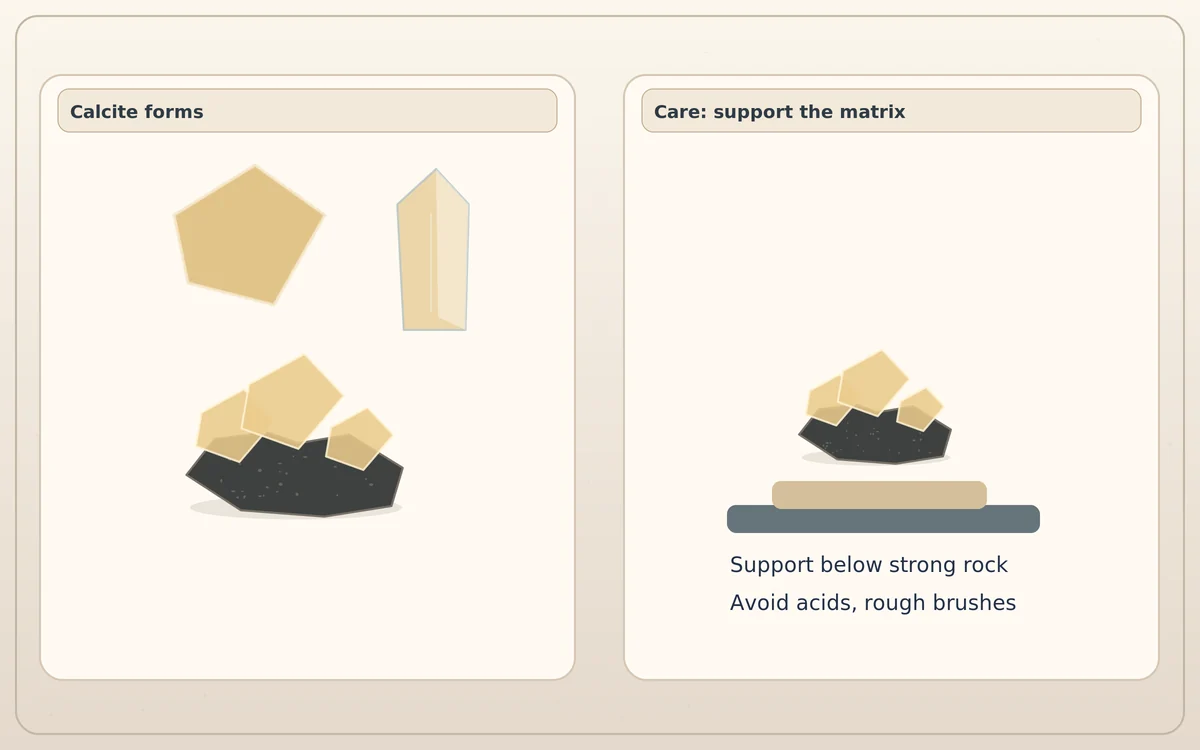
Lift calcite-on-matrix pieces by a stable part of the host rock or fitted mount , not by a projecting crystal, thin blade or glittering druse. Before moving the piece, observe how it balances and whether a crystal extends below the base. Clean hands may be appropriate for some robust matrix surfaces, but clean nitrile gloves can help where fingerprints or contamination matter; gloves do not prevent mechanical damage from an awkward grip.
For large pieces, use both hands and a padded temporary landing surface. Do not twist the specimen inside a tight stand. An acrylic or inert support can be shaped around the strong matrix rather than under fragile calcite tips. Soft cushioning can prevent a hard shelf from scratching a prepared base, but loose fabric and fibres should not catch in crystal points.
Keep the piece away from curtain edges, crowded shelves, busy entrances and places where a child or pet might reach it. Place it below or at an appropriate stable eye level depending on size and anchoring; a heavy specimen should never rely on a narrow shelf lip or a balance point that is easy to disturb.
Bright direct sunlight can warm a specimen and make flaws less visible through glare; avoid unnecessary prolonged strong light, particularly for mixed-mineral pieces whose associated species or colours may be more light-sensitive. Stable room conditions and a protected cabinet are often more useful than attempts to “energize” a stone outdoors.
Cleaning calcite without damaging the crystals
Start with prevention. A covered display case, clean shelf and careful placement reduce dust without requiring frequent direct contact. Whole calcite specimens are not jewellery: instructions for polishing a stone bead or washing a carving should not automatically be applied to exposed rhombohedra, scalenohedra or delicate matrix coatings.
For a stable, dry piece, first examine whether dust lies loosely on exposed rock or is lodged among fragile tips. A very soft clean brush may be used sparingly on robust matrix only , with minimal pressure, when the composition and attachments are understood. Avoid dragging bristles across thin crystals; they can scratch a face or knock off a point. Fragile or valuable pieces may be better left untouched until a conservator advises.
Avoid vinegar, lemon juice, acidic cleaners, bleach, household descalers, abrasive powder, toothpaste, steel wool, ultrasonic cleaners, steam and pressure washing . Acidic substances attack calcite directly; aggressive mechanical methods risk scratching and cleavage damage. An apparently clean quartz-like surface beneath the calcite does not make the carbonate crystals acid-resistant.
Do not prescribe routine soaking, immersion or running-water rinsing for an unidentified matrix. Water can enter cracks, disturb loose deposits, affect secondary minerals and complicate thorough drying. A mineral is not necessarily water-safe because its chemical formula looks simple. If existing contamination requires wet treatment, use mineral-specific professional guidance rather than a blanket home recipe.
After any accidental spill, isolate the piece from other objects, document what contacted it and seek specialist guidance where appearance or condition changes. Do not try to restore a fresh etched spot with polishing paste: restoring natural crystal faces is generally not equivalent to polishing a cut stone.
Storage, humidity and display materials
Store a natural specimen in a clean, physically stable environment with modest, controlled fluctuations in humidity and temperature. Calcite is not subject to the same well-known humidity-related oxidation mechanism as pyrite, but any associated pyrite, soluble deposits, adhesives or host-rock components can change the risk. In a damp Indian coastal or monsoon-season room, avoid condensation and poorly ventilated damp cabinets.
Use a fitted, non-abrasive support or an inert tray that contacts only stable matrix. Separate specimens so hard quartz points cannot rub against softer calcite. A small label should remain legible and detached from delicate crystal faces. When storing several pieces, do not stack them or allow the weight of another specimen to rest on calcite edges.
Museum conservation work also identifies a less obvious risk: acidic vapours from some wood products, adhesives and display materials can affect calcium-carbonate collections . This matters most in enclosed, poorly ventilated cases where emissions accumulate. Choose low-emission, tested materials and avoid placing sensitive calcite directly against fresh wood finishes or suspect glues. It is not necessary to discard every wooden household shelf, but valuable material deserves a stable inert contact surface and a suitable case.
A cabinet should protect the specimen without concealing critical condition changes. Look periodically for new loose fragments, a shifted mount, unusual surface deposits or changes in accompanying minerals. Record changes with photographs; do not automatically scrape away an unexplained white coating, since it may represent deterioration or original mineral growth.
Vastu, Sphatik and the meaning of a natural calcite display
Mineral specimens are often placed in Indian homes as part of an attractive, orderly, reflective or devotional environment. Vastu Shastra deals broadly with the relationship of buildings, orientation, spatial organisation and use of rooms. People may choose a crystal display as a contemporary interpretation of a harmonious interior, especially in a study, prayer area or living room. These choices can carry genuine personal or cultural meaning without becoming a geological property of calcite.
A natural calcite-on-matrix piece is not the same object as a Sphatik mala , which traditionally refers to clear quartz beads, or a carved yantra or consecrated ritual implement. Likewise, a modern claim that yellow calcite belongs compulsorily in a single compass direction should not be attributed to classical Vastu literature without an identifiable textual basis. Different households may follow different traditional lineages and local practices.
For a puja setting, choose a calm, clean, stable place that does not interfere with the worship space. Keep incense ash, oil, water, flower liquids and acidic cleaning substances away from exposed crystals. If the household performs water-based purification rituals, let the practice remain symbolic and keep the calcite out of direct contact with liquids. A separate stable stand can support the specimen while preserving its natural form.
For a study or consultation room, a small well-labelled specimen can encourage attention to nature and Indian geology. Its cultural role need not depend on unverified claims of changing finances, curing disease or guaranteeing results. The primary practical test for placement remains whether the object can stand safely and be enjoyed without repeated handling.
Three realistic specimen decisions
A honey-coloured rhombohedral calcite on a dark base
The seller shows a strong front image but no underside. Ask for a side view and the rear, check whether the rhomb faces have chipped corners, and establish whether the dark support is natural matrix or an added stand. Request dimensions and total weight. A clean label such as honey-coloured calcite on dark matrix; locality unverified may be appropriate until more evidence is available.
A pointed dogtooth calcite spray for a living-room shelf
The points are exposed and the item appears tall relative to the base. Check whether it balances without a hand holding it. A fitted stand and packaging with tip clearance are important. If the cabinet door or a curtain passes close to the points, choose another location or a more compact specimen rather than trimming natural crystal tips to fit the room.
A mixed calcite and zeolite assemblage from Maharashtra
The market label says pure Indian calcite , yet photographs show blades and glassy square-looking crystals beside a central carbonate group. Ask which portions are identified as calcite, zeolite and apophyllite. Preserve any traceable original locality; do not assume a famous mine from the colour arrangement. Cleaning and shipping should follow the most fragile or sensitive component, not only the dominant calcite.
Frequently asked questions
Is calcite the same mineral as quartz or Sphatik?
No. Calcite is calcium carbonate (CaCO₃), while quartz is silicon dioxide (SiO₂). Calcite has Mohs hardness 3 and excellent rhombohedral cleavage; quartz is significantly harder. Clear appearance alone does not make calcite Sphatik, and the devotional uses of a quartz mala should not be transferred automatically to a natural calcite specimen.
Does “calcite on matrix” mean the whole piece is calcite?
Not necessarily. On matrix means the visible calcite is attached to supporting rock or earlier mineral material. The matrix may be basalt, quartz, chalcedony or another mineral combination. A responsible seller should distinguish the principal crystal from the support and list other identifiable associated minerals.
Why do some calcite crystals look like sharp teeth?
They have a scalenohedral crystal habit, commonly called dogtooth calcite . The pointed geometry is a natural growth form, not a sign that the crystals were carved. It does not guarantee that every point is intact. Side-view photographs help establish condition and attachment.
Is a flat calcite face always polished or broken?
No. Calcite can form naturally flat crystal faces, but it also cleaves along smooth rhombohedral planes. A cut matrix base is a third possibility. Growth markings, condition photographs and preparation disclosure help distinguish these cases; a single flat face cannot settle the question on its own.
Can I use vinegar or lemon juice to clean calcite crystals?
No. Acids react with calcium carbonate and can etch, dull or dissolve exposed crystal surfaces. Lemon juice, vinegar, acid descalers and similar cleaning mixtures are unsuitable for calcite display specimens. An acid reaction belongs in trained mineral identification procedures, not ordinary home cleaning.
Can a calcite cluster be washed in water?
Do not assume so. Whole pieces may include cracks, delicate crystals, unknown matrix minerals and earlier preparations that make immersion risky. Prefer dust prevention and non-contact assessment; consult a mineral conservator for valuable or soiled pieces. Routine soaking is not the same as cleaning a polished stone.
Is orange calcite different from calcite on matrix?
Orange calcite describes colour, while calcite on matrix describes a physical specimen form. An orange calcite pyramid may be cut and polished; a natural orange-tinged calcite cluster may have exposed growth faces and host rock. Their buying and care considerations are different, even though both may contain calcite.
How can I tell calcite from aragonite?
Both share the formula CaCO₃, but they have different crystal structures. Aragonite often forms prisms and needle-like aggregates; calcite frequently forms rhombs and scalenohedra. Appearance can overlap, so identification may require more than photos. Do not use destructive acid or scratch tests on a valuable specimen.
Do I need a stand for a calcite specimen?
Only if the natural matrix or prepared base does not hold the piece securely. A support should touch robust matrix rather than thin crystal tips and should prevent sliding or tipping. Weight, shelf capacity and nearby activity matter more than selecting an ornate decorative base.
Can I put calcite in a puja room or Vastu display?
Yes, if the household wishes and the specimen can be kept safely. A clean, stable space is practical. Natural calcite crystal groups are not interchangeable with Sphatik quartz malas, and fixed directional benefit claims should not be presented as ancient Vastu requirements without evidence. Keep ritual liquids and smoke residues away from delicate crystal surfaces.
What should I check when ordering a one-of-a-kind piece?
Request actual photographs from several sides, dimensions, total weight, crystal-tip condition, stable standing orientation, mineral and matrix names, known repairs, treatment history and available locality evidence. Confirm that the photographed piece is the piece that will ship and that the packaging supports its matrix without pressing on points.
Final checklist: choose the real calcite specimen, preserve its natural form
A beautiful calcite piece is often memorable because it retains the geometry and attachments created by mineral growth. Identify the crystal and matrix separately; look for original terminations, cleavage damage and repairs; retain locality only when evidence supports it; and use a stable display and gentle, mineral-aware care. The most useful label is the one that accurately describes the specimen in front of you , not the one with the longest list of suggested benefits.
For further traditional context about displaying natural stones in the home, explore OmmRudraksha's existing Vastu section . Specific natural-calcite product links should be added only after the relevant physical stock, photographs, condition and Smartstore routes are verified.
Related reading
- What Is a Crystal Cluster? Crystal Growth and Natural Forms
- Geodes, Druzy Specimens and Agate Nodules: What Is Different?
- How to Buy a Natural Mineral Specimen Online
- Natural Crystal Clusters and Geodes in Vastu: Traditional Placement and Meaning
- Cleaning and Storing Natural Crystal Clusters and Geodes
- How to Pack Fragile Crystal Clusters, Geodes and Mineral Specimens
- Indian Mineral Specimens: Apophyllite, Stilbite and Associated Minerals
- Apophyllite Crystal Specimens: Identification, Matrix and Care
- Stilbite, Scolecite and Heulandite: Comparing Crystal Habits
- Pyrite Cubes and Matrix Specimens: Natural Forms, Vastu Associations and Storage
- Fluorite, Celestite, Aragonite and Gypsum: Delicate Specimens


