

A natural crystal cluster can look as though it only needs a quick rinse: the individual points are bright, the cavity of a geode is lined with sparkling crystals, and a little dust seems to be sitting between them. Yet cleaning an entire mineral specimen is very different from washing a polished gemstone bead. The exposed points can break, the host rock may absorb water, and a second mineral on the same piece may react differently from the main quartz. An old repair or dye may introduce another risk that is invisible in a photograph.
The most useful rule is identify the whole specimen before choosing a cleaning method. Begin by preventing dust and unnecessary handling. If cleaning is genuinely needed, start with the least intrusive approach the specimen can tolerate. Do not assume that because quartz itself is comparatively durable, every amethyst geode, quartz cluster or drusy slice can safely be washed.
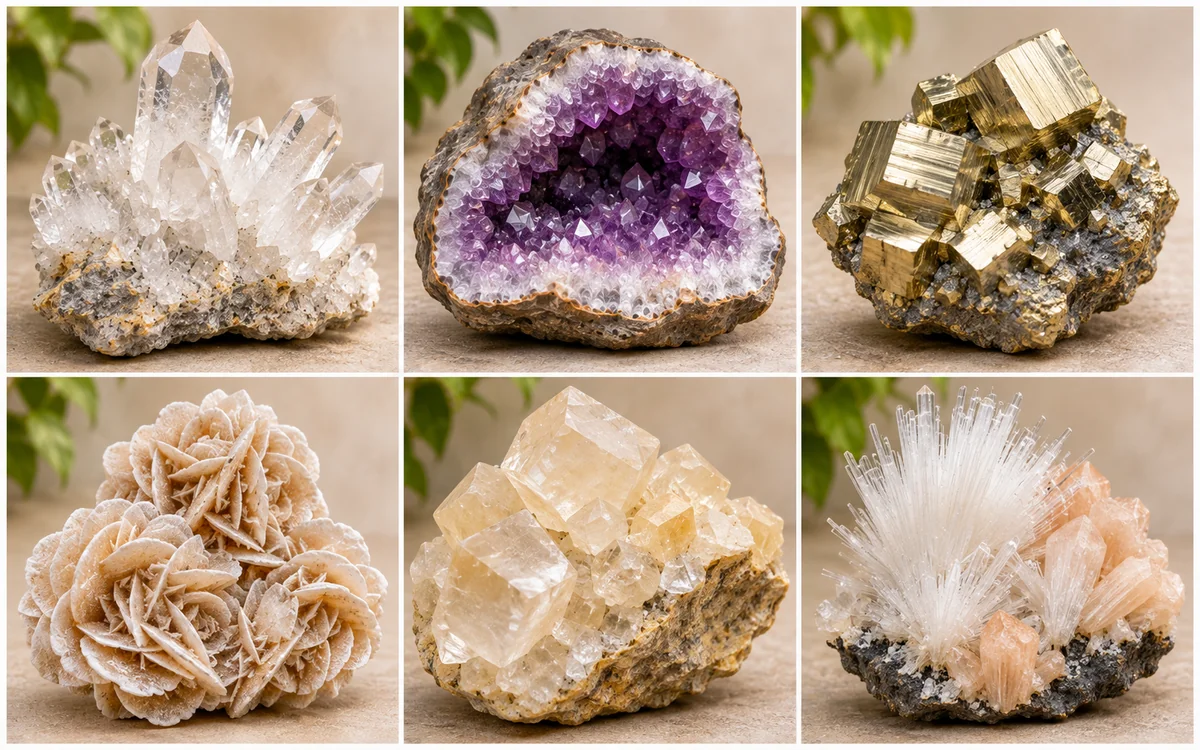
This guide is for natural, often irregular mineral specimens: quartz clusters, amethyst geodes, agate druses, pyrite-bearing rocks and mixed-mineral collector pieces. It explains practical dusting, moisture and sunlight risks, display and storage choices, signs of damage, and how physical preservation can coexist with respectful Vastu or devotional use. It is deliberately different from care instructions for a smooth tumbled stone, bracelet or carved pyramid.
The first decision: what exactly are you trying to clean?
A mineral specimen is an assembly of surfaces with different histories and properties. Before lifting it from a shelf, look closely in ordinary, indirect light. Identify the main crystal species as far as the documentation allows, then note the darker base rock, other crystals, fracture lines and any adhesive or stand. If the original seller has not identified these features, treat the material as mixed or uncertain rather than guessing from colour.
The word geode refers to a cavity-bearing geological object; druzy or drusy describes a coating of small crystals; cluster describes several associated crystals. Those are different physical forms. Dust lodged deep in a cavity can be difficult to remove without reaching fragile edges, while a cluster with tall projecting tips is more exposed to accidental knocks. A flat, polished agate rim may tolerate a soft cloth even when its interior drusy surface must not be rubbed.
Make a short condition record before cleaning
Examine the specimen's best display face, the underside and the rim or points. A few clear photographs are useful, especially for a unique geode or collector piece. Record any existing chips, white or coloured powder, loose grains, cracked matrix, repaired points or discoloration. If something is already flaking or powdering, stop before dusting. A new powder may be an alteration product, not ordinary household dust.
Do not attempt a hardness scratch test, acid-drop test or rubbing test on a finished sale specimen. Those can permanently alter the surfaces you are trying to preserve. Mineral identification belongs in supplier documentation or qualified examination; care should not become an improvised identification experiment.
| What you see | Possible significance | Sensible first action |
|---|---|---|
| Light, loose household dust on intact quartz tips | Ordinary deposition | Move less; consider minimal gentle dry dusting if the piece is stable |
| Dust trapped below delicate points | Hard-to-reach area rather than a defect | Leave it rather than force a tool into the cavity |
| Loose, needle-like or blade-like crystals | Physically fragile mineral habit | Avoid brushing and vibration; seek specimen-specific advice |
| Whitish, yellowish or greenish deposits newly appearing near pyrite | Potential mineral deterioration | Isolate, document and seek conservation guidance; do not wash |
| Dark stain, sticky joint or suspicious coating | Possible adhesive, treatment or environmental change | Record it, avoid solvents and consult the supplier |
| Wobbling base or tilting display | Risk of mechanical fall | Stabilize the support before attempting any cleaning |
Why a whole cluster needs different care from a gemstone
Polished stones have usually had fragile projections removed. Their surfaces are comparatively accessible, although treatments, fractures and mineral type still matter. A natural cluster retains sharp terminations, tiny growth faces, contact surfaces and often the original matrix. It may contain minerals with entirely different responses to water, humidity or pressure.
Consider an amethyst geode with a purple quartz lining. GIA notes that amethyst as a gem can be cleaned with warm soapy water under suitable circumstances. That guidance does not automatically make immersion suitable for a large geode: the wall may contain porous rock, an unidentified mineral coating, filled fractures, dye, cement, a fitted support or repair material. Cleaning decisions must be made for the entire object, not the hardest visible component.
The same issue arises with Indian apophyllite-and-stilbite specimens. A supplier may correctly identify one prominent species while the associated delicate sprays are the first parts to be damaged by a brush. A pyrite cube can appear robust, yet water and sustained humidity create a different risk. The mineral name, physical habit, matrix, treatment and condition all matter.
Prevent dust before thinking about removal
The safest cleaning is often the cleaning you never have to perform. Choose a display place where kitchen grease, incense soot, open-window road dust and frequent hand contact are limited. Set the piece back from an exposed shelf edge, away from strong fans and from areas where guests may casually lift it by a crystal point.
A fitted, ventilated or properly designed display case can reduce dust and handling. For specimens with special humidity needs, an appropriately managed case or box may also help control the environment. An ordinary unmonitored airtight container is not automatically safe for all minerals; some materials require a particular humidity range, and a damp specimen sealed into a box may be trapped with the moisture that harms it.
Place a stable, non-shedding support beneath the specimen. Use a purpose-made stand where necessary, and verify that any padding does not abrade the base or hide a loose section. Avoid resting a jagged geode rim directly on polished timber or glass where movement can scratch the surface. Keep the mineral away from candles, oil lamps and open flames, especially in devotional arrangements.
A simple maintenance rhythm
A short inspection every few weeks is more useful than a vigorous scheduled wash. Check whether dust is accumulating, whether the specimen has shifted, whether the supporting shelf remains dry, and whether new cracks or powder have appeared. Clean the surrounding shelf first, moving the mineral only if its weight and stability allow safe handling. Never spray furniture cleaner into a display case containing mineral specimens.
For a carefully protected display, the correct outcome may be no direct cleaning at all. The objective is preservation, not achieving a glossy or artificially polished appearance.
Gentle dry dusting: when it is suitable, and when to stop
For a stable, reliably identified piece with no friable minerals, a clean, very soft brush used with barely any pressure can sometimes lift superficial dust from accessible surfaces. Work on a low, padded work area; support the base rather than gripping a crystal. Brush away from the tips instead of pushing into them. Use a brush that does not shed stiff bristles or leave fibres behind.
Even this method is not universal. Conservation guidance warns that brushing or strong blasts of compressed air can dislodge thin crystals and delicate coatings. Fine needle sprays, brittle mineral crusts, powdering pyrite, loose calcite blades and repaired tips should not be brushed as though they were smooth ornaments. Do not put a cloth or cotton bud into a dense drusy cavity if it can snag on sharp points.
A small hand-operated air puffer may be appropriate for a stable surface, but do not use a powerful compressed-air can, hair dryer, vacuum nozzle or jet of air against a fragile cluster. Strong airflow can remove more than dust; canned products may introduce propellants or cold blasts. Avoid blowing with your mouth, which can introduce moisture droplets onto the specimen. A household vacuum should never touch the crystals.
If dust will not lift without pressure, leave it. When a specimen is valuable, fragile, treated or unidentified, ask a mineral conservator or knowledgeable curator before using any cleaning technique. Document what was done; a change in surface appearance after cleaning is a reason to stop and reassess, not to scrub harder.
Should you use water, soap, salt water or a chemical cleaner?
Do not use water as the default for an assembled cluster, geode or unknown mineral specimen. Water can dissolve some minerals, encourage corrosion of sulfides, affect glues, carry dirt into pores and leave marks as it dries. Drying a wet matrix completely can be difficult. Sudden temperature differences introduce another risk for some minerals and repaired surfaces.
There are situations in professional mineral preparation where an identified, water-resistant single-mineral sample can be washed. That does not justify recommending the same treatment to an unknown display piece. A polished amethyst gemstone and a natural amethyst geode may share a quartz component but not the same tolerance of immersion. If the seller recommends a wet method, ask what minerals and treatments were verified and whether the guidance applies to this exact specimen.
Avoid household acids such as vinegar or lemon juice. They react with calcite and other carbonate minerals and may etch a cavity lining or matrix. Avoid bleach, descalers, ammonia mixtures, detergents of unknown composition, polishing compounds and solvents. Steam cleaners and ultrasonic jewellery devices can damage fragile crystals and repairs; they are unsuitable general-purpose cluster cleaners.
Do not place natural mineral specimens in salt water as a ritual or cleaning shortcut. Salt solution is not a universal cleaning medium, and it can create additional problems when retained in pores or deposited on drying. Likewise, do not leave an unidentified cluster sitting on damp salt, bury it in salt or pour liquids through its cavity.
Mineral-by-mineral care: the key distinctions
The following table provides conservative starting guidance for intact specimens. It is not a blanket permission to clean a particular item, nor a substitute for identifying its matrix, surface treatment and repairs.
| Mineral or form | Main concern for an unpolished specimen | Conservative handling and display choice |
|---|---|---|
| Clear quartz or milky quartz cluster | Projecting tips, attached matrix, repairs; quartz durability can be misleading | Support the matrix, protect terminations, limit dust, do not assume the whole piece tolerates water |
| Amethyst cluster or cathedral geode | Intense light can fade some colour; temperature shock and fragile interior tips | Indirect lighting, stable temperature, carefully supported base; no steam or routine soaking |
| Agate geode and druzy quartz slice | Fine crystals, cut rims, possible dye or coating, porous backing | Dust prevention and gentle surface-specific handling; avoid rubbing fine druse or wetting unknown coatings |
| Pyrite cube, cluster or pyrite-bearing matrix | Humidity can promote oxidation and damaging decay products | Keep in monitored dry conditions appropriate for pyrite; avoid water, salt and close contact with affected pieces |
| Gypsum, selenite or desert rose | Soft surfaces, fragile blades and some water solubility | Keep dry and supported; avoid immersion, abrasive cleaning and handling fine edges |
| Calcite or aragonite crystal aggregate | Acid sensitivity, cleavage or delicate crystal structure | No vinegar, lemon, descaling agents or aggressive brushing; support the matrix |
| Fluorite crystal cluster | Cleavage and breakage; some colours can change under strong light | Stable stand, low-impact handling and indirect light; avoid heat and ultrasonic treatment |
| Celestite geode | Brittle crystals and possible colour/light sensitivity | Stable, low-traffic display out of strong sunlight; avoid forceful brushing |
| Apophyllite, stilbite, scolecite and associated minerals | Mixed species, thin sprays and fracture-sensitive growths | Minimize handling, avoid brushing fine needles, follow actual assemblage documentation |
| Malachite or copper-bearing specimen | Sensitive surface, powders and mixed mineral coatings | Do not grind or scrub; avoid acids and contact with dust or loose mineral particles |
Quartz and amethyst: durable mineral, delicate form
Quartz is relatively hard, and a well-formed crystal face may withstand incidental contact better than soft gypsum. But the point can still chip when struck, and one quartz crystal may be attached to another by a narrow contact. The matrix can be soft or crumbly. A large amethyst cathedral also has a heavy outer shell and a hollow interior: the object may be most vulnerable when carried or placed, not when viewed.
For amethyst, prolonged intense light can change some purple colour. This makes a permanently sunny windowsill a poor default. Indirect room light helps preserve the appearance while letting the crystalline surface remain visible. Do not apply a wet-cleaning recommendation intended for a loose or faceted amethyst gemstone to a heavily prepared, mounted or mixed-mineral geode without checking the whole object.
Pyrite: watch the environment, not just the shine
Iron pyrite can undergo oxidation that produces acidic alteration products and can fragment a specimen. Museums distinguish ordinary collection conditions from the drier conditions required for vulnerable pyrite. The Institute of Conservation advises that pyrite-containing specimens should preferably remain around 45% relative humidity or lower, while stressing that different materials need different conditions. This is a specialist storage preference, not a universal humidity target for every mineral or every Indian home.
A simple hygrometer may help reveal whether a display or storage area is persistently humid. For a fragile or valuable pyrite specimen, a suitable controlled enclosure and appropriately managed desiccant may be warranted. Do not place loose silica gel directly over the crystals or assume a permanently sealed box with no monitoring is enough. Consult a conservator for active deterioration: white or yellowish deposits, cracking and crumbling require more than wiping or washing.
Keep deteriorating pyrite separated from neighbouring objects and labels where possible, because its acidic products can damage nearby collection materials. Dryness may slow decay but cannot guarantee reversal of damage that has already occurred.
Gypsum, calcite and fragile crystal sprays
Gypsum varieties including many desert roses are soft, and gypsum is slightly soluble in water. Brushing the edges of a sandy rosette or wetting its surface can disturb details. Calcite and aragonite are calcium carbonates; acidic liquids can react with them. A casual vinegar “cleaning” can also be a destructive test. Fine scolecite sprays and other fragile Indian mineral assemblages may lose needle-like crystals if brushed or shaken.
The right approach for these pieces is chiefly environmental: stable display, dust protection, no casual handling and informed storage. When exact mineral identification is uncertain, preserve the specimen untouched until reliable advice is available.
Humidity, light and temperature: choose the environment for the specimen
There is no universal room-humidity number that suits every natural mineral. Museum guidance generally favours stable, moderate conditions for mixed collections, but pyrite may need drier treatment while other minerals can be damaged by excessive drying or moisture fluctuations. This is why a rule such as “keep all crystals in a completely dry airtight box” is not sound.
In humid climates, avoid bathrooms, damp walls, open balconies, leaking window ledges and storage cupboards that develop condensation. In air-conditioned rooms, avoid a position where cold air strikes a specimen directly and moisture later condenses when the room warms. Keep temperature changes gradual where possible; do not move a chilled geode straight into strong sun or place one beside a heater.
Use indirect lighting for amethyst and other light-sensitive coloured minerals. UV-heavy lamps or continuous direct sunlight are not helpful for preservation. If an object is displayed in a devotional area, maintain sensible clearance from diyas, incense sticks and hot lamps; soot deposition can be difficult to remove from a dense druse, and heat can affect mineral colour and adhesives.
A stand, shelf or display case should be stable enough for the complete weight. Large geodes need support beneath their shell, not pressure on their crystal points. Where a specimen requires a specialist microclimate, record the humidity target and monitor it rather than relying on a vague product label such as “energy charged.”
Storing a cluster when it is not on display
Storage should protect against movement, dust, light and unsuitable environmental change. Choose a clean rigid box or tray of sufficient size. The specimen should rest securely on a suitable inert support, with empty space around projecting tips. A clear lidded box helps prevent repeated handling merely to identify the item; an opaque archival container is preferable for particularly light-sensitive pieces.
Never let one geode slide against another. Keep mineral fragments, stands, screws and labels from touching delicate crystal faces. A loose metal stand can scratch a polished rim or break a point during transport. Avoid cotton wool or fuzzy wrapping that catches on needles, and do not put adhesive tape on any mineral surface.
Store the identity label with, but not stuck to, the specimen. Record the mineral name, any associated species, the item's unique stock or collection code, known locality, size, condition, purchase information, treatments and original photographs. A label that falls away from its stone can be as costly to a collector as minor physical damage, especially when provenance matters.
For high-value minerals, use a fitted support or tray rather than simply piling soft material around crystals. If a specially dry container is needed for pyrite, make it a monitored arrangement selected for that item; do not transfer that rule to a gypsum or other mineral without considering its particular chemistry. If a piece has arrived damp, do not immediately seal it into storage. Ask the supplier or conservator how that material should be safely stabilized.
A practical storage checklist
- Confirm the specimen code, mineral description and current condition from photographs.
- Choose a stable base or cradle that supports the matrix without touching fragile tips.
- Keep separate pieces from striking one another; use non-shedding, appropriate supports.
- Avoid direct light and locations prone to condensation, heat or large humidity swings.
- Retain treatment and locality information; do not stick labels directly to the crystals.
- Check stored material periodically for loose fragments, new deposits and deterioration.
What to do when a specimen starts changing
Crystals may arrive with natural growth marks, and not every white fleck is a problem. What matters is whether something has changed. Compare fresh photographs with the condition record. A new powder, change in colour, detached point, stained base, cracking mineral matrix or sticky repair should trigger a pause in cleaning and handling.
If you suspect pyrite decay, isolate the piece from its neighbours and seek specialist advice. Do not brush away an unknown powder, wash it into a sink or add household chemicals to “neutralise” it. If a specimen is unlabeled and may include hazardous or fibrous minerals, avoid creating dust and request qualified identification before handling it further. Keep curious children and pets away from loose pieces and dust.
For ordinary breakage, save detached fragments in a separate labelled container rather than trying an improvised instant-glue repair. A natural mineral specimen may be repairable, but the right adhesive and technique depend on the mineral and conservation goals. An undocumented repair also changes the information future buyers need.
Vastu, puja and the distinction between ritual care and physical cleaning
In a Vastu-inspired setting, cleanliness, orderly placement and respectful care of objects are meaningful parts of the environment. A natural quartz or amethyst piece may be chosen as a contemplative or decorative focus. Sphatik has particular associations in Indian devotional practice, and some contemporary crystal-placement traditions use clusters or geodes in a study, reception area or home mandir.
Physical cleaning and ritual purification are not the same process. A household may follow a tradition involving mantra, prayer, a clean cloth, flowers or another symbolic practice. These can be undertaken without wetting the specimen or exposing delicate minerals to heat and smoke. An object used near a diya should be set a safe distance away; a cluster does not become more physically durable because of its ritual significance.
Do not assume every crystal needs a salt-water bath, sunlight exposure or smoke contact to fulfil a spiritual purpose. Directions sometimes suggested for stones in modern crystal-healing or Vastu retail practice should not automatically be attributed to classical Vastu texts. Where a family follows a specific sampradaya or puja method, the traditional practice and the material limits of the object can both be respected.
It is often enough to keep the surrounding space clean, ensure the piece is stable, and use prayer or mantra without applying substances to the crystal. This preserves both the visual character of the mineral and the dignity of the setting.
Common mistakes to avoid
- Using the same routine for every mineral. A quartz geode, pyrite cube and gypsum rose are physically different.
- Treating the Mohs hardness number as a cleaning guide. Hardness describes scratch resistance; it does not guarantee strong terminations, safe immersion or resistance to chemicals.
- Brushing deeper when dust remains. A small trapped particle is less serious than a broken natural crystal point.
- Leaving clusters in strong sun to dry or “charge.” Some minerals lose colour, and heat can stress repairs or crystals.
- Spraying polish or perfume near a display. Surface coatings, dyes and matrix minerals may react unpredictably.
- Using a salt-water cleanse without material verification. Mineral and repair damage may result.
- Sealing an already damp specimen in a box. Condensation or moisture can remain inside.
- Displaying a heavy geode on an unstable stand. Falling is a much more immediate risk than ordinary dust.
- Discarding locality and condition labels. They are part of the record for the actual specimen.
Frequently asked questions
Can I rinse an amethyst geode under running water?
Do not make this a default. Loose or polished amethyst can have different care requirements from a whole geode with host rock, repairs and other possible materials. Confirm the actual specimen's makeup and preparation before using any wet method.
What is the safest way to remove dust from a clear quartz cluster?
First reduce dust exposure. If the piece is stable, clearly identified and not repaired or mixed with fragile minerals, minimal gentle dry dusting of accessible surfaces may be suitable. Stop if a point shifts, the matrix sheds material or pressure would be needed.
Can I use a toothbrush on small drusy crystals?
Avoid that shortcut. Even a soft toothbrush can catch on tiny projecting faces or pull a loose coating from a porous base. Dust prevention and expert advice are safer than trying to scrub deep drusy cavities.
Is sunlight good for cleaning or charging amethyst?
Sunlight does not remove physical dirt, and some amethyst colours can fade after prolonged intense exposure. A ritual intention does not require leaving a specimen in a hot window. Indirect light is a more protective choice for ordinary display.
Does a crystal cluster need salt water after someone touches it?
Not for physical cleanliness, and salt water may harm the mineral, coatings or repairs. For devotional customs, use a non-contact method compatible with the family's tradition and the object's material.
How should I store a pyrite cube cluster in a humid city?
Avoid damp open-air display and monitor humidity. Pyrite may need a more controlled, relatively dry enclosure than other specimens. If powder, staining or crumbling appears, separate the item and seek a conservator rather than washing or sealing it without assessment.
Can gypsum or selenite specimens be washed?
Water is a poor default: gypsum is soft and slightly soluble, and fragile forms may lose surface detail. Keep the specimen dry and seek material-specific advice rather than soaking it.
Can I clean calcite with vinegar or lemon juice?
No. Calcite is a carbonate mineral that reacts with acid. Using vinegar as a household cleaner can etch or damage the specimen; an identification demonstration on a disposable fragment is not permission to treat a collector piece.
What if a crystal point breaks off while moving the specimen?
Keep the fragment and photograph the condition. Avoid gluing it immediately. The appropriate repair depends on the mineral, value, intended use and whether the item is being documented for resale or collection.
Should a natural geode be kept permanently in an airtight box?
Not automatically. A dust-protective case helps, but a sealed box without humidity monitoring may trap moisture or create unsuitable conditions. Choose the enclosure based on the actual mineral assemblage, condition and preservation needs.
A lasting-care routine for a natural collection
A good mineral display does not have to look freshly washed. Natural crystal growth includes uneven faces, fine surface texture, matrix and small protected recesses. Preserve those features by choosing a suitable location, keeping dust off wherever possible, handling the base instead of the tips, and documenting any change before trying to correct it.
For everyday home collections, prevent dust, protect delicate growths, keep light and moisture appropriate, and clean only when justified. When the species, treatment or matrix is uncertain, the least intrusive action is usually the wisest. A natural cluster or geode is best appreciated as a real geological specimen, with its beauty and traditional significance cared for rather than polished away.
Continue exploring the Vastu collection to compare related decorative forms and traditional contexts.
Related reading
- What Is a Crystal Cluster? Crystal Growth and Natural Forms
- Geodes, Druzy Specimens and Agate Nodules: What Is Different?
- How to Buy a Natural Mineral Specimen Online
- Natural Crystal Clusters and Geodes in Vastu: Traditional Placement and Meaning
- How to Pack Fragile Crystal Clusters, Geodes and Mineral Specimens
- Amethyst Crystal Clusters and Geodes: Formation, Vastu Traditions and Care
- Pyrite Cubes and Matrix Specimens: Natural Forms, Vastu Associations and Storage
- Fluorite, Celestite, Aragonite and Gypsum: Delicate Specimens


