
Geodes & Druzy Specimens

New

Amethyst Geode Half

An amethyst geode half reveals violet quartz crystals inside a natural rock cavity, with distinctive mineral layers for spiritual spaces, Vastu-inspired displa…
Out of stock
Call for pricing
New

Amethyst Cathedral Geode

A tall amethyst cathedral geode displays violet quartz crystals inside an arch-shaped rock cavity, creating a distinctive focal point for spacious spiritual an…
Out of stock
Call for pricing
New

Amethyst Druzy Slice (Identity Pending)

An amethyst druzy slice may show fine violet quartz on a thin mineral section. Specimen identity, treatment and availability must be confirmed before ordering.
Out of stock
Call for pricing
New

Agate Geode Half

An agate geode half reveals layered chalcedony and an open mineral cavity, often lined with delicate quartz crystals, for Vastu-inspired display and mineral co…
Out of stock
Call for pricing
New

Agate Geode Pair

A matched agate geode pair reveals two complementary sections of one mineral specimen, with related chalcedony bands and crystal-lined cavities for balanced di…
Out of stock
Call for pricing
New

Quartz Druzy Agate Slice

Quartz druse and banded agate may occur in a thin slice. The substrate, crystal coating, preparation and availability must be confirmed before ordering.
Out of stock
Call for pricing
New

Celestite Geode

Explore pale-blue celestite crystals lining a natural geode cavity, with guidance on specimen selection, protected indoor display and gentle shell-supported ha…
Out of stock
Call for pricing
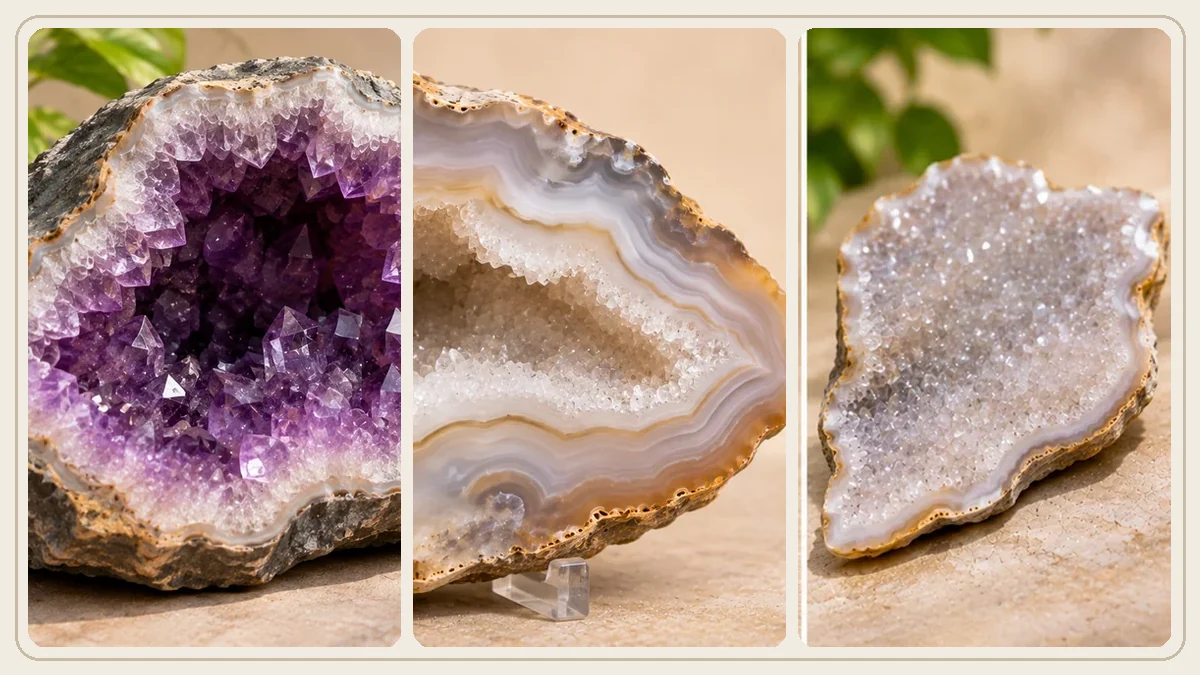
About this collection
geodes druzy category feature

Geodes reveal geology in cross-section: an enclosing rock wall surrounds a cavity in which crystals grew inward. Cut agate geodes may show bands of chalcedony around a hollow quartz-lined centre; amethyst examples reveal violet quartz points. A druzy coating consists of many fine crystals on a surface, and need not have formed inside a geode.

This proposed category distinguishes actual hollow specimens, cut geode halves, true matching two-half sets and druzy-coated slices. The correct designation depends on the specific object and its construction rather than a general marketing synonym.

Recognising geode and druzy forms

A single agate geode half preserves a cut and polished face along with the original exterior rind. A matched pair consists of two documented complementary halves sold together as a fixed linked set, not merely two similar geodes. A quartz druzy plate may show fine crystalline crust on a flat agate or host-rock surface without an enclosed hollow.

Tall amethyst cathedral geodes are another distinct format with different display, shipping and weight considerations. For tall or heavy items, the footprint and stability of the base matter as much as the height of the open cavity.

Surface treatment, dyeing and honest naming

Agate colours may be natural or modified; decorative examples may be dyed or otherwise treated. Ask for a specific disclosure rather than assuming bright colour is an origin signature. A photograph alone cannot authenticate mine, age, colour treatment or a genuine pairing.

Do not call a solid druzy slice a geode unless the actual specimen has a cavity. Do not describe a matched set as originating from one piece unless the parts and stock records establish that relationship.

Vastu display and interior placement

Geode halves and sparkling druzy surfaces are used by many contemporary households as decorative focal points and symbolic crystal objects. In Vastu-inspired spaces, choose placement that is orderly, clean and respectful, while recognising that a particular mineral-to-direction formula may be a modern custom rather than a universal classical instruction.

A stable low console or wide shelf is more suitable than a narrow elevated ledge for a heavy geode. Protect delicate crystal cavities from handling, abrasive dusting, direct impact and unnecessary sun or water exposure.

Packing and specimen-specific documentation

An actual item record should include outer dimensions, weight, cavity dimensions when relevant, condition, surface treatments, repairs and whether a stand is required. Show the front face, rear rind, base and sensitive crystal detail.

During packing, support the strong outer shell or matrix and preserve a no-contact zone around inward-pointing crystals. A rigid inner package and cushioned outer carton may be appropriate, but the real design must be checked against the specimen’s geometry and mass.

Frequently asked questions

Does druzy mean a geode is hollow?

No. Druzy describes a surface coating of fine crystals, not necessarily a cavity.

What makes an agate geode pair a matched pair?

It must consist of two actual complementary halves tracked and supplied together as one documented set.

Can a heavy cathedral geode stand on any shelf?

No. Verify weight, centre of gravity, base stability and the furniture’s load capacity.

Are brightly coloured agate geodes always natural-colour?

No. Dyeing and other treatments may occur; the seller should disclose supported treatment information.

How should crystals inside a geode be packed?

Packing should protect the strong shell and maintain clearance around fragile internal crystal growth.

Related reading

Astrology Showroom WhatsApp Specialist