

A small electric-blue cavansite rosette can look surprisingly solid. A white okenite puffball can look as soft as cotton. Both are natural mineral specimens, but neither should be treated like a polished gemstone, a bracelet bead or an ordinary decorative rock. The outward appearance is misleading: much of their beauty depends on the preservation of slender projecting crystals, delicate attachments and an undisturbed surface. Even a brief touch can permanently change the shape of the most vulnerable material.
Collectors value these specimens for their natural growth, their matrix and, often, their connection with Maharashtra's basalt cavities. For someone choosing a mineral for a shelf, cabinet or Vastu-oriented setting, the right question is not simply whether its colour is attractive. It is whether the exact specimen can be displayed safely, handled rarely and, if necessary, transported without touching its delicate growth. For some pieces, the best purchasing decision is to arrange specialist viewing rather than attempt ordinary courier delivery.
This guide compares cavansite and okenite, explains how they differ from similar-looking minerals, and describes a conservation-first approach to cleaning, mounting, photographing and assessing specimens before sale. It also clarifies why the special fragility of okenite should remain a separate decision from the ordinary care of quartz, amethyst and tumbled stones.
Fragility is about crystal structure and shape, not just hardness
A mineral's Mohs hardness tells us primarily about its resistance to scratching by another material. It does not tell the whole story about resistance to impact, pressure, catching or flexing. A slender crystal can snap because it projects beyond its base. A group of many fine crystals can lose its texture when pressed. An otherwise sound mineral can detach if its connection to the supporting rock is narrow, weakened or repaired.
Three separate vulnerabilities deserve attention:
- Individual crystal vulnerability. Thin needles, blades, fibres and tiny points can chip, flatten or break.
- Attachment vulnerability. A blue rosette, white spray or miniature puffball may sit on a relatively small contact area. The host rock can survive an accident while the display feature is lost.
- Specimen-level vulnerability. Loose matrix, a cut or undercut base, previous repairs or the combined weight of different minerals can make an object unstable even when the crystals themselves are intact.
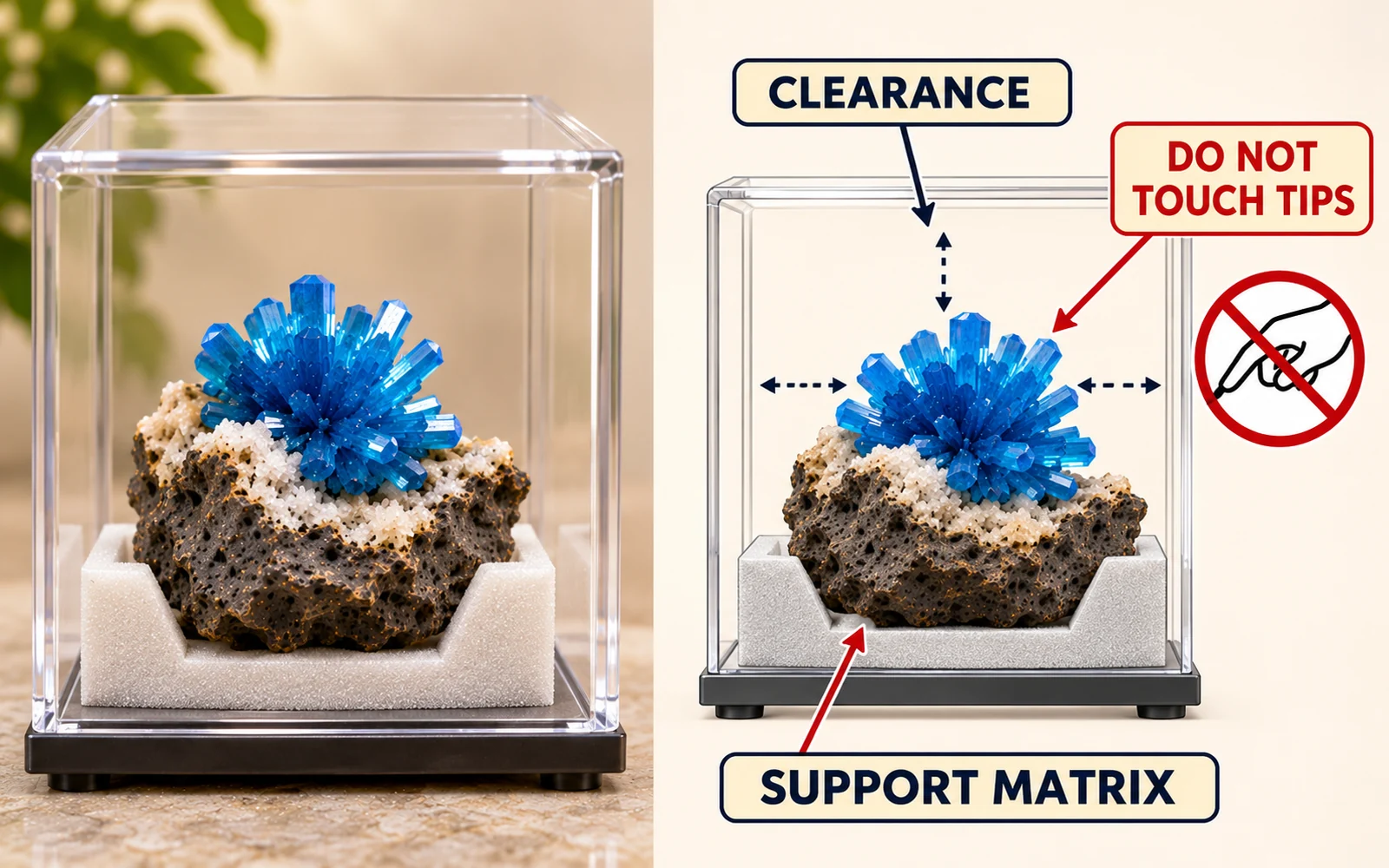
These distinctions matter because protection must be directed at the actual weak point. Putting thick padding directly against the exposed crystals may make damage more likely. The safest support usually contacts a strong part of the matrix , while leaving a protected space around the delicate mineral growth. Museum conservation guidance emphasizes supported handling, non-snagging surfaces and individual mounts for specimens with projecting components.
What is cavansite?
Cavansite is a distinct hydrated calcium vanadium silicate mineral. Its famous vivid blue colour is associated with its vanadium-bearing composition. Cavansite commonly occurs as small radiating groups of slender crystals, rounded rosettes or other spray-like aggregates attached to a supporting matrix. Those blue clusters may be only a small part of a much heavier specimen, but their shape and condition determine much of its visual appeal.
Cavansite is especially celebrated from the Wagholi quarry area near Pune, Maharashtra , where research has documented its occurrence in secondary mineral fillings of basalt-related cavities and breccia pockets. Mineral studies also describe associations with stilbite, heulandite, calcite and other cavity minerals. A blue cavansite rosette on pale stilbite against darker host rock can be an impressive natural composition.
The location of famous examples does not prove that every blue specimen is from Wagholi. A seller needs a supplier record, original locality label, acquisition history or comparable evidence to support a quarry-level claim. The words Indian cavansite may be appropriate when country-level provenance is documented, but Wagholi cavansite is a more specific statement requiring its own evidence.
Why cavansite breaks more easily than its appearance suggests
The blue mineral may form a tight-looking ball, yet the outer surface is made of projecting crystal ends. A fingernail, jewellery chain, rough cloth or bubble wrap pulled across those points can catch and detach them. Cavansite also has cleavage, so the impact behaviour of its crystals cannot be inferred from hardness alone. A narrow neck of supporting matrix, or a previously glued group, introduces a second possible failure point.
When moving a specimen, touch the substantial basalt or stable rock base, never the blue rosette. If the base is too narrow to lift safely without approaching the crystals, move the entire specimen in its prepared tray . A mounted cavansite piece that can be moved without remounting is better suited to display than a loose piece repeatedly repositioned by hand.
Cavansite is not the same mineral as pentagonite
Pentagonite is chemically related to cavansite and can also produce intensely blue slender crystals. The two are dimorphs : they share a chemical composition but differ in crystal structure. Both have been studied in the Wagholi area. The 2025 research on cavansite and pentagonite in these quarries is particularly useful for interpreting their mineralization, but does not allow every photographed blue spray to be identified without further evidence.
A slender or star-like blue growth should not automatically be relabelled pentagonite , and a rounded spray should not automatically be asserted to be cavansite . Crystal habits can overlap or be imperfectly developed. If a supplier documents both minerals on a single specimen, identify which region is which and retain the basis of the determination. Colour saturation, price and geographical reputation are not substitutes for an appropriate mineral identification.
What is an okenite puffball?
Okenite is a distinct hydrated calcium silicate mineral. It is known for extremely fine, radiating, hair-like crystals that may form nearly spherical or hemispherical masses. These rounded growths are often called okenite puffballs because they resemble white cotton, miniature snowballs or soft tufts. They are mineral crystals, not textile fibres, and the apparent softness should not be tested by touching them.
The celebrated puffball form can grow in cavities of volcanic rocks, including examples from India. Some specimens have one tuft in a basalt pocket; others show several puffballs with associated minerals or cavities lined by secondary mineral growth. Both the fine crystal surface and the supporting rock are part of the specimen's natural history.
Okenite can also occur in other forms, so not every white mineral tuft is automatically okenite. Fine scolecite, mesolite and other fibrous or acicular mineral growths can resemble it in photographs. A properly identified specimen label should be retained whenever available; a seller should not attach an okenite name solely because a white patch looks fluffy.
The single most important rule: do not touch the puffball
The characteristic surface consists of many tiny crystals. Contact can flatten, disarrange or detach them. Once the radial texture has been bruised, its original appearance cannot reliably be restored by brushing or fluffing. Even an attempt to remove one dust particle may cause a larger visible defect.
Do not press a finger against the tuft. Do not stroke it to demonstrate softness, move it with tweezers, test it with a cotton swab, wrap it directly with tissue or brush the fibres. The same advice applies when taking photographs: move the camera or its support rather than rotating an unsecured okenite specimen over and over.
Okenite's fibrous crystal habit does not by itself mean it is asbestos. The practical reason for keeping the surface undisturbed here is preservation of fragile crystals and avoidance of unnecessary mineral dust. Unknown dusty or fibrous specimens should still be handled prudently and identified before any intervention.
Cavansite, okenite and scolecite compared
| Feature | Cavansite | Okenite | Scolecite (useful comparison) |
|---|---|---|---|
| Typical appearance | Strong blue radiating rosettes or sprays | White to cream fine fibrous puffballs | White or colourless slender needles in sprays or bundles |
| Mineral identity | Hydrated calcium vanadium silicate | Hydrated calcium silicate | Zeolite-group mineral |
| Common display setting | Blue growth on matrix, sometimes with zeolites | Cotton-like tuft within or on cavity matrix | Needle sprays on mineral or rock matrix |
| Primary damage risk | Blue projections chip, detach or snag | Fine tuft loses its untouched texture when contacted | Thin exposed needles snap or detach |
| Safest contact point | Stable matrix or fitted mount | Stable matrix or fitted mount; never the tuft | Matrix or fitted mount; never the spray |
| Cleaning posture | Prevent dust; no routine contact cleaning of blue crystals | Prevent dust; do not brush or wet the puffball | Prevent dust; avoid brushing fragile needles |
| Sales readiness | Conditional on specialist packing of the exact piece | Specialist enquiry only; no routine courier offer | Fragile-specimen packaging and condition checks |
These are typical forms, not a photograph-only identification key. A chemically sound mineral name and a shipping decision are separate judgements. A well-identified okenite puffball may still be inappropriate for ordinary delivery.
Why some Indian basalt specimens contain such delicate crystals
The basalt flows of the Deccan volcanic province provide the broader geological setting for many admired Indian secondary minerals. Once rock had solidified, cavities and fractures could become pathways for later mineral-bearing fluids. As the conditions changed, different minerals precipitated onto cavity walls or earlier growth. A basalt pocket may preserve several generations of minerals with striking differences in colour and crystal habit.
Work on cavansite and pentagonite from Wagholi provides a deposit-specific scientific account of their formation. Other studies of Deccan cavities document changing secondary mineral assemblages and the importance of local conditions. This is why a cavansite specimen may share matrix with stilbite or heulandite without proving that every such combination grew in the same order at every quarry.
Okenite occurs in Indian and non-Indian localities. If the original label is missing, an attractive white puffball does not automatically establish Maharashtra provenance. Similarly, finding a small blue mass on basalt does not by itself establish its exact species, location or collecting date. Accurate geological descriptions say what is supported and leave uncertainty visible.
For collectors, the matrix is not disposable packaging. A curve in the basalt can indicate a cavity wall, and a secondary mineral coating can provide context for later growth. Aggressive trimming to make a specimen stand upright may remove that information or expose a fragile attachment. Display supports should compensate for an uneven base without making unsupported cuts into the specimen.
Eight ways fragile specimens get damaged
1. Grasping the most attractive crystal
People naturally reach for the bright blue rosette or fluffy white tuft because that is the feature they want to examine. This is precisely the part least suited to handling. Put the base or fitted tray under the lifting points before the piece is brought near a display shelf.
2. Brushing dust into fragile growth
A soft brush can still snag tiny okenite fibres or break cavansite projections. What is gentle on a polished agate slice is not necessarily gentle on an exposed crystal spray. Dust prevention is therefore preferable to later cleaning.
3. Letting packaging touch exposed crystals
Tissue, cotton wool, foam, bubble wrap and cloth can all damage projecting minerals if they are pressed against or pulled past them. A specimen should be restrained by a safe supporting zone and surrounded by clearance , not cocooned tightly around its delicate display surface.
4. Resting the piece against glass
Glass-fronted cabinets are useful, but the specimen should not lean its crystals against the front pane. A door that closes onto a projecting rosette or shakes a crowded shelf can cause serious damage despite the protective enclosure.
5. Using an unstable or narrow stand
A small amount of blue cavansite may sit high above a broad base; another specimen may balance on a narrow contact point. Evaluate its centre of gravity and use a stable, non-abrasive mount. Avoid adhesive applied directly to valuable mineral surfaces without specialist advice.
6. Repeated repositioning for photography
Rotating the specimen to obtain a perfect view may be riskier than leaving it on one mount and changing camera angles. Record the front, side and base carefully on a supported surface. Do not sacrifice a fine spray to produce an extra sales photograph.
7. Improvised ritual contact
Washing, immersion, oil, coloured powder, perfume, garlands and repeated handling may be appropriate to some ceremonial objects, but these activities can damage delicate natural mineral formations. Keep living devotional practices and the care of fine museum-type specimens distinct; place a fragile specimen nearby rather than treating it as a washable idol.
8. Assuming an ordinary parcel will always be safe
A courier label saying fragile is not a substitute for mechanically secure packaging. Vibration, impact, inversion and crushing can all act on a parcel. A specimen with unsupported okenite fibres may remain unsuitable for routine dispatch despite a careful box and an expensive courier service.
Handling cavansite without touching the blue crystals
Before lifting a cavansite piece, make a quick condition record. Confirm where the matrix is strongest, whether any blue group overhangs a side, and whether the piece is loose on its stand. Look for detached fragments on the shelf, visible previous repairs and gaps below the centre of mass. These clues are easier to record before moving anything.
Prepare a clean, stable tray with a low-slip, non-snagging inert lining. Use two hands beneath the sound part of the matrix or lift the entire fitted mount. Keep the piece close to the work surface rather than carrying it high across a room. Clear sleeves, loose jewellery, watches and hanging camera straps from the work area.
If there is no secure lifting point, do not improvise a grip around the blue crystal growth . A custom mount or curator-style transport tray is preferable. If the piece came with a fitted base, move the base and specimen together where safe instead of detaching it for every inspection.
A compact blue rosette can be more durable than a long exposed spray, but that is only a relative observation about geometry. It does not prove a particular specimen safe to ship. A large cavity specimen may contain several very different attachment strengths, including fragile associated zeolites that need their own clearance.
Handling okenite: the correct choice is often no handling
Okenite should ideally remain inside a protected, transparent enclosure where it can be seen without routine contact. Treat the puffball as a no-touch surface . Set the specimen on a fitted mount that supports the basalt or other stable matrix, not the fibres. The case should be positioned so that it can be viewed without opening and cleaning it frequently.
If a repositioning or transfer is unavoidable, work out the route and support arrangement before opening the case. A collector or conservator can design a cradle that holds the rock and keeps the tuft completely clear. A shallow loose tray is not sufficient if the piece can roll when the tray moves.
Do not use adhesive tape near a puffball, apply glue to the tuft, tie a restraint over the fibres or introduce a household vacuum nozzle into the cavity. If the specimen has already shed material or shows an unstable attachment, stop and seek specialist advice. Trying to push detached fibres back into place is likely to worsen the appearance.
Should an okenite puffball be offered as a normal product?
Not without a specimen-specific professional packaging and fulfillment decision. A beautiful white puffball may be suitable for local, supported handover, specialist transport or a collector appointment while remaining unsuitable for ordinary e-commerce fulfillment. The sales presentation must not imply guaranteed safe courier arrival simply because another stone specimen has been shipped successfully.
A merchant can still publish an educational article about okenite and consider a specialist enquiry process later. That is different from activating a generic product page with immediate checkout, default shipping rates and an unverified stock image. The latter approach would create risks for both the mineral and the customer.
Display: the protective case is part of the presentation
A clear lidded case or small museum-style cabinet is often the best visual solution for these objects. It keeps airborne dust away, limits accidental touching and allows the mineral to be appreciated without frequent movement. The enclosure should have enough clearance on all sides and above every projecting group. A stable, adequately sized shelf and appropriate light complete the setup.
Avoid cramped bedside tables, entryway counters, narrow window ledges, busy desks and surfaces frequently used by children or pets. Secure the case so it cannot slide or overturn when a door closes or the shelf is bumped. For a heavier matrix, verify that both the mount and supporting furniture can bear the actual weight.
Light should make the crystal growth visible without exposing the specimen to avoidable heating or prolonged direct sun. A diffuse indoor light is generally preferable to a hot spotlight pressed close to a small enclosure. Environmental requirements are not identical for all associated minerals; inspect the whole specimen before choosing a case environment. If an unknown metal-sulphide or water-sensitive mineral is present, obtain appropriate storage guidance rather than applying a one-size-fits-all humidity rule.
A display decision matrix
| Situation | Better action | Avoid |
|---|---|---|
| Compact cavansite on broad basalt base | Fitted inert mount in a dust-resistant case | Bare handling by the blue rosette |
| Cavansite with long exposed blue needles | Extra clearance and specialist mount | Wrap touching crystals; shallow loose tray |
| Okenite puffball in a cavity | Enclosed, mounted, rarely disturbed display | Touching or brushing the tuft |
| Specimen with weak, repaired or loose matrix | Conservator or specialist assessment | Moving repeatedly to test stability |
| Mineral sought for a frequently handled ritual area | Choose a more robust, appropriate object | Washing or adorning fragile mineral growth |
| Customer requires ordinary courier delivery | Consider a sturdier different mineral specimen | Presuming a puffball can be shipped normally |
Can cavansite or okenite be washed or dusted?
The appropriate default is preventing contamination rather than washing the crystals . For okenite puffballs, do not recommend immersion, spraying, wet cloths, soft brushes, compressed-air blasts or vacuuming over the tuft. Even a low-force tool may disturb fine crystals. If dust has already settled deeply into a puffball, consult someone experienced in mineral conservation; loss from intervention may be worse than leaving the dust undisturbed.
For cavansite, the same no-contact approach applies to delicate blue crystal surfaces. A stable, sound patch of bare matrix may sometimes be handled differently, but it should not be cleaned in a way that sends liquid or particles into the blue rosettes or associated minerals. Avoid household detergents, acids, bleach, ultrasonic baths, steam and long water soaks. Do not attempt to diagnose a mysterious coating by scratching or dissolving it on a valuable specimen.
Museum care recommendations allow different cleaning procedures for different geological specimens and urge careful assessment of composition, fragility and condition. The point is not that all mineral specimens can never be cleaned; it is that fragile, projecting, mixed-mineral objects require much more restraint than polished or massive material.
If fine fragments have fallen off, save them separately in a labelled container rather than brushing them away. Record the condition and storage history, take careful photographs and seek advice before trying repairs. An attempt to hide repaired material is both poor conservation practice and a problem for an honest product listing.
How to pack these minerals when transport is considered
For suitable, assessed cavansite pieces, transport should be planned around the stable matrix. The inner holder should immobilize that support while leaving a protective no-contact space around the blue growth. Non-snagging materials are preferred near exposed projections, and the secured inner unit can be cushioned inside a rigid outer carton. Movement must be prevented without placing compressive force on the display crystals.
A specialist should confirm that the chosen padding and restraint are appropriate for the specimen's geometry and weight. The precise arrangement may differ for a broad basalt base, a delicate crystal group on stilbite, or an irregular cavity section. There is no safe universal foam-cutting pattern or guaranteed maximum drop height that applies to all cavansite pieces.
For okenite , that general packing outline should not be interpreted as shipping approval. Extremely delicate tufted specimens may need a fitted rigid mount, supervised handling and specialist delivery, or may not be suitable for transport at all. A merchant should make that decision on an actual stock item rather than from a reference photograph.
Before any authorized movement, record multiple condition views; inspect attachment points; use a stable, fitted support; ensure clearance; and document the intended method of unpacking. The customer should never have to pull a soft wrapping material across a puffball to reach the specimen.
Buyer checklist: what to request before paying
A photograph can show vivid colour yet hide condition, repairs and packing constraints. Ask for evidence that relates to the actual specimen rather than a representative catalogue picture.
- Mineral identity: is the blue feature cavansite, pentagonite or uncertain? Is the white tuft confirmed as okenite, or merely labelled as such?
- Exact-item views: front, oblique side, base and close-up of exposed crystals, without misleading lighting or recolouring.
- Scale and weight: dimensions of the whole object and, where practical, size of the blue group or white puffball; avoid using an unrelated specimen's weight.
- Attachment condition: any loose groups, naturally broken crystals, visible chips, repairs, added glue or recently detached fragments.
- Matrix: rock or associated mineral support, contact area, undercuts and whether a separate stand is included.
- Locality record: India, Maharashtra or quarry-level detail only as supported by supplier documentation.
- Treatment and preparation: trimming, mounted bases, coating, cleaning, dye, adhesives or specimen reassembly where applicable.
- Display plan: enclosure, stable stand, shelf load, child/pet access and future handling frequency.
- Dispatch feasibility: whether the seller has approved the exact piece for transport and can show a credible specimen-specific packing process.
- Arrival procedure: safe opening instructions, condition-record comparison and a clear process if damage is found.
For okenite, an answer such as “we pack all crystals in bubble wrap” should be a reason to decline standard delivery , not a reassurance. For cavansite, request that the seller show how the blue projections remain clear of restraints. If those questions cannot be answered, it is reasonable to choose a less vulnerable specimen.
Vastu and devotional display: preserve both meaning and mineral
Natural crystal and mineral specimens are sometimes displayed in Indian homes in connection with contemporary Vastu practices, personal symbolism and the wish to create a calm, orderly environment. The aesthetic and devotional importance of an object to its owner can be genuine without asserting that cavansite or okenite has a compulsory direction prescribed in classical Vastu texts . Specific modern claims about a blue cavansite stone delivering certain financial, medical or planetary results are not established by mineralogical evidence or documented here as ancient injunctions.
A respectful, practical approach is to choose a stable and clean place that suits the family's devotional or decorative setting. A protected cabinet near a study, living area or thoughtfully arranged personal space may be better for these fragile minerals than a location chosen solely to satisfy a rigid compass chart. The overall Vastu discussion, where useful, belongs within the broader context of room arrangement, access, proportion, order and the needs of those using the space. Readers exploring those traditions can visit the site's existing Vastu section .
If regular ritual contact, abhisheka, water, oil, incense residue or garlanding is central to a practice, choose an appropriate durable ritual object rather than a fragile puffball or cavansite rosette. A protected mineral specimen can be appreciated nearby without being handled as a repeatedly washable article. This preserves both the significance of the practice and the natural specimen.
What this means for OmmRudraksha's specimen catalogue
The two minerals call for different merchandising decisions:
Cavansite on matrix (proposed concept GR21). A future product page can be considered for a premium single specimen only after mineral identity, exact photography, measurements, condition, provenance claims, specialist packing and actual-stock dispatch approval. A good article or representative image does not make a particular piece ready for sale.
Okenite puffball (proposed concept GR22). This concept remains on hold for an ordinary e-commerce page and routine shipping. It may be addressed as an educational subject or, later, a specialist collector enquiry after real stock and transfer arrangements have been evaluated. It should not be silently converted into a checkout-enabled product or described as routinely courier-safe.
Scolecite spray (proposed concept GR18). Scolecite is a separate zeolite mineral, but its thin needles present a related physical protection problem. If real stock exists, the precise spray, matrix and packing method must be assessed on their own merits. It should not be relabelled as okenite merely because both appear white.
This article's role is educational. It is not a stock confirmation, price list, quality certificate, laboratory report or claim that any proposed product is currently available. Future product links should remain inactive until those stock, identity, media and publication checks are complete.
Frequently asked questions
Is cavansite the same as pentagonite?
No. Cavansite and pentagonite are distinct mineral species with the same chemical composition but different crystal structures. The blue colour alone does not establish which is present.
Why is cavansite fragile if it is a mineral rock?
Its slender crystal ends, natural cleavage, small attachment areas and associated matrix can be vulnerable to pressure and shocks. The physical shape of a specimen matters as much as a simple hardness number.
Can I touch an okenite puffball to feel whether it is soft?
No. Its cotton-like appearance comes from very fine mineral crystals, which can be crushed or disturbed by touching. Keep the tuft untouched.
Is okenite actually cotton or a man-made decoration?
Natural okenite is a mineral, not cotton. However, a seller should substantiate the mineral identification of the specific piece, and a photograph alone is not proof of provenance or naturalness.
Does a white needle spray always mean okenite?
No. Scolecite, mesolite and other mineral growths can resemble parts of okenite specimens. Appropriate identification should be based on more than visual resemblance.
Can I wash cavansite or okenite in water?
Do not use routine water washing on these delicate growths. Prevent dust through proper display and consult a qualified specialist if a specimen requires treatment.
Can I use an air blower or brush on the white puffball?
Neither should be a routine home-cleaning method. Air movement and brush contact may disturb the fine crystals. A protected case is a better preventive approach.
Are cavansite and okenite zeolites?
No. Cavansite and okenite are distinct silicate minerals and should not be given the mineralogical label zeolite species . They can occur in geological associations with true zeolite minerals such as stilbite or heulandite.
Does a Wagholi label prove a specimen's exact origin?
Only if the location claim is supported by documentation for that specimen or its traceable lot. Similar appearance is not proof of an exact quarry.
Can a cavansite specimen be shipped to my home?
Some particular pieces may be suitable for specialist packaging and delivery after examination; others may not be. Ask for approval of the actual piece , not a generic shipping promise.
Can an okenite puffball be shipped by normal courier?
Routine courier shipping should not be assumed safe. For this collection plan, okenite remains a specialist-enquiry or hold item pending an individual transport assessment.
Where should a fragile specimen be placed according to Vastu?
Choose a secure, clean location consistent with your household's spatial and devotional preferences. There is no substantiated universal classical rule assigning these specific minerals a mandatory compass direction, and stability is essential.
A simple principle for long-term preservation
The most attractive feature of cavansite and okenite is also the feature most easily lost. When collecting them, preserve the intact crystal habit, the natural matrix and the truthful specimen record . Display them in a stable protected setting, touch only safe supporting surfaces, avoid casual cleaning and insist on stock-specific decisions before transport. A responsible collection should let these minerals be admired for years without asking their delicate growth to tolerate the treatment of an ordinary polished stone.
Related reading
- What Is a Crystal Cluster? Crystal Growth and Natural Forms
- How to Buy a Natural Mineral Specimen Online
- Natural Crystal Clusters and Geodes in Vastu: Traditional Placement and Meaning
- Cleaning and Storing Natural Crystal Clusters and Geodes
- How to Pack Fragile Crystal Clusters, Geodes and Mineral Specimens
- Indian Mineral Specimens: Apophyllite, Stilbite and Associated Minerals
- Apophyllite Crystal Specimens: Identification, Matrix and Care
- Stilbite, Scolecite and Heulandite: Comparing Crystal Habits


