

A glossy metallic mineral specimen can be compelling even without bright colour. A natural hematite iron rose may consist of overlapping steel-grey blades, while a magnetite specimen may show dark, sharply defined octahedral crystals rising from its host rock. Both contain iron and oxygen, both can look almost black in photographs, and both are sometimes marketed beside polished magnetic ornaments. Yet hematite and magnetite are different mineral species, and the most interesting collector pieces are not interchangeable with manufactured magnetic beads or carved decorations.
This guide focuses on naturally grown specimens: the geometry of hematite rosettes, the characteristic shapes of magnetite crystals, their mineral associations, practical identification and the information a careful buyer should expect. It also explains the limitations of magnet tests and how to keep fragile iron-oxide specimens safe in a home collection or a Vastu-inspired display.
Hematite and magnetite: the essential mineral difference
Hematite is an iron(III) oxide, Fe₂O₃. It occurs in earthy reddish masses, dense rounded or kidney-shaped deposits, sparkling flaky aggregates, and attractive metallic crystals. A specimen can look silver-grey from the outside even though the powdered mineral typically produces a red to reddish-brown streak. The Greek-derived name relates to this colour association, not necessarily to the visible colour of a polished object.
Magnetite, Fe₃O₄, is a distinct iron oxide containing iron in different oxidation states. It is generally black and characteristically magnetic. Its crystal structure belongs to the cubic system, commonly expressed in natural collector specimens by octahedral forms. Magnetite can occur as well-formed individual crystals, compact granular masses, or as part of a mixed rock. A naturally magnetized piece of magnetite may be called lodestone, but that historic term should not automatically be applied to every dark magnetite crystal or every object that attracts a magnet.
| Feature | Natural hematite | Natural magnetite | What a buyer should remember |
|---|---|---|---|
| Chemical composition | Fe₂O₃ | Fe₃O₄ | Both contain iron, but they are different minerals |
| Typical exterior | Red-brown earthy to shiny steel-grey or black | Black, sometimes lustrous metallic faces | Dark colour alone is inconclusive |
| Characteristic natural form | Plates, iron roses, micaceous scales, botryoidal masses | Octahedra, some other cubic-system forms, massive grains | Shape is a clue, not definitive species proof |
| Streak on appropriate test material | Red to reddish brown | Black | Streak can damage a specimen; never test a sale piece casually |
| Magnetic response | Usually slight or not evident with an ordinary hand magnet; mixtures may respond | Often pronounced | Magnet attraction alone cannot certify authenticity |
| Collector vulnerability | Thin plates and flaky surfaces can chip or shed | Sharp corners and matrix attachments can break | Handle by sound matrix, not edges or crystal points |
Both minerals are relatively dense compared with ordinary quartz-rich rocks. That does not make heft an adequate identification method: a small iron-oxide-rich object, a manufactured ferrite, and a natural multi-mineral aggregate may all feel heavy in the hand. Use a combination of evidence, including exact-item photographs, disclosed preparation, locality records where available, and professional identification if a premium label depends on the species.
The geometry of natural hematite iron roses
How an iron rose develops
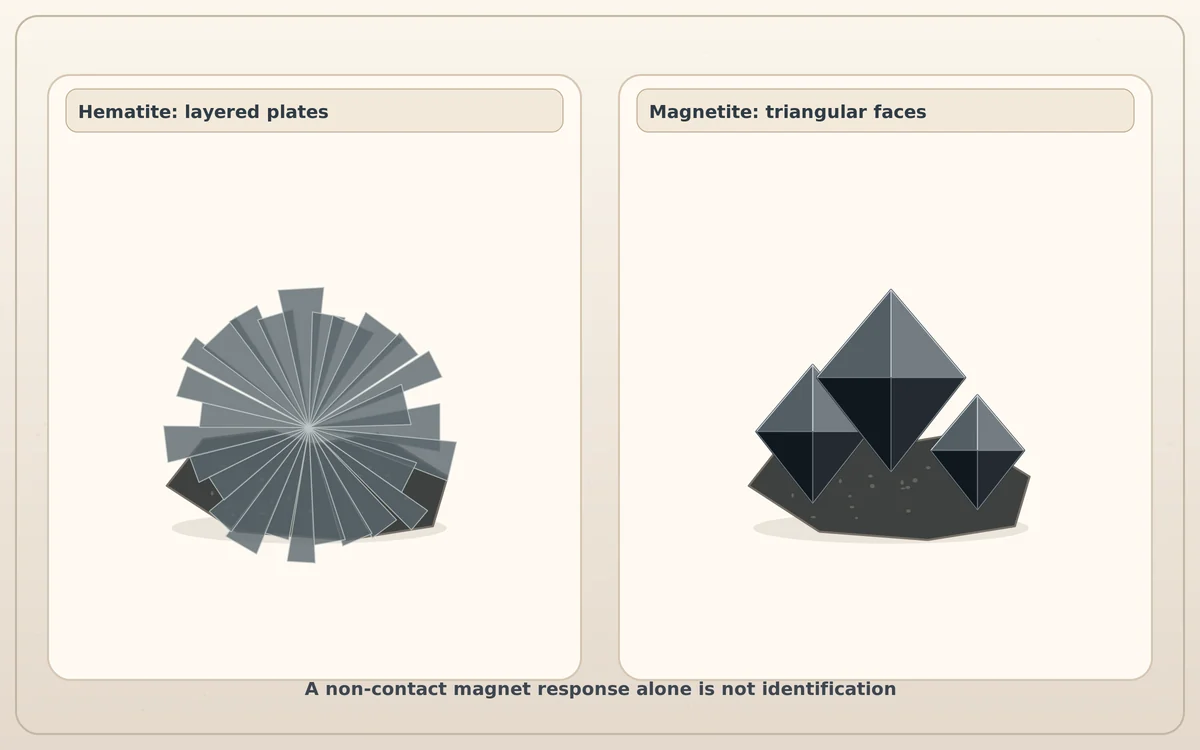
An iron rose or hematite rose describes a rosette-like grouping of flattened mineral crystals. Individual tabular blades overlap in a radiating arrangement, somewhat like petals seen from above. Their shining surfaces can appear angular, layered and nearly circular as an aggregate even though the constituent crystals are not curved flower petals. In a well-preserved piece, repeated crystal edges and overlapping growth can be examined from both front and side.
Some collectible iron roses have sharply defined plate edges and a silver-black metallic sheen. Others carry naturally adherent surface minerals, minor iron-oxide staining or matrix that makes the outline irregular. A true natural rose should not be expected to be perfectly symmetric, mirror-polished or identical to another rose in a photograph. The term rose is a descriptive habit name, not proof of a mineral species in isolation; unusual iron-rose aggregates may comprise other iron minerals. An exact species claim still requires appropriate evidence.
When comparing pieces, look for multiple independent crystal plates and the way they join. A photograph showing only the upper face can conceal a snapped rear plate, a saw-cut base, an old adhesive repair or a crowded growth junction. Ask to see a side view with a ruler and the exposed back. A naturally irregular rosette on stable matrix can be more desirable than a symmetrical-looking display whose origin or preparation is unclear.
Specular hematite and other habits
Specularite or specular hematite describes metallic, often glittering platy or micaceous hematite. It is a variety or habit description, not a new element or an alternative to the mineral name. Some pieces have numerous very small reflecting faces instead of large isolated plates. Other hematite specimens show smooth-looking rounded, botryoidal or kidney-ore surfaces caused by different growth arrangements.
These varied habits matter when selecting a specimen. A thick, compact piece may tolerate ordinary display more readily than thin and exposed plates, though neither should be subjected to abrasion. The best presentation preserves the original edges, growth contacts and attached matrix. Do not confuse a naturally layered iron rose with a polished hematite pendant or shaped ornamental sphere simply because both share an iron-oxide name.
Natural magnetite octahedra and their limits
Why eight faces are a useful clue
A natural magnetite octahedron has eight triangular faces: visually it resembles two four-sided pyramids joined base to base. In a specimen with multiple crystals, different octahedral points may intersect the matrix or one another. Some faces are flattened, interrupted or partly covered by adjacent minerals. Perfectly detached and equally proportioned crystals are not the only legitimate examples of natural growth.
The cubic crystal system allows additional forms, and magnetite can appear as masses or granular aggregates without obvious external crystal geometry. A black rough lump that attracts a magnet is not automatically a fine octahedral specimen. Ask whether the sale photo clearly shows individual crystalline faces or whether it instead depicts a magnetite-rich rock, a polished object or a composite display.
Why an octahedron is not a stand-alone identification
Other minerals can be octahedral, and an apparent octahedral shape may survive even after the original mineral has been replaced. Martite is hematite that has formed as a pseudomorph after magnetite: the outside retains a magnetite-like shape while the material has changed. A black eight-faced specimen therefore cannot be certified as magnetite merely because the outline fits an octahedron.
If a supplier offers a valuable natural magnetite octahedral crystal, request reliable identification, photographs of crystal faces, information about the host rock and any previous labels. If the specimen has been altered or is described as martite, the distinction belongs in the product description rather than being hidden in a vague “iron crystal” title.
Magnetic tests: what they can and cannot tell you
Magnetite frequently has an obvious response to a hand magnet. Many relatively pure pieces will attract one strongly, and some naturally magnetized magnetite can attract small iron objects without an external magnet. Hematite generally responds weakly or not noticeably to a simple hand magnet, but natural pieces may be intergrown with magnetite or contain magnetic inclusions. Other iron-bearing materials and manufactured ceramics can also be magnetic.
For these reasons, magnetic attraction establishes neither the full mineral identity nor natural origin. A magnet attached to a seller's hand does not show whether the object is a natural octahedral magnetite specimen, a magnetite-containing rock, a ferrite imitation or a manufactured magnet embedded in an ornamental object. Even an honest demonstration can reveal only part of a specimen's composition.
If a non-invasive check is appropriate and the specimen is not fragile, the seller may demonstrate attraction by bringing a small protected magnet close to a stable surface without letting it strike the crystal. No customer should be encouraged to slam magnets against projecting faces or use strong magnets next to electronics or other sensitive items. Do not use magnets to drag a specimen across a table. A strong magnet may pull a small mineral piece suddenly, causing avoidable impact or chipped corners.
Streak is informative, but can destroy the finish
In mineral identification, a streak is the colour of powdered mineral on a suitable unglazed ceramic plate. Hematite characteristically gives a reddish streak; magnetite typically gives black. This is a useful laboratory or teaching distinction, yet it literally removes material. It is inappropriate to scrape an iron rose, valuable magnetite octahedron or finished sale specimen to prove the label.
A seller can document a comparable sacrificial fragment from the same identified lot, where scientifically defensible, or provide reliable mineral evidence through a qualified laboratory. Neither a photo of somebody else's streak test nor a general mineral handbook should be presented as a laboratory report for the exact item being sold. For higher-value or disputed pieces, professional analytical work may be needed.
“Magnetic hematite,” hematine and manufactured lookalikes
An especially common source of consumer confusion is the phrase magnetic hematite. Many polished black, mirror-bright magnetic beads or small magnetic ornaments sold under that expression are made from manufactured ferrite-like material rather than naturally crystallized hematite. The trade term hematine (also seen as hemalyke or similar names) commonly describes such imitation or manufactured material. Its precise composition can vary by manufacturer.
A manufactured object is not necessarily defective for its intended use. The problem arises when the wording suggests that a moulded, strongly magnetic ornament is a natural hematite iron rose, a geological magnetite specimen, or a scientifically tested mineral. Buyers need a clear separation between material, form, treatment, and natural origin.
| Listing description | What should be checked before accepting it | Appropriate seller response |
|---|---|---|
| “Natural hematite iron rose” | Are there true natural overlapping plates, full-side views and species evidence? | Show the actual rosette, matrix and condition |
| “Natural magnetite octahedron” | Are eight-faced natural crystals actually visible and identified? | Show close-ups, matrix, magnetism evidence and provenance |
| “Lodestone” | Is the magnetite naturally magnetized, not merely attracted to a hand magnet? | Qualify the claim if the magnetic character is unverified |
| “Magnetic hematite beads” | Are they manufactured hematine or ferrite rather than natural hematite? | Clearly disclose manufactured material; do not claim a natural rosette |
| “Hematite after magnetite” | Is this a credible pseudomorph identification? | Use a precise label and preserve associated documentation |
| “Iron mineral specimen” | Which species are reliably identified, and which are merely suspected? | Separate confirmed facts from provisional labels |
A promotional photograph showing metallic shine, a compass needle or a magnet floating nearby is no substitute for a material disclosure. In particular, a black object with uniform cast details or matching surfaces on many supposedly unique examples deserves careful questioning. Likewise, a naturally heavy and dark piece need not be suspicious simply because it is inexpensive: real iron oxides are common. It is the unwarranted specificity of a claim, not price or appearance alone, that requires evidence.
Martite, ilmenite, goethite and other lookalikes
Several minerals can complicate visual identification. Martite, as noted, is hematite replacing magnetite and may preserve octahedral geometry. Ilmenite is another dark iron-bearing oxide that can look similar to magnetite; mixed specimens may show a magnetic response from associated magnetite. Goethite commonly occurs as brown, yellow-brown or dark iron oxyhydroxide in masses, coatings and weathered deposits. Pyrite can look metallic but commonly shows brassy-gold colours and different habits.
A specimen of mixed iron oxides may genuinely contain more than one named mineral. A patchy red-brown coating on a magnetite crystal need not be a treatment, but it should not be confidently called hematite without evidence. A black crystalline aggregate identified as hematite may contain enough magnetite to influence a simple magnet test. Reactions to magnets are also affected by the amount of magnetic mineral and its distribution in the host rock.
The sound buying approach is conservative: label the confirmed dominant species, qualify uncertain secondary minerals and keep the original locality or collection history when available. Avoid testing by acids, chipping a crystal to view its interior, polishing its faces or making an aggressive scratch on the retail piece. Those actions can reduce both scientific information and collector value.
How to read a specimen's matrix and natural surface
Matrix means the supporting rock or natural material to which mineral crystals are attached. For hematite or magnetite, a matrix can show how the crystals developed, preserve contact boundaries and make the object stable enough to display. A matrix may include quartz, other iron minerals or a mixed rock, but those associated species should not be asserted without evidence. Dark colour alone does not make every base “basalt,” and a silvery crystal cannot be assigned a particular mine from shine or shape.
Natural crystals can be incomplete where they grew against another mineral or the enclosing host. A broken surface is different from a growth face: a sharp step, fracture and changed lustre may indicate damage, but some growth irregularities are original. A flat underside may be a naturally fractured support or a trimmed base. A cut base is not automatically unacceptable; it should simply be described as prepared, and any glued mount should be documented.
For a rose, the edge and underside photographs are especially important because thin plates can break under their own weight if the object is lifted from its tips. For magnetite octahedra, include an angled view that shows multiple triangular faces and the degree to which each crystal projects beyond the matrix. These views reveal the actual material in a way that a single dramatic frontal photograph cannot.
Photographing the exact hematite or magnetite specimen
A physical mineral specimen is a particular object, not an interchangeable illustration of a species. A catalogue page should show the exact piece the buyer will receive, or clearly state that a product is a specimen family and explain what will vary. For genuine collector-grade stock, one set of representative images used for many different pieces is insufficient where rose shape, crystal breaks, matrix and condition affect value.
Before a listing is approved, prepare a simple photo set: one neutral-light front view, one side view, one rear or underside view, one scale image with a ruler, and at least one macro of the significant natural faces or any flaws. Record dimensions along meaningful axes and a measured weight for the particular piece. If a stand is removable, state whether the stand is included and whether the dimensions include it. A label such as 4 cm crystal should clarify whether the measurement covers the main crystal, the complete cluster or a mounted display.
Do not over-polish photography to erase tiny chips, natural iron-oxide staining or matrix texture. Soft, diffused light is better than a strong photographic flash that makes every dark metallic face appear as a white highlight. Colour temperature may alter the appearance of red-brown dust and black lustre, so a neutral reference image is useful. A reverse image search cannot establish authenticity or locality for an actual specimen.
Which buyer questions save the most trouble?
Ask whether the piece is a naturally grown rosette, octahedral cluster or merely a polished magnetic ornament; which mineral name is confirmed; what the matrix is; whether any faces were glued or repaired; and whether the object has been oiled, coated, heated, trimmed or mounted. Request the exact photographed item, condition disclosures, a measured weight, secure packing and a documented return procedure for transit damage. A claimed source country, quarry or laboratory identification should come with a record appropriate to that claim.
India, locality descriptions and responsible provenance
India has extensive iron-ore geology and multiple iron-oxide occurrences, but a seller should not infer that a polished black object, natural rose or magnetite octahedron comes from a famous Indian locality merely because similar minerals are found in the country. A general country label may be reported by a supplier; a quarry-level origin needs stronger documentation. Conversely, imported natural specimens can be sold by an Indian retailer without being described as Indian-mined.
A useful provenance record separates verified information, supplier-reported information and visual interpretation. The invoice and original collector label can support a reported chain of custody, while a hand-written destination or familiar mineral habit alone cannot prove extraction at that mine. Preserve older labels if present, even where modern regional names differ; they can be valuable to future collection research.
This caution matters for both minerals. Natural iron roses are documented in collections from multiple countries. Natural magnetite crystals also occur in several geological environments. None of those general facts identifies the source of a particular piece, and references to celebrated foreign specimens should be examples of geological possibility, not stock-origin claims.
Safe cleaning of iron-oxide clusters and metallic plates
For most natural hematite and magnetite specimens, preventing dust accumulation is preferable to repeated cleaning. Keep the object in a stable, ventilated, clean cabinet or enclosed display, on a support that does not press against delicate edges. Handle a sturdy base with clean dry hands or suitable gloves; avoid gripping an iron-rose plate, loose projecting magnetite octahedron or thin crack in the matrix.
If a piece is dusty, first decide whether cleaning is necessary. On a firmly attached, uncoated surface, a very soft brush or hand air blower may remove loose dust, but do not brush a shedding micaceous surface, a fragile repair or a flaky mineral association. Do not use a powered air compressor, abrasive pad, ultrasonic cleaner or stiff toothbrush. For professional specimens or uncertain surface coatings, consult a conservator instead of experimenting.
Avoid routine soaking, vinegar, lemon juice, acid cleaners, rust removers, salt-water immersion and oil-polishing recipes. These are not reliable general cleaning methods for an unknown mineral-and-matrix combination. An apparently stable iron oxide may sit on a water-sensitive or iron-sulfide-rich host. Moisture can also reach hidden adhesive or a porous display base. A quartz-associated piece may need different care from a specimen with pyrite, goethite or unknown clay coatings.
Keep specimens away from water splashes, condensation, damp bathrooms and direct contact with wet flower arrangements. If an object was accidentally wetted or develops powdery residues, photograph the change and seek material-specific guidance rather than sealing it damp inside plastic. Museum conservation guidance repeatedly warns that the cleaning method must reflect the actual mineral composition, not a generic “stone” category.
Display and storage: support, dust and magnetic safety
Hematite rose blades can catch on fabric and chip; magnetite octahedra can protrude sharply from a cluster. Give each specimen its own stable recess, small support ring or inert mount designed for its weight and shape. A non-slip support should contact a broad base rather than a sensitive face. Keep the display below an unstable high shelf, away from children's reach and from vibrations or frequent rearrangement.
Humidity, dust and abrupt temperature changes are worth controlling for any mixed collection, but do not apply pyrite-specific decay thresholds automatically to hematite and magnetite. A damp location is generally poor practice; the needs of the associated minerals and any metal mounting hardware may be more restrictive than the dominant oxide. Protect paper labels from moisture separately. Never allow a magnetic specimen to pull iron dust, staples, or loose metal fragments into delicate crystal gaps.
A strong natural or added magnet should be stored thoughtfully near magnetic-stripe items, compasses, precision instruments and sensitive electronic equipment. Ordinary natural magnetite need not be sensationalized as a technological hazard; actual field strength, proximity and whether magnets have been added matter. If a display contains powered LEDs or an electronic label, check the setup rather than making a blanket claim that all magnetite damages phones.
For shipping, support the matrix and immobilize the entire specimen in an inner container with clearance around projecting faces. Double-box valuable or fragile pieces and never press bubble wrap directly onto delicate rose plates. Inspect photographs and weigh the boxed piece so a buyer can distinguish a properly protected collectible from a casually wrapped dark stone. Heavy specimens should be supported independently from fragile crystals in the same shipment.
Hematite, magnetite and Vastu-oriented display
Within Indian spiritual and decorative practice, natural mineral forms are sometimes selected for a meditation corner, study shelf or Vastu-inspired arrangement. Contemporary crystal-use literature may associate dark iron-bearing minerals with steadiness, grounding or resolve. Such interpretations can be meaningful personal symbols, but they should not be treated as scientifically measured effects or exact prescriptions from classical Vastu treatises about hematite rosettes and magnetite octahedra.
Traditional Vastu Shastra gives attention to the orientation, organisation, light and character of a space. Contemporary placement suggestions for specific collector minerals are a different layer of practice. A home may choose a naturally formed hematite rose as a quiet desk accent or a magnetite specimen in a labelled study collection without attributing guaranteed prosperity, health, protection or planetary results to the mineral.
Where a family maintains a puja or devotional area, a small mineral can be displayed respectfully if it is stable, clean and does not obstruct lamps, water vessels or regular worship. Avoid splashing water, flowers or incense residue onto exposed natural crystal faces. Do not insist that a magnetic stone has to sit in one compass direction or that it must be used as a substitute for a gemstone prescribed in Jyotish. Practical respect for the object and the room comes first.
A collector's buying checklist for two very different minerals
Use the following checklist before selecting a naturally grown specimen rather than a polished magnetic product.
| Check | Hematite iron rose | Magnetite octahedral specimen |
|---|---|---|
| Distinctive feature | Genuine overlapping tabular blades | Documented eight-faced natural crystals |
| Main visual risk | Broken or repaired blades concealed underneath | Chipped points, flat cast-like shapes, obscure matrix |
| Mineral identity | Correct hematite label, not generic magnetic ornament | Correct magnetite label, not magnetism alone |
| Additional disclosure | Any mounting, adhesive, polishing or lost plates | Any added magnet, repair, matrix preparation or pseudomorph claim |
| Exact-item evidence | Front, edge, reverse and size photo | Face macro, side, matrix and ruler photo |
| Product readiness | Needs a real intact unique specimen | Conditional until natural stock and identity are verified |
Do not assume a premium price guarantees geological origin. A collector may value a tiny but well-formed octahedron more than a larger uncrystallized magnetite lump. A natural iron rose can also be valuable for unusually intact plate arrangement, locality evidence and association with other minerals rather than mass alone. Prices and rankings depend on the exact piece; this article intentionally does not assign unsupported market valuations or certification claims.
For OmmRudraksha's proposed catalogue, GR28 (Hematite Rose Specimen) remains a primary page concept awaiting exact-piece identification and photography. GR29 (Magnetite Crystal Specimen) is conditional and should not be published as a distinct offering until a genuine mineral sample with suitable crystal habit and evidence is verified. Proposed pyrite cube specimens are another mineral family altogether and must not be substituted merely because all three can appear metallic.
FAQ: hematite and magnetite specimens
Is hematite the same as magnetite?
No. Hematite is Fe₂O₃ and magnetite is Fe₃O₄. Both are iron oxides, but their crystal structures, usual magnetic behaviour and streak colours differ. Some natural pieces contain more than one iron oxide, so exact identification may require more than appearance.
Does real hematite attract a magnet?
Pure hematite usually shows little or no obvious attraction to a simple hand magnet. A natural hematite-rich specimen containing magnetite may respond, and some other iron minerals can confuse a test. Strong magnetic attraction therefore does not by itself prove or disprove a seller's entire description.
Why is my “magnetic hematite” bead so strongly magnetic?
Many commercial magnetic beads called hematine or magnetic hematite are manufactured ferrite-like materials rather than naturally crystallized hematite. Ask the seller for a clear material and origin declaration. Such a bead is not the same product as a natural iron-rose collector specimen.
What is a natural hematite iron rose?
It is a rosette-like growth of overlapping, relatively flat crystals, often with metallic steel-grey lustre. The name describes a natural aggregate shape. The species identity and locality still need evidence, and the thin plates may be fragile.
Are all black octahedral crystals magnetite?
No. Other minerals may form octahedral shapes, and hematite can replace earlier magnetite while retaining an octahedral exterior. Check species, magnetic behaviour, matrix and provenance instead of identifying solely from a geometric outline.
What is lodestone?
Lodestone is a historic term for naturally magnetized magnetite that can itself attract iron. Not every magnetite specimen is naturally magnetized in the same way, and an external hand-magnet demonstration does not establish a lodestone claim.
Can I test a collector mineral with a streak plate at home?
A streak test removes material and can damage crystals or polished surfaces. It should not be attempted on a one-of-a-kind purchased specimen. Request documented identification or seek qualified advice where the species claim matters.
Can hematite and magnetite be washed in water?
Do not assume washing is appropriate for a mounted or mixed-mineral specimen. The matrix, associated minerals, coatings and repairs may be sensitive. Prevent dust, use conservative dry care for stable surfaces, and consult a professional when uncertain.
How should I lift and display a hematite rose?
Support its broad, sound base or matrix with both hands as needed. Do not pinch the thin petals or balance the piece on a fragile edge. Use a stable stand in a protected location away from accidental knocks and splashes.
What pictures should I request for magnetite crystal specimens?
Ask for actual-piece photographs showing multiple crystal faces, the rear, host matrix, scale, chipped corners and any repairs. A close-up of a genuine octahedron is more informative than a generic photo of a black magnetic stone.
Is magnetism a guarantee that a specimen is natural?
No. Manufactured ferrite objects and composite decorative items can also be magnetic. A natural specimen claim depends on crystal growth, traceable material, condition and appropriate identification evidence, not a single attraction test.
Does Vastu require hematite or magnetite in a fixed direction?
There is no reliable basis to claim a universal classical Vastu rule specifying these modern collector forms in one exact direction. Some people use them symbolically in contemporary arrangements. Choose a stable, respectful display location rather than relying on guaranteed outcomes.
Final perspective: collect the crystal habit, not just the magnetic claim
A natural hematite iron rose and a magnetite octahedral cluster reward close observation. Their surface geometry tells a different story from the shiny finish of a shaped bead, and their history is clearer when the mineral label, matrix, condition and preparation are documented. A magnet or attractive colour photograph can assist a conversation, but neither replaces proper identification.
The best purchase is the actual specimen whose physical form can be seen honestly, whose uncertainties are described, and whose display and packing match its vulnerabilities. Treat iron-oxide minerals as geological objects first; their decorative and personal spiritual significance can then be enjoyed without confusing a manufactured magnet, a natural crystal and a claimed traditional remedy.
Related reading
- What Is a Crystal Cluster? Crystal Growth and Natural Forms
- How to Buy a Natural Mineral Specimen Online
- Natural Crystal Clusters and Geodes in Vastu: Traditional Placement and Meaning
- Cleaning and Storing Natural Crystal Clusters and Geodes
- How to Pack Fragile Crystal Clusters, Geodes and Mineral Specimens
- Pyrite Cubes and Matrix Specimens: Natural Forms, Vastu Associations and Storage
- Fluorite, Celestite, Aragonite and Gypsum: Delicate Specimens
- Display Stands, Bases and Labels for Natural Mineral Specimens
- Building a Small Natural Mineral Reference Collection


