

A well-chosen collection of natural minerals can make geology visible in a way that photographs alone cannot. Hold a quartz crystal next to a calcite rhomb, compare a pyrite cube with magnetite, or observe how an apophyllite crystal sits on a basalt matrix: each specimen offers a different question about composition, crystal growth, light, hardness or the history of the rock. The point is not to gather the greatest number of impressive pieces. It is to build a small, documented group that can be studied, compared, protected and understood over time.
A natural mineral reference collection is different from a bowl of polished stones, a jewellery assortment or a decorative gemstone-tree display. Reference pieces retain useful geological evidence: a characteristic crystal form, a natural matrix, a cleavage face, a mineral association or a recognisable surface texture. A small unpolished specimen may be more informative than a large sculpted ornament. Correct names and accurate labels matter just as much as appearance.
This guide explains how a beginner, family, teacher or careful collector can design such a collection without assuming that any particular commercial kit is available. It covers choosing specimens, distinguishing minerals from rocks, non-destructive observations, provenance, record keeping, safe storage, traditional Indian associations and practical buying decisions.
What makes a mineral collection a reference collection?
The difference lies in purpose, comparison and documentation. A display collection might favour dramatic colours and symmetry; a reference collection deliberately includes different properties. One specimen can demonstrate excellent crystal faces, another a visible cleavage plane, another metallic lustre, and a fourth the relationship between crystals and host rock. A teaching set can be aesthetically pleasing, but every item should answer an identifiable learning question.
Start with a written scope: small natural mineral specimens, generally unpolished, showing different crystal habits and physical properties. That scope prevents a collection from drifting into dozens of nearly identical quartz points. It also distinguishes geological specimens from tumbled-stone sets, which may be useful for studying colour and polish but often hide original crystal faces and matrix.
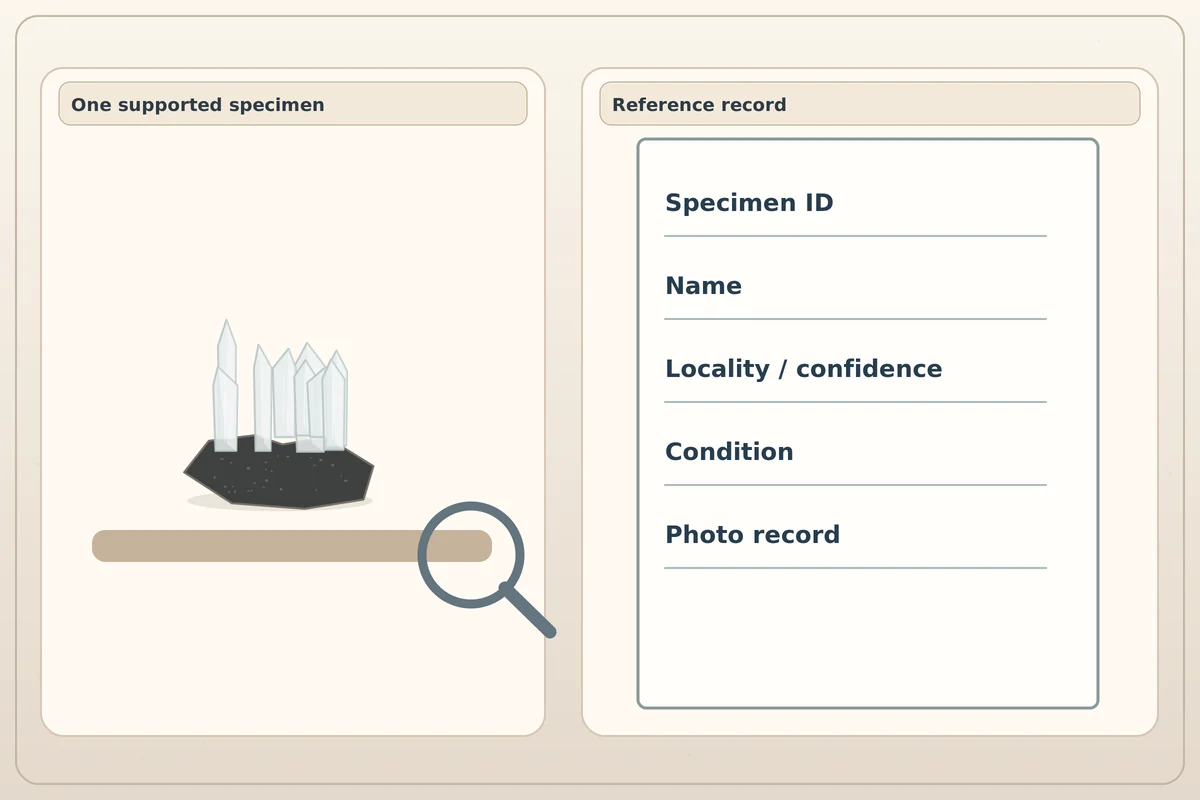
Each piece needs a stable reference number, a specimen-level label and a short condition record. The Smithsonian's mineral collections illustrate the value of catalogued objects that can be retrieved by locality, catalogue number and other contextual information. A home collection need not adopt museum-scale software to use the same underlying discipline. A notebook or spreadsheet, backed up alongside photographs, is enough to begin.
A reference specimen is not automatically a scientifically certified identification. A supplier label may be reasonable but untested; a photograph may support a broad group name rather than a precise mineral species. Keep the certainty level visible instead of turning a promising identification into a laboratory conclusion.
Begin with questions, not with a shopping list
Choose what the collection should demonstrate. A useful first group might address six questions: What is a mineral? Why do different substances grow into different shapes? Why do some crystals break along flat planes? Why does one mineral scratch another? Why are some surfaces metallic and others glassy? What do crystal and matrix together reveal about growth?
These questions lead to a balanced collection. Quartz illustrates hard, glassy crystals with no prominent cleavage. Calcite introduces different crystal habits and rhombohedral cleavage. Gypsum gives a contrast in softness. Fluorite offers cubic growth and prominent cleavage. Pyrite illustrates metallic lustre and natural cubic forms. Hematite or magnetite introduces iron-oxide properties. Feldspar and mica connect individual minerals to common rocks. An apophyllite–zeolite association can show mineral growth in cavities, provided that the identity and condition of the exact piece are documented.
Do not require a novice to buy every example immediately. Begin with six to eight safe, well-labelled pieces; add a specimen only when it teaches something the existing group does not. Where a mineral is fragile or needs difficult storage, use a photograph, drawing or museum reference for the first lesson instead of handling an unsuitable object.
A practical starting selection: forms and learning goals
The following is an educational planning example, not a fixed set, a current OmmRudraksha stock list or a promise that every form can be supplied. Select genuine individual specimens based on identification, condition, availability and safe handling. Rock specimens such as granite can be introduced separately because granite is a rock made of multiple minerals, not a mineral species.
| Candidate specimen | Useful visible feature | Main lesson | Condition or safety note |
|---|---|---|---|
| Natural quartz crystal or small cluster | Prismatic faces, natural terminations | Crystal habit, fractures, relatively high hardness | Avoid broken sharp tips; do not perform scratches on a sale piece |
| Calcite rhomb or on-matrix crystal | Rhombohedral form or cleavage | Cleavage versus growth face; carbonate identity | Soft and acid-sensitive; no vinegar demonstration on the display specimen |
| Fluorite crystal | Often cubic faces; clear cleavage contrast | Habit differs from cleavage; colour varies | Cleaves readily; limit strong light exposure for sensitive colours |
| Gypsum specimen | Tabular, fibrous or desert-rose habit | Very low hardness and form variation | Extremely scratch-prone; slightly water-soluble |
| Pyrite crystal | Metallic cubes or pyritohedra | Metallic lustre and natural symmetry | Keep dry; check periodically for signs of oxidation |
| Hematite specimen | Metallic or earthy surface; rosette habit | Iron oxide and variable appearance | Shape and magnetic response alone are not decisive |
| Magnetite specimen, if verified | Octahedral or other natural growth | Magnetic response as one diagnostic clue | Keep magnets away from sensitive equipment; genuine habit must be checked |
| Mica sheet or rock-associated mica | Thin separable layers | Sheet structure and cleavage | Layer edges are fragile; avoid peeling a valued specimen |
| Feldspar crystal or fresh rock piece | Cleavage and rock-forming context | Rock versus mineral, common silicates | Species-level name requires reasonable evidence |
| Apophyllite-group crystal on matrix | Glassy crystal growth with supporting rock | Cavity growth and multi-mineral associations | Not quartz or a zeolite; brittle cleavage and matrix need support |
| Stilbite sheaf or another identified zeolite | Bladed fans or bow-tie aggregates | Different mineral species sharing a basalt cavity | Exposed thin blades can break; choose a protected sample |
| Safe, clearly labelled basalt or granite rock | Several grains or a natural rock texture | How rocks and minerals relate | Identify as a rock, not as a single mineral species |
Not every specimen must be visually perfect. A modest quartz crystal with a natural contact and partial matrix can be more educational than a spotless polished tower. But damage should be described accurately: a broken tip is a condition issue, not an automatic sign of authenticity. An unconfirmed white needle spray should remain “needle-like mineral, identification pending” until evaluated, rather than being labelled as scolecite by colour alone.
Separate mineral species, crystal habits and geological rocks
A mineral is identified by its chemical composition and ordered crystalline structure, with recognized natural variation. A crystal habit describes the external form in which a mineral has grown; it is not a separate mineral identity. “Pyrite cube,” for example, names a growth form of pyrite. A “quartz cluster” is several quartz crystals associated in natural growth. A “calcite dogtooth” describes a habit and does not create a different species from calcite.
A rock can contain several minerals. Granite commonly contains quartz, feldspar and mica in varying proportions. Basalt can act as the host matrix for later crystals deposited in cavities. A geode is a cavity-related geological object that may have crystal linings; the presence of a hollow interior does not itself establish the species of the crystals. A tumbled quartz pebble remains quartz, but its polish usually obscures evidence of original crystal growth.
This distinction is particularly important in Indian collector material. An attractive specimen may carry apophyllite-group crystals beside stilbite and other zeolites, yet apophyllite itself is not a zeolite. Label each identified part separately when justified. Avoid “seven rare minerals” on a display card when several supposed names merely describe colour, habit or commercial nicknames.
A specimen can also contain uncertain components. One label could read “Apophyllite-group crystals with reported stilbite on basalt; accompanying fine white coating unidentified.” That is useful, transparent information. A more confident locality or specific chemical species can be added only when appropriate evidence is obtained.
Use a two-stage collection rather than buying everything at once
For the first stage, prioritise stability and comparison. A safe, small quartz specimen, calcite example, fluorite, gypsum, pyrite, feldspar and mica may offer several contrasting properties without demanding an elaborate case. Their names and properties should be checked against reliable references, not just packaging. If a piece is too delicate for routine student handling, show it under a clear cover or use a separate teaching photograph.
A second stage may add two or three more specialised examples: an apophyllite association from the Deccan Traps, a verified magnetite crystal, or an individual crystal group with prominent natural matrix. Each addition needs a clear reason. Buying five more quartz colours without a distinct teaching question does not improve a foundational identification collection nearly as much as adding a contrasting mineral structure.
Keep a separate study object if hands-on testing is required. A rough, inexpensive sample selected specifically for permissible testing can be used for hardness or streak demonstrations under supervision. Do not scratch, acid-test, break or cut a carefully documented collector specimen. Such procedures can destroy the very faces, labels and condition evidence that make it useful as a reference.
Observe first: a repeatable, non-destructive examination
A simple observation sequence teaches discipline and reduces unjustified guesses. Place the specimen on a stable tray with diffuse light, a clean background and a scale marker. Avoid balancing it on its sharpest point. Record what is visible before consulting the seller's label, then compare your notes with established descriptions.
- Record overall form: Is the object a single crystal, cluster, geode half, mineral on matrix, massive piece or multi-mineral rock?
- Inspect the surface: Look for glassy, metallic, earthy, pearly or waxy lustre, and whether the finish is natural or polished.
- Check shape carefully: Are apparent faces flat and repeated? Are there natural growth contacts, terminated tips, cleavage surfaces or broken edges?
- Note colour and transparency: Record these, but do not use colour as the sole identification test. Lighting and treatment can alter appearances.
- Identify the matrix: Where present, is it a dark host rock, a chalcedony lining, another crystal species or an artificially attached base?
- Describe condition: Note chipped ends, loose grains, repaired contacts, signs of moisture damage or any fragile overhanging features.
- Photograph the exact piece: Front, back, sides, scale and one detail view. Keep the photos tied to its reference number.
- Assign confidence: Use verified, probable, supplier-reported or unidentified, with a short reason for the designation.
A 10× hand lens is often enough to appreciate small natural facets and growth relationships. Magnification improves observation; it does not by itself turn a visual match into a lab analysis. For suspected uncommon or valuable species, seek an appropriate mineralogical assessment before advertising a specific identification.
Identification properties: useful clues and limits
Mineral identification considers several properties together. The Mineralogical Society of America's identification key and geology teaching resources discuss hardness, streak, lustre, cleavage, fracture, habit and specific gravity. Those are diagnostic tools, not instructions to damage everything you own. On a collector's item, begin with photographs, original labels, comparisons and the non-destructive observations above.
| Property | What it can tell you | What it cannot prove alone |
|---|---|---|
| Colour and transparency | Visible appearance and possible zoning | Mineral species, natural origin or absence of treatment |
| Crystal habit | Clues from cubes, prisms, plates, sheaves or sprays | Certain identification without chemistry and structural context |
| Cleavage and fracture | How a mineral tends to split or break | Whether any particular flat face is an untouched growth termination |
| Lustre | Glassy, metallic, pearly or earthy surface character | Composition when multiple minerals share a similar appearance |
| Streak and hardness | Strong diagnostic evidence on appropriate teaching material | Safe testing instructions for delicate or unique display specimens |
| Magnetic response | A useful clue for some iron minerals | Automatic proof of natural magnetite or hematite identity |
| Matrix and associations | Geological environment and growth relationships | Exact quarry, mine or locality without records |
A polished magnetic item sold as “magnetic hematite” is not a substitute for an authenticated natural magnetite crystal in a crystallography lesson. Similarly, a bright orange quartz point does not necessarily demonstrate untreated natural citrine colour. Where treatments, synthetic origin or reconstructed objects are possible, the label should distinguish observed appearance from verified history.
Labels: every specimen needs a stable identity
Give each object an independent number, such as NMR-001, and never recycle it after an item is lost or moved. Put a small, non-damaging label in its compartment or on its separate base. The specimen number should link to a fuller record outside the display tray. The number is an internal reference, not a scientific certification or a locality guarantee.
| Field | Example or instruction | Why it matters |
|---|---|---|
| Specimen number | NMR-001 | Connects the specimen, label and images |
| Mineral or rock name | Quartz (reported natural crystal) | Avoids confusion between species and commercial names |
| Composition or group | SiO₂, when identity is supported | Adds an educational property without asserting extra species |
| Form or habit | Multiple naturally grown points on matrix | Describes what the student can actually see |
| Locality | “India, reported by supplier; not independently verified” | Preserves the quality of provenance evidence |
| Source and date | Supplier invoice or lawful collection note | Supports traceability and later inquiries |
| Size and weight | Actual recorded measurements | Helps packaging and later condition comparisons |
| Condition and treatment | Minor tip chip; treatment not confirmed | Avoids misleading claims about perfection or origin |
| Identification confidence | Confirmed by test, probable, reported or unknown | Makes uncertainty explicit |
| Image references | NMR-001-front.jpg; NMR-001-detail.jpg | Supports future examination and replacement records |
Place the display card where it can be read without picking up the mineral. Keep the original supplier label even if a later evaluation revises the name: the correction belongs in the record history. For an educational reference set, a specimen changing identification is an opportunity to teach how evidence improves knowledge, not a reason to erase the earlier label.
An optional larger card may describe cleavage, hardness and habit, but qualify values as typical properties of the identified mineral, not laboratory measurements of this particular piece. If the object is a mixed-mineral association, one property table may not apply equally to every visible crystal.
Provenance and responsible acquisition
Collectors should know the difference between a reliable specimen history and a famous locality printed as a marketing claim. “Maharashtra, India” and a named quarry near Jalgaon are not interchangeable. Similar-looking apophyllite or zeolite specimens can occur at multiple sites. Keep a supplier's reported locality marked as reported until there is a traceable collection record, old label, invoice, reliable lot record or equivalent basis.
The most robust beginner approach is to obtain legally sourced specimens from sellers willing to identify the actual item, disclose notable treatments and keep available provenance information. If collecting directly in the field, determine the permissions, land status, conservation restrictions and mineral rules that apply in that place. Field access does not automatically grant permission to remove specimens. Avoid protected areas, unsafe mine workings, active excavation sites without authorisation, and destructive collection practices. Geological Society of America guidance stresses legal permissions and limiting disturbance; those principles also make sense for responsible private collecting, while local Indian law and site rules must be checked separately.
Replaced, repaired or damaged pieces deserve a retained history. If a specimen is split into two study portions, give each part its own suffix and record the relationship. Do not silently relabel an old, unidentified piece with a fashionable location because it resembles a current market listing.
Storage: one mineral-care rule does not suit every sample
A reference collection works only if it survives handling. Use separate trays or compartments lined with clean, compatible padding. Keep sharp points from touching adjacent specimens, and do not press fragile crystal sprays into dense foam. Heavy stones need a supported base; geodes need rim clearance and secure placement. Labels should be present without adhesive on exposed crystal faces.
Light, temperature, humidity and airborne pollutants affect mineral species differently. Some fluorite colours may fade in strong light, gypsum can be scratched easily and should not be washed casually, and apophyllite or zeolite sprays may have brittle protrusions. Pyrite that is actively oxidising needs careful isolation and humidity control rather than a damp display cabinet. The National Park Service and conservation organisations recommend suitable housing and preventive care, not one universal cleaning bath for all geological objects.
For a small collection at home, choose a clean, dry, stable indoor place away from direct sunlight, sinks, windows with condensation, cooking fumes and frequent vibration. Check a piece's particular conservation needs before sealing it with wood, household foam, soft plastic or an unknown adhesive. Some storage materials release harmful compounds over time. Wash hands after handling geological objects and avoid breathing dust or touching potentially hazardous powders.
Not every mineral belongs in a children's handling kit. Avoid loosely stored asbestiform/fibrous materials, radioactive specimens, toxic mineral powders and questionable arsenic-, mercury- or lead-bearing material for a beginner set. If identification or safety is uncertain, segregate the item and seek expert advice. A labelled photo can teach the same basic recognition lesson without unnecessary exposure.
Organise the box to teach comparisons
A useful layout has a learning order, not simply a rainbow of colours. Place quartz and calcite side by side to compare cleavage tendencies; show gypsum and a harder mineral to discuss scratch resistance without performing an actual scratch test; pair a metallic pyrite crystal with a nonmetallic example for lustre; and distinguish a natural mineral on matrix from a multi-mineral rock. Use removable compartment dividers so a changing curriculum does not require moving attached labels.
A twelve-slot tray does not need twelve minerals on day one. Leave blank positions for future evidence-backed additions, or for two views of one complex specimen. The display card can contain a short observation prompt: “Find two natural faces”; “Identify the host rock”; “Which part is the matrix?” Keep front-facing labels brief and move extended explanations into a booklet or record sheet.
For public display, provide a scale and a clear instruction not to touch fragile samples. For home use, a transparent case protects fragile edges from dust and curious hands. Do not assume the case is stable simply because it looks attractive: check its weight, hinges, edges and centre of gravity, and make sure it cannot slide off the shelf.
A four-session learning plan
Session 1: Recognise the material. Begin by sorting photographs or specimen cards into minerals, rocks, geological cavity objects and worked ornaments. Compare a natural quartz cluster with granite. Ask students to explain why a rock can contain multiple minerals. No specimen needs to be scraped, soaked or broken.
Session 2: Describe without naming. Give learners a quartz specimen, a calcite crystal and a metallic example under supervision. Have them write shape, lustre, observed faces and visible matrix before seeing their labels. Compare the observations with descriptions from a museum or mineral identification key. A well-supported answer includes observations and uncertainty, not only a memorised name.
Session 3: Follow provenance. Take one documented item and trace its specimen number, supplier record, locality confidence, purchase date and condition photographs. Contrast that with a stone whose supplier provided no location. Discuss why “unknown locality” is better than inventing a specific mine. This exercise turns basic mineral collecting into sound evidence practice.
Session 4: Curate and protect. Ask learners to arrange the collection so each item teaches something different. They prepare label cards and explain why pyrite should be monitored for oxidation, why a gypsum specimen needs gentle handling and why a fine zeolite spray should not be passed around. Record any changes in condition before returning the pieces to the box.
Repeat the sessions after a few months. A good reference collection grows through sharper questions and improved documentation, not through constant purchasing.
Display traditions in an Indian home: Vastu and mineral science
Mineral specimens can be appreciated in Indian homes as natural forms of Prithvi tattva, the earth element, and as objects of study, beauty and contemplation. Traditional Vastu Shastra addresses built space, directional planning, light, proportions, function and the relationship between activities and their settings. These established concerns provide a meaningful context for selecting a safe and orderly display area, keeping an entry uncluttered and respecting household worship spaces.
Contemporary crystal-placement practices are not the same as mandatory classical Vastu prescriptions. Quartz, pyrite, amethyst and other minerals may be given symbolic associations in modern spiritual retail descriptions, but such associations should be identified as contemporary beliefs unless supported by a specific traditional source. Do not state that a particular mineral collection must stand in the north-east, south-west or Kubera corner for guaranteed prosperity, health or educational achievement.
The practical side of placement is clear: choose a stable shelf with suitable light, manageable dust, safe access and no falling hazards. If a household wants to keep the collection near a study desk or a quiet meditation area, the intention may be meaningful without changing the mineral's chemical identity. In a puja space, prevent contact with water, oil, lamps, incense heat or other materials that could harm fragile specimens. The broader Vastu guidance can complement placement planning, while the mineral labels should remain geologically accurate.
Buying a collection versus assembling individual specimens
Buy from the individual specimen outward, not from a generic description such as “mixed 12 natural healing crystals.” Request clear photos, names, measurements, provenance confidence, treatment information and condition notes. Identify what the price includes: one labelled specimen, a stand, a protective box, multiple pieces or a fully assembled assortment. If there is a set, require a fixed list of actual components and a record that connects each piece to its label.
For a responsible labelled set, a seller must verify a bill of materials, safe packaging for the full mix and whether replacements would change the educational contents. One strong specimen of each kind is preferable to a number of anonymous fragments with unsubstantiated names. Do not list an unverified composition or promote a set as available merely because its concept has an internal product code.
For OmmRudraksha, the proposed GR35 labelled natural mineral reference set remains a held concept, not a current sale offer. Its composition, exact natural specimens, labels, safety and condition, storage tray, packing method, stock and relationship to an existing tumbled-stone teaching product must all be established before any standalone product page is approved. This educational guide does not imply those conditions have been met. Similarly, proposed apophyllite and pyrite specimens are examples for future catalogue relationships, not live links or confirmed availability.
Frequently asked questions
1. How many specimens should a beginner start with?
Six to eight thoughtfully chosen and reliably labelled specimens can demonstrate a useful range of crystal shapes, lustre and hardness relationships. The exact count is less important than whether each item adds a different geological lesson. It is reasonable to expand gradually and keep empty slots in the tray.
2. Are tumbled stones suitable for a mineral reference collection?
They can support lessons about colour, polish, density or commercial processing, but tumbling often removes natural terminations, cleavage surfaces and matrix. For a collection centred on crystal habits, include unpolished examples. Keep any tumbled-stone assortment as a separate comparison group rather than calling it a natural crystal-growth series.
3. Is a geode a mineral species?
No. A geode is a cavity-related geological object whose interior may contain quartz, chalcedony, calcite or other deposited material. The mineral species must be identified separately. A cut, polished exterior is preparation of the specimen and should not be mistaken for its original natural surface.
4. Can a crystal's colour prove its mineral identity?
Usually not. Different minerals can share a colour, one mineral can occur in many colours, and lighting, surface coating or treatments may alter appearance. Examine habit, matrix and other properties, then keep an appropriate confidence level. Unusual or expensive specimens may require professional analysis.
5. Should I scratch every specimen to test hardness?
No. Scratching leaves permanent damage and can destroy delicate faces. Use dedicated, expendable teaching materials if a supervised practical experiment is necessary. For collector specimens, rely first on non-destructive observations and reliable provenance information.
6. What should a specimen label say when the locality is unknown?
Write “locality unknown” or “India, supplier-reported; unverified” if that is the actual level of evidence. Record the source, date and label history. Do not assign a named quarry from a visual resemblance to a photograph. Honest uncertainty makes the collection more credible.
7. Do all natural minerals belong in the same storage box?
Not without considering individual care needs. Gypsum is very soft, fragile zeolite sprays need clearance, fluorite can cleave, and vulnerable pyrite needs dryness and monitoring. Some minerals present dust, toxicity or radioactivity concerns and should not be in a basic handling collection. Use species-aware compartments and specialist advice when appropriate.
8. Can magnetism reliably separate hematite from magnetite?
Magnetic response can be a useful clue, but natural mixtures and manufactured magnetic materials complicate the result. A strongly magnetic polished bead sold as “hematite” is not proof of a natural hematite crystal, and a weak response does not complete an identification. Observe actual mineral habit and seek verified labels.
9. Why keep the original supplier label if the name changes?
The original label forms part of the object's documentary history. A revised identification should be added to the specimen record with the date, reason and evidence, while the old label is retained or photographed. Without that history, later collectors cannot understand why a name or locality changed.
10. What is the difference between a reference set and a gemstone gift set?
A reference set is arranged to teach mineral properties, natural forms, matrix relationships and documented identities. A gift set may be selected chiefly for colour, decorative finish or theme. Either can be attractive, but a scientific teaching claim requires dependable specimen-level labels and a consistent, checkable contents list.
11. Does Vastu prescribe a specific arrangement for these minerals?
Vastu provides a framework for ordered, suitable spaces; contemporary spiritual interpretations also give symbolic meaning to certain crystals. It is not accurate to treat every modern crystal-direction chart as a universal instruction from classical Vastu texts. Use a practical safe display position and describe personal beliefs without guaranteeing outcomes.
12. Is OmmRudraksha's proposed labelled mineral reference kit available now?
This article is educational. A proposed labelled-set concept must first pass verification of the exact specimen list, labels, condition, packing and stock, and must be clearly distinct from an existing tumbled-stone set. No purchase availability is asserted here; individual products should be linked only after their real catalogue records and stock are confirmed.
A lasting collection is one you can explain
A strong small collection does not need rare minerals, luxury boxes or a large budget. It needs a clear purpose, a sensible spread of natural forms, good observations, reliable labels and appropriate care. A crystal with modest colour but traceable provenance can be more useful than a dazzling unnamed object. A specimen whose identification is revised carefully has taught something valuable. And a set that remains safe and understandable years later is more meaningful than a crowded display of unrecorded purchases.
Begin with a few genuine, manageable minerals. Give them unique numbers, document their condition, compare their natural features and expand only when a new example answers a new question. That is how a small mineral collection becomes a dependable personal reference rather than just an assortment of stones.
Related reading
- What Is a Crystal Cluster? Crystal Growth and Natural Forms
- Geodes, Druzy Specimens and Agate Nodules: What Is Different?
- How to Buy a Natural Mineral Specimen Online
- Natural Crystal Clusters and Geodes in Vastu: Traditional Placement and Meaning
- Cleaning and Storing Natural Crystal Clusters and Geodes
- How to Pack Fragile Crystal Clusters, Geodes and Mineral Specimens
- Clear, Milky and Smoky Quartz Clusters Compared
- Indian Mineral Specimens: Apophyllite, Stilbite and Associated Minerals
- Apophyllite Crystal Specimens: Identification, Matrix and Care
- Stilbite, Scolecite and Heulandite: Comparing Crystal Habits
- Pyrite Cubes and Matrix Specimens: Natural Forms, Vastu Associations and Storage
- Fluorite, Celestite, Aragonite and Gypsum: Delicate Specimens
- Hematite and Magnetite Specimens: Forms and Buying Questions
- Display Stands, Bases and Labels for Natural Mineral Specimens


