

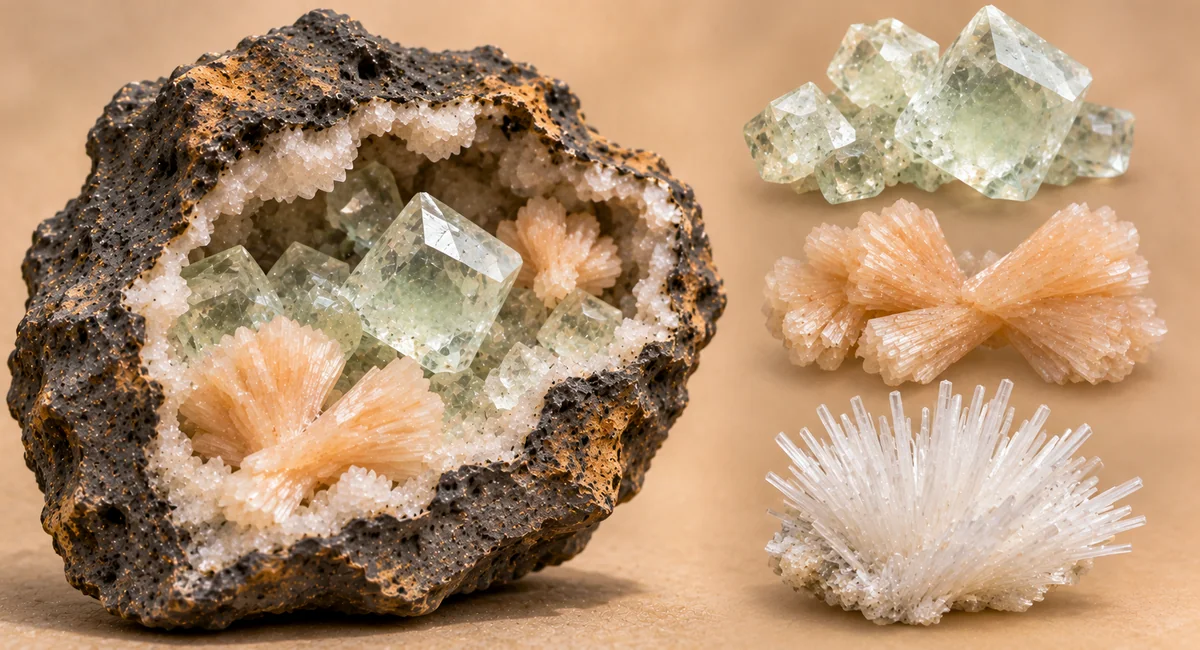
India is internationally known for spectacular mineral specimens in which clear or pale-green crystals rise from dark basalt, surrounded by cream, peach, white or pink mineral groups. Many of these displays come from the Deccan volcanic province of western India. A specimen may combine glassy apophyllite-group crystals, sheaf-like stilbite, fine scolecite sprays, heulandite plates and earlier layers of chalcedony or calcite. Their beauty comes from several different minerals sharing a single geological setting, not from being one generic “Indian crystal.”
Understanding these associations makes a collection more meaningful. It helps explain why a pale-green crystal may not be quartz, why a peach bow-tie group is not automatically calcite, and why the expression zeolite cluster needs care when an apophyllite-group mineral is the main attraction. It also shows why a seller should document the identity, locality and condition of the exact piece offered, rather than assigning every colourful Deccan specimen the same mine name.
This guide introduces the geology of Indian basalt-pocket specimens, the minerals commonly seen together, the distinctions between apophyllite and true zeolites, and the questions that matter when buying, displaying and preserving these naturally formed assemblages.
Why western India produces such remarkable mineral specimens
The Deccan volcanic province and its basalt flows
The Deccan Traps cover a large part of western and central India and consist predominantly of multiple lava flows. The familiar stepped landscape reflects layers of rock produced by volcanic eruptions. Their worldwide geological importance is separate from the later mineral specimens that collectors treasure: many decorative crystals developed after the basalt itself had solidified.
As volcanic rock cooled, gas bubbles could leave openings known as vesicles. Fractures, larger pockets and other permeable zones also created places through which fluids could circulate. Some empty spaces remained open; others became partly or completely filled by newly precipitated minerals. A vesicle filled with secondary minerals is often called an amygdale. Collectors use the broad expression basalt cavity specimen for pieces that preserve crystals grown in such openings.
Mineral-rich fluids interacting with the basalt supplied dissolved elements. Changes in fluid chemistry, temperature and other conditions allowed successive minerals to crystallize along pocket walls or over existing crystals. The precise sequence is not identical from quarry to quarry, or even from pocket to pocket.
Why one specimen can contain several mineral species
A dark host-rock base may have a pale chalcedony lining, with zeolite-group minerals deposited over it and later apophyllite-group crystals projecting into remaining space. Another pocket can show a different order, a different mineral mixture or only one conspicuous species. Natural growth contacts, overlapping blades and partially covered surfaces are clues to this history.
Scientific work on the Deccan volcanic province has documented complex, multi-stage cavity mineralization rather than one simple event. Research at the Savda quarry complex near Jalgaon, Maharashtra, for instance, describes secondary minerals including chalcedony, calcite, heulandite, stilbite and apophyllite, with evidence that formation occurred in stages. The result is a valuable reminder: an appealing combination of species is not proof of a single universal growth sequence.
Indian mineral specimens at a glance
These names refer to different mineral species or groups. Shape and colour are useful clues, but a visual guess is not a substitute for proper identification.
| Mineral or group | Typical appearance in a collector specimen | Correct classification | What deserves attention |
|---|---|---|---|
| Apophyllite-group minerals | Clear, white or pale-green, often blocky to pyramidal glassy crystals | Hydrated sheet-silicate group; not a zeolite | Cleavage, damaged faces, species-level identification |
| Stilbite group | Cream, white, peach or pink blades forming sheaves and bow ties | Zeolite-group minerals | Sheaf tips, surface damage, correct mineral name |
| Scolecite | White or colourless slender needles and radiating sprays | Zeolite-group mineral | Extremely exposed, delicate points |
| Heulandite subgroup | Often pearly, tabular or bladed crystals in light colours | Zeolite-group minerals | Identification and condition of thin plates |
| Mordenite | Fine fibres or slender aggregates, sometimes in early cavity coatings | Zeolite-group mineral | Fine-fibre fragility; avoid casual abrasion |
| Chalcedony | Compact, waxy-looking or botryoidal silica layers | Microcrystalline silica, not a zeolite | Whether a coating predates later crystals |
| Calcite | Crystals or coatings in varied shapes, sometimes close to zeolites | Calcium carbonate | Cleavage, acid sensitivity and correct distinction from quartz |
| Cavansite | Small intensely blue crystal groups on associated matrix in some Indian specimens | Separate calcium vanadium silicate mineral | Identification, fragility and locality evidence |
One specimen does not have to include all these minerals. The seller should identify only the materials reasonably established for the piece in hand. If a tiny white coating cannot be identified reliably, the correct description may be “unidentified secondary mineral” rather than a confident species name.
Apophyllite: the glassy crystal that is not a zeolite
In commercial listings, apophyllite is often used as a convenient group name. In formal mineralogy, however, the apophyllite group contains multiple species. Fluorapophyllite-(K) is a familiar and widespread member; another specimen may require a different species designation, or may not have been tested to that level.
Apophyllite-group minerals are hydrated silicates with a sheet-like structural arrangement. Although they regularly occur beside natural zeolites and are sold in the same collector category, they should not be described as a zeolite species. Calling a piece an apophyllite and zeolite association is reasonable where the accompanying zeolite is identified; simply declaring “apophyllite is a zeolite” is not.
Well-formed apophyllite-group crystals can appear square in cross-section, with broad reflecting faces and distinctive pyramidal or flattened terminations. Some are transparent; others are milky, white or greenish. Their brilliant appearance is one reason they can be mistaken for clear quartz in photographs. Colourlessness alone does not justify calling apophyllite Sphatik. Sphatik ordinarily refers to quartz in Indian gemstone and devotional terminology, whereas apophyllite is a different mineral group.
Cleavage is important to collectors. An apophyllite crystal can break along a preferred internal plane, leaving a smooth-looking flat face. A flat surface may therefore be a cleavage break rather than a complete natural termination. In buying photographs, examine the top and sides, not just the attractive front view. Do not scratch or strike an individual crystal to test it.
When a vendor knows only the broad group, the honest label is apophyllite-group crystals or apophyllite specimen, species not laboratory confirmed. A more specific label such as fluorapophyllite-(K) is appropriate when the identification has reasonable support. A special colour, a seller's claim, or a familiar Maharashtra appearance alone is insufficient for species-level proof.
Stilbite: delicate sheaves and bow-tie crystals
Stilbite is among the well-known zeolite minerals associated with Deccan basalt cavities. Its crystals frequently form blades arranged in curved fans, sheaves or the symmetrical-looking aggregates called bow ties. Cream, pale pink and peach shades can look especially striking alongside glassy green apophyllite and dark basalt.
“Bow tie” is a description of crystal habit, not the formal mineral species. Several related zeolite-group minerals can show similar external shapes; the stilbite subgroup includes more than one member. A seller may use stilbite as a general identification when species-level analysis is unavailable, while avoiding unjustified certainty about the chemical end member.
Stilbite should not be judged as if it were a tumbled gemstone or jewellery bead. The ends of its thin blades can abrade or detach, especially if repeatedly touched. A small sheaf naturally crowded by other crystals is not necessarily a defect; a snapped blade, visible adhesive or detached remnant is a separate condition matter.
For a combined specimen, photograph the stilbite from the side as well as the front. The side view shows whether the sheaf is firmly attached to matrix or projecting unsupported into space. In any description, explain which mineral is the main display feature rather than calling the entire piece simply “green apophyllite” when prominent stilbite is present.
Scolecite, heulandite and other associates
Scolecite: slender needles and radiating sprays
Scolecite commonly forms slender, needle-like crystals, sometimes in bundles or sprays. It belongs to the zeolite group, unlike apophyllite. White sprays may create a dramatic contrast against dark basalt, but their thin extremities are particularly exposed to breakage. The specimen's attractiveness can depend on intact needles that should never be grasped during handling.
When apophyllite and scolecite appear together, there are two separate mineral identities to check. The general category apophyllite with zeolite minerals may be useful as an umbrella description; the specific phrase apophyllite with scolecite should be used only when that association is reasonably established. Scolecite should not automatically be substituted for other needle-like zeolites such as mesolite.
Heulandite: plates and growth layers
Heulandite-group minerals can show tabular or bladed crystals with attractive pearly-looking faces. They are recognized from Deccan basalt cavities and can occur in assemblages with stilbite, scolecite, calcite and apophyllite. Identifying a small plate solely from a photograph may be difficult because related zeolites and some other minerals can resemble one another.
The exact growth order can vary. A layer that appears to underlie the main crystals may represent an earlier deposit, but interpreting that sequence reliably may require examination beyond retail photography. For an honest product description it is better to report the visible association than to invent a detailed geological story for an individual specimen.
Cavansite, calcite, chalcedony and others
The best-known Indian collector combinations are not limited to apophyllite and zeolites. Some basalt pockets host blue cavansite groups, calcite crystals or chalcedony linings; other mineral species may occur in small amounts or within particular localities. Cavansite is not a general word for any blue inclusion, and calcite is not quartz. Their different chemical compositions can have consequences for cleaning and storage.
A complex piece may be legitimately sold as a multi-mineral assemblage if each significant species is stated with an appropriate confidence level. The vague expression zeolite stone loses useful information when the dominant mineral is apophyllite or calcite. Collectors should be able to tell which part of the specimen each mineral name describes.
A specimen can tell a story through its matrix
Matrix means the host rock or mineral base on which prominent crystals are attached. In the Deccan context, this may be basalt or a secondary mineral lining of a former cavity. The matrix is not merely excess weight: it can preserve the natural relationship between the mineral species and make the specimen more informative.
A dark basalt remnant can contrast visually with bright crystals. A fine white coating may cover basalt before larger transparent crystals appear. A curved cavity-wall fragment can indicate where mineral growth once extended toward empty space. A sawn or trimmed base may have been prepared so the object can stand safely. The presence of a flat base does not necessarily mean the displayed crystals were carved, but the preparation should be disclosed.
A specimen called apophyllite on stilbite suggests that stilbite acts as the supporting surface, while apophyllite with stilbite on basalt describes both visible minerals on a rock matrix. These distinctions should be based on the actual piece, not chosen simply to add extra keywords.
Reading natural growth contacts
Where a later crystal sits over an earlier surface, there may be partly hidden faces or distinct changes in texture. This can be a natural growth relationship. Conversely, a point attached with modern adhesive, a separately assembled mineral perched on a different matrix, or a repaired break needs independent disclosure. A close-up of the junction often provides more useful information than a distant promotional image.
The absence of visible adhesive is not absolute proof that a specimen is unrepaired. Good sellers keep condition and preparation records, especially for valuable one-of-a-kind combinations.
How well do locality labels identify an Indian specimen?
Western India is a region of documented and historically important mineral collecting. Localities associated with Deccan basalt specimens include areas around Pune, Nashik and Jalgaon in Maharashtra, among others. Scientific studies specifically address the Savda quarry complex near Jalgaon and basalt occurrences around Mumbai. These are documented geological examples, not a blanket statement that every Indian apophyllite or stilbite specimen comes from one of those sites.
The label India gives a broad country of origin; Maharashtra, India is more specific; a reliable quarry-level identification is more informative still. It should be retained only when supported by a supplier record, original label, documented collection history or another traceable source. A mineral pairing that resembles a photographed specimen from Jalgaon cannot by itself prove a Jalgaon origin.
For collecting or purchasing, distinguish three kinds of information:
- Verified label: a recorded locality tied to the exact specimen or documented collection lot.
- Reported but unconfirmed label: the supplier provides a locality without enough history to substantiate it; retain the report with qualification.
- Visual guess: the seller assigns a famous quarry name because the appearance is familiar. This should not be converted into a factual origin.
Avoid automatically using older place names such as Poona or Bombay on a modern sales page without explaining that they are historical names appearing in older publications. A named geological district is not proof of a particular mine, collector or excavation date.
How to compare two apophyllite-and-stilbite specimens before buying
Two specimens can have the same mineral names yet differ dramatically in form, rarity, condition and suitability for home display. Use the following comparison rather than assuming identical pricing or substitutable stock.
| Buying question | What a useful listing should show | Why it matters |
|---|---|---|
| Which mineral is dominant? | Close photographs and a clear two-or-three-mineral description | Distinguishes a prominent apophyllite display from a stilbite bow-tie specimen |
| What is the form? | Front, side, back, and base images | Reveals crystal orientation, exposed sprays and stable display angles |
| Are all tips intact? | Macro images of glassy terminations and thin blades | Separates natural growth contacts from obvious impact damage |
| Is the piece repaired or assembled? | Disclosure of adhesive, restoration or joining | Important for condition and long-term stability |
| Where does it come from? | Original label or source-record level of confidence | Prevents unsupported quarry and district claims |
| Is it the exact item? | Photographs, dimensions, weight and unique stock code for that piece | Natural specimens vary too much to substitute representative photos |
| How should it be packed? | Support method based on the strongest matrix and fragile tips | Reduces transit damage and surprise arrival condition |
| Does it need a stand? | Weight-bearing base and included stand, if any | A projecting crystal group may not balance safely on its own |
A collecting label can be concise without being vague. For example: Apophyllite-group crystals with stilbite on dark basalt matrix; Maharashtra, India (supplier-reported); exact species and quarry not independently tested. That is more informative than 100% natural rare green zeolite crystal from a specific secret mine, when no evidence supports the stronger claims.
Display, Vastu associations and respectful Indian use
Indian homes may display natural mineral specimens in studies, living rooms, reception spaces, meditation corners or near personal collections. In contemporary Vastu-inspired practice, owners sometimes choose light-coloured crystals for a calm appearance or use visually striking multi-mineral clusters as objects of attention. There is also a cultural distinction between decorative crystal specimens and established ritual objects such as a prescribed Yantra, deity image or Sphatik mala.
Traditional Vastu considers the arrangement of space, orientation, appropriate room use, proportion, natural light and the household setting. It is not accurate to suggest that classical Vastu texts specifically prescribe fluorapophyllite-(K) with stilbite in a fixed direction simply because that specimen is now offered commercially. A collector may meaningfully display a Deccan specimen in a puja-adjacent or contemplative setting, while describing that choice as a contemporary decorative or devotional preference rather than an ancient mineral-specific injunction.
For wider context on home arrangements and the types of objects available, see the Vastu collection.
For placement, prioritize a clean and stable surface that does not obstruct movement. An open, needle-rich scolecite spray is less suitable for a frequently handled shelf or a child's reach. A heavy basalt-base specimen belongs on a load-bearing surface, not a narrow ledge. Sharp and brittle crystals should be positioned away from curtain movement, door swings and pets. In a worship area where water, oils, incense or flowers are used, keep the specimen separate from substances that could wet or stain its minerals and matrix.
The word Sphatik should be reserved for its appropriate quartz context; a transparent apophyllite specimen is not automatically a substitute for a Sphatik religious object. Traditional significance can be discussed respectfully without claiming that any specimen cures illness, guarantees wealth or changes measurable room energy.
Cleaning, humidity and protecting delicate crystal faces
A Deccan association may contain minerals with different cleavage, surface hardness and responses to moisture. The least robust constituent determines the safest handling approach. A smooth quartz bead-care instruction should never be copied directly to a fragile apophyllite-and-stilbite combination.
Begin with dust prevention. A covered display cabinet or suitable clear specimen case reduces the need to touch exposed crystals. Handle the piece only by a structurally stable matrix or by its fitted support, never by a green apophyllite tip or a stilbite bow tie. Do not brush delicate scolecite needles; even a soft brush can catch them. Avoid routine soaking, ultrasonic cleaning, steam, household acids, detergents and salt-water rituals on an unidentified mixed-mineral specimen.
The safe default is no wet cleaning until the full mineral association and any repairs are understood. Where dust must be removed, consult specimen-specific conservation advice and use a non-contact or carefully controlled method suitable for that piece. Keep display conditions reasonably stable rather than exposing hydrated minerals to cycles of intense heat, direct sun, condensation and damp storage. Different mineral species respond differently to environmental extremes, so a single humidity target should not be imposed on every specimen.
For long storage, use a clean, stable tray or enclosure, prevent the item from tipping, protect projecting crystals from touching the lid, and preserve its paper or digital label. Any separated fragments should be retained with the original item record, not quietly discarded or glued back without noting the intervention.
Shipping an Indian multi-mineral assemblage
A mineral combination can be physically more vulnerable than either species sounds on paper. A heavy basalt base may survive a drop while glassy apophyllite faces cleave, stilbite blades snap or fine scolecite sprays disintegrate. Bubble wrap pressed directly onto crystal tips is particularly problematic because removing the wrap can apply force to the most delicate parts.
The packer should assess the actual specimen, stabilize its strongest structural points, leave clearance around projecting crystals, and immobilize the supported piece within a protected inner package. A second cushioned carton can provide an additional shipping buffer when the item and transport mode permit it. Fragile needle-rich specimens may require specialist supports or collection-only arrangements rather than ordinary courier dispatch. A generic “fragile” sticker is not an adequate packing method.
Before dispatch, record the exact specimen, all major faces, the base, dimensions, weight, pre-existing damage and packing state. The recipient should open the package on a stable low surface and inspect the piece against those records. Instructions for packing and unpacking should accompany a collector-grade item.
A collector's label for a natural Indian mineral assemblage
An informative card need not be long. It should be precise about what is known and explicit about what is not. A useful format is:
Apophyllite-group crystals with stilbite on basalt
Locality: Maharashtra, India — supplier-reported; quarry not independently verified
Specimen: unique item code, exact dimensions and weight
Condition: natural growth contacts; observed chips, repairs or trimmed base described separately
Identification: visually consistent with the stated minerals; species-level analytical testing not performed
Care: fragile projections; keep on stable support and avoid routine wet cleaning
This is a label template, not a statement about a real OmmRudraksha inventory item. A real product record must replace every example field with information from its own photographed specimen.
Frequently asked questions
Is Indian apophyllite a zeolite?
No. The apophyllite group is a different family of hydrated silicate minerals. It commonly occurs with true zeolites, including stilbite and scolecite, in basalt cavities. A marketplace grouping that combines them does not change their mineralogical classification.
Is green apophyllite the same as clear quartz or Sphatik?
No. Green or colourless apophyllite can resemble quartz in photographs, but their mineral identity, structure and physical properties differ. The devotional and retail use of the term Sphatik normally refers to quartz, not apophyllite.
What does “apophyllite with stilbite” mean?
It means that two distinct mineral components have been identified on the same natural specimen. The precise growth relationship varies: crystals may be attached to basalt, overlie chalcedony or be partly intergrown. The description should match the actual piece.
What is a stilbite bow tie?
It is a habit in which stilbite-like blades form a fan or double-ended sheaf. It is a description of shape, not by itself proof of a specific mineral species or a particular Indian quarry.
Does every apophyllite-and-stilbite cluster come from Pune?
No. Western India includes multiple documented collecting districts and basalt-cavity settings. Exact locality must come from a traceable specimen record rather than visual similarity to another specimen.
Are apophyllite and stilbite formed at the same time?
They can occur together, but that does not establish simultaneous crystallization. Research describes multiple mineralization stages in Deccan cavities; the growth history of an individual piece needs specimen-specific evidence.
Can I wash an apophyllite-and-stilbite cluster under a tap?
Routine washing is not recommended for unidentified or fragile mixed-mineral specimens. Exposed crystal faces, thin blades, unknown coatings and possible repairs make wet cleaning risky. Use material-specific conservation advice.
Can I put the specimen in a home mandir?
It can be a respectful decorative choice if safely placed and protected from water, oils, heat and frequent handling. It should not be presented as a universally prescribed classical Vastu remedy or as a replacement for an established puja object.
Are green crystals automatically valuable or rare?
No. Colour alone does not prove rarity, treatment history, mineral species, condition or locality. The exact specimen's quality, associations, integrity and documentation matter.
Why are exact photographs important?
Individual mineral specimens are not interchangeable manufactured units. Photographs show the actual crystal configuration, damaged points, matrix, display balance and condition of the piece the customer will receive.
The main lesson for collectors
India's Deccan basalt-cavity minerals are fascinating because they display a natural sequence of geological events in one compact object. A lustrous apophyllite-group crystal beside peach stilbite and a dark volcanic matrix is not merely a colour combination: it brings together different mineral species, growth habits and a documented Indian geological tradition of collecting.
The most trustworthy collection or product description preserves those distinctions. Name apophyllite separately from zeolites, identify associated minerals only to the level supported, retain honest locality records, disclose any repairs, and match every photograph and measurement to the actual physical specimen. That approach respects both the mineralogical importance of the Deccan specimens and their place as beautiful objects in Indian homes and collections.
Related reading
- What Is a Crystal Cluster? Crystal Growth and Natural Forms
- How to Buy a Natural Mineral Specimen Online
- Natural Crystal Clusters and Geodes in Vastu: Traditional Placement and Meaning
- Cleaning and Storing Natural Crystal Clusters and Geodes
- How to Pack Fragile Crystal Clusters, Geodes and Mineral Specimens
- Apophyllite Crystal Specimens: Identification, Matrix and Care
- Stilbite, Scolecite and Heulandite: Comparing Crystal Habits
- Cavansite and Okenite: Why Some Mineral Specimens Are Fragile


