

Natural zeolite specimens from India's Deccan basalt formations can look dramatically different even when they formed in the same volcanic landscape. One piece displays soft peach-coloured blades gathered into a bow tie; another carries a burst of thin white needles; a third has flat, glassy or pearly plates arranged across its matrix. These are familiar collector appearances associated with stilbite, scolecite and heulandite. They are not three names for the same mineral, and they should not be sold as interchangeable varieties of “zeolite crystal.”
The first distinction to understand is crystal habit: the characteristic external shape of crystals and aggregates. Stilbite is often recognizable by sheaves and bow-tie groups; scolecite frequently forms long prismatic needles and radiating sprays; and heulandite commonly develops tabular, bladed or coffin-shaped crystals. The description is a starting point, not a laboratory identification. Mineral species can share colours and shapes, imperfect growth can obscure recognizable faces, and mixed specimens often contain several minerals touching one another.
This guide explains the three habits in detail, why these zeolites appear in mineral specimens from western India, how to assess the actual crystal faces and matrix, what identification remains uncertain from photographs, and how to buy, display and care for each type without damaging its natural structure.
The three zeolites at a glance
All three belong to the broad zeolite group of hydrated aluminosilicate framework minerals. That shared classification does not erase their differences in composition, crystallography and appearance. More precise mineral names and species-level testing can matter in a scientific collection, even when a retail description reasonably uses a familiar group name.
| Feature | Stilbite | Scolecite | Heulandite |
|---|---|---|---|
| Common collector appearance | Blades assembled into wheat sheaves, fans, bow ties or rounded aggregates | Slender, elongated prisms forming parallel bundles, sprays and radiating fans | Flattened plates, blades and modified rhombic or coffin-shaped crystals |
| Typical visible colours | White, cream, pale peach, pinkish or colourless | White, translucent or colourless, sometimes with a silky-looking aggregate | Colourless, white, cream, salmon, reddish or greenish, depending on specimen |
| Important identification limitation | Similar bow-tie forms occur in closely related zeolites, including stellerite | Natrolite and mesolite can also produce fine needles | Clinoptilolite and other tabular zeolites may resemble heulandite |
| Main handling concern | Easily damaged thin blade margins and sheaf ends | Snapped needles and abrasion of the exposed spray | Cleavage, breakage at thin plate edges and weak matrix attachments |
| Best photographic detail | Front and side view of the sheaf, including the central junction | Close-up of needle bases and full spread of tips | Oblique light revealing individual plate outline, thickness and cleavage |
Neither specimen size nor colour alone establishes quality or mineral identity. A well-preserved small scolecite fan can be more informative than a large broken cluster; a heulandite plate with recognizable natural edges may be more valuable to a particular collector than a glossy but incompletely identified piece. The intended purpose—study, collection or Vastu-inspired display—also affects which form is suitable.
What crystal habit actually tells you
Habit is an observed shape, not a mineral certificate
A crystal's internal ordered structure controls the possible relationships between its faces. The external appearance also reflects available space, fluid chemistry, changes during growth and interference from nearby minerals. A mineral may form individual crystals in one pocket and crowded aggregates in another. Words such as bladed, acicular (needle-like), tabular, radiating and sheaf-like describe what can be seen, not a claim that every specimen of the mineral must share one exact shape.
In a specimen listing, “stilbite bow tie” ideally communicates both a mineral identification and an observable growth habit. “White needle crystal” describes only an appearance until its species is established. “Coffin-shaped plate” describes a common heulandite outline but is not a substitute for supporting identification. Careful sellers keep those two levels of description separate.
Growth contacts differ from fresh damage
Natural crystals may intersect or terminate against one another, creating flat contact areas, uneven junctions and crowded faces. A blade can be partly enclosed by a neighbouring crystal. That is different from a broken tip or a recently detached fragment. Look for the overall pattern of growth and examine the junction with the matrix before judging condition. A photograph cannot always tell whether a small surface is a natural growth face, cleavage plane, cut or fracture; the description should acknowledge that uncertainty.
Matrix is part of the specimen
The matrix is the rock or mineral base that supports the prominent crystals. It may be basalt, chalcedony, another zeolite or a complex layer of successive mineral growth. On a mixed Deccan specimen, white scolecite needles may rise from pink stilbite while nearby heulandite plates remain partly exposed. Such a piece is more precisely described by its main visible mineral plus its associates than by a generic name like “Indian zeolite rock.”
Stilbite: sheaves, fans and bow-tie aggregates
Stilbite is well known for crystals that resemble blades gathered into a wheat sheaf. Some widen outward from a narrower central region, producing the familiar bow-tie appearance. Other aggregates form curved fans or rounded groups. Individual stilbite crystals can also occur without a symmetrical bow tie, so the absence of that shape does not rule stilbite out.
Its lustre is often glassy on some crystal faces and pearly on cleavage surfaces. Cream, peach and pale pink stilbite are visually attractive when positioned against dark basalt or alongside clear apophyllite. These colours are descriptive—not proof of species, treatment status or origin. A dealer should not label any peach bow-tie crystal “stilbite-Ca” solely because a similar specimen appeared in a photograph from Maharashtra.
Why “stilbite-Ca” and “stilbite” are not identical labels
Commercial and historical descriptions commonly shorten a formal mineral identification to stilbite. The stilbite subgroup includes distinct species, notably calcium- and sodium-dominant stilbite members, alongside related minerals such as stellerite. Several can develop closely resembling aggregates. Stellerite may look like stilbite-Ca even to experienced collectors viewing a hand specimen, so a rigorous species-level determination can require mineralogical analysis. When the exact member has not been established, stilbite-group specimen or stilbite, species-level identification unconfirmed may be more defensible than an unsupported suffix.
How to inspect a stilbite sheaf
Observe the central attachment point, the edges of individual blades and the tips at both ends. A complete sheaf may have many naturally unequal margins. Transparent adhesive at the base, bright fresh chips or a crystal suddenly projecting at an implausible angle can be reasons to ask for additional photographs—not automatic proof of repair. Side views are particularly valuable: an apparently compact bow tie seen from the front can extend far from the supporting matrix and be vulnerable to impact.
The word bow tie is a habit description, not a manufacturing shape. A natural specimen may be asymmetrical, crowded or partly covered by later mineral growth. Uniformity should not be advertised as evidence of greater naturalness.
Scolecite: fine needles, fans and radiating sprays
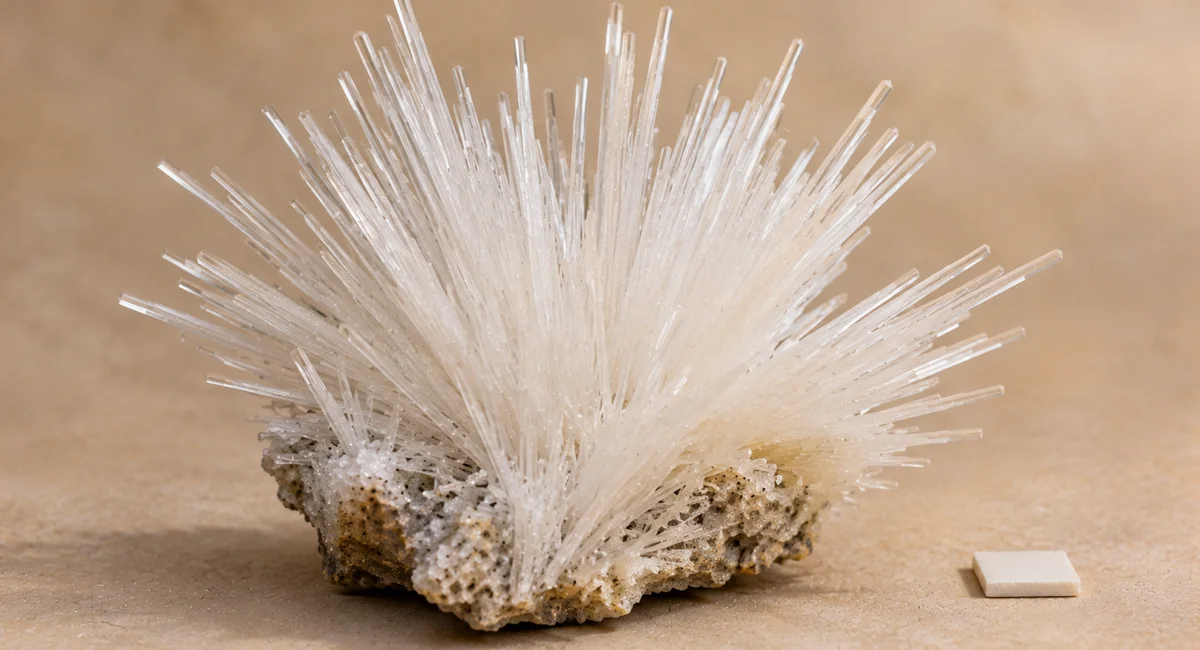
Scolecite belongs to the natrolite subgroup of zeolites and often forms slender, elongated prismatic crystals. Groups of these may fan outward from one attachment zone, creating an open spray or a tightly packed cluster. Under side light, the needles can appear delicate, glassy or almost silky. Their fragile-looking geometry is real: thin crystals with long unsupported ends can break even when the mineral itself is not exceptionally soft.
A scolecite spray may show dozens of fine tips, some extending farther than others. It might rest on pale zeolite matrix, dark basalt or a cluster of stilbite blades. The needle pattern is the central visual feature, but a buyer must also inspect its base. A broad, secure attachment can help with display and packing; a narrow junction or a precarious overhang requires greater care.
Scolecite versus natrolite and mesolite
Scolecite is not the only needle-forming zeolite. Natrolite and mesolite can appear very similar in photographs, especially in fine radiating groups. All three are recognised mineral species with differences in composition and structure. The phrase “white needle zeolite, possibly scolecite” may be a more accurate preliminary label than an unverified confident assertion.
Mineralogical tests such as X-ray diffraction or appropriate spectroscopy, considered with chemical information where necessary, can help resolve closely related needle zeolites. Such techniques are not routinely available for every retail specimen. Without them, an original reliable mineral label or traceable collecting record may be the strongest evidence available, while still allowing for some uncertainty. Never test a valuable spray by snapping, burning, scratching or bathing its needles.
The difference between natural needles and breakage
Natural needle clusters can show interrupted growth, curved-looking bundles and crystals that terminate against another mineral. Breakage more often produces truncated ends or loose fragments, but it is often hard to distinguish them without close examination. Ask for a macro photograph of a representative fan and any visibly damaged area. Count of intact tips is less useful than an honest condition description covering the entire specimen.
When displayed, keep the spread of needles away from human traffic, curtain fabric and shelves where adjacent objects could brush them. Scolecite is better treated as a stationary mineral collection object than as a frequently handled décor item.
Heulandite: tabular plates and coffin-shaped crystals
Heulandite-group minerals often form flat tabular or bladed crystals. A classic form is a modified rhombic plate with truncated or angled corners, conventionally described as coffin-shaped. That name describes a mineral outline, not a polished or carved object. The plates may be transparent, translucent or pearly, and can occur individually, stacked or in radiating arrangements.
The precise external form varies, and many heulandite specimens do not show a textbook coffin outline. Crystals may be crowded or partly buried in matrix. A large flat face can be a natural crystal face, a cleavage surface or an exposed break, and it should not be categorised without inspecting the surrounding edges. Oblique light and a side-view photograph help reveal thickness, layering and attachment.
Heulandite species and clinoptilolite lookalikes
Heulandite is commonly used as a broad label; formal species names include chemical suffixes, such as heulandite-Ca where justified. Clinoptilolite is a closely related zeolite with structural similarities, and some specimens cannot be distinguished securely by outward appearance. Scientific work can require more than one type of analysis to establish the exact mineral. Therefore a listing that says heulandite-group crystals may be more appropriate than an unsupported end-member name.
The colour range is broad: white or pale pink plates are common in collections, but heulandite should not be defined only by its colour. An attractive shiny plate may be heulandite, a similar zeolite or another mineral altogether. The host matrix and associations help interpret the specimen but are not conclusive tests.
Cleavage and condition of a heulandite specimen
Heulandite has prominent cleavage, so smooth-looking planar surfaces are not always intact growth faces. A thin plate may split or chip at its margin. When evaluating a specimen, inspect the edges for fresh chips, the supporting base for cracks and any signs of repair. A carefully trimmed rock base is not inherently deceptive, but the fact of trimming should be disclosed when the specimen is sold as entirely unworked.
For a collector, plates with recognizable natural outlines are appealing. For display, a broad supporting base and protection from knocks matter more than the number of exposed crystal edges.
How western India's Deccan basalt pockets host these minerals
The Deccan volcanic province is an important source of natural zeolite specimens. Basalt lava flows solidified with vesicles, fractures and other cavities. Later mineral-bearing fluids circulated through openings and deposited new minerals along surfaces and into available space. Over time, a pocket could host several layers of secondary mineral growth rather than just one species.
Published research on the Savda quarry area near Jalgaon, Maharashtra, documents multi-stage mineral formation, including heulandite and stilbite associated with calcite, chalcedony and later mineral assemblages. Other Deccan localities can have different distributions and sequences. It would be inaccurate to describe one scientific case study as the required growth order for every specimen from Maharashtra.
An authentic combination may include heulandite plates under or beside stilbite sheaves and a spray of a needle zeolite. However, the combination does not prove an exact quarry. A seller should distinguish a documented locality, a supplier-reported location and a visual resemblance to another photographed piece. Country-level identification such as “India” is reasonable when well supported; a specific mine or district requires correspondingly specific evidence.
Apophyllite can accompany zeolites without being one
Apophyllite-group minerals often occur in the same basalt cavities and can form glassy square-looking crystals beside stilbite and other zeolites. Despite that association, apophyllite is not a zeolite species. It is a different silicate mineral group. If a piece is genuinely apophyllite with stilbite, list the two minerals individually. Avoid calling clear apophyllite Sphatik (quartz) because it is transparent, or selling the whole combination under “stilbite” when the largest visible crystals belong to apophyllite.
Practical identification without damaging the specimen
The safest first inspection uses good photographs, scale, the original label and the overall association. Start by naming what is observable, then distinguish between a likely identification and one supported by analysis. The following comparison helps evaluate a listing.
| What you observe | Possible interpretation | What it cannot prove |
|---|---|---|
| Peach or white blades flare from a central waist | A stilbite-like sheaf or bow-tie aggregate | The exact stilbite subgroup species, or that the material is not stellerite |
| Many thin white prisms rise together from a base | A scolecite-like needle zeolite spray | Distinction from natrolite or mesolite by colour alone |
| Flat, angled, coffin-shaped plates | Heulandite-like tabular crystal habit | Distinction from related zeolites without further evidence |
| Clear square-looking crystals beside sheaves | Possible apophyllite-group association | That apophyllite is itself a zeolite or quartz |
| Dark matrix, chalcedony coatings and several mineral forms | A multi-stage mineral assemblage in a basalt cavity | Exact mine, age or crystal-growth sequence |
| Very smooth or unusually level crystal surface | Natural face, cleavage, damage or preparation are all possible | Whether the piece is unbroken without context and close-ups |
An experienced mineralogist may use optical properties, chemical analyses, X-ray diffraction or Raman spectroscopy when identification matters. For a retail listing, distinguish “identified from a credible supplier label” from “laboratory-confirmed”. Do not claim a scientific certificate unless it covers the actual piece and species. Destructive at-home testing can spoil delicate mineral crystals and is unnecessary for ordinary buying decisions.
Comparing appearance, condition and collectability
There is no universal ranking in which one mineral habit is always “best.” Collector quality depends on what the buyer seeks: recognizable morphology, pristine tips, aesthetics, locality information or an interesting multi-mineral association. An otherwise common mineral can make a remarkable display when its growth habit is exceptionally clear and intact.
For stilbite, look at fullness and separation of the sheaf, visible blade edges and whether the bow tie can be viewed from more than one angle. For scolecite, examine the density and condition of needles, the openness of the spray and how securely the group meets its base. For heulandite, examine the plate outlines, cleavage and supporting matrix. Evaluate the whole specimen, not just the brightest photograph.
Repairs, stabilisation or trimming need not automatically disqualify an authentic mineral specimen, but they affect its description, value and care. Seller transparency is more useful than broad terms such as “premium,” “highest vibration” or “museum quality” without evidence. A museum-style appearance is not a certification by a museum.
Photos that a one-of-a-kind listing should show
A good listing of a natural mineral specimen should provide the actual item, not an unrelated example. Request a front three-quarter view, a side view revealing overhangs, the back and underside, a macro of distinctive crystal faces and a close-up of any visible repair or break. A ruler or scale card near—not resting on—the specimen helps judge size; weight should be recorded separately.
For a scolecite specimen, a profile photo showing the longest needles and their distance from the matrix is especially valuable. For stilbite, the central junction and the underside of each sheaf matter. For heulandite, a view showing both the face and edge of the plate helps clarify structure. Record the stand separately, specifying whether it is included and whether adhesive or a mount contacts the specimen.
Measurements and locality labels
List length, width and height for the exact specimen, including the projecting crystals. State whether dimensions include a permanent base or stand. Record weight of the mineral itself when practicable, not just a boxed shipping weight. Retain original locality labels and clearly distinguish “India,” “Maharashtra,” and a mine-level origin. Do not turn a visually plausible origin into a verified one.
Safe handling: why crystal shape matters more than hardness
These minerals are not polished bracelet beads or tumble stones. Even if a piece is harder than a fingernail, thin blades or needles can snap under small forces applied at the wrong angle. Never lift a specimen by a stilbite bow tie, a scolecite fan or the edge of a heulandite plate. Support the stable underside or an appropriate tray and keep fingers away from projecting points.
For a piece with multiple minerals, follow the precautions needed by its most vulnerable component. Loose, flaking or unstable surfaces require especially cautious handling. Handling should be limited where a collector specimen has fine fibres or fragile crusts, regardless of whether a supplier labels the main mineral as durable.
Dusting and cleaning
The preferred preventive measure is a clean display cabinet or protected shelf that keeps dust away. If dust has accumulated, assess the mineral, matrix, adhesives and stability before attempting removal. For delicate scolecite sprays, do not brush directly across needles or use a strong stream of compressed air. Avoid routine soaking, ultrasonic cleaning, steam and harsh household chemicals for all three specimen types, especially when the association contains other minerals or older adhesives.
A very gentle dry method may be appropriate for a stable, compact surface, but there is no one-size-fits-all cleaning method. If loose particles or damage appear, stop and seek advice from a conservator or knowledgeable mineral specialist. Acids and abrasion are particularly inappropriate as casual identification or cleaning tools.
Humidity, light and storage
Zeolites are hydrated minerals, and dehydration or other environmental changes can affect certain members. That does not mean every stilbite, scolecite or heulandite specimen requires a sealed wet environment. Keep conditions moderate and reasonably stable, away from heaters, direct intense sunlight, abrupt thermal changes and damp storage. Monitor the matrix and any associates because they can respond differently to humidity.
Store fragile pieces on individual padded supports or mounts so that no crystal tip carries the weight of the specimen. Avoid placing several clusters in the same bag or box where their needles can tangle or their plates collide. Original specimen labels should remain associated with the piece without tying paper tags to a delicate crystal.
Packing a stilbite, scolecite or heulandite specimen for shipping
Secure shipping begins with photographing the exact piece and noting any existing chips or repairs. Protect the matrix and stable contact areas, not the exposed crystal ends. A fitted cradle should hold the base while leaving clearance around the sheaf, spray or plate edges. For fragile scolecite, the ends of the longest needles must not reach packing foam or box walls, even if the carton is briefly inverted or jolted.
Use an inner protective container, then cushion that container inside a stronger outer shipping carton. Loose peanuts or paper that can migrate into needle clusters are not reliable direct contact materials. Heavy geodes must never share an unsupported cavity with a light needle specimen. Trial checks for movement should be done without shaking the specimen itself. Confirm transport service, insurance terms, packing method and unboxing instructions before dispatching a costly item.
For OmmRudraksha's proposed mineral collection, final shipping rules must depend on the actual specimen and a packing test, rather than being inherited automatically from a similar-looking catalogue picture. Particularly fragile forms may justify enquiry-only availability until satisfactory transport protection is demonstrated.
Traditional Vastu meaning and contemporary mineral display
Natural mineral specimens can be meaningful decorative objects in a household that observes Vastu. Their shape, colours and association with the earth may suit a study, sitting room or contemplative area. Some modern crystal-focused Vastu practices associate pale minerals with calmness or the arrangement of nature indoors. Those specific claims should not be presented as ancient scriptural instructions for stilbite, scolecite or heulandite without clear textual evidence.
Classical Vastu considerations concern the site, spatial organisation, proportion, orientation, circulation and suitability of the room. A beautiful mineral cluster can be selected within that broader framework rather than substituting for it. In a home mandir or meditation corner, keep the specimen stable, clean and appropriately separate from lamps, incense smoke, splashing liquids and frequent offerings. A fragile scolecite spray near a burning diya is neither a practical nor a traditional necessity.
The word Sphatik in Indian devotional and gemstone usage usually refers to clear quartz. Stilbite, scolecite and heulandite are different minerals, even when white or colourless. Do not equate them with a Sphatik mala, consecrated Yantra or prescribed astrological gemstone. A consultation can discuss symbolic preference and room context, but no mineral placement should be advertised as a guaranteed remedy for health, wealth or planetary conditions.
How to choose among the three for your room or collection
If the priority is a sculptural display with rounded, fan-like lines, stilbite sheaves may be attractive. If you prefer a delicate radiating formation and can provide a secure, enclosed place, a scolecite spray offers a different morphology. If your interest is in visible planar crystal faces and layered mineral associations, heulandite is worth examining. The correct choice depends on the actual condition and stand, the space available and whether the specimen can be preserved safely.
A household with small children, pets or a busy shelf may be poorly suited to uncovered needles, regardless of visual appeal. A cabinet or other protected display can make a fragile specimen more practical. Select for an honest mineral identity, an intact natural habit and a reliable display base before choosing solely on a fashionable association or colour.
Questions buyers commonly ask
Are stilbite, scolecite and heulandite all zeolites?
Yes. All three belong to the zeolite group of minerals, but they represent different species or subgroups and can have different crystal habits. Apophyllite, which often occurs next to them, is not itself a zeolite.
Does a bow-tie shape prove a crystal is stilbite?
No. Stilbite commonly forms bow ties, but related minerals such as stellerite can look very similar. A reliable original label or analytical evidence may be needed to identify the exact species.
Is every white needle spray scolecite?
No. Natrolite and mesolite also form needle-like aggregates. A photograph can suggest a scolecite-like habit but may not be sufficient for species-level identification.
Why are some heulandite crystals called coffin-shaped?
The term describes a characteristic modified rhombic, tabular crystal outline. It refers to natural crystal morphology, not a carved shape. Not every heulandite specimen has this habit.
Can a specimen contain all three minerals?
A multi-mineral association is possible in Deccan basalt pockets, but a specific specimen should be labelled with only the minerals that can be reasonably identified. Similarities between species make photographic identification uncertain.
Is stilbite-Ca different from stilbite?
Stilbite-Ca is a more specific name for a calcium-dominant species, while “stilbite” is often used broadly in commerce. A formal suffix should be used only where evidence supports it.
Are these minerals the same as quartz or Sphatik?
No. Quartz has a different mineral composition and structure. Transparent or pale specimens of heulandite, scolecite or stilbite should not automatically be called Sphatik.
Can I wash scolecite needles in running water?
Routine washing is not recommended. Thin needles are easily damaged, and an associated matrix or adhesive may react differently to moisture. Preventing dust and obtaining specimen-specific conservation advice are safer starting points.
Which is easiest to ship: stilbite, scolecite or heulandite?
There is no universal answer because the shape, support, mass and condition of the individual piece matter. Exposed scolecite sprays often need particularly careful tip clearance, while stilbite sheaf edges and heulandite plates also demand protection.
Can I place these minerals in my Vastu prayer room?
They may be used as decorative mineral specimens where practical and appropriate to the household. Keep them on a secure support, away from heat, liquid offerings and repeated handling. Do not mistake them for a prescribed ritual object or claim a traditional directional rule without an identifiable source.
How can I check a claimed Maharashtra origin?
Ask for the original locality label, collecting history or supplier documents tied to that actual specimen. A mineral habit that resembles famous Deccan material does not identify an exact mine or district.
What should an accurate online listing disclose?
The principal mineral, associates when identified, dimensions, weight, exact-item photographs, damage and repair history, treatment or trimming, locality confidence and shipping method. If species or provenance is uncertain, the uncertainty should remain visible rather than disappearing from the listing.
Final perspective
Stilbite sheaves, scolecite needle sprays and heulandite plates show three striking ways minerals can grow in nature. The best description recognises each habit and its limits: a bow tie is not a chemical analysis, a white needle is not automatically scolecite, and a pearly plate is not conclusive evidence of heulandite. For a meaningful collection or Vastu-inspired display, choose the actual specimen for its verified identity, preserved growth features, honest condition record and safe long-term care.
Related reading
- What Is a Crystal Cluster? Crystal Growth and Natural Forms
- How to Buy a Natural Mineral Specimen Online
- Natural Crystal Clusters and Geodes in Vastu: Traditional Placement and Meaning
- Cleaning and Storing Natural Crystal Clusters and Geodes
- How to Pack Fragile Crystal Clusters, Geodes and Mineral Specimens
- Indian Mineral Specimens: Apophyllite, Stilbite and Associated Minerals
- Apophyllite Crystal Specimens: Identification, Matrix and Care
- Cavansite and Okenite: Why Some Mineral Specimens Are Fragile


