

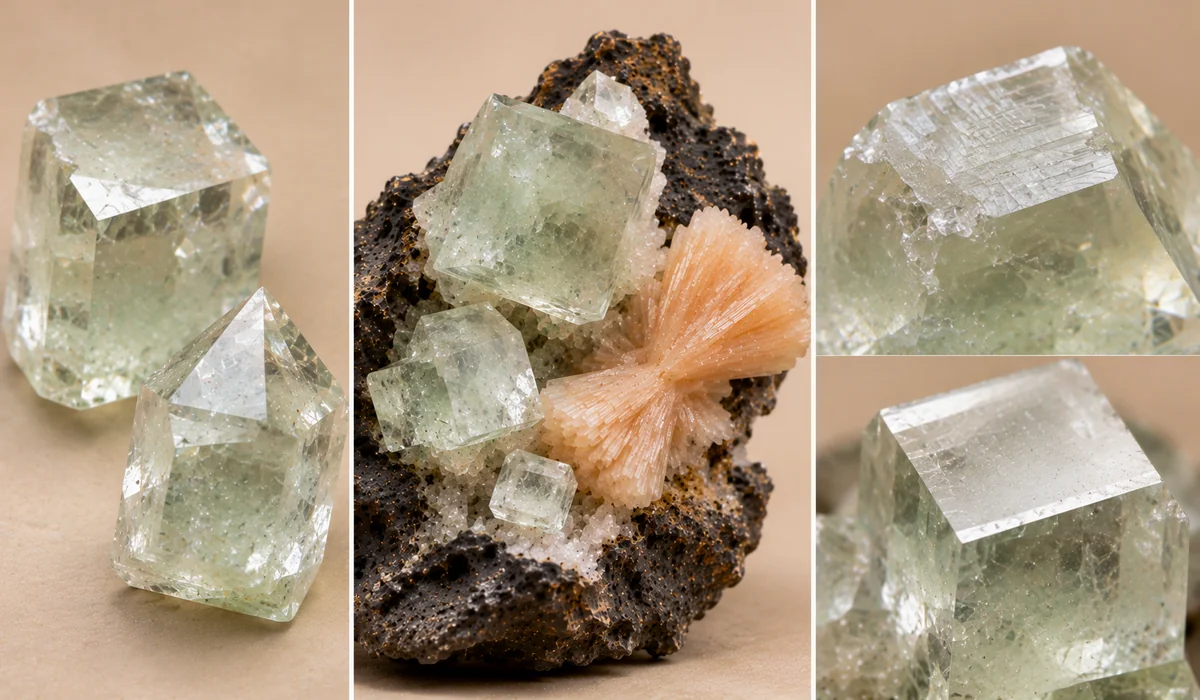
An apophyllite specimen often has a distinctive, almost architectural appearance: sharply reflecting, square-looking transparent crystals rising from a dark rock base or from cream and peach mineral blades. Some crystals are colourless; others have a pale green tint, white clouding or variations across one face. The impression can resemble polished glass, although the crystals may be entirely natural and have never been cut into their present shapes.
That combination of beauty and vulnerability makes apophyllite crystal specimens different from polished quartz beads, carved Sphatik towers and hard-wearing decorative stones. The crystal faces, cleavage and natural mineral associations all matter when identifying, buying, handling and displaying a piece. The word apophyllite also has a technical complication: in modern mineral classification it is a group name, not always a complete species-level identification.
This guide concentrates on individual natural specimens—their crystal forms, the matrix to which they are attached, conditions that deserve disclosure, safe care and sensible display. It does not treat all green crystals as apophyllite or all Indian basalt-cavity specimens as the products of one named quarry.
What is apophyllite, and why is it sold under one common name?
In mineral shops, apophyllite commonly refers to crystals belonging to the apophyllite group of hydrated silicate minerals. The trade name is useful for a collector looking at recognisable crystal habits, but formal species names can be more precise. Fluorapophyllite-(K) and hydroxyapophyllite-(K) are examples of named members; they differ in their chemistry. Not every retail specimen has been analysed to establish which species is present.
Apophyllite-group minerals contain structurally bound water and form predominantly tetragonal crystals. Their familiar faces can produce a nearly cube-like outline even though the crystal is not truly cubic. For many specimens, the visibly recognisable habit is a short square prism with a broad flat face or a pyramid-like termination. Longer prismatic examples also occur. These forms reflect natural crystallography, not necessarily a lapidary carving.
It is useful to distinguish three levels of description:
- Apophyllite-group crystal specimen: appropriate when the group is well supported but no reliable species determination is documented.
- Fluorapophyllite-(K), for example: a specific mineral name that should be based on credible evidence rather than mere colour or seller convention.
- Transparent or green crystal of uncertain identity: an honest provisional description when apophyllite itself has not been verified.
Mineral identification may call for an experienced mineralogist and, where necessary, laboratory techniques. A colourful seller tag does not replace that work. An untested specimen can still be admired and collected, provided its level of certainty is represented faithfully.
Apophyllite is not a zeolite species
Apophyllite-group minerals often occur beside zeolites and are sometimes sold under the commercial expression Indian zeolite minerals. That merchandising shorthand can be misleading. Stilbite, scolecite and heulandite belong to zeolite groups; apophyllite is not itself a zeolite. An accurate label can say apophyllite with stilbite, apophyllite associated with zeolites or apophyllite-group crystal on basalt, where the observations support those descriptions.
The distinction matters beyond terminology. Different minerals have different shapes, cleavage and sensitivities. A combined piece should be cared for according to its most vulnerable constituent, not treated as if it were one uniformly resistant stone.
How to recognise natural apophyllite crystal habit
Crystal habit means the characteristic external form displayed as a mineral grows. In apophyllite, the arrangement of flat faces often provides a better first clue than colour alone. Still, no single external feature is an absolute identification test.
Square prisms and blocky crystals
Look for four-sided-looking prisms, often with broad faces meeting at approximately right angles. On some specimens the crystals appear short and blocky; others extend outward from the matrix. The visual impression can be almost cubic, but pseudo-cubic appearance does not make a mineral part of the cubic crystal system. Apophyllite is characteristically tetragonal.
Natural adjacent crystals may differ in size, slope or orientation. Some grow into a cavity with space to form broad, intact faces; others meet a neighbour and develop flattened contacts. A cluster need not display a repeated pattern of identical perfect points. Several highly regular faces may be genuinely natural, while a polished object may have been shaped by a person. Examine the junctions and base as well as the shining tops.
Pyramidal terminations and flat basal faces
Some apophyllite crystals finish in distinctly pyramidal faces, while others have an obvious flat basal face. It is important not to treat every flat face as damage or every pointed face as proof of an intact natural termination. The geometry and surface character need to be read in the context of the whole crystal.
A broad, smooth face may be part of the original crystal form, or it may have been exposed through cleavage. Cleavage occurs when a crystal breaks preferentially along a plane in its internal structure. An existing cleavage surface can look unusually smooth or reflective; a freshly chipped corner or detached point may be more irregular. Good close-up photographs help a prospective buyer distinguish these possibilities, but some cases need hands-on expert examination.
Lustre, transparency and colour
Apophyllite specimens may appear colourless, white, pale green or in other light tones. Their lustre can be strikingly glassy on some faces and somewhat pearly on cleavage-related surfaces. Transparency varies within and between specimens. Tiny inclusions, internal features or minor associated material can change the overall appearance.
Pale green does not prove a specific apophyllite species, a particular mine or freedom from treatment. Likewise, a clear apophyllite crystal should not be relabelled as quartz simply because both transmit light. Colour is one observation among several; for a valuable specimen, any unusual identification or treatment assertion should be supported independently.
Apophyllite versus quartz, calcite and zeolite crystals
These natural minerals may share a glassy look, but they are not synonyms. The form, internal structure and usual handling requirements differ.
| Material | Helpful visual clue | Important distinction | Buying implication |
|---|---|---|---|
| Apophyllite-group crystals | Square-looking prisms, flat basal or pyramidal faces; often colourless or pale green | Tetragonal hydrated silicate group with prominent basal cleavage | Ask about cleavage faces, chipped edges and species-level confidence |
| Quartz or Sphatik | Typically elongated six-sided-looking quartz prisms with distinctive terminations | Quartz is silicon dioxide and does not have apophyllite's prominent basal cleavage | Do not name every clear crystal Sphatik |
| Calcite | Many crystal habits, including rhombohedral forms; visible cleavage in some pieces | Carbonate mineral rather than apophyllite or quartz | Different material sensitivities; do not perform an acid test on a sale specimen |
| Stilbite-group minerals | Blade-like crystals, fans, sheaves and bow ties | A zeolite mineral, often a companion rather than the main glassy crystal | Inspect fragile blade tips and associated mineral labels |
| Scolecite | Fine, needle-like sprays | A zeolite with especially vulnerable slender tips | Handle and ship as a highly delicate mixed-mineral piece |
| Heulandite-group minerals | Often tabular or bladed crystal forms | Zeolite group, not equivalent to apophyllite | Small associates may require specialist confirmation |
The differences are useful to a collector without encouraging destructive tests. Do not scratch, chip, acid-test, heat or soak a valuable natural specimen to see which mineral it might be. Scratch testing can ruin a face even when the inferred hardness seems correct; chemical tests can harm a coating, matrix or unidentified associate.
Hardness is not the same as resistance to breakage
Apophyllite commonly has a Mohs hardness around 4.5–5. Hardness relates to resistance to scratching; it does not by itself describe how easily a crystal can cleave, fracture or detach from its base. A crystal of a harder mineral can still be brittle, and a soft-looking piece can be mechanically stable if its form is compact.
Apophyllite's perfect basal cleavage is particularly relevant. An otherwise appealing crystal may break along a preferred plane after an impact, leaving a flat surface. A cluster mounted on a soft or fractured matrix can also suffer damage at the attachment point. That is why the condition and geometry of the whole specimen matter more than a single hardness number.
Why apophyllite occurs with stilbite in India
Many collector specimens containing apophyllite and stilbite are associated with the Deccan volcanic province of western India. Repeated basalt flows created geological settings with fractures and cavities; later mineral-bearing fluids could deposit secondary minerals along the cavity walls. Some cavities grew combinations of zeolites, apophyllite-group crystals, chalcedony, calcite and other associated minerals.
The minerals did not necessarily appear in one step. Changes in water chemistry, available ions, temperature and cavity space may produce successive generations of crystals. Studies of western Indian basalt deposits document varied secondary mineral associations and mineralization zones. These studies support the geological context, not a unique location or growth story for every loose specimen.
What the word matrix means
The matrix is the natural base or host material supporting the visible crystals. On a Deccan specimen it may include dark basalt, a lining of chalcedony, an earlier zeolite mineral or a combination of materials. A dramatic transparent apophyllite crystal can stand on a compact rock remnant; another may emerge directly from a soft-looking stilbite sheaf.
A preserved matrix is not excess material to hide in photographs. It can show how the crystal is attached, whether a piece is stable, and what associated minerals remain. An intact base may be an important part of the specimen's collector value. Conversely, an artificially trimmed or sawn base can be perfectly reasonable for display if the preparation is disclosed.
What “apophyllite with stilbite” actually tells you
A specimen described as apophyllite with stilbite has at least two named mineral components. Transparent to pale green apophyllite may rise from cream or peach stilbite blades. The listing should ideally show which crystals are which, without assuming that every pale blade is stilbite or every square prism has been chemically confirmed as fluorapophyllite-(K).
Apophyllite can also be associated with scolecite or other delicate zeolites. The correct listing identifies each reliably established mineral and marks uncertain additions as provisional. When a proposed product is distinguished by a particular apophyllite–scolecite association, the seller needs evidence that both species really occur on that exact item.
How to assess the crystal faces and natural condition
A quality assessment should address the actual specimen rather than rely on terms such as AAA, premium healing crystal or museum quality without a stated basis. Collectors value different things: sharp faces, balanced composition, visual contrast, unusual associations, locality history, intact condition or distinctive crystal habit.
A condition review from front, side and back
Ask for a well-focused front view and a side view that shows how far the apophyllite projects from its base. The back and underside reveal whether the matrix is coherent, whether the piece sits securely and whether there are visible cuts or repairs. A close-up of prominent faces can show terminated points, contact surfaces and chips.
Look for a difference between a natural growth contact and an impact break. A crystal may have grown against a neighbouring mineral and therefore lack an open termination. That is not automatically damage. A chipped corner, detached crystal, repaired joint or conspicuous missing piece is a different matter and should be described.
Cleavage: a hidden weakness in a beautiful surface
Because apophyllite breaks readily along a specific structural plane, a perfectly flat-looking area can be ambiguous. Before calling it a polished surface, a natural top or an old break, examine the neighbouring faces and ask for a closer image. An experienced seller should be able to describe visible cleavage and disclose uncertainty when the actual history is unknown.
Do not ask the seller to demonstrate cleavage by striking the piece. A mineral identification should never depend on destroying part of a unique collector specimen for a routine sales listing.
What about repairs, coatings and mounted pieces?
Some collector minerals are stabilized, supported, mounted or repaired after recovery. Those actions are not always improper, but they change what a buyer is receiving. A specimen with a reattached apophyllite crystal is different from an untouched natural association. If a stand is permanently bonded, a display mount can be part of the object and may affect dimensions and cleaning.
Ask whether the item contains added glue, coatings, assembled crystals, colour enhancement or a separate base. A repair may be visible under close inspection, or it may be difficult to identify from ordinary photographs. When the history is genuinely unknown, record unknown rather than treating it as confirmed untreated or undamaged.
Why exact locality labels require evidence
The words India and Maharashtra can be reasonable broad origin labels when backed by a credible supplier record. Names of specific mines, quarries or districts require a stronger evidence chain. A specimen that resembles a published Deccan example cannot be assigned to Pune, Jalgaon, Nashik or a named quarry purely by its colour and stilbite association.
Useful provenance includes an original collector label, shipment record tied to a particular inventory lot, mine documentation or an established previous collection record. Retain the original wording and indicate when a reported locality remains unverified. Do not silently upgrade reported from Maharashtra into an exact quarry identity.
A false precision can be worse than an honest broad label. For a shopper focused on home display, the visible quality and accurate mineral identification may be more useful than a glamorous location claim; for a locality collector, reliable evidence is essential.
Buying an apophyllite specimen online: exact-item checklist
An online buyer should be able to answer what mineral is offered, what its crystal form looks like, what it is attached to, and whether the object in the photographs is the object that will arrive. For individual collector specimens, a generic photograph cannot replace exact-stock images.
| Listing detail | Minimum useful information | Concern to clarify |
|---|---|---|
| Identity | Apophyllite group, with species level only if supported | A named species claimed from appearance alone |
| Mineral associations | Which areas are stilbite, scolecite or other known minerals | All materials described as one “zeolite stone” |
| Exact photographs | Front, sides, rear, base, close-ups, a scale reference | Only a stock image or a highly filtered hero shot |
| Dimensions and weight | Length × width × height and weight for the exact piece | No indication whether the stand is included |
| Condition | Cleavage, chipped corners, loose crystals, old breaks, repairs | “Perfect” without rear and close-up views |
| Preparation | Sawing, mounting, adhesive, coating, colour treatment if known | Unqualified claims of “untouched” |
| Locality | Original recorded locality and confidence of attribution | Exact quarry asserted without documentation |
| Shipping | How the matrix is immobilized and tips protected | Thin crystals wrapped tightly against the carton |
A seller can also supply a photograph of the specimen beside a ruler, photographed without precarious handling. For one-of-a-kind pieces, note a stable item identifier so that stock and photographs cannot be accidentally interchanged. Dimensions should specify whether the height includes a detachable stand.
Choosing between a single apophyllite specimen and a combined piece
A single-mineral apophyllite cluster can showcase crystal faces, transparency and a compact natural form. A specimen with stilbite may add soft colour contrast and a more complex geological story, but the zeolite sheaves can create additional fragile projections. A piece with needle-like scolecite may need an even more restrictive handling and shipping process.
Choose according to the actual size, base stability, intended location and tolerance for delicate material. A very large display piece is not automatically superior to a smaller specimen whose crystals are better preserved. Likewise, a busy multi-mineral composition is not always the easiest item for a frequently used household shelf.
Safe handling: protect both crystal and matrix
Apophyllite should be approached as a fragile mineral specimen. Before moving it, look for the most stable part of its matrix. Support that base with both hands where practical; do not lift by a tall prism, termination or stilbite fan. Remove rings or other items that could knock an exposed edge. Keep the object close to a supporting surface during movement.
A wide, even support is usually safer than a narrow pedestal. Where a specimen has an uneven back or overhanging crystals, use a stable purpose-made support that bears the matrix rather than pressing against crystal points. Keep heavy pieces away from shelf edges, narrow window ledges, the reach of children and locations where sleeves or bags can catch projecting faces.
When a specimen is too fragile for normal handling
Stop and request expert advice if the matrix is crumbling, a large crystal moves relative to its base, there are many unsupported needles or a repair appears unstable. Repeated handling to examine the same face can itself create risk. A good storage box with a viewing window may be preferable to an open shelf for delicate specimens.
For shipping, the piece must be supported at the solid base and immobilized within appropriately fitted packaging, with clearance around crystal tips and protection against impacts. An outer protective carton and an inner supported package can help, but the exact arrangement depends on weight and shape. Materials should not be forced between fragile crystals merely to fill every gap.
Cleaning apophyllite without damaging its surfaces
The safest default for an unfamiliar apophyllite-and-matrix specimen is preventive care, not frequent wet cleaning. Display it away from cooking grease and heavy dust. If cleaning is needed, first establish all constituent minerals, repairs and coatings. Museum guidance emphasises that mineral cleaning methods depend on composition and the presence of delicate crystals.
Start with a dry, low-contact approach
For an intact and confidently identified specimen, a very soft clean brush or other conservator-approved gentle technique may be suitable for reachable stable areas. Brush away from the most delicate projecting points, without applying pressure. Avoid rubbing broad reflective faces or repeatedly polishing them with cloth. Dust can be prevented more effectively with a clean covered display case.
A powerful air blast, hard brush or aggressive vacuum can dislodge crystals, small labels or old repairs. Do not use ultrasonic jewellery cleaners on complex apophyllite or zeolite specimens. If dust is trapped between fragile growths, leaving it in place may be safer than an improvised removal.
Avoid routine soaking, salt water and chemical cleaners
Do not assume that because quartz tolerates certain cleaning conditions, an apophyllite crystal and its unknown basalt/zeolite matrix will do the same. Routine immersion, detergent scrubbing, acidic cleaners and repeated water sprays can create risks for mixed specimens and adhesives. Salt-water baths are especially inappropriate as a default practice for delicate mineral collections.
There is no universal recommendation to wash a natural apophyllite specimen under running water. If specific treatment is required, the actual mineral mixture, condition and preparation must be assessed. For an expensive or damaged collector piece, professional conservation guidance is preferable to experimentation.
Sunlight, humidity and heat
Keep apophyllite and associated minerals in a stable environment away from direct harsh sunlight, heaters and abrupt temperature changes. Strong sun can warm a specimen unevenly and may affect some associated minerals, coatings or mounts; it is not a reliable way to “cleanse” the physical object. A dry room is not automatically ideal for every possible mineral association, so avoid applying arbitrary humidity targets without identifying the components.
Closed storage or display cases help reduce dust and handling. Use inert, non-abrasive supports; keep the mineral away from objects that can strike it. Check mounts and packing periodically for compression or ageing, particularly if adhesive was used by a previous owner.
Apophyllite in Vastu-oriented and devotional display
Mineral collectors and householders may enjoy apophyllite for its luminous, geometric appearance. In contemporary Vastu-inspired decor, people sometimes choose a clear or pale-green mineral display for a study, reception space, meditation corner or peaceful living area. This is a modern decorative and symbolic practice, not evidence that named apophyllite-group minerals are prescribed in a classical Vastu text.
Apophyllite should also not be substituted for Sphatik simply because it resembles a clear crystal. In Indian devotional and gemstone usage, Sphatik generally refers to clear quartz; an apophyllite specimen is a distinct material. A specific religious practice or prescribed ritual object should be represented in its own terms rather than replaced with a similar-looking collector mineral.
A thoughtful arrangement considers stability, cleanliness, proportion, light and the intended use of the room. Within a Vastu-oriented space such as a shelf area or near a home mandir, keep the specimen safely supported and separate from liquids, lamps, incense ash or surfaces that become hot. If a consultant makes a directional recommendation, distinguish the household's Vastu tradition from a product-specific marketing claim. No direction or crystal placement can be presented as a guaranteed physical or financial outcome.
The role of the specimen is meaningful as a natural object and, for some households, as part of a personally valued environment. Its mineral identity and physical care remain independent of those associations.
How an OmmRudraksha product description should be written
For a genuine future stock item, start with the exact thing available for sale, rather than a generic title repeated across many different specimens. A practical title could be Natural Apophyllite Crystal Specimen on Matrix when its group identification is supported. For a documented combined piece, Apophyllite with Stilbite on Basalt may convey more useful information. The listing should include a clear material-identification confidence statement where relevant.
For product concepts GR15 (apophyllite specimen) and GR16 (apophyllite with stilbite), the final pages need exact photographs, reliable mineral labels, measurements, treatment and condition records, stand details, and validated shipping arrangements. GR20 (apophyllite with scolecite) remains conditional: a separate offering makes sense only if the actual two-mineral association is verified and meaningfully distinct from other stock.
Describe the main display face and the vulnerable part of the specimen. Record whether any crystal is loose or repaired. An attractive photograph is useful, but a professional description also tells the customer what to expect when looking at the back, underside or matrix. Avoid precise quarry claims not supported by original records.
Frequently asked questions about apophyllite specimens
Is apophyllite the same as clear quartz or Sphatik?
No. Apophyllite belongs to a separate mineral group and has its own crystal structure and cleavage properties. In ordinary Indian gemstone terminology Sphatik refers to clear quartz. A transparent appearance is not evidence that a crystal is quartz.
Is apophyllite a zeolite?
No. Apophyllite-group minerals frequently grow alongside zeolite minerals in basalt cavities, but are classified separately. Stilbite and scolecite are examples of genuine zeolite associates.
What does fluorapophyllite-(K) mean on a mineral label?
It is a named species in the apophyllite group. The species designation conveys more precise chemistry than the general trade term apophyllite. The label should be supported by credible identification rather than inferred solely from green colour or tetragonal-looking crystals.
Why does apophyllite sometimes look like a perfect square crystal?
Its tetragonal crystal structure commonly produces square-looking prisms, flat faces and pyramidal terminations. A cube-like appearance does not mean the mineral crystallizes in the cubic system or has been cut into shape.
Does every flat top mean the crystal has been broken?
No. A natural basal face may be flat, but apophyllite also has perfect basal cleavage that can create a smooth-looking break. Detailed observation and condition photographs are needed before assigning one explanation.
Why are so many specimens shown with peach-coloured stilbite?
Some basalt cavities host both apophyllite-group crystals and stilbite. The contrasting shapes and colours make attractive collector displays. Their coexistence does not establish a unique quarry, an identical growth history or any specific mineral species without evidence.
Can apophyllite be washed with water or salt water?
Avoid routine washing or salt-water soaking of whole natural specimens. A piece may include water-sensitive or delicate associates, old repairs or unknown coatings. Begin with preventive care and seek specimen-specific advice if cleaning is actually needed.
Can I put an apophyllite cluster on a sunny windowsill?
A secure, shaded position is usually the more cautious display choice. Narrow ledges, strong heat, prolonged direct sun and accidental knocks can threaten fragile crystals, mounts and some associated materials. Select a broad, stable support instead.
What photographs should an online listing show?
For the exact piece: front, both sides, back, matrix underside, major crystal close-ups, scale and any chips or repairs. The weight, dimensions and whether a stand is included should be stated. A representative photograph must not replace actual-stock images.
Can an apophyllite specimen be used in a Vastu-inspired room?
It can be chosen as a meaningful decorative mineral. Specific apophyllite crystal-placement customs are largely contemporary and should not be attributed without evidence to classical Vastu texts. Secure positioning and suitable care remain important.
The essential distinction
A natural apophyllite specimen is most valuable to understand as a particular geological object, not as a generic glassy point. Its square-looking crystal forms, cleavage, host matrix and associated minerals tell a more precise story than its colour. When identification is careful, the actual piece is photographed transparently, and the fragile crystal faces receive appropriate support, it can be appreciated and preserved for many years.
The best purchase is not necessarily the greenest or tallest cluster. It is the one whose material, associations, condition, origin confidence and safe display needs are accurately known and clearly communicated.
Related reading
- What Is a Crystal Cluster? Crystal Growth and Natural Forms
- How to Buy a Natural Mineral Specimen Online
- Natural Crystal Clusters and Geodes in Vastu: Traditional Placement and Meaning
- Cleaning and Storing Natural Crystal Clusters and Geodes
- How to Pack Fragile Crystal Clusters, Geodes and Mineral Specimens
- Indian Mineral Specimens: Apophyllite, Stilbite and Associated Minerals
- Stilbite, Scolecite and Heulandite: Comparing Crystal Habits
- Cavansite and Okenite: Why Some Mineral Specimens Are Fragile


