

A natural mineral specimen is not simply an ornament that can be balanced on whichever stand matches the furniture. A quartz cluster may have dozens of exposed points; an amethyst geode can be much heavier than it looks; a scolecite spray can lose its finest needles if a support touches the wrong place. A carefully chosen stand protects those details while presenting the specimen's natural shape, mineral association and locality. A poor stand can turn an otherwise sound purchase into a broken one.
The essential question is therefore not “Which display base looks premium?” but “Where can this particular object safely carry its own weight?” Once that is answered, the stand, case and label can be designed around the real mineral. This guide covers stable display stands, contact surfaces, supports for fragile clusters and geodes, accurate labels, specimen records, practical photography, and the difference between an aesthetically pleasing display and a claim that a mineral has a particular traditional significance.
The advice applies to personal collections, study shelves, showroom cabinets and individual natural mineral specimens sold by OmmRudraksha. A stand pictured in an article is an illustration of a method, not evidence that any proposed product or mineral is currently in stock.
Why the stand is part of specimen care
Minerals are affected by gravity even when nobody handles them. Their weight rests on a small area of contact, which may be broad and tough or unusually narrow and fragile. A heavy piece resting on a few sharp crystals can gradually damage those crystals or move unexpectedly if someone nudges the shelf. A stand also determines how often the owner must touch the specimen to dust the furniture or read a label.
A good display arrangement has four jobs. First, it supports the actual weight through a sound part of the matrix or a suitable mount. Second, it stabilises the piece against sliding, rocking and tipping. Third, it protects delicate points from hands, surrounding objects and routine cleaning. Fourth, it interprets the object: a reader should understand what mineral is shown and what is genuinely known about its origin.
The visual effect matters, but it comes after these requirements. A tall clear stand that makes a geode look weightless is not desirable if its arms press into brittle amethyst crystals. A beautiful wooden plinth is not automatically appropriate in a closed case if its finish or adhesive releases harmful vapours. Museum collection-care practice begins with the individual object and the hazards of its intended setting; a collector can use the same sequence at a smaller scale.
Start with the actual specimen, not a generic stand size
Examine the load-bearing part
Lay the specimen on a protected work surface in its safe, existing position. Observe the matrix, the naturally formed host rock or underlying mineral mass. On many quartz and basalt-cavity specimens, this is much stronger than the exposed points. On a geode half, the cut rim or solid external shell may offer a safer support than the interior crystal lining. On a fragile mineral spray, the accessible matrix may be small, awkwardly placed or insufficient for ordinary display.
Never assume that the flattest-looking face is a strong contact surface. A smooth face could be a cleavage break, a repaired section, a thin mineral overgrowth or an unstable saw cut. Where a specimen has old adhesive, cracks, crumbly matrix or detached fragments, the mount decision must wait for condition review. Do not test strength by pulling on a crystal cluster or pressing against a delicate surface.
Locate the centre of mass and likely tipping direction
The highest visible crystal is not necessarily near the centre of mass. A large crystal mass may project sideways while the matrix underneath is narrow. A shallow geode half may be stable lying back but top-heavy when held almost upright. Compare the object's weight distribution with the footprint of the base. If the effective weight projects outside that stable footprint, a slight disturbance can tip the assembly.
There is no one acceptable stand width or weight ratio for every object. Base design depends on geometry, weight, contact points, surface friction and surroundings. A stand that works on a perfectly level counter may not be secure on a narrow shelf near a door or a cabinet that vibrates during movement. For an unusually heavy, valuable or tall specimen, obtain a purpose-built mount and confirm its performance with a competent mount-maker; avoid improvised balancing trials on the fragile original.
Record the display orientation
Many minerals have a visually preferred front, but aesthetics should not dictate an unsafe angle. Photograph the proposed side, front and rear. Identify any overhanging points, vulnerable rims and natural-looking flat faces that are actually breaks. If the stand forces an object into an extreme angle merely to show more colour, choose a lower angle or a different arrangement. A safe, slightly less dramatic presentation is preferable to damaging an irreplaceable form.
Common stand and base designs compared
| Display method | Typical suitable specimen | Main advantage | Main caution |
|---|---|---|---|
| Wide, flat padded tray | Solid rough stones and stable matrix fragments | Distributed load; easy movement of tray | Does not restrain a top-heavy specimen on its own |
| Shallow custom-fit cradle | Uneven quartz clusters, delicate matrix pieces | Supports the stronger underside at several points | Poorly fitted foam can push into crystals |
| Properly sized transparent acrylic easel | Certain light slices or stable cut geode pieces | Open sightline and unobtrusive appearance | Thin arms may flex, scratch or concentrate pressure |
| Protected metal armature | Selected heavy or irregular specimens | Can provide targeted, rigid support | Bare metal contact, movement and poor padding can harm surfaces |
| Wide fixed plinth with fitted cradle | Large geodes or tall mineral displays | Stable footprint and clear presentation | Plinth and specimen must be assessed together |
| Enclosed display case with internal mount | Fragile sprays, small valuable specimens | Reduces dust, handling and accidental contact | Trapped humidity, pollutants and bad mount materials remain risks |
| Individual drawer tray with label | Study sets and specimens not continuously displayed | Supports identification and reduces exposure | Requires a reliable link between tray and catalogue |
These are functional descriptions, not manufacturer safety ratings. Even two pieces of the same mineral can require different mounts because one has a compact base and the other stands on a thin branch of matrix. For one-of-a-kind stock, the display support should be confirmed against the actual item, not selected only by a product-category name.
Which materials belong near a mineral specimen?
Mount materials should be evaluated for mechanical stability, surface texture and chemical compatibility. Conservation-grade polyethylene foam is frequently used as discreet cushioning or a custom cradle. Properly chosen acrylic can serve as a clear rigid support. Protected metal components can be appropriate where the geometry requires strength. None should become a universal default: the contact area, surface condition and other minerals on the same specimen still matter.
| Material | Potential role | Important qualification |
|---|---|---|
| Conservation-grade closed-cell polyethylene foam | Gentle shaped support, shock isolation | Use suitable density and do not compress exposed needles |
| Stable acrylic sheet or rods | Clear easel, case, discrete display arm | Inspect edge finish, thickness, flex and contact pressure |
| Stainless steel armature with appropriate inert padding | Structural support for a designed mount | Keep bare metal away from vulnerable crystal faces |
| Inert barrier or tested archival interlayer | Separates object from uncertain plinth material | Must be compatible with the mineral and mechanically secure |
| Finished wood base | Attractive external furniture/plinth | Wood, coatings and adhesives may emit pollutants in enclosed cases |
| Stone or concrete plinth | Stable external mass or display furniture | Weight does not excuse sharp contact or an unsafe top-heavy assembly |
| Pressure-sensitive tape, general-purpose putty or household glue | Avoid as direct specimen attachment | Can fail, stain or leave difficult residues |
Do not apply ordinary glue or sticky putty directly to natural crystals simply to make them stand upright. Such products may be difficult to remove and can conceal damage. A special conservation intervention or repaired historic specimen is a different matter and should be recorded as such. For a normal retail display, favour a properly designed mechanical cradle and easily removable support instead of an unreported permanent attachment.
Even materials described as “acid-free” or “archival” should not be accepted uncritically. Those words may refer to one component of a product, not the entire assembled stand. A cardboard tag is different from an adhesive label; a polished acrylic stand is different from a plastic holder with softeners or unknown coatings. When the specimen is unusually sensitive, choose documented, tested materials with professional advice.
Supporting clusters and geodes without sacrificing their natural form
Quartz clusters: protect the tips
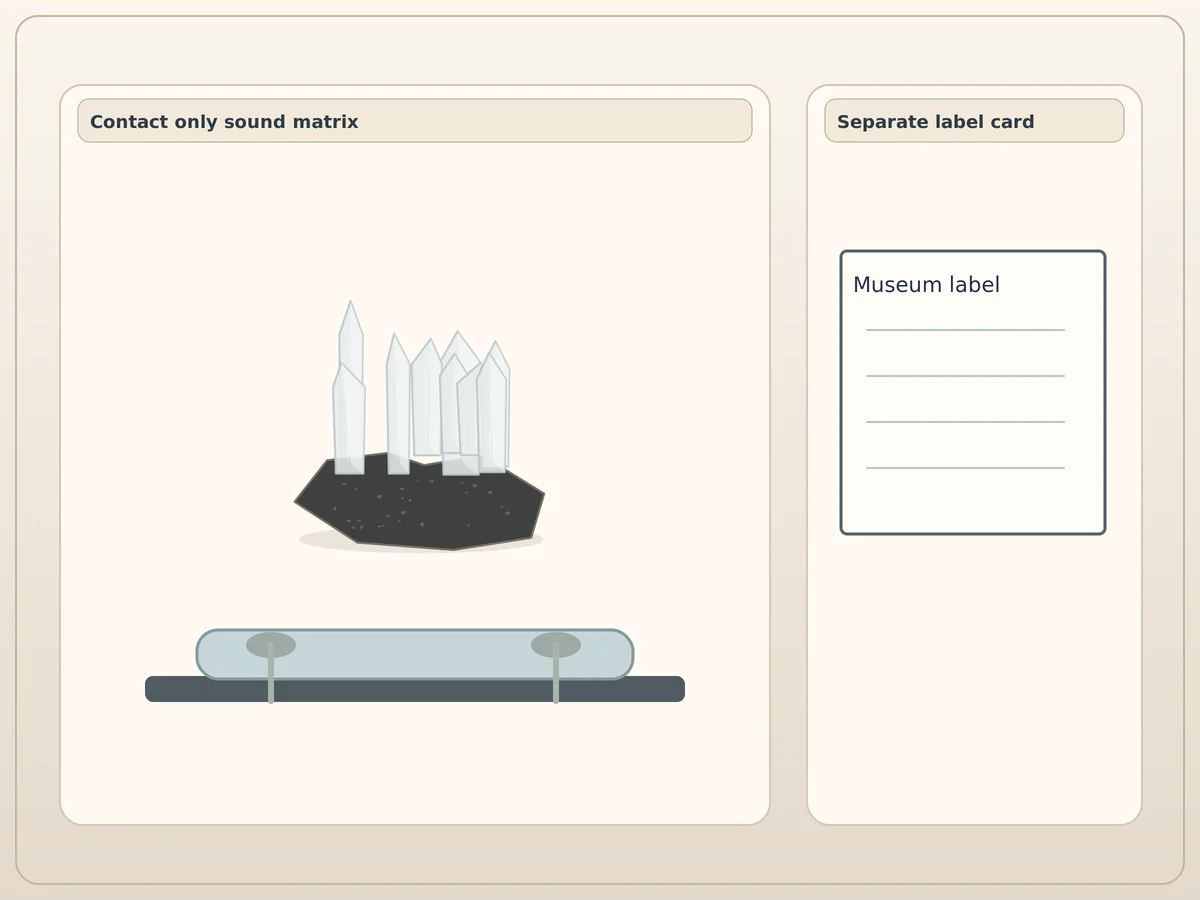
A quartz cluster can be physically hard and still have vulnerable terminations. Its sharpest points should not be used as feet. A support should contact the lower matrix or a suitable broad natural surface, allowing the crystals to rise without carrying the load. If the underside is irregular, a shallow fitted cradle can be safer than a high three-prong display stand. The fit must be checked so the specimen cannot slide off the cradle when the surrounding furniture is touched.
Quartz can occur alongside more delicate minerals. A host rock holding apophyllite, stilbite or tiny needles should not be mounted as if the entire assembly were a robust quartz boulder. Examine the weakest attached mineral, not merely the hardest dominant mineral.
Geode halves and cathedral forms: manage weight and leverage
Geodes frequently tempt owners to display their sparkling interiors vertically. That may be safe for an appropriately shaped small half but risky for a large or tall specimen. A broad, heavy plinth supports only one part of the problem; the geode also needs a secure relation to the plinth. A shallow cradle supporting the outside shell can reduce local pressure at the rim. Never secure an oversized geode by wedging mount arms between internal crystal points.
A matched pair of geode halves should be assessed as two objects. Each half requires its own support, especially if the halves have unequal mass. If they are displayed side by side, leave enough distance to prevent contact when the shelf is cleaned. The fact that two halves came from one nodule does not mean their contours make a safe combined upright stand.
Fine sprays and brittle matrices: display less, protect more
Scolecite, okenite and fine drusy formations can be damaged by a brushing sleeve, a cleaning cloth or a visitor's finger. A closed case with a stable internal mount may be a better choice than an open stand. For especially fragile okenite puffballs, no-touch access, specialist transport assessment and restricted handling are essential. A clear cover does not compensate for a support touching the puffball itself.
For an apophyllite–stilbite assemblage, the matrix may be stable while the larger transparent apophyllite faces have cleavage vulnerabilities. The support must not press against a termination or potentially fractured face. A specimen can appear motionless for months but still be in a poor arrangement if it has been resting on the wrong point.
A practical stand-selection sequence
Use a repeatable sequence when displaying a new item rather than choosing an accessory solely from a photograph. Keep the object on its protective tray until the proposed display arrangement is ready.
- Identify the specimen and its vulnerable features. Note matrix, crystal tips, cleavage, weak joins and repairs. Unknown or hazardous materials need specialist assessment.
- Record dimensions and approximate mass. Note projection depth and the intended orientation, not just height and width.
- Choose strong support zones. Prefer stable host material and broad contact, never decorative crystal points.
- Select a low-risk mount type. Compare flat tray, cradle, easel or enclosed mount against the object's geometry.
- Check materials and interfaces. Inspect padding, edge finish, coatings and any adhesives used to assemble the stand away from the specimen.
- Assess stability before public access. Review tipping, sliding, vibration, shelf width and the likely movement of nearby objects.
- Document the final arrangement. Photograph the rear support, save the stand type and record any fragile points that must not be handled.
For very heavy or unusually valuable specimens, the final physical stability assessment belongs to an experienced handler or mount-maker. No simple mathematical formula substitutes for that work. The sequence above is a selection checklist, not permission to perform risky load tests on a rare crystal.
Display cases: dust protection without creating a new risk
A case can reduce accidental contact, dust accumulation and repeated handling. It may also improve the presentation of a labelled specimen collection. However, a poorly chosen cabinet can concentrate volatile emissions from wood, paints, textiles or adhesives. Airtightness affects how internal humidity and contaminants accumulate. Conservation practice recommends evaluating the complete enclosure, not just choosing an attractive transparent lid.
Look for sufficient clearance between the specimen and case walls, removable access for professional inspection, and a stable internal base. Avoid positioning exposed points where someone might strike them while opening the door. A cabinet should not depend on the crystals themselves to stop objects from sliding. A valuable display near children, pets or high foot traffic may need a secure case rather than a simple tabletop arrangement.
Light needs mineral-specific attention. Some fluorite varieties and other colour-sensitive minerals may change with prolonged strong light; bright sunlight also heats enclosures and shelves. For a home display, indirect illumination and shorter exposure are prudent starting points. Keep lamps sufficiently separated to avoid noticeable heat buildup, and never assume that a clear acrylic cover blocks all harmful wavelengths without verified material specifications.
Relative humidity is likewise not universal. Pyrite showing oxidation requires different control from minerals that respond badly to overly dry conditions or rapid changes. A mixed collection may need separate cabinets or trays; a single target humidity for every specimen is not scientifically justified. Any valuable or sensitive collection should be reviewed as an assemblage of different materials.
Labels: identify the actual specimen, not a mood or promise
A mineral label is a factual record. It should state what is observed and what is known, with uncertainties clearly identified. The display name and catalogue entry should match. A label reading only “Energy Stone” loses the scientific identity and provenance of the object. Conversely, a label with an impressive but unverified mine and a laboratory-sounding species name misleads the buyer.
At minimum, an ordinary collector-facing label can include:
- Mineral name or assemblage: for example, Quartz cluster or Apophyllite-group crystals with stilbite.
- Reported location: use the most precise location genuinely supported; otherwise say locality unconfirmed.
- Unique specimen reference: a stable inventory or catalogue number that points to a record.
- Physical context where relevant: natural matrix, cut geode half, repaired area or treatment disclosure.
A display card can be concise; the accompanying catalogue may hold the full record. For example, a specimen supplied as “apophyllite from Maharashtra” without traceable quarry records can be labelled “Apophyllite-group specimen — Maharashtra, India (supplier-reported; precise locality unverified)” rather than naming a famous quarry by guesswork. If the seller has not confirmed the group identification, even the mineral label should be qualified.
Keep old owner, dealer and collection labels with their specimen even when a newer presentation card is made. Handwritten historic labels may provide provenance evidence that later marketing graphics cannot replace. Photograph both sides and store the image in the record. Do not remove an original number or replace it with a retail price sticker.
One specimen, one catalogue record
Natural mineral pieces are often visually similar but not interchangeable. A useful catalogue ties photographs, measurements, condition and labels to one actual object. It should survive a change of stand or display case and remain useful if the object is sold, returned, loaned or moved to storage.
| Record field | Practical information to keep | Why it matters |
|---|---|---|
| Specimen identifier | Unique code assigned at intake | Prevents mix-ups among similar pieces |
| Mineral identification | Confirmed name or explicitly tentative identification | Avoids false species or material labels |
| Locality confidence | Documented, supplier-reported or unknown | Preserves the quality of provenance information |
| Form and composition | Cluster, matrix, geode half, mixed assemblage | Keeps forms distinct for inventory and SEO |
| Measurements and mass | Actual dimensions and weight of one specimen | Supports stand selection and safe packing |
| Condition | Broken tips, cleavages, repairs, loose fragments | Prevents surprise damage claims and bad mounts |
| Treatment and preparation | Cut/polished base, adhesive repair, dye or other treatment if known | Distinguishes natural mineral from prepared presentation |
| Support and display | Mount description, contact areas and case location | Allows safe removal and return to display |
| Photographs | All faces, underside, close-ups and original labels | Links marketing to the actual piece |
| Acquisition details | Supplier, date and source documents | Supports record continuity and later review |
For OmmRudraksha, research IDs such as GR09, GR12 and GR35 are planning identifiers, not proof that an inventory unit or selling SKU exists. A future real item must receive its appropriate stock code and exact photographs after intake. Do not turn a generic proposed “labelled mineral reference set” into a ready-to-sell kit while the exact components, labels and bill of materials remain unverified.
Printing and positioning labels safely
A label should be readable without forcing the visitor to pick up the mineral. Small, high-contrast print is often better than decorative lettering that obscures the name. A modest card on a stand or in the case can carry the display information; a longer catalogue entry may be accessed separately. The card should not block the specimen's meaningful crystal habit or share a fragile point of support.
Avoid fastening adhesive labels directly to untested crystal faces. An apparently harmless sticky dot may leave a residue or detach a fragment when removed. If a specimen-number marking is required for a scientific collection, use an appropriate, documented conservation method for that material; collectors should not casually copy marking techniques to every mineral. An unattached archival tag in a dedicated tray is often the safer option for small private collections.
Place labels so they cannot fall onto needles, slide under a geode or act as an unintended wedge. Keep price labels separate from permanent collection identifiers so the object retains its identity after sale. If a label mentions a treatment, matrix or repair, make sure it describes the actual specimen, not a category-wide assumption.
How stands improve photographs without hiding condition
A stable, unobtrusive stand makes it easier to show an object's real form in photographs. For a retail listing, photograph the exact piece with the stand and again from views that reveal the back, underside and natural matrix. Show crystal tips and any repairs honestly. If a stand or plinth is included in the sale, say so; if it is photography equipment only, state “display stand not included” or the equivalent.
A clear acrylic easel can visually disappear against a light background, but that can mislead viewers about how a specimen balances. A photograph should not conceal a precarious base or imply that a point is self-supporting when a hidden mount holds it upright. For a large geode, include a side view demonstrating the angle and an accurate measurement. Do not use props to obscure a damaged rim.
Museum-style labelled photographs can provide useful context: mineral name, form, origin confidence and approximate size, with separate detail views for the label itself. For an online product, inventory photography and editorial illustrations have different roles. Concept art for an article must never be substituted for the image of the physical specimen being sold.
Stand choices for several real-world specimen forms
A small quartz cluster may need only a shallow inert cradle if the underside is irregular. A tall transparent stand is not automatically better. Inspect how the matrix contacts the support and whether any point hangs below the level of the tray.
A matched agate geode pair should normally be mounted as two separate halves with two support assessments. The relationship between the halves can be explained by a shared label and a single catalogue record for the pair, but their mounting points need not be identical.
A heavy amethyst cathedral may need a structural, custom-built base. Its high centre of mass and protruding crystal interior make improvisation particularly hazardous. If the base is cut or the shell has been strengthened, record that preparation accurately.
A cavansite or scolecite spray is better interpreted with a low-touch enclosed arrangement. The most striking crystal sprays may also be the parts most exposed to visitors and cleaning. Support should come from stable matrix, not the colourfully projecting mineral.
A pyrite cube cluster requires attention to environmental conditions as well as mechanical support. A polished wood stand may look elegant but should not place a potentially moisture-sensitive specimen in an unmonitored enclosed microclimate. Watch for physical signs of degradation and keep handling records.
A gypsum desert rose can shed or abrade thin plates when gripped. A padded horizontal tray is often safer than a clamp holding the outer petals. Avoid routine wet wiping; the specimen should be protected from both careless cleaning and excessive movement.
What Vastu-oriented display can and cannot determine
Vastu Shastra traditionally concerns the organisation of built spaces: site, orientation, proportion, access, function and the relationship of rooms and features to the larger environment. A modern mineral collection can be displayed thoughtfully within such a space without claiming that each mineral species has an ancient mandatory stand, height or compass direction.
Some contemporary Vastu and crystal-display traditions associate particular colours or stones with calmness, prosperity or meditation. These are modern interpretive customs unless a specific textual lineage has been identified. A seller should not present “pyrite must stand in the north” or “an apophyllite cradle must face northeast” as universal instructions from classical architectural treatises without evidence.
The physical design remains important even when the specimen has devotional or contemplative significance. A mineral placed near a puja space should not obstruct ritual movement, face open flame, collect oil smoke or be positioned where water offerings could spill onto sensitive crystals. A home meditation shelf may benefit more from a clear, stable arrangement and correct labels than from a precarious display chosen for a symbolic direction.
For readers interested in the broader placement tradition, the existing Vastu guidance section can provide context. The conservation principles in this article are physical requirements; the symbolic meanings should be understood as separate cultural choices.
Buying a mineral stand: questions worth asking
Before purchasing a stand for an existing specimen, determine the actual footprint, mass and support geometry. Request measurements of the stand's usable contact area and the maximum load established by its manufacturer. A generic “large” label does not establish suitability. Ask whether the support arms are adjustable, whether protective interfaces are fitted, and whether the material is appropriate near the specimen's surfaces.
If a mineral and stand are sold together, request an exact-item photograph in the final display orientation. Ask whether mounting uses adhesive, whether any damage is concealed, whether the stand is included in the stated price and whether disassembly is safe. A one-of-a-kind premium object should have a condition record before and after fitting.
For fragile or heavy items, ask about packaging of the stand separately from the specimen. Shipping the two rigidly attached can transfer impacts through the support or create crushing pressure; shipping them disassembled may be safer if removal is possible without touching crystals. The packing decision depends on the actual construction and should be made with a competent handler.
Routine maintenance: change the environment, not the specimen
Dust shelves and cases in ways that do not require brushing fragile mineral tips. Remove the specimen by its safe support or tray where appropriate; do not pull by a projecting crystal. Inspect the base periodically for looseness, cracked plastic, degraded padding, sliding contact, corrosion or changes to the mineral itself. Check any enclosed case for condensation, new odours or signs of unstable adhesives or finishes.
When a stand looks damaged or no longer supports the object properly, do not simply add a blob of glue or putty. Return the mineral to a safer padded tray and reassess. If a specimen has rare, unstable or hazardous minerals, obtain qualified specialist advice; the correct next step may be controlled storage rather than immediate redisplay.
Finally, keep labels and records current. A moved specimen needs its catalogue location updated. A revised identification should preserve the earlier label and explain what changed. A customer who receives the mineral should be able to tell which piece was purchased and how it was supported and cared for.
Frequently asked questions
1. Is an acrylic stand always safe for a mineral specimen?
No. Acrylic may be appropriate as a stable, well-finished support, but a thin or poorly shaped stand can flex, scratch an edge or press on delicate crystals. Suitability depends on the actual piece and its load-bearing contact points.
2. Should I glue a geode to a wooden base?
Do not use household glue as the default mounting method. Permanent adhesives can fail, stain or conceal preparation. A properly designed cradle or specialist mechanical support is preferable for many collector specimens; any existing attachment should be disclosed.
3. Does a heavier base automatically prevent tipping?
No. Base mass is only one factor. Footprint, centre of mass, mount height, contact geometry and the surrounding shelf all influence stability. A heavy but narrow base may still be unsafe for a tall geode.
4. Can I place an amethyst cluster directly on glass?
A sound, stable matrix can sometimes rest on an appropriate protected surface, but smooth glass offers little impact cushioning and exposed points should never bear the weight. Consider a shallow inert support and ensure the display cannot slide.
5. What should the smallest mineral label say?
At minimum, give the mineral or assemblage name, supported locality information and an identifier linked to a proper record. If the precise locality or identification is uncertain, state that uncertainty rather than guessing.
6. Is a vintage handwritten label worth keeping?
Yes. An original collector or dealer label can provide provenance that a new retail card cannot replace. Preserve it with the specimen, photograph it and transcribe the information into the catalogue without silently upgrading uncertain claims.
7. Can museum wax or poster putty secure a crystal cluster?
Such products should not be relied upon as the default solution for a valuable natural mineral. Residues, failure and inappropriate contact are concerns. An inert, well-fitted mechanical support is generally a better first approach.
8. Does every mineral need a sealed display case?
No. A robust specimen on a stable shelf can sometimes be displayed openly. Fine needles, valuable pieces and specimens exposed to frequent handling may benefit from a case, but enclosure materials and humidity must also be considered.
9. Are stands and labels included when buying a specimen?
That is an item-specific commercial detail. A product listing should say clearly whether the pictured stand, base and display card are included. A photograph alone should not imply that accessories form part of the purchase.
10. Can the same support be used for quartz, pyrite and gypsum?
A support type may be reused after individual assessment, but the care needs differ. Quartz tips can break, pyrite may require special environmental control, and gypsum can abrade easily. There is no universal mineral stand-and-cleaning combination.
11. Should Vastu placement decide the stand shape?
Personal devotional or contemporary Vastu preferences can influence where a specimen is displayed, but should not override safe weight distribution, case stability, exposure risks or correct species identification. The traditional spatial context and modern mineral-colour customs should be described separately.
A sound display is one that can be understood and maintained
The best mineral stand rarely calls attention to itself. It gives the object enough support to show natural crystal habits without making an unsupported promise about origin, treatment or power. A precise label gives the piece a traceable identity; a catalogue protects that identity if the mineral moves, changes hands or needs conservation attention.
For OmmRudraksha's natural mineral collection, this means selecting stands and labels only after the actual stock piece is photographed, identified, weighed and checked for damage. Research concepts, proposed SKU names and representative editorial images remain distinct from verified retail inventory. A beautiful display becomes a reliable collection when its support, specimen, label and records all agree.
Related reading
- What Is a Crystal Cluster? Crystal Growth and Natural Forms
- Geodes, Druzy Specimens and Agate Nodules: What Is Different?
- How to Buy a Natural Mineral Specimen Online
- Natural Crystal Clusters and Geodes in Vastu: Traditional Placement and Meaning
- Cleaning and Storing Natural Crystal Clusters and Geodes
- How to Pack Fragile Crystal Clusters, Geodes and Mineral Specimens
- Indian Mineral Specimens: Apophyllite, Stilbite and Associated Minerals
- Cavansite and Okenite: Why Some Mineral Specimens Are Fragile
- Pyrite Cubes and Matrix Specimens: Natural Forms, Vastu Associations and Storage
- Fluorite, Celestite, Aragonite and Gypsum: Delicate Specimens
- Hematite and Magnetite Specimens: Forms and Buying Questions
- Building a Small Natural Mineral Reference Collection


