

A group of brass-yellow cubes rising from dark rock can look almost engineered. The straight edges, reflective faces and repeated geometric forms are nevertheless possible products of natural crystal growth. Pyrite is one of the minerals most admired for this effect. A specimen may show individual cubes, interlocking groups, striated faces, pentagon-faced pyritohedra , or smaller metallic crystals scattered over a contrasting host rock.
Those attractive forms also raise practical questions. Is a cube naturally grown or cut from a larger block? Does the specimen contain true pyrite, another metallic sulphide, or a mixture? Is the gold-coloured surface stable? Most importantly, how should a real pyrite specimen be stored in an Indian home, where seasonal humidity and monsoon conditions can be substantial?
This guide focuses on natural pyrite cubes and pyrite-on-matrix collector specimens , not on carved pyrite pyramids, elastic bracelets or polished tumbled stones. It covers the crystals themselves, what the matrix reveals, distinguishing lookalikes, honest sales descriptions, Vastu associations, and a practical approach to preventing humidity-related deterioration.
What is natural pyrite?
Pyrite is an iron disulphide mineral with the chemical formula FeS₂ . It belongs to the sulphide mineral class and usually crystallises in the isometric (cubic) system . Fresh surfaces can have a strong metallic lustre and a pale brass-yellow colour; this appearance gave rise to the English nickname fool's gold . The name describes a common resemblance, not an indication that pyrite is artificial or valueless.
Its typical Mohs hardness is around 6–6½ and its specific gravity is approximately 5 . Pyrite is brittle rather than malleable. These physical properties help distinguish the mineral from native gold, but they are not invitations to scratch, strike or break a finished specimen. A collector piece may lose an irreplaceable edge through an unnecessary identification test.
The word crystal describes an ordered mineral structure. It does not guarantee a transparent or pointed appearance. Pyrite is opaque and metallic, yet can form excellent natural crystals. A piece of pyrite with sharply defined cubes is as genuinely crystalline as a clear quartz cluster, even though its visual character is completely different.
A naturally square crystal is not automatically carved
The cubic system permits crystal faces to meet at right angles. Under suitable geological conditions, the growth of pyrite can produce strikingly square, flat faces. Some cubes show exceptionally crisp geometry; others have stepped surfaces, fine parallel lines or partial overgrowth by neighbouring crystals. The presence of a neat cube is therefore not by itself proof of machine cutting .
However, not every square pyrite item is a complete natural crystal. A block may be cut, polished, glued to a base or selectively trimmed for display. The correct question is whether the claimed natural faces, edges and attachments are supported by inspection of the exact piece .
The main natural crystal habits of pyrite
Cubes and intergrown cube clusters
A single pyrite cube has six principal square faces when fully developed. Real specimens often grow against the matrix or against one another, leaving incomplete faces and naturally intersecting edges. Several connected cubes can form a cube cluster : a three-dimensional aggregate, not a pile of separate metallic ornaments.
Pyrite cubes sometimes display striations —fine parallel lines on their faces. These can be natural growth features and are useful clues in specimen photography. They are not a guarantee of identity: scratches from processing may also appear as lines, and not every genuine cube is conspicuously striated. Close photographs should show their character without relying on one clue alone.
Famous cubic specimens are known from several geological districts, including the Navajún area of La Rioja, Spain. That locality is an example of well-developed natural cubes; its appearance cannot be used to assign a Navajún origin to an unlabelled retail specimen.
Pyritohedra and mixed crystal forms
Pyrite is not restricted to cubes. A pyritohedron is a distinctive 12-faced form whose faces are pentagonal. Pyrite also develops octahedral forms and combinations in which some cube faces and other forms appear on the same crystal. Such combinations may make an otherwise simple-looking mineral surprisingly complex under side lighting.
When an object has twelve pentagon-like faces, calling it a pyritohedral crystal may be more accurate than calling it a pyrite cube . A pyritohedron is not a carved Feng Shui shape just because it has a geometric outline. In this guide, natural form refers to geological growth, while carved form means a shape imposed after the mineral grew.
Massive, granular and replacement forms
Pyrite can also be massive , granular or finely disseminated in rock, without distinct individual cube faces. It occurs in numerous geological settings, including sedimentary deposits, hydrothermal veins and metamorphic rocks. This matters when a seller offers a brassy lump as a "natural cube cluster" even though no exposed cubes are visible.
Pyrite can replace or coat other materials, producing shapes inherited from an earlier mineral or organic structure. In such cases the outer form may be a pseudomorph or replacement, not a freely grown pyrite cube. Specific replacement claims require evidence; the presence of unusual texture alone is not enough.
Pyrite on matrix: why the base matters
In a mineral specimen, matrix is the host rock or earlier mineral base to which the display crystals are attached. It can preserve part of the geological context and make the object more informative than a detached crystal. A sharply faceted cube partly embedded in rock may have been collected from an original growth surface. A group of tiny cubes may follow a vein, cavity surface or fracture.
The matrix can also determine how safely the item can be held and displayed. A robust rock base may make a cluster stable; a thin, fractured slab can shed grains or break under the weight of heavy pyrite. Some specimens combine pyrite with quartz, calcite or other minerals, and the care requirement must account for every significant component , not just the golden crystals.
A cut base is not inherently dishonest. Collectors sometimes trim matrix so a specimen sits upright. But a sales description should disclose if the base is saw-cut, if an attachment was repaired, or if separate pyrite crystals have been added to form an assembled ornament.
Three different product descriptions
| Description | What the photograph should actually show | Common listing error |
|---|---|---|
| Natural pyrite cube cluster | Connected, recognisably cubic pyrite crystals, with real contact surfaces and any visible matrix disclosed | Calling loose glued cubes a single naturally intergrown cluster |
| Pyrite on matrix | Pyrite crystals or groups attached to named or conservatively described host rock | Cropping away matrix while inventing a geological origin |
| Massive or granular pyrite | Metallic pyrite without prominent free-standing cube geometry | Advertising every brassy rough piece as "pyrite cubes" |
| Pyritohedral or mixed-form pyrite | Pentagonal and/or mixed naturally developed faces | Calling an unusual natural form a machine-polished cube without evidence |
For OmmRudraksha's future catalogue, GR25, Pyrite Cube Cluster , is a proposed product-family concept. GR26, Pyrite on Matrix , remains conditional: it deserves its own saleable page only if actual stock shows a meaningfully different mineral form and the listing has unique evidence. A keyword variation is not enough to justify a second product page.
Natural growth, trimmed matrix, repairs and assembled pieces
An individual cube may have a pristine front but a broken rear corner. Another may stand on a flat sawn rock slice while the crystals themselves remain uncut. Both can be genuine pyrite specimens, although their condition and preparation differ.
When assessing a piece, inspect front, back, side and base . Look for uninterrupted crystal boundaries, points where the crystals meet matrix, obvious joins or mismatched adhesives, breaks that catch light differently from natural faces, and areas of re-coating. A repair may be acceptable to a collector if honestly disclosed; it is not equivalent to uninterrupted natural growth.
Do not assume a brilliant surface is naturally preserved simply because it is metallic. Cleaning, polishing, oiling, waxes, varnishes or other surface preparations may have been used on particular objects. Such treatment can alter appearance and sometimes complicate future conservation. Ask what is known about preparation; never invent an absence of treatment when supplier records are missing.
Pyrite, marcasite, chalcopyrite and gold: what is different?
Pyrite is easily confused with other metallic materials in ordinary photographs. A gold-coloured surface is useful for recognition but never settles identification.
| Material | Mineral identity and visible clues | Main caution for a buyer |
|---|---|---|
| Pyrite | FeS₂; cubic system; brass-yellow; may form cubes, pyritohedra and striated faces | Check exact crystal habit, matrix, repair and condition |
| Marcasite | Also FeS₂ but orthorhombic , commonly showing different, sometimes radiating forms | Especially important instability and identification concerns; not interchangeable with pyrite |
| Chalcopyrite | CuFeS₂; commonly brass-yellow, often softer and sometimes iridescent | Colour and rainbow-like surface do not establish pyrite identity |
| Native gold | Elemental Au; metallic yellow; malleable rather than brittle | Do not rely on colour, and never damage a specimen to compare |
| Coated or assembled decorative object | May contain real pyrite or another base with added finish or adhesive | Disclose preparation; do not sell as undisturbed natural intergrowth |
Marcasite and pyrite are polymorphs : they have the same chemical formula, FeS₂, but different crystal structures. This is why the terms should not be substituted casually. The historical jewellery term marcasite jewellery often refers to small pieces of pyrite, not necessarily the mineral marcasite. Retail naming is not a laboratory identification.
The catalogue concept GR27, Marcasite Mineral Specimen , remains HOLD_NO_PAGE / specialist hold because of the heightened risk of instability and misidentification. This article is educational and does not authorize a marcasite listing.
Why a photograph cannot certify every specimen
Cubic morphology provides a strong clue for conspicuous pyrite cubes, but mixed or massive sulphides are harder to judge. Hardness, streak and reaction tests may have destructive consequences; a buyer should not be asked to perform them on a purchased specimen. For expensive, disputed or unusually labelled pieces, retain reliable supplier documentation and seek appropriate mineralogical examination when required.
The special problem: moisture and pyrite decay
One reason natural pyrite deserves a separate care guide is pyrite oxidation , commonly called pyrite decay or pyrite disease in mineral collections. Pyrite exposed to oxygen and moisture can form iron sulphates and acidic by-products. In affected pieces, expanding corrosion products may weaken a specimen, stain its surroundings and eventually cause cracking, powdering or disintegration.
Pyrite does not inevitably crumble merely because it is pyrite. Many well-formed specimens remain attractive for long periods. Susceptibility varies with composition, crystal condition, associated minerals, impurities, previous exposure and storage environment. Nevertheless, a polished-looking exterior is not proof that moisture sensitivity can be ignored.
What deterioration may look like
Warning signs can include an unusually dull or greyed metallic surface, fine powder collecting around the specimen, new cracks, discoloured deposits, or staining and corrosion on the surrounding tray or label. Some corrosion products may be pale or rusty in appearance. These signs are reasons to investigate , not a complete visual diagnosis: ordinary surface tarnish, dirt or an unrelated mineral coating can look superficially similar.
If a once-stable piece begins to shed powder, isolate it from other minerals and valuable documents. Avoid touching deposits with bare hands, creating airborne dust or attempting to neutralise the mineral using household solutions. A deteriorating piece warrants advice from a knowledgeable geological conservator or specialist curator.
Relative humidity: use evidence, not one universal number
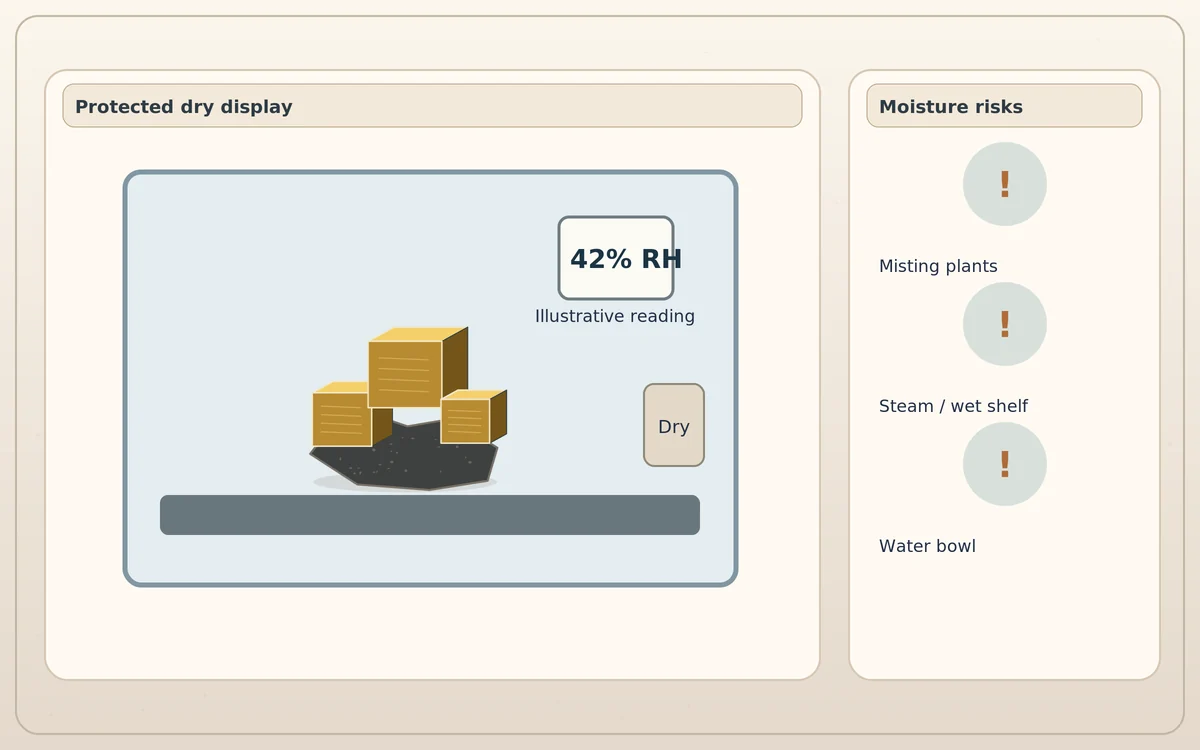
Museum conservation guidance is more specific than generic advice to "keep stones dry." The Canadian Conservation Institute notes particular vulnerability of pyrite above roughly 50% relative humidity (RH) in the presence of oxygen. The American Museum of Natural History recommends dry conditions, below 45% RH for stored pyrite, with stricter controlled conditions for affected material. The UK Institute of Conservation likewise treats pyrite as a special case within geological collections.
These values are useful risk-management guidance , not guarantees. The exact environment for a mixed-mineral specimen may need specialist decisions because other minerals and host materials may respond differently to very low humidity. A display cabinet showing 40% RH on one afternoon can become humid during the monsoon unless the conditions are monitored.
For a normal home display, choose a dry location well away from bathrooms, kitchens, window condensation, open verandas, fountains and floor-cleaning splashes. If the home is persistently humid, a properly designed sealed protective case with monitored humidity and suitable conditioned silica gel can be better than an open shelf. The desiccant must not touch the crystals or spill into the matrix.
A practical dry-storage routine for pyrite
- Record the starting condition. Photograph the specimen from the same angles, including the back, edge of the matrix and any known cracks. Keep the purchase label and date.
- Check the shelf or case. Use a small calibrated or checked hygrometer and look for seasonal RH changes, not just a single reading.
- Provide a stable base. Place the matrix on a non-shedding inert support or padded tray. Support the heaviest portion of the specimen rather than the projecting cubes.
- Control moisture exposure. Keep it away from wet cleaning, incense ash, water offerings, misting plants and condensation. Consider a controlled dry enclosure when indicated.
- Reduce needless handling. Dust the display case instead of repeatedly rubbing the metallic faces. Avoid pressure on narrow crystal attachments.
- Inspect periodically. Look for new powder, staining, unexplained odour, loose grains or change in lustre. Compare with the earlier photographs.
- Isolate suspect material. If active deterioration is suspected, protect nearby specimens and seek professional assessment. Do not place it back in the same damp location.
What about silica gel, sealed boxes and humidity indicators?
A sealed enclosure is not automatically a dry enclosure. It can trap moisture if the specimen or packing was damp when sealed. Silica gel also requires appropriate conditioning or replacement, and indicator materials or electrical sensors need periodic checks. For a valuable piece, choose an enclosure that supports viewing without repeated opening, allows space around projecting crystals, and uses inert components.
If the matrix is fragile shale or contains humidity-sensitive salts, overly aggressive desiccation may itself cause problems. The proper response is to identify the whole specimen and set compatible storage conditions, potentially with expert input. The core objective is stable, appropriate microclimate rather than indiscriminate drying.
Cleaning pyrite cubes without damaging the specimen
A natural pyrite cluster is not a metal ornament that should be polished to a mirror finish. Abrasive scrubbing can blunt crystal edges and erase subtle growth features; repeated liquid cleaning adds unnecessary moisture. Even if a single robust pyrite crystal sometimes tolerates specific professional cleaning methods, that does not make immersion safe for a mixed-matrix collector piece.
Begin with prevention : keep the case or shelf clean, limit handling and use a protective cover where appropriate. For an apparently stable, robust specimen with no loose surfaces, carefully removing light dust using a very soft dry brush may be possible after checking the matrix; do not brush friable, powdering or heavily repaired surfaces. Sensitive pieces may be better left untouched while a conservator advises.
Avoid soaking, vinegar, lemon juice, strong acids, detergent baths, steam, ultrasonic cleaners, aggressive polishing, metal-bristle brushes and experimental coatings. Do not apply oil to make a dull piece look shiny: a cosmetic layer can obscure condition changes and complicate later treatment. No home cleaning method reverses established pyrite decay.
Why "salt cleansing" is especially unsuitable
Some spiritual decoration guides propose dipping crystals in salt water, burying them in salt, washing them with milk, or leaving them outdoors in rain. Those practices are physically unsuitable for pyrite, particularly on porous or mixed mineral matrix. Moisture, residual salts and repeated wetting can increase risk rather than preserve the specimen.
A household may perform a mantra, prayer or respectful intention near a mineral without placing liquids, powders or smoke directly onto it. Traditional devotional respect and physical conservation can coexist when the ritual does not require wetting the object.
Displaying pyrite in an Indian home and a Vastu-oriented setting
Natural minerals are often chosen for a Vastu -oriented home or office because their forms, colours and placement carry meaning to the people living there. Gold-coloured pyrite has become especially popular in contemporary spiritual retail as a symbol of prosperity, steady effort or abundance. Some modern practitioners associate it with Kubera , the traditional guardian of wealth and the northern direction.
It is important to distinguish those contemporary pyrite-placement customs from classical Vastu architecture, which discusses spatial organisation, orientation, proportion, entrances and appropriate use of a site. There is no substantiated basis in the sources used here for claiming that an ancient Vastu text requires a natural pyrite cube on a specific desk or promises money from one. Pyrite should not be confused with gold, the Navaratna gem set, a ritual yantra, or a substitute for a chart-specific Jyotish gemstone.
Practical placement choices
A stable pyrite cluster can be displayed on a study shelf, office cabinet, collector's stand or another dedicated dry location where it is visible but unlikely to be knocked over. If a household chooses a northern area because of its Kubera association, that can be understood as an optional modern interpretive preference , not a mandatory mineral rule. The practical requirements—load-bearing shelf, safe base, dry air and access for inspection—remain primary.
Avoid putting heavy pyrite above a bed, beside a humidifier, at the edge of a crowded work desk or where children can handle detached crystals. Avoid a puja tray where water, flowers or oils are repeatedly poured over objects. If the piece is included near a devotional space, place it to one side on a dry, protected surface and keep any offerings separate.
For wider discussions of traditional room planning, the existing Vastu section is a more appropriate starting point than treating a single crystal as a complete architectural remedy.
Buying a natural pyrite specimen online: exact-piece checklist
A reliable product page should help the buyer evaluate the real specimen rather than showing only an idealised reference photograph. A beautiful promotional image cannot establish the condition of the item that will arrive.
Ask for front, back, side, top and base images , plus at least one close-up showing any face striations, existing dull patches, repairs, cracks and exposed host matrix. A scale or accurate dimensions should accompany the images. The weight should be for the actual specimen , including matrix and any permanent fixed stand, with the packaging excluded unless stated.
What the seller should disclose
| Listing field | What a trustworthy listing should state | Why it matters |
|---|---|---|
| Mineral identification | Pyrite, with any significant other species named conservatively | Prevents confusion with marcasite and chalcopyrite |
| Physical form | Natural cube cluster, pyritohedral form, massive pyrite or pyrite on matrix | Matches the actual growth habit |
| Exact photographs | All sides, base, crystal contacts and condition details | Helps distinguish intact growth, cuts and repairs |
| Preparation | Matrix trimming, adhesives, coatings, stabilization or unknown treatment history | Separates natural growth from later handling |
| Origin | Documented locality, qualified reported locality or unspecified origin | Avoids unsupported famous-mine claims |
| Dimensions and weight | Measurements and weight of the actual piece | Helps with stand choice and safe shipping |
| Preservation | Any known oxidation, loose powder, staining or unstable matrix | Pyrite can deteriorate if humidity is mishandled |
| Dispatch suitability | Supported mounting, immobilisation and protective double boxing where needed | Preserves crystal edges and host attachment |
A specimen with known cracking is not necessarily unsaleable, but it requires an accurate condition description. If there are active signs of pyrite decay, it should be held from ordinary shipment until assessed rather than dispatched as a normal decorative stone.
Distinguishing GR25, GR26 and GR27 in the proposed catalogue
GR25 — Pyrite Cube Cluster is the planned primary product concept for a real, visibly cubic specimen family. Its eventual selling copy should show whether cubes are intergrown, attached to matrix or loose, and it must not advertise a nonexistent standard size or mine of origin.
GR26 — Pyrite on Matrix is CONDITIONAL_DISTINCT_ITEM . It becomes a separate candidate only when actual stock and photographs show a different on-matrix presentation with a worthwhile buyer distinction. Otherwise it should remain within the suitable specimen family rather than create duplicate pages.
GR27 — Marcasite Mineral Specimen is HOLD_NO_PAGE for specialist review. It is not authorised for routine sale or for automatic substitution into pyrite orders. If a supplier describes a mineral as "marcasite pyrite," request an identification clarification before making a public claim.
None of these concepts has been checked against live Smartstore slugs or stock in this editorial phase. Product links must remain inactive until the items, prices, photographs, safe packing and routes are approved.
Packing and receiving a pyrite-on-matrix specimen
The high density of pyrite means a specimen may be heavier than it appears. A dense cube cluster can break its supporting matrix in transit if packed by the corners rather than its centre of mass. The parcel needs a rigid inner support , clearance around exposed crystal faces, immobilisation within the inner box and adequate cushioning in a stronger outer box. Loose cubes should not be allowed to rub against other rocks or each other.
The packing materials should be clean, dry and suitable for contact with the matrix. A humidity-control insert may be appropriate for a susceptible specimen, but it is not a substitute for assessing whether the item is already deteriorating. Never seal a damp specimen straight after an improvised wet cleaning.
When the package arrives, place it on a stable surface and open the support from the outside inward. Lift the specimen by the supported base or matrix, not by one projecting cube. Compare its condition with the dispatch photographs and report any fresh fracture, new powder or damp packing before attempting treatment. Keep the original labelled documentation with the collector record.
A simple collector record for future care
A small label or private record makes care more reliable. Include a specimen ID, the name pyrite (FeS₂), physical form, host matrix if known, supplier and locality evidence, acquisition date, dimensions, weight and any noted repairs. Record where it is displayed and whether it has a dedicated humidity monitor.
A dated photograph at acquisition is particularly helpful. The question "has this face become dull?" is difficult to answer months later without a comparison. If a new powder deposit appears, a condition log helps the owner tell a conservator what changed and how quickly.
Avoid labels that claim a precise formation age, rare trace element, sacred origin or confirmed mine without supporting evidence. A clean, accurate label is more valuable to a collector than an impressive but unverified legend.
Common questions about pyrite cubes and matrix specimens
Are natural pyrite cubes really formed without carving?
Yes. Pyrite commonly crystallises in the cubic system and can develop naturally square faces. A particular piece may still have a cut base, repaired contacts or polished surfaces, so the seller should distinguish natural crystal growth from later preparation.
Is pyrite the same mineral as marcasite?
No. Both have the formula FeS₂, but their crystal structures differ. Pyrite is generally cubic; marcasite is orthorhombic. Some jewellery uses the trade name marcasite for pyrite, which makes precise collector-specimen labelling especially important.
Why does some pyrite form a 12-sided crystal?
A natural pyritohedron can have twelve pentagonal faces. Pyrite may also develop combinations of pyritohedral, cubic and other crystal faces. This is a mineral growth habit, not evidence of a ritual carving.
Does every pyrite specimen develop pyrite disease?
No. Many pyrite pieces remain stable for long periods. However, moisture and oxygen can trigger destructive oxidation in susceptible material. Storage should account for humidity, matrix composition and existing condition rather than assume universal immunity.
What relative humidity is safer for pyrite storage?
Museum sources recommend keeping pyrite dry; some recommend below 45% RH for stable material. Actively deteriorating pieces may require specialist lower-humidity management. Do not impose an arbitrary low-RH target on a mixed-mineral specimen without considering its other materials.
Can I wash a pyrite cluster under running water?
Routine washing is not recommended for an unknown collector specimen, especially one with porous matrix, repairs or possible deterioration. Prioritise dust prevention and safe dry handling; seek expert advice for difficult deposits or damage.
Is an orange or brown surface always rust or pyrite decay?
Not necessarily. Natural surface alteration, unrelated minerals, dust, coatings and oxidation can produce different colours. New powder, cracking or staining is a reason for caution; reliable identification may require specialist examination.
How can I tell pyrite from chalcopyrite without scratching it?
Good photographs of crystal habit and a trustworthy seller's identification are safer starting points. Chalcopyrite is often softer and may show iridescent tarnish, but colour alone does not settle every case. Laboratory mineral identification is preferable to destructive home tests for an important piece.
Can I keep pyrite in a prayer room or near a deity image?
A household may include a mineral as a respectful decorative object if it is stable and dry. Keep it away from water, milk, oil, incense ash and other direct offerings. Contemporary Vastu placement preferences should not be presented as ancient mandatory pyrite rituals.
Does a pyrite cube guarantee wealth or business success?
No guaranteed financial result follows from owning or placing pyrite. Modern prosperity associations may be meaningful personal symbolism, but they are not a replacement for financial planning or responsible decisions.
Should a damaged pyrite specimen be returned to a humid shelf after cleaning?
No. If oxidation or active decay is suspected, isolate it and address the environment before considering any treatment. A surface-cleaning attempt does not resolve the conditions causing deterioration.
Is pyrite on matrix better than a loose cube?
Neither form is universally better. A matrix specimen offers geological context and can be a striking display; a detached cube may show more crystal faces. Compare the actual natural form, condition, documentation and safe display requirements rather than using one ranking for all collectors.
Final perspective: natural geometry with responsible care
A natural pyrite cube is appealing because its striking geometry comes from mineral growth, not because it resembles a manufactured golden ornament. Its matrix and associated minerals tell more of that story, while honest photographs and labels allow the buyer to assess the specific object rather than rely on an idealised image.
For display in a Vastu-oriented setting, choose a location that is meaningful to the household and physically suitable for a moisture-sensitive collector specimen . Dry, stable storage, honest identification and periodic condition checks are more dependable than immersing pyrite in cleansing liquids or assuming any gold-coloured mineral is maintenance-free. This approach respects both the natural object and the traditions within which it may be displayed.
Related reading
- What Is a Crystal Cluster? Crystal Growth and Natural Forms
- How to Buy a Natural Mineral Specimen Online
- Natural Crystal Clusters and Geodes in Vastu: Traditional Placement and Meaning
- Cleaning and Storing Natural Crystal Clusters and Geodes
- How to Pack Fragile Crystal Clusters, Geodes and Mineral Specimens
- Calcite Crystals on Matrix: Habits, Appearance and Care
- Fluorite, Celestite, Aragonite and Gypsum: Delicate Specimens
- Hematite and Magnetite Specimens: Forms and Buying Questions
- Display Stands, Bases and Labels for Natural Mineral Specimens


