

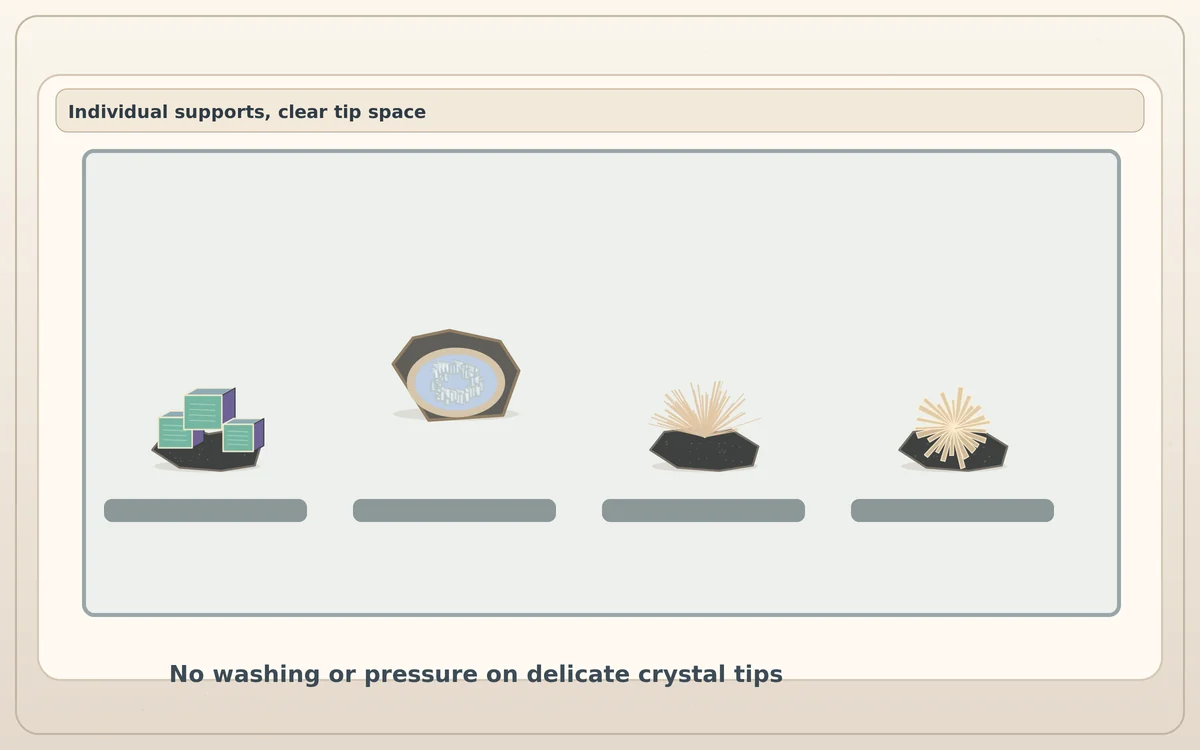
Some of the most beautiful mineral specimens are also among the least forgiving to handle. A transparent green fluorite cluster can show geometric crystal faces and delicate stepped growth. A pale-blue celestite geode may appear sturdy because its cavity has a thick rocky shell, although its inward-pointing crystals are easily chipped. Radiating aragonite sprays and sand-bearing gypsum desert roses may look like sculptural objects yet contain narrow, breakable crystal edges. These pieces are not ordinary polished stones: they are three-dimensional mineral formations whose original surfaces and supporting matrix are part of their character.
The four names are sometimes grouped together as “delicate crystals,” but they are not the same mineral and do not have one interchangeable cleaning or display routine. Fluorite is a calcium fluoride with prominent cleavage; celestite is strontium sulfate; aragonite is a calcium carbonate; gypsum is hydrated calcium sulfate. Their differences affect safe lifting, light exposure, contact with water, and what a seller should disclose about the actual specimen.
This guide compares natural crystal habits and collection care rather than repeating general advice about carved fluorite pyramids, tumbled gemstones or generic spiritual stones. It is intended for someone examining an individual cluster, geode or natural mineral formation for a home, office, puja space or reference collection.
Four delicate minerals at a glance
The same word crystal may describe a sharply formed natural cube, a fragile spray, a thin cleavage plate or a sandy rosette. Start with the material and its construction, not just its colour.
| Mineral and formula | Common natural specimen appearance | Approximate Mohs hardness | Main vulnerability | First display precaution |
|---|---|---|---|---|
| Fluorite — CaF₂ | Cubes, stepped faces, octahedral forms or intergrown crystals; green, purple, blue and other colours | 4 | Perfect octahedral cleavage, chipped corners; some colour varieties sensitive to prolonged light | Support from below; avoid sun and abrupt temperature changes |
| Celestite / celestine — SrSO₄ | Pale-blue, white or colourless tabular to prismatic crystals lining a geode or on matrix | 3–3.5 | Easy edge damage and cleavage; some blue material may be light-sensitive | Support the outer shell, leave the interior untouched |
| Aragonite — CaCO₃ | Radiating needles, clustered prismatic crystals, sprays and star-like aggregates | 3.5–4 | Brittle projecting points; acid-sensitive carbonate surfaces | Protect extended points; avoid acidic products |
| Gypsum — CaSO₄·2H₂O | Clear selenite crystals, satin-spar fibres, gypsum flowers and sand-bearing desert roses | 2 | Very easy scratching and cleavage; slight water solubility | Avoid washing and repeated brushing |
Hardness measures resistance to scratching, not resistance to breakage. Even a comparatively harder fluorite crystal can split along cleavage planes; a gypsum desert rose can be damaged by a careless dusting motion. Conversely, a well-supported specimen can remain an excellent display object for years when its individual risks are respected.
What makes a natural mineral specimen fragile?
Cleavage, fracture, hardness and crystal habit are different things
A mineral's cleavage is its tendency to split along particular planes in its crystal structure. Fluorite exhibits excellent cleavage along octahedral directions, while celestite and gypsum also have prominent cleavage. A crystal that looks thick from the front can develop a flat break if pressure is applied at the wrong angle. A flat broken face must not automatically be described as an intact natural termination.
A crystal habit is the outward form the mineral develops during growth: cubes, plates, prisms, needles, sheaves or rosettes. A projecting needle creates a mechanical risk even if its chemistry is reasonably stable. The host matrix may carry much of the specimen's weight, or it may be a weak and crumbly crust that cannot safely serve as a handle. These properties must be assessed together.
The owner's practical question is therefore not simply “is fluorite hard?” but “which faces, junctions and exposed tips could fail if this particular piece moves?” Hardness charts can support identification; they cannot approve a specimen for rough handling or postal shipment.
Delicate surfaces are not necessarily defects
Intergrown faces, naturally crowded crystals, inclusion clouds and irregular cavity edges are often normal features of geological formation. A collector may value these precisely because they reveal how the specimen grew. Broken tips, repaired matrix contacts, flaking coatings and loose fragments are separate condition issues. Neither perfect symmetry nor an entirely smooth base is proof of natural authenticity.
When reviewing pictures, look for original growth contacts, areas where crystals terminate against other crystals, and any discreet preparation such as a sawn base or an attached stand. Transparent adhesive, a trimmed shell or an artificial coating should be disclosed, not concealed as natural growth.
Fluorite crystal clusters: striking faces, easy cleavage
Natural cubes, colour zoning and crystal intersections
Fluorite is calcium fluoride, CaF₂, usually forming crystals within the cubic crystal system. Well-known habits include cubes with flat reflecting faces and intergrown combinations; cleavage may produce octahedral-looking fragments. Individual crystals can be colourless or coloured purple, green, blue, yellow or other shades. Different growth zones may show different colours in one crystal, which is visually appealing but not a certificate of source or treatment.
Natural specimens sometimes show stepped faces, fine growth patterns and contacts where several cubes have grown together. A genuine mineral cluster need not resemble a perfectly machined stack of transparent blocks. The seller should distinguish natural crystals attached to matrix from manufactured carvings or loose cleavage pieces arranged for decoration.
Fluorite can fluoresce under some ultraviolet wavelengths, a phenomenon historically associated with the mineral's name. Not all fluorite responds identically, and fluorescence alone cannot authenticate a specimen or establish a locality. Routine UV demonstrations are unnecessary for a home-display purchase; repeated intense light exposure may be unhelpful for vulnerable colour centres and may affect display materials.
How to lift and protect fluorite
Hold a sound, broad rock base or a purpose-designed support that carries the full weight. Never lift the piece by a protruding cube or clamp foam directly over an exposed edge. Since cleavage can produce surprisingly smooth-looking planes, examine suspicious flat surfaces in a side photograph rather than tapping or scratch-testing the crystal.
For display, choose a level shelf out of direct sunlight and avoid lamps that generate heat close to the stone. Some fluorite localities have well-documented light-sensitive colours, so it is sensible to reduce prolonged bright exposure even when the exact source is uncertain. That precaution is not a claim that every fluorite colour will fade at the same rate. Also avoid rapid temperature changes and unstable mounts.
Celestite geodes: a heavy outer shell around fragile crystals
Celestite is the widely used collector name for celestine, a strontium sulfate mineral with formula SrSO₄. It can occur as pale-blue, white, colourless or other tinted crystals. Some beautiful retail specimens consist of many blue crystals extending into a natural cavity. The contrast between rough surrounding rock and bright interior faces makes them attractive display pieces, but the two parts of the object have very different mechanical strength.
Why a geode may be strong outside and vulnerable inside
A celestite geode can be relatively heavy for its size. The rocky shell or prepared base should carry its weight, while the crystal-lined interior must remain clear of fingers, loose packing and display clips. A seemingly small crack in the shell may matter if it affects the way the piece stands. The exposed crystal points may have chipped tips that become obvious only in oblique close-up images.
A vertical or angled geode requires a stand designed for its true centre of gravity, not just one that matches its photograph. If it can rock or rotate when touched gently at the base, reconsider the support. Do not attach hooks, wire loops or adhesive pads to the celestite faces. Large pieces are best kept away from a narrow ledge, doorway or child-accessible shelf.
Does pale-blue celestite fade in sunlight?
Some blue celestite material can lose or alter colour under prolonged exposure to strong light or heat. Because sensitivity depends on the specimen, a seller should not promise that every pale-blue geode is permanently colour-fast. A shaded indoor position, away from strong window light and hot display lamps, is a reasonable conservation-first choice.
Differences in camera white balance, background and illumination can make blue celestite look much more intense online than it appears at home. Request neutral daylight-equivalent photographs with the exposure and colour processing kept realistic. Colour strength is not sufficient evidence of genuine celestite, a natural geode cavity or a particular country of origin. Mineral identification and provenance need independent support.
Aragonite clusters: radiating crystals of calcium carbonate
Aragonite has the formula CaCO₃, the same overall chemistry as calcite, but a different crystal structure. This relationship is called polymorphism. Aragonite commonly develops elongated, prismatic, needle-like or radiating crystal arrangements. Some specimens resemble stars or branching coral; others appear as compact groups of intergrown crystals. These shapes are not carved sculptures merely because they look symmetrical.
Aragonite clusters can have narrow points and junctions that fail under side pressure. A sound matrix or broad central mass must be evaluated separately from the outward-facing crystals. A large, dramatic starburst may need considerably more free space than a smaller compact cluster of equal mass. The right display decision depends on how far the fragile points extend, not just on height and weight.
Aragonite versus calcite: related, not interchangeable
Calcite and aragonite share a chemical formula yet differ in crystal structure and common appearance. Both are carbonate minerals and can be damaged by acids. Calcite often shows characteristic rhombohedral cleavage, whereas aragonite may show elongated or radiating habits; neither shape alone proves species identification, because natural habits overlap and other minerals can look similar.
Do not test a valuable aragonite specimen with vinegar or acid to establish authenticity. Acid reactions are used in mineralogy under controlled conditions, but applying acid to an ornamental specimen can permanently etch, dissolve or discolour exposed crystal surfaces. A seller should identify the piece from reliable records or specialist examination rather than turning the buyer's specimen into a destructive test sample.
Aragonite's other display concerns
Avoid placing a delicate spray beneath a wall fan, next to a swinging curtain or among objects that people regularly rearrange. An isolated base with sufficient clearance is safer than packing several clusters closely together. If a natural cluster comes with a support, check whether the holder bears the broad main mass without pinching the small crystals. Photograph multiple angles before moving it, so future changes in condition are easier to recognise.
Gypsum specimens: very soft, sometimes slightly soluble
Gypsum is a calcium sulfate dihydrate, CaSO₄·2H₂O. It is much softer than the three other minerals in this guide—about Mohs 2—and its forms are unusually varied. Transparent large crystals are commonly called selenite, fibrous aggregates satin spar, and radiating formations grown amid sand grains may form desert roses. These names refer to habits or varieties of gypsum rather than four unrelated mineral species.
Gypsum's perfect cleavage and low hardness mean even ordinary wiping can abrade a surface. It is also slightly soluble in water. Its role as a water-containing mineral in a chemical formula does not make it safe to soak: the water bound into its crystal structure is not the same thing as an invitation to immerse the specimen.
Why gypsum desert roses should not be washed
A gypsum desert rose often includes real sand grains trapped among crystal blades. Washing or scrubbing may remove attached particles, soften or damage surfaces, and make originally sharp rosette edges look worn. Do not assume that a sandy object is “dirty” or that all grains should be removed. Sand can be part of the original formation, not an unwanted packing residue.
The safest home routine is usually leave the surfaces alone, display behind a transparent cover and remove dust from the enclosure instead. If a conservator has assessed a robust piece and recommends limited non-contact or dry cleaning, follow that specimen-specific advice. Do not recommend saltwater baths, vinegar, soap, ultrasonic cleaners or steam. Household cleaning recipes cannot distinguish gypsum from other visually similar minerals, nor identify weak matrix cement.
Selenite, satin spar and desert rose labels
Clear selenite may form tabular or transparent crystals; satin spar is typically fibrous and can show a silky or chatoyant appearance; a gypsum desert rose may be tan or beige because of incorporated sand and sediment. Not every commercial “desert rose” is gypsum: barite desert roses also exist, and their identification matters because barite and gypsum differ considerably in hardness and density. Similarly, a polished satin-spar wand is not the same physical product as an uncut natural gypsum flower or sand-bearing rosette.
Buyers should request a credible mineral name, whether the item is whole and naturally formed or trimmed, and photographs that show the actual front, back and edges. A generic title such as “selenite crystal rose” should be clarified before a specific product description is written.
Side-by-side care: what actually differs?
The most damaging assumption is that any advice appropriate for a hard quartz tumbler also applies to these delicate specimens. It does not. Review the mineral species, the matrix, the exposed growth habit and any treatment before choosing a method.
| Care question | Fluorite | Celestite | Aragonite | Gypsum |
|---|---|---|---|---|
| Safe lifting point | Broad stable matrix or protected mount | Outer shell or substantial base, never cavity crystals | Solid central mass or a supporting mount | Firm backing/base, not thin rosette blades |
| Main mechanical issue | Cleavage and chipped cube edges | Cleavage, fragile interior points and heavy geode shell | Brittle radiating points and narrow junctions | Very soft blades and easy surface abrasion |
| Water cleaning? | Avoid by default on whole or unknown mixed specimens | Avoid on delicate geodes | Avoid; never use acidic products | Do not soak or wash; slight solubility |
| Bright sunlight? | Avoid prolonged direct exposure; some colours sensitive | Avoid strong exposure; blue may change | Avoid strong sun and thermal stress; matrix-specific | Avoid hot direct exposure and temperature cycling |
| Best dust strategy | Prevent dust, inspect before any gentle action | Covered display, no contact with interior tips | Enclose or dust around, not against fragile sprays | Enclosure cleaning instead of rubbing the mineral |
| Packing focus | Isolate cleavage edges, support matrix | Lock shell securely with zero tip contact | Rigid cradle with space around sprays | Rigid support with no compression of soft rosettes |
These are conservative home recommendations, not laboratory treatment protocols. A specimen containing two or more minerals follows the most restrictive requirements of its vulnerable components. A fluorite crystal on a soft calcite matrix, for example, cannot be treated as if it were a freestanding fluorite cube; a gypsum formation with loose sand needs different handling from a small intact solid cluster.
A safe handling routine for a new specimen
Before lifting a newly delivered object, inspect the packing and identify which portion bears its weight. If material appears loose, do not pull the specimen out by the most visible crystals. Put a clean padded surface nearby, with enough space that no exposed point brushes a wall or another object.
- Read the label and condition notes. Check whether the seller reports repairs, weak matrix, trimmed edges, prior adhesives or special support instructions.
- Open the outer packing away from the mineral. Use cutting tools only where no crystal or bag could be contacted.
- Separate cushioning without pulling at crystal tips. If foam touches the points, slow down and support the object before removing it.
- Lift under a structurally sound base. For a large geode, use both hands or a tray; do not place fingers inside the cavity.
- Inspect under soft light. Compare the visible condition with the exact-piece photographs and note any broken fragments left in the box.
- Set it into its final stable support. Check clearance, orientation and tipping risk before withdrawing your hands.
- Record its identity and placement. A simple photo and label will help future care, dusting and insurance records.
If a chip has detached, retain the fragment and packaging. Do not reattach it with household glue, because the adhesive may damage the mineral or make a later professional repair more difficult. Contact the seller with dated photographs before attempting any conservation action.
Cleaning: why prevention is better than scrubbing
A clear lidded display box, dust-free shelf and proper mount can reduce handling dramatically. Conservation organisations commonly favour preventive measures because even experienced curators cannot give one universally safe washing method for all geological objects. A newly acquired mineral should not automatically be rinsed simply because it has travelled through a warehouse.
For ordinary dust outside an enclosure, first clean the surrounding shelf and the outside of the case. If the specimen itself needs attention, confirm its mineral identity and whether the matrix, cavity lining, coatings and any adhesive can tolerate direct contact. Do not use a hard brush, polishing compound or compressed-air blast against delicate surfaces. If light dry brushing has been independently approved for an appropriate robust portion, use minimal force and avoid projecting crystals. Never assume the softest or most soluble part of the specimen can tolerate the routine used on the hardest crystal.
Avoid soaking or wet-wiping gypsum. Avoid vinegar, citrus cleaner and bathroom descalers around aragonite or calcite-bearing pieces. Do not use ultrasonic cleaning on multi-mineral specimens or geodes with weak contacts. Fluorite cleavage can fail with impact or thermal shock, and a celestite geode's fragile crystal-lined cavity should not be exposed to forceful rinsing or brushing.
Light, heat and humidity: do not use one rule for everything
Minerals have different forms of sensitivity. Some fluorite colours and some blue celestite can change after prolonged intense light exposure; other specimens may be more stable. The correct general precaution is to avoid direct, prolonged sunlight, not to claim every mineral will inevitably fade within an invented number of days. If a specimen is precious, display it in controlled indirect light and rotate it into dark storage when not needed for viewing.
A transparent case can limit dust and touch, but ordinary glazing is not a guarantee against ultraviolet radiation. LED lighting usually reduces unwanted lamp heat compared with many hotter lamp technologies, yet the intensity and distance still matter. Position lights to illuminate the piece gently without warming its surface. A shelf above a radiator or beneath an air-conditioner discharge is poor for fragile pieces because temperature cycling and vibration can stress supports.
Humidity precautions must also be specific. Gypsum should be protected from moisture and wet cleaning, but a desiccant-saturated microclimate is not automatically the best setting for every mixed specimen. Some hydrated minerals and accompanying mounting materials can be affected by inappropriate drying. Store delicate pieces in a clean, stable indoor environment and consult specialised conservation advice if there is active deterioration. The pyrite-decay advice applicable to sulfide minerals should not be copied unchanged onto all celestite or gypsum specimens.
Displaying delicate specimens in Vastu-oriented spaces
Natural minerals may be chosen for a home or office because they are beautiful geological formations or because a family associates them with purity, serenity or attentive space-keeping. Indian Vastu traditions discuss orientation, proportion, access, cleanliness, light and the purposes of rooms. They do not establish a universal classical rule that a fluorite cluster must go in one direction, a celestite geode in another, or a gypsum desert rose in a particular corner.
Contemporary crystal-placement customs sometimes associate pale-blue celestite with calm, purple fluorite with concentration, aragonite with grounding and white gypsum or selenite with clarity. These may be meaningful modern symbolic practices, but they are not laboratory properties or assured outcomes. Do not replace a traditional Sphatik item in worship with a mineral that merely looks colourless; Sphatik normally refers to quartz, not celestite, fluorite or gypsum.
A respectful placement begins with an appropriate location. An Ishanya (north-east) area may be significant in a family's Vastu practice, yet the chosen shelf must still be sturdy, shaded and away from water bowls, incense ash, ritual sprinkling and regular foot traffic. An open puja shelf can expose soft gypsum to cleaning liquids and celestite points to accidental touch. A small protective case beside the devotional area is often more sensible than setting delicate crystals directly among lamps, flowers and vessels.
The most sustainable approach honours cultural practice while preserving the physical specimen: keep it accessible to view, not to repeated handling, and avoid claiming it will cure illness, change finances or reverse every Vastu defect.
Choosing a safe stand or display case
A stand should support the whole specimen rather than a single crystal edge. A large celestite geode needs a cradle under its shell, with enough weight and footprint to prevent tipping. A fluorite cube cluster may need a low inert pad beneath the matrix. Radiating aragonite and gypsum rosettes benefit from mounts that leave all projecting tips clear and do not rub along their sides.
An existing trimmed base can be convenient, but ask whether the trimming was done before sale and whether the specimen stands securely without hidden support. Museum-style inert foam, a properly designed acrylic cradle or a suitable collection tray may be more appropriate than a decorative metal clasp pressing the crystal faces. Use non-staining materials; avoid adhesive directly on a valuable mineral unless a professional conservation method has been approved for that specimen.
For a household display, consider nearby activity: pets, children, dusting routines, shelf vibration, door movement and unstable tables. A closed cabinet reduces incidental contact but cannot fix a heavy object sitting on a narrow edge. Preserve any original label and condition photograph, and keep enough clearance that the box lid cannot touch taller crystals when it closes.
Buying a natural fluorite, celestite, aragonite or gypsum piece online
These specimens should be sold as identifiable individual objects, not as generic images representing a random piece of the same colour. A customer may reasonably accept natural variation, but variation is different from receiving a material of another species or a piece with undisclosed damaged points.
Ask for the exact specimen or an exact lot with traceable identifiers, and review:
- A whole front photograph, side profile, rear view and an image of the underside or base; a visible scale or ruler is helpful.
- Close-ups of the most fragile faces: fluorite cleavage edges, celestite cavity tips, aragonite sprays and gypsum rosette blades.
- Measurements of the entire item in its sale orientation, not merely the largest crystal; weight of the piece plus any separately attached stand.
- Identification of the mineral species and any other visible host or associated minerals; suspected or untested minerals should be described with appropriate uncertainty.
- Provenance at the level actually supported: country, state, region, mine or quarry only if traceable records exist.
- A condition statement covering broken or repaired points, exposed adhesive, natural cracks, trimmed base, sealants, dye or coatings.
- Shipping procedure matched to the piece's weight, shape, cleavage and projected tips; fragile items may need a specialist assessment.
A celestite geode with a thick shell should have an image showing the shell and standing position; beautiful close-ups alone hide tipping risk. For fluorite, a broken-looking flat edge can be a cleavage surface, so photographs from more than one angle matter. An aragonite “star” should be checked for missing arms. A gypsum desert rose should show whether the sand and rosette are naturally integrated or merely attached decorative pieces.
Natural crystal growth, natural colour, treatment status and provenance are separate claims. A natural crystal can have a prepared base or repaired area. Conversely, a clear label with a famous origin does not establish the physical identity of the piece without evidence.
Packaging and transport: protect tips from pressure
If a specimen must be shipped, pack the weight-bearing base securely inside a shaped, inert support so it cannot move. Leave the fine crystals free from pressure. Bubble wrap pressed directly into a celestite cavity or around aragonite sprays may crush points before the parcel even leaves the workshop. Place the protected inner assembly inside a sufficiently robust outer carton with shock-absorbing separation on all sides, while keeping the specimen immobilised.
Gypsum desert roses require especially gentle contact against their soft blades. A plastic bag loosely rubbing the specimen may abrade it; conversely, enclosing a damp piece in impermeable packaging can trap unwanted moisture. Fluorite cubes need isolated edges, not a tight bundle of pressure points. For heavy geodes, the shell should be anchored in its cradle, and the outer packaging must tolerate substantial mass. No packing arrangement guarantees safe transit; document the piece before sealing and confirm the carrier is suitable for unusually fragile objects.
For some exceptionally delicate pieces, the responsible decision may be local handover or specialist delivery rather than a standard courier. This is a transport decision, not a judgment about the mineral's beauty or traditional meaning. On arrival, unpack slowly over a soft work surface and keep photographs and fragments if anything appears damaged.
FAQ: delicate mineral specimens
Is fluorite harder than celestite?
Yes. Fluorite is approximately Mohs 4, while celestite is commonly about 3–3.5. That does not make fluorite impact-resistant: its perfect cleavage means sharp edges and large crystals can break along internal planes.
Can I keep a celestite geode in direct sunlight?
A shaded position is better. Some pale-blue celestite can be light-sensitive, and the geode's supporting matrix may also react poorly to repeated heat or large temperature changes. A brighter photograph does not prove a geode is stable under prolonged sun.
What is the difference between aragonite and calcite?
Both are calcium carbonate, CaCO₃, but have different crystal structures and often different growth habits. Aragonite may form radiating sprays or prismatic clusters; calcite commonly shows distinctive rhombohedral cleavage. Acid can damage both, so avoid destructive home testing.
Is gypsum the same as selenite?
Selenite is a common name for a transparent crystalline form of gypsum. Satin spar and gypsum desert roses are other forms or habits. Mineral identity still matters because similar-looking retail products may use other mineral names or contain mixed materials.
Can I wash a gypsum desert rose to remove sand?
No routine wash is advisable. Gypsum is soft and slightly water-soluble, and sand grains may be naturally incorporated into the growth. Use a protective display case and clean the case instead of scrubbing the specimen.
Why does a fluorite crystal sometimes show a flat missing corner?
It might be a natural growth feature, a cleavage break or preparation damage. Fluorite can split along well-defined planes. Inspect images from the side and compare condition records rather than declaring a flat face natural or damaged from a single view.
Are all blue celestite geodes from Madagascar?
No location should be assigned solely from colour or appearance. Some commercial specimens are associated with Madagascar, but country or quarry origin for the exact piece must come from a traceable supplier record or other credible documentation.
Can aragonite crystal clusters be used near incense and puja lamps?
They can be displayed respectfully nearby only when physically protected from ash, accidental contact, liquids and heat. A protective case on a stable shaded shelf is usually safer than placing exposed sprays beside flames or vessels used for ritual washing.
Which mineral in this comparison is the softest?
Gypsum, at approximately Mohs 2, is the softest of the four. However, the most exposed crystal shape or weakest matrix can be the greatest handling risk regardless of numerical hardness.
Should I use the same humidity level for all four minerals?
No precise universal setting is appropriate for all mineral combinations. Protect them from wet environments and abrupt changes, inspect mixed matrices and use mineral-specific professional advice where needed. A dry-storage rule for susceptible pyrite should not automatically be transferred to every hydrated mineral.
Is a crystal with a trimmed base still natural?
It can be a natural mineral specimen with a prepared base. The original crystals may be naturally grown while the underside was cut for display. The important point is transparent disclosure, including any repaired junctions or added stand.
What should I do if a piece arrives with broken crystal tips?
Stop handling the specimen, keep the fragments and all packaging, photograph the condition and compare it with the seller's pre-dispatch pictures. Contact the seller before cleaning or using household adhesive; specialist conservation advice may be appropriate for a valuable piece.
Final perspective: select a mineral and a care plan together
Fluorite, celestite, aragonite and gypsum offer very different natural growth forms and mineral histories. Their beauty does not make them interchangeable with durable tumbled stones, nor does the shared description delicate imply they will respond identically to water, heat, dusting or movement.
A good specimen purchase includes an accurate identity, realistic photographs of the exact piece, honest condition notes, a stable support and a plan for careful packing and display. Choosing a sheltered location preserves both the geological features that make the mineral special and any personal or cultural meaning the owner gives to it. For OmmRudraksha's future collection, that specimen-first approach should guide both the content and each eventual product listing.
Related reading
- What Is a Crystal Cluster? Crystal Growth and Natural Forms
- Geodes, Druzy Specimens and Agate Nodules: What Is Different?
- How to Buy a Natural Mineral Specimen Online
- Natural Crystal Clusters and Geodes in Vastu: Traditional Placement and Meaning
- Cleaning and Storing Natural Crystal Clusters and Geodes
- How to Pack Fragile Crystal Clusters, Geodes and Mineral Specimens
- Indian Mineral Specimens: Apophyllite, Stilbite and Associated Minerals
- Cavansite and Okenite: Why Some Mineral Specimens Are Fragile
- Calcite Crystals on Matrix: Habits, Appearance and Care
- Hematite and Magnetite Specimens: Forms and Buying Questions
- Display Stands, Bases and Labels for Natural Mineral Specimens


