

Buying a natural mineral specimen online is different from ordering a polished gemstone bead, a manufactured ornament or a regular household product. Two pieces described as “amethyst cluster” can differ dramatically in crystal growth, matrix, condition, colour, weight and the way they stand. An attractive photograph tells part of that story; an accurate listing must tell the rest.
The safest way to choose is to treat each specimen as an individual physical object with its own identity and condition. Ask whether the photograph shows the exact piece that will arrive, confirm what minerals it contains, check the back and base, and understand any treatment, repair or preparation. Then consider whether the piece fits its intended purpose—collecting, a Vastu-inspired interior, a study area, a home mandir or simply an attractive shelf display.
This guide gives a practical online buying checklist for natural clusters, geodes, druzy pieces and mixed-mineral specimens. It focuses on facts that a product page should supply and questions worth asking before placing an order; it does not replace a laboratory identification or an inspection of the actual specimen.
First decide what kind of specimen you want
A specimen name often blends three different ideas: mineral identity, natural form, and commercial presentation. Keeping them separate prevents many disappointing purchases.
| Listing description | What it usually promises | What still needs checking |
|---|---|---|
| Clear quartz cluster | Several associated quartz crystals | Natural growth, repairs, matrix, tips, whether this is the photographed piece |
| Amethyst geode half | A cut portion of a cavity-bearing amethyst specimen | Actual cavity, cut face, backing, weight and support |
| Agate druzy slice | A cut agate or chalcedony piece with fine crystals | Whether druzy is present, colour treatment, polished edges |
| Apophyllite with stilbite | A specimen with two identified mineral components | Correct species names, relative abundance, fragile areas, supplier locality record |
| Pyrite cubes on matrix | Pyrite crystals attached to another material | Crystal integrity, support, moisture condition and exact matrix description |
| Fluorite crystal cluster | Associated fluorite crystals | Cleavage damage, colour under ordinary light, accurate size and safe packing |
| Mineral reference set | Several separately identified specimens sold together | Exact components, labels, individual sizes, substitutions and box contents |
A cluster shows associated crystals; a geode involves a cavity-bearing geological form; a druzy surface is covered with numerous tiny crystals. These descriptions can overlap, but none is a guarantee that a rock is untreated or has a documented mine origin. Do not judge quality from the shape name alone. A single outstanding crystal can have stronger collecting appeal than a large but poorly described group.
1. Insist on photographs of the exact piece
This is the most important online buying test for a one-of-a-kind specimen. Mineral growth is irregular, so a photograph of “a similar item” does not disclose the actual piece's broken tips, contact faces, matrix, preparation or stability. A representative image is useful for an educational article or to introduce a mineral type; it is not a substitute for exact-item photographs when you are choosing a premium individual cluster or geode.
Ask the seller to identify whether the listing uses actual-piece photographs, a selected-piece option, or representative batch photographs. For a collector specimen, request a consistent identifier or stock code visible in the listing and on the packing slip. If several pieces share one listing, understand how the item is selected and what variations are permitted.
Six photographs worth asking for
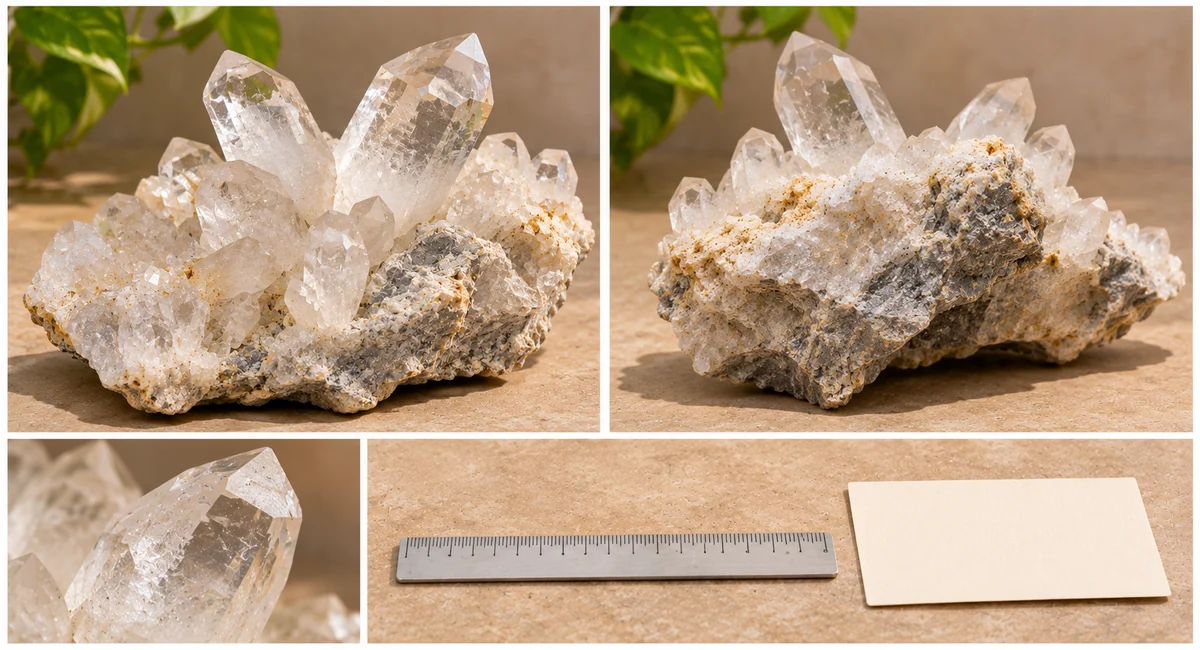
- Front, in ordinary neutral light: Shows the intended display face without exaggerated saturation or backlighting.
- Back: Reveals matrix, saw cuts, less attractive surfaces, attached supports or repairs that the front may hide.
- Both sides: Shows depth, leaning crystals, cavities and overall profile.
- Base or underside: Helps determine whether the specimen can stand independently, has been trimmed, or requires a cradle.
- Close-up of critical crystals: Shows terminations, thin points, visible chips, glue or suspect coatings without assuming that every natural contact is damage.
- Scale photograph: Includes a ruler and, preferably, the piece's stated dimensions. A hand can offer context but is not a precise measuring device.
For geodes, a front view of the opening and a side view of the rind are both useful. For apophyllite, scolecite, cavansite or other delicate assemblages, ask for a detail showing fragile projecting parts. For a heavily backlit agate, also request a daylight or diffuse-light photograph; translucency can appear dramatically different with a lamp behind it.
Do not interpret photographic brightness as proof of treatment. Camera exposure, white balance, light direction and screen settings can change colour. Ask for treatment history and material evidence rather than deciding authenticity from one image.
2. Ask for measurements, weight and a stable display view
“Small,” “medium,” “large” and “extra large” are not universal specimen grades. They say little without numbers. A tall cluster can be narrow and top-heavy; a short geode half can be exceptionally heavy because of its rock backing.
For an exact individual specimen, ask for overall length × width × height, the weight, and the orientation in which the measurements were taken. Confirm whether the figures include a permanently attached base or detachable stand. A scale photograph also prevents the miniature crystal photographed in macro mode from being mistaken for a table-size decoration.
Size matters for several reasons. A customer may need an appropriate shelf depth, a safe place away from a doorway, a display stand that can take the load, and a delivery service equipped for heavy or delicate material. Larger specimens are not always better: aesthetic balance, intact crystal faces, locality records and presentation may matter more than kilograms.
Check the centre of gravity. A natural specimen may balance in a studio using an unseen prop. If a stand appears in the picture, ask: Is that stand included? Is it detachable? Can the mineral remain stable without it? Do not order a tall cathedral or irregular cluster on the assumption that every piece has a flat natural base.
3. Understand species, associations and the matrix
A useful mineral listing identifies what the visible crystals actually are. “Natural crystal rock,” “healing stone cluster” or “seven-energy mineral” is not an adequate mineral identification. Ask for the principal species—quartz, fluorite, calcite, pyrite, apophyllite-group mineral, stilbite, or another identifiable material—and separate associated minerals when they are known.
Matrix is the supporting rock or mineral base. In one specimen it may be basalt, in another quartz or another mineral, and in a third its identity may be uncertain. The seller should say “matrix mineral not identified” rather than assigning an unsupported name. Some associated crystals can be significantly more fragile than the main mineral; that affects handling and care.
A Deccan mineral assemblage may contain apophyllite and stilbite or other zeolite-group minerals. Apophyllite is not itself a zeolite, even when it occurs with zeolites. Similarly, transparent pointed crystals are not automatically clear quartz or Sphatik. Colour alone is not a reliable identity test. The USGS notes that accurate identification of rocks and minerals can be extremely difficult from photographs alone; where identity materially affects price, consider competent mineralogical assessment rather than destructive home tests.
Ask what kind of identification supports the name: a supplier's longstanding trade description, an expert examination, or a laboratory report. Those are not equal levels of evidence. A mineral name on a printed tag helps organize a collection but does not by itself authenticate the species.
4. Separate natural growth from cutting, treatment and repair
A specimen can be natural mineral material and still have been prepared by people. Preparation is not automatically a defect. A geode may be cut in half and its opening polished so the internal structure can be seen. A crystal cluster may have a trimmed matrix for a stable base. Some fragile pieces receive stabilizing treatments; broken crystals can be carefully reattached. The important question is whether the listing tells you what has been done.
| Term | What it means for a buyer | Essential question |
|---|---|---|
| Sawn or trimmed base | Rock or matrix has been cut to display or stabilize the piece | Is the cut shown, and can it sit securely? |
| Polished face | A surface has been worked to reveal a pattern or improve finish | Which surfaces are polished and which are natural growth faces? |
| Reattached crystal | An original or separate fragment has been fixed back using adhesive | Where is the repair and is it visible? |
| Stabilized matrix | Material has been consolidated to reduce breakage | What was used, if known, and does care change? |
| Dyed stone | Additional colour has been introduced | Is the colour treatment disclosed? |
| Heat-treated quartz | Temperature has been used to alter appearance | What was the starting material and what is known of the treatment? |
| Coated crystals | A surface layer changes lustre or colour | Is the coating described accurately? |
| Composite or assembled object | Multiple components have been joined into a display | Is it presented as assembled rather than a single naturally grown association? |
Growth contacts are not necessarily breaks. Two crystals can grow against one another and leave flat or irregular contact faces. Conversely, a freshly broken termination, an obvious glue joint or a polished replacement tip are different matters. A buyer should request condition notes with clear images instead of insisting that every natural point be geometrically perfect.
Treatments deserve special attention with familiar materials. Agate may be dyed; quartz may be surface-coated; and much commercial citrine is produced by heating amethyst. GIA documents major gemstone treatments and their care implications. That does not mean every golden quartz specimen is heated, or that a photograph proves how it was coloured. Ask the seller to state the known treatment history and to distinguish confirmed untreated, known treated, and treatment unknown.
No origin, treatment or authentication claim should be made merely because a competitor's item looks similar.
5. Learn to read condition descriptions
A specimen can look beautiful yet contain delicate or previously damaged areas. A good listing should distinguish characteristics that arose during growth from damage introduced during extraction, cutting, packing or handling.
Look for details such as:
- Intact prominent terminations: Are the main visible points complete? Are any small side points naturally crowded or visibly chipped?
- Fractures and cleavage: Does the mineral have natural splits or fragile cleavage planes that affect safe handling?
- Matrix stability: Is the underside sound, or does the rock shed fragments when moved?
- Repairs: Were crystals or sections reattached? Is the stand or acrylic base permanently glued on?
- Loose particles: Are there detachable fragments or thin needle-like sprays?
- Surface condition: Does the mineral show altered colour, powdering, staining or signs of humidity-related deterioration?
Mineral collectors have documented the use of repairs even on valuable specimens; their existence should be made clear to a prospective buyer. A disclosed repair is not identical to undisclosed damage. What matters is transparency and the price paid for the specific piece.
Be particularly cautious with thin scolecite needles, okenite-like fine fibres, exposed cavansite aggregates and delicate fluorite. Do not handle such specimens by their points. Some mineral families also require extra chemical and environmental precautions; if a listing includes a hazardous or uncertain species, request specialist handling information before buying it for an ordinary household.
6. Check locality and provenance without accepting a label blindly
Locality means where a specimen was found, ideally with an accurately recorded mine, quarry or geological occurrence. Provenance includes the documented path by which it reached the present owner: the collecting record, earlier collection labels, dealer information, purchase paperwork and related notes. A specimen may have a reliable locality without an extensive ownership history, or historic labels without sufficient modern verification.
For Indian material, descriptions such as “Maharashtra,” “Deccan,” or “India” can be legitimate broader locality statements, but none automatically proves a particular district, quarry or mine. Ask whether the stated origin is based on the actual supplier's documentation or merely a common occurrence of that mineral. A blue cavansite specimen should not be assigned a famous locality solely because similar specimens have been collected there.
Preserve original labels, even when they are old, abbreviated or use historic mineral names. An original label is evidence of a previous attribution, not definitive proof that the attribution is correct. A well-kept collection record includes the seller's current description, the original label photographs, dates and any later identification updates. Museum and mineral-society collection guidance consistently emphasizes the value of keeping a specimen connected to its documentation.
If the place of origin is unknown, “locality not verified” is an acceptable honest answer. It is preferable to an impressive but unsupported mine name. For casual home decoration, locality may be secondary to appearance and safe use; for advanced collecting and price comparison, it can be central.
7. Compare prices without using imaginary grades
No universal price-per-gram formula describes all mineral specimens. A heavy, ordinary quartz piece and a small, sharply formed crystal from a documented uncommon locality may command very different prices. Likewise, the terms “collector grade,” “museum grade,” “premium” and “AAA” can be used inconsistently by different sellers; do not treat them as laboratory certification.
A sensible comparison considers the actual object: species, crystal quality, aesthetic balance, colour, size, condition, completeness, documented locality, rarity, cutting or repairs, and the seller's return and packing arrangements. Ask whether the price includes the stand, display box, taxes, handling or shipping. When a listing calls a specimen rare, request a reason that relates to its mineral form or documented locality, not a generic sales phrase.
For budget planning, compare two or three individually photographed pieces of similar form and size, not an abstract “natural crystal cluster” category. Consider the whole landed cost. A fragile inexpensive specimen that travels poorly may be a worse purchase than a slightly more expensive piece with documented condition, careful packing and meaningful after-sales support.
8. Confirm how the exact specimen will be packed and shipped
The best photograph is of little use if a fine crystal arrives detached. Mineral specimens need specimen-specific packing. Cushioning should support the matrix or sturdy base and protect delicate points from direct pressure. The item should not move within its inner packaging, and the inner package should be protected against shock within the outer carton. Fragile and valuable pieces may need a fitted support, a protected display box or double-boxing rather than routine bubble wrap pressed against the crystals.
Ask whether any projecting points touch the packing material, whether a heavy geode is secured against shifting, and whether detachable stands are packed separately. For very fragile specimens, request the seller's assessment of whether shipping is suitable at all. Weight, insurance terms, return rules and available delivery services should be checked before checkout; do not assume that every parcel is insured against damage or that a “fragile” sticker guarantees gentle handling.
On delivery, photograph the unopened outer package if damaged; record the state of the packing before lifting the specimen; unpack from the supported base; and check the exact item against the original listing images. Retain labels, invoices and packing material until the agreed inspection or damage-reporting period has passed. Do not attempt to glue or clean a damaged crystal before documenting the issue and contacting the seller.
9. Choosing a specimen for Vastu, puja and home display
Natural mineral specimens can have a place in a home as objects of beauty, natural history and spiritual association. In Indian devotional settings, clear quartz or Sphatik is valued in some traditions for clarity and purity; modern Vastu-oriented interiors may also choose amethyst, quartz, pyrite or other specimens for symbolic and decorative purposes. Those associations should be described as the relevant traditional or contemporary understanding—not as a measured guarantee that the object will change health, wealth or the physical energy of a room.
If a specific Vastu practice is important to you, choose the actual space and intended use first: a home mandir, meditation area, reception counter, study or carefully protected display shelf. Consider the object's dimensions and weight, safety of the support, sunlight exposure, cleaning requirements, and whether it obstructs a passage. A tall geode should not be placed on an unstable ledge simply to satisfy a fashionable direction rule. Where a direction is proposed during a genuine Vastu consultation, assess the room and the tradition in context rather than claiming one universal direction for every mineral.
A natural quartz cluster is not the same object as a consecrated Sri Yantra, a ritual Shaligram, or an assembled gemstone tree. Each has its own form and cultural meaning. A specimen may be chosen primarily for its geology, appearance or symbolism; there is no need to imply that buying a more expensive piece produces a stronger assured spiritual result.
For an overview of related categories and existing traditions, see OmmRudraksha's Vastu collection. Product-level links to new crystal clusters, geodes and mineral specimens should be added only after those exact catalogue pages exist and are approved for public view.
10. A practical checklist before you place the order
Use this checklist while reviewing the listing, rather than relying on a vague promise of “premium natural quality.”
| Check | What a trustworthy listing should provide | When to pause and ask |
|---|---|---|
| Exact item | Photographs or clear selection rules for the actual specimen | Only an unlabeled illustrative image is shown |
| Identification | Principal mineral and known associated species | The listing says only “natural crystal” |
| Form | Correct cluster, geode, druzy, rough or carved classification | The description uses all form names interchangeably |
| Measurements | Dimensions and weight of the item offered | Size is stated only as “large” |
| Condition | Tips, matrix, repairs and known damage | Rear/base never shown; no condition detail |
| Treatments | Known dye, heat, coating, assembly or stabilization disclosed | Strong claims of “completely untouched” with no support |
| Locality | Specific documented locality or explicit uncertainty | A famous mine name without a source record |
| Stand/contents | Whether stand, label, case or accessories are included | Display props in photographs are not explained |
| Packing | Method appropriate to weight, matrix and fragile points | Ordinary packing promised for delicate sprays or tall geodes |
| Returns | Applicable delivery, damage-reporting and return process | No clear path for an incorrect or damaged item |
A transparent seller may have to answer “not established” for some details. That is better than an invented grade, laboratory certificate or locality. For a high-value or technically uncertain specimen, request additional evidence before committing to the purchase.
Frequently asked questions
Can photographs prove that a mineral specimen is genuine?
Not reliably in every case. Good images help assess the piece's physical form and visible condition, but photographs alone often cannot establish exact mineral identity, treatment or geographic origin. For material claims that significantly affect price, request appropriate expert or laboratory evidence.
Should every natural specimen have perfect crystal tips?
No. Natural growth contacts, crowded surfaces and irregular faces are common. Fresh chips, glued repairs and polished replacements are different matters. Ask the seller to describe and photograph the exact condition rather than using perfection as a simple authenticity test.
Is a cut geode still a natural mineral specimen?
Yes, it can contain entirely natural geological material even though it has been opened and possibly polished for display. The cutting and polishing should be described accurately. “Natural mineral” does not mean that no human preparation has ever occurred.
Is a mineral certificate necessary for every cluster or geode?
Not always. The relevance of an independent report depends on the material, price and specific claim. A generic printed “authenticity certificate” does not independently verify an exact specimen if it lacks meaningful identification and traceability. For ordinary mineral displays, accurate photos and documentation may be more useful than a decorative certificate.
Can I select a crystal cluster from a picture of a similar piece?
A representative image may be acceptable for a clearly described low-value batch item with disclosed variation. For collectible or premium one-of-a-kind specimens, demand exact-item images before purchase and confirm the seller will ship that specific piece.
Which mineral specimens are easier to keep in a home?
Solid, stable quartz specimens are often easier to handle than fine needle sprays, crumbly matrices or materials sensitive to humidity, light or cleavage damage. Always check the entire specimen, including associated minerals and treatments; the principal mineral name alone does not guarantee suitable care.
Can a specimen's country of origin be trusted from its appearance?
No. Similar-looking minerals occur in different places. A locality claim needs documentation tied to the particular specimen. A mineral's reputation for occurring in India, Brazil or Madagascar does not prove where the item for sale was collected.
What should I do if a specimen arrives with broken crystals?
Document the outer box, internal supports, the piece and loose fragments before moving or cleaning anything. Keep packaging and labels, check the seller's stated reporting window, and contact the seller promptly with photographs. Avoid unapproved repairs before the claim is resolved.
How should I choose a mineral specimen for a Vastu-inspired room?
Choose the mineral and form according to the room's practical needs, your household tradition and your preferred symbolism. Check weight, stability, headroom, daylight and care. If a traditional placement is recommended by a practitioner, consider it in the context of the particular space; do not treat a generic internet direction chart as a guarantee of an outcome.
Final buying principle
A good online mineral purchase is the one that arrives as represented: the same physical specimen, the stated mineral or disclosed uncertainty, honest treatment and condition information, correct dimensions, a believable locality record where available, and packaging suited to its fragility. Beauty and traditional meaning can be part of the decision, but they are most satisfying when supported by accurate knowledge of the actual stone.
Related reading
- What Is a Crystal Cluster? Crystal Growth and Natural Forms
- Geodes, Druzy Specimens and Agate Nodules: What Is Different?
- Natural Crystal Clusters and Geodes in Vastu: Traditional Placement and Meaning
- Cleaning and Storing Natural Crystal Clusters and Geodes
- How to Pack Fragile Crystal Clusters, Geodes and Mineral Specimens
- Indian Mineral Specimens: Apophyllite, Stilbite and Associated Minerals
- Fluorite, Celestite, Aragonite and Gypsum: Delicate Specimens
- Display Stands, Bases and Labels for Natural Mineral Specimens
Explore related specimens
- Amethyst Crystal Cluster
- Clear Quartz Crystal Cluster
- Clear Quartz on Matrix
- Smoky Quartz Cluster
- Milky Quartz Cluster
- Rose Quartz Rough Specimen
- Agate Geode Half
- Heulandite Mineral Specimen
- Calcite Crystal on Matrix
- Pyrite Cube Cluster
- Pyrite on Matrix
- Hematite Rose Specimen
- Magnetite Crystal Specimen
- Fluorite Crystal Cluster
- Aragonite Crystal Cluster
- Malachite Botryoidal Specimen


