

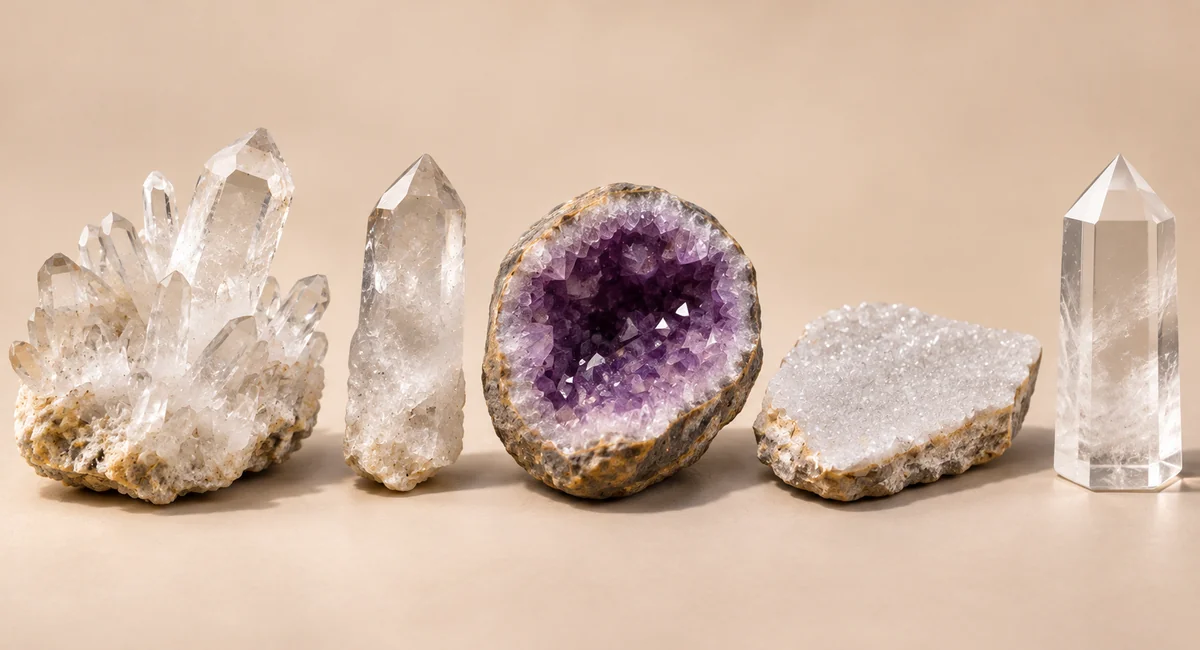
A crystal cluster is a natural group of crystals that have grown together, commonly attached to one another or to a piece of their original host rock. Rather than being carved into a regular design, the visible faces, angles and terminations of a natural cluster reflect how minerals developed in their geological setting. A clear quartz cluster may show many individual points leaning in different directions; an amethyst cluster can display densely packed purple terminations; and an apophyllite specimen may combine sharply formed crystals with entirely different associated minerals.
The attraction of a genuine mineral cluster is not perfect symmetry. It is the opportunity to see natural crystal growth: crowded points, unequal lengths, crystal faces, growth contacts and sometimes the rock from which the specimen was removed. Understanding these details helps a buyer distinguish an intact mineral specimen from a polished gemstone, a carved crystal tower, an open geode or an assembled decorative object.
What makes a group of crystals a cluster?
In mineral collecting, cluster is a practical description of a group of crystals associated in one specimen. It is not the name of a separate mineral species. A cluster can consist predominantly of one mineral, such as quartz, or feature one conspicuous species growing alongside other minerals. A seller should still identify the constituent minerals rather than treating the word cluster as a guarantee of quartz or any other material.
Three visible features are especially useful:
- Individual crystals: Look for recognizable faces, edges or separate growth directions. A mass of rough stone may be naturally crystalline internally without displaying a cluster of distinct crystal points.
- Natural relationships: Crystals may intersect, touch or have grown side by side on a common surface. A shared rock base is common but is not mandatory for a natural cluster.
- Growth or contact surfaces: Some points end in natural faces; others terminate against neighboring crystals, disappear into the matrix, or were broken during extraction. Natural growth is not a promise that every tip is unbroken.
A cluster may have hundreds of miniature terminations or only two or three prominent crystals. Neither number establishes superior quality by itself. The mineral species, crystal habit, overall integrity and intended use matter more than the number of tips.
How crystal clusters form in nature
Minerals grow when the surrounding environment supplies their chemical constituents under conditions that permit an ordered crystal structure to develop. The route varies: minerals can crystallize as magma cools, precipitate from mineral-bearing fluids, or develop through other geological processes. Many collectible quartz clusters form where silica-bearing fluids move through openings in rock and deposit quartz as conditions change.
1. Space becomes available
A fracture, vein opening, pocket or rock cavity gives crystals room to grow. Without sufficient open space, grains may interlock into solid rock, leaving few large external faces. Where a cavity remains open, individual crystals can extend into it.
A rock cavity need not become a commercial geode. The term geode describes a particular cavity-lined geological form; many beautiful clusters are recovered from veins and pockets rather than from rounded geodes.
2. Growth begins on a surface
Crystallization starts at sites where a mineral can establish an ordered structure. Several crystals may begin close together on a cavity wall or existing matrix. As they grow, their faces develop at angles governed by the mineral's internal symmetry, while the available space and fluid conditions influence which faces become prominent.
3. Crystals compete for room
A crystal growing into open space may develop a long, clean prism and an intact termination. Its neighbour may be crowded, partly enclosed, or interrupted by an adjacent point. This is why a natural cluster rarely resembles a manufactured row of perfectly identical towers. Unequal lengths, intersections and irregular growth directions can be expected.
4. Growth can pause, resume or change
New mineral-bearing fluid, changing temperature or changing chemistry can alter the rate, appearance or sequence of crystal growth. Some specimens preserve multiple stages as zones, inclusions, coatings or additional mineral associations. These are geological clues, but a photograph alone usually cannot establish the exact history or locality of a particular item.
For quartz specifically, well-formed crystals commonly have prism faces and a pointed end made from several crystal faces. The familiar six-sided outline is useful, but quartz belongs to the trigonal crystal system; its apparently hexagonal external shape does not make every quartz crystal hexagonal in crystallographic classification.
Understanding crystal habit: why clusters look different
Crystal habit describes the characteristic external appearance of a crystal or an aggregate. Different species form different characteristic habits; even the same species can look quite different as its faces develop in different proportions.
| Form or habit | What you may see | Important buying distinction |
|---|---|---|
| Prismatic | Elongated crystals with recognizable lengthwise faces | Common in many quartz points; the outline alone does not verify the species |
| Terminated | A natural end composed of crystal faces | A natural termination differs from a sawn or polished point |
| Druzy or drusy | A sparkling covering of numerous small crystals | Describes the fine surface crystal coating, not necessarily a geode |
| Radiating or spray-like | Fine crystals arranged outward from a centre or base | May be very delicate, especially in needle-like minerals |
| Tabular | Flat, plate-like crystals | Seen in some minerals and distinct from elongated quartz prisms |
| Massive | Mineral without obvious large individual external faces | Natural rough material, but not automatically a point-bearing cluster |
Not every crystal is quartz. Pyrite may form cubic crystals; calcite commonly exhibits forms quite different from quartz; stilbite can grow in sheaves; and some zeolite-group minerals form fine sprays. An attractive group of pointed crystals should not be labelled Sphatik simply because it appears colourless or glassy.
The parts of a quartz cluster
A quartz cluster is easier to assess when you can identify its main visible elements:
Prism faces. These are the elongated side faces on well-formed quartz crystals. Their proportions vary, giving some points a slender profile and others a short, broad appearance.
Termination. This is the growth end where the crystal naturally concludes. A clean termination often adds visual appeal, but a flat top may instead indicate a fracture or a cut surface. Do not decide solely from a distant product photograph.
Contact faces. A crystal that grew against another mineral or adjacent quartz point can show flattened or irregular areas where growth space was restricted. Such a contact is not automatically damage.
Matrix. The host rock or mineral base on which the visible crystals grew. Matrix can make the specimen more informative and attractive, but it can also be fragile, porous or susceptible to handling damage.
Inclusions and coatings. Internal particles, tiny trapped phases and later mineral coatings can change appearance. They are not automatically signs of poor quality, and they do not establish origin or authenticity without further examination.
Cluster, single point, geode, druzy and carved tower: what is different?
These names describe different physical forms. They should not be treated as interchangeable SEO labels.
| Object | Defining feature | What to verify |
|---|---|---|
| Natural crystal cluster | Several associated or intergrown crystals | Species, natural growth contacts, matrix, damage and repairs |
| Single crystal point | One prominent crystal, attached or detached | Natural versus polished termination; condition of the base |
| Geode half | A geological cavity with mineral lining | Actual cavity, cut edge, possible dye or treatment |
| Druzy specimen | Fine crystals coating a surface | Mineral identity, surface condition, substrate |
| Rough massive stone | Mineral material without clear large external faces | Correct mineral name; do not promise defined points |
| Carved crystal tower | A shape cut or polished by people | Material identity, finish and accurate designation as carved |
| Gemstone tree | Stones or chips arranged with wire or another assembly | Handcrafted construction, not natural mineral crystal growth |
A geode can contain a cluster-like display of crystals, but a cluster does not need to be a geode. A druzy surface may appear on the interior of a geode, on a rock face or on another specimen. A quartz tower carved into six sides can look impressive, yet its regular outline was fashioned by a lapidary rather than grown in that exact form.
This distinction is particularly important when comparing Vastu decorative objects: a natural cluster, a gemstone tree and a polished pyramid may be made of related mineral materials, but they are not the same kind of object.
Natural crystal clusters used in homes and Vastu-inspired spaces
In Indian spiritual and decorative practice, Sphatik (clear quartz) is appreciated for its clarity and associations with purity, worship and contemplative surroundings. Modern Vastu-oriented interiors also use amethyst, clear quartz and other mineral specimens on shelves, in meditation areas and as meaningful decorative objects. These uses may draw upon traditional symbolism as well as more recent crystal-placement customs; they should not all be presented as explicit prescriptions from a single classical Vastu text.
A natural crystal cluster can suit a home mandir, study, reception area or quiet sitting space when its appearance and dimensions are appropriate. Some people choose clear quartz for its luminous appearance and associations with clarity; others favour amethyst for its purple colour and contemplative symbolism. Those choices can be meaningful without requiring a measurable claim that a cluster changes the physical energy of a room.
For a genuine Vastu-conscious arrangement, consider the whole space: doorway and circulation, cleanliness, stability, light, proportion, use of the room and the way the object relates to other furnishings. Do not place a heavy or sharp specimen where it obstructs access, could fall from a height or is exposed to repeated handling. If a specific directional placement is being recommended as part of a traditional consultation, explain the tradition and the actual room context rather than assigning the same direction automatically to every mineral.
A cluster is not interchangeable with a consecrated Yantra or a prescribed puja object. When the purpose is devotional, the relevant deity, tradition and household practice should determine the arrangement; a decorative quartz specimen is a separate choice.
How to judge a natural cluster before buying
Natural mineral specimens are often individually variable. A label such as “amethyst cluster” or “clear quartz cluster” describes a general material and form, not a guarantee that all pieces in a batch look alike.
Examine the complete piece, not only the front
Good product photographs should show the most attractive display face, the back and base, the point terminations, and any visible broken or reattached areas. A side view helps establish the depth of the piece; a base view helps indicate whether it will sit securely.
A mineral specimen may be entirely natural yet have a sawn base for stable display. The cut should be disclosed as a preparation detail, especially if the product is described as “completely unworked.” Likewise, a repaired natural cluster is still mineral material, but a reattached crystal or a composite assembly should be described accurately.
Ask about condition and treatment
Important questions include whether a specimen has been dyed, coated, heat-treated, repaired, stabilized or assembled from separate pieces. Avoid assuming that strong colour is always natural or that a clear crystal is necessarily untreated. The correct answer sometimes is that treatment history is unknown; that uncertainty should be recorded honestly.
Contact surfaces formed during growth should be distinguished from fresh chips. Not every irregular tip indicates mishandling. Conversely, a conspicuously perfect point could be polished or restored, so assess the whole specimen and its description together.
Check how the specimen will stand
A broad rock matrix may provide a stable display base; a tall narrow cluster might need a separate stand. The centre of mass matters more than the beauty of the main viewing angle. Ask whether the stand is included, detachable or merely a photographic prop.
For a one-of-a-kind specimen, expect photographs and measurements of that exact piece. Representative photographs can help explain the mineral type, but they should not replace the image of the item to be shipped.
Record the information that gives a specimen its identity
For an individual natural cluster, useful details include:
- Mineral identification, with associated minerals listed separately where known.
- Overall length, width, height and weight, measured on the exact specimen.
- Matrix material where reliably identified.
- Visible tips, fractures, chips, repair, polish or other preparation.
- Locality or mine only when supported by traceable supplier information.
- Whether a display stand or case is part of the offer.
- Care and packing requirements, especially for fragile terminations.
An attractive label cannot replace these facts. Price, authenticity confidence and collectability depend on the actual piece, not just the colour shown in a generic catalogue image.
Simple display and care for crystal clusters
The safest default is to treat a natural cluster as a three-dimensional mineral specimen, not like a smooth tumble-polished stone. An exposed termination can chip if knocked; a delicate associated mineral or crumbly matrix may be damaged by washing even when the main quartz crystals themselves are comparatively durable.
Place the specimen on a stable shelf or stand with enough clearance for its points. Lift a supported base rather than grasping a delicate tip. Dust gently only where the material permits; begin with a clean, soft, dry brush and avoid vigorous scrubbing. Do not routinely immerse a mixed-mineral cluster, apply salt water, or use harsh household cleaners. When composition or treatments are uncertain, request specimen-specific care instructions.
Some coloured minerals are sensitive to prolonged strong light, and some specimens react poorly to humidity. A quartz cluster with a mixed or unidentified matrix should not automatically receive the same care advice as a polished quartz bead. Detailed species-by-species handling belongs in a separate care guide.
Common misconceptions about crystal clusters
“More points always means a stronger or better cluster.” A large number of points changes the appearance, but it does not establish mineral identity, condition, rarity or a guaranteed Vastu result.
“Every point has to be perfect for the cluster to be natural.” Natural growth contacts are common. Damaged, cut and repaired areas are different issues that should be disclosed.
“Every sparkling cavity is a geode.” A fine crystal coating can be called drusy; a geode requires an appropriate cavity-bearing geological form.
“Every transparent pointed cluster is Sphatik.” Sphatik conventionally refers to clear quartz in this retail context. Identification cannot rest only on transparency and pointed appearance.
“A natural cluster and a carved crystal tower are the same product.” Both can use genuine minerals, but their forms have different origins. One displays natural crystal growth; the other is shaped by cutting and polishing.
Questions people ask about crystal clusters
Is a crystal cluster always made of quartz?
No. Quartz clusters are familiar and widely sold, but groups of crystals occur in many mineral species. The identity of each species matters for care, value, and accurate description.
Can a single quartz point be called a cluster?
A clearly isolated single crystal is better described as a point. Two or more associated crystals may form a small cluster. The boundary is a practical trade-description matter, so photographs and a careful physical description are more useful than rigid claims based on the number of tips.
Are all naturally formed clusters attached to rock?
No. Some retain host matrix; others separate naturally or during extraction. The absence of matrix does not automatically mean an object is artificial, but a seller should not claim an original host-rock attachment without evidence.
How is an amethyst cluster different from a clear quartz cluster?
Both primarily comprise quartz, but amethyst's purple colour and the specimen's specific growth environment produce different appearances. Their precise shape, matrix, treatment and locality still need individual verification.
Is it appropriate to keep a cluster in a puja or meditation space?
Some households include crystal specimens for their beauty, symbolic associations or contemplative atmosphere. Keep placement respectful of the relevant devotional tradition and safe for the available space. A mineral display is not automatically a replacement for established ritual objects.
Can I wash a crystal cluster with water?
Not as a universal rule. Even if the main mineral is quartz, a specimen may include moisture-sensitive minerals, unstable matrix, adhesives or finishes. Follow verified mineral- and specimen-specific care instructions.
What is the best first cluster to buy?
For someone learning how natural crystals look, a clearly described quartz cluster with visible faces, understandable condition and good photographs is often a useful starting point. Choose one you can place securely and handle safely rather than chasing a particular number of points.
Choosing a specimen with confidence
A worthwhile natural crystal cluster reveals something about how minerals grew. Look for a credible mineral name, distinct natural faces, appropriate description of its matrix, and photographs that show the real condition of the piece. If a specimen is offered for traditional Vastu or contemplative display, select it for the appearance, size and symbolism that suit your setting—and ensure the display is stable and appropriate for the room.
For related collections and broader traditional context, explore OmmRudraksha's Vastu collection. Future guides in this series will examine geodes and druzy specimens, quartz varieties, Indian mineral associations, specimen care and how to select an individual piece online.
Related reading
- Geodes, Druzy Specimens and Agate Nodules: What Is Different?
- How to Buy a Natural Mineral Specimen Online
- Natural Crystal Clusters and Geodes in Vastu: Traditional Placement and Meaning
- Cleaning and Storing Natural Crystal Clusters and Geodes
- Clear, Milky and Smoky Quartz Clusters Compared


