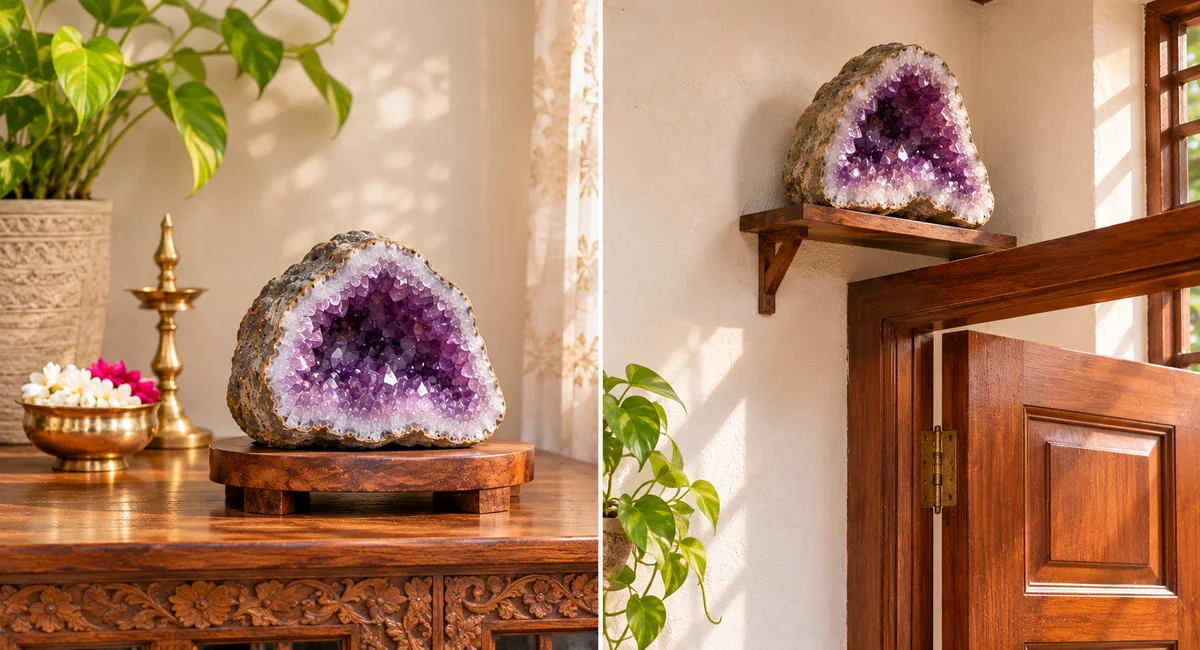
A natural crystal cluster is more than a polished decorative shape. It shows the way mineral crystals developed together, often on a piece of their original rock. An amethyst geode reveals a mineral-lined cavity, sometimes with hundreds of purple quartz points facing into its open centre. Both can become striking objects in an Indian home, a reception area or a quiet place for contemplation. For households that value Vastu, the question is not simply “Which direction should a crystal face?” but how its size, material, meaning and position fit the space as a whole.
Vastu Shastra is a long-standing Indian tradition of considering land, orientation, measurements, spatial divisions and the purposes of different areas of a building. Many contemporary Vastu consultations also recommend natural quartz, amethyst and other mineral displays as symbolic objects. These are related practices, but they are not identical. A modern recommendation to put a particular geode in a particular corner should not automatically be presented as a verse from the Mayamata, Manasara or another classical architectural treatise.
This guide gives a useful way to think about natural crystal clusters and geodes in a Vastu-conscious space: traditional directional language and devotional associations, the actual differences between mineral forms, appropriate rooms and placements, and practical protection for valuable or delicate specimens.
What Vastu Shastra contributes to a mineral display
Vastu is not merely a list of decorative remedies. Its textual and living traditions concern the arrangement of inhabited space: how a site is assessed, how cardinal directions are determined, how plans are measured and divided, and how built areas support particular activities. The Vastu Purusha Mandala provides an important spatial framework in many explanations of classical Vastu architecture. Individual schools, regions and texts can differ in their detailed rules.
In this context, placing any object begins with the room itself. Is it used for worship, study, reception or relaxation? Where are the doors and windows? What occupies the centre? Is a passage clear? Is the chosen surface sound and stable? Does the arrangement feel deliberate rather than crowded? An ornament that obstructs the entrance or risks falling is not improved merely because its label claims an auspicious direction.
The broad traditional concern with order, proportion, purpose, orientation and cleanliness makes a sensible starting point. A crystal cluster may serve as a focal point within such an arrangement. It does not substitute for the larger considerations of site, layout or actual building conditions.
Classical Vastu and contemporary crystal placement
It helps to separate three kinds of statements:
- Classical architectural principles. These concern orientation, spatial divisions, architectural proportions and the distribution of activities in a building. They can be studied against named texts and scholarly interpretations.
- Devotional and customary practice. Clear quartz, often called Sphatik, has a place in some Hindu devotional traditions. A Sphatik Shivling, Sphatik mala or other prescribed worship object has its own ritual identity and is not automatically equivalent to an uncarved cluster or geode.
- Contemporary Vastu or crystal-healing recommendations. Modern practitioners may associate amethyst with calm, clear quartz with clarity, or specific directions with particular mineral displays. These are interpretive customs rather than universally established mineral-placement instructions found in every old Vastu text.
None of these needs to be dismissed. They need to be identified accurately, so readers can follow their own tradition or consultation without confusing devotional prescriptions, present-day advice and physical mineral facts.
Understanding the forms before choosing their position
A mineral's shape affects how it can be displayed. A crystal cluster consists of associated or intergrown crystals; a geode is a rock body formed around an internal mineral-lined cavity; and a druzy surface is a covering of many small crystals. A geode may have a sparkling druzy lining, but a flat druzy slab is not necessarily a geode. A carved pyramid, a gemstone tree and a naturally terminated quartz cluster are also separate product forms.
| Object | Physical character | Display consideration | Vastu-conscious interpretation |
|---|---|---|---|
| Clear quartz or Sphatik cluster | Several natural quartz crystals, possibly on host matrix | Keep tips protected; check the resting base | Appreciated for clarity and simplicity in contemporary spiritual displays |
| Amethyst crystal cluster | Purple quartz points in a natural grouping | Avoid persistent intense sunlight; protect exposed terminations | Often chosen in modern contemplative or meditation-oriented decor |
| Amethyst geode half | Open cavity lined with purple quartz crystals | Check cut base, mass, centre of gravity and open side | Decorative focal point; direction alone does not define its meaning |
| Large cathedral geode | Tall or elongated mineral-lined cavity | Requires stable floor-level or reinforced support, never a precarious high shelf | Suitable only where its scale respects circulation and room use |
| Quartz or agate druzy specimen | Fine crystals coating a surface or cut material | Check attached support, coating integrity and dust exposure | Can be displayed as natural mineral beauty without calling it a ritual object |
| Carved tower or pyramid | Mineral shaped by cutting and polishing | Stable footprint and clear treatment disclosure | A different object with its own modern symbolism; not natural cluster growth |
If an item contains more than one mineral, material-specific precautions govern the whole piece. Do not wash a mixed specimen as though every part were hard, durable quartz. Also avoid claiming an unverified specimen comes from a particular mine or sacred location: geological origin and devotional meaning are different questions.
Ishanya, the northeast and directional Vastu vocabulary
Traditional descriptions of the Vastu Purusha Mandala associate directions and sectors with particular deities and roles. The northeast is commonly called Ishanya (Īśānya), associated with Ishana or Shiva in many Hindu directional traditions. The southeast is Agneya, the region associated with Agni; the southwest is Nairritya, and the northwest is Vayavya. These names belong to a larger system of spatial interpretation—not to a scientific chart that measures the effect of minerals.
Contemporary household advice frequently recommends a clean, quiet northeast or northeast-side prayer/meditation area. A person may choose a modest Sphatik or amethyst specimen there as an expression of clarity, devotion or calm. That is an intelligible modern Vastu-inspired arrangement. But the claim that every natural quartz cluster must be placed in the northeast, or that a particular mass of amethyst corrects a specific architectural defect, needs a traceable authority; it is not a universal rule to impose on every home.
How to interpret a directional suggestion responsibly
If someone recommends a direction for a particular mineral, ask what the recommendation is based on: an identified text, a regional family practice, a contemporary Vastu method or a personal preference. Then inspect the actual location. A north-eastern shelf that receives harsh sun, catches a swinging door or cannot bear the weight of a geode may be a poorer display position than a secure, shaded shelf elsewhere.
A compass bearing is only one part of an architectural context. In apartments, the room geometry, building orientation, use of the space and safe access matter. Avoid rotating a geode every few days because an online chart offers conflicting answers. For a specialist consultation, the practitioner should explain the underlying method and why a particular object is appropriate for that room.
Sphatik and sacred display: not every quartz specimen is a puja object
The Sanskrit term Sphatik is widely used in Indian devotional and gemstone commerce for clear crystalline quartz. Sphatik malas and Sphatik Shivlings are familiar examples in some Shaiva and other Hindu practices. Ritual use depends upon the object, the community and the prescribed mode of worship; a quartz cluster does not acquire the status of an installed Shivling or consecrated Yantra merely by sharing its mineral material.
If a household keeps a Sphatik mala, a Shiva image or another consecrated article in its prayer space, follow that household's sampradaya, temple guidance or family custom for actual worship. A cluster can be a separate decorative or contemplative object nearby if desired. It should not block the principal deity, occupy a place reserved for an offering lamp, or require worship merely because it is transparent.
There is no need to invent a universal prana pratishtha ritual for a commercial geode. For ordinary decorative stone, keeping the area clean, secure and respectful is sufficient. If the owner has a specific liturgical intention, ritual matters belong to that tradition rather than a retail placement chart.
What do clear quartz, amethyst and other natural specimens traditionally mean?
The most defensible interpretation starts by recognizing that mineral identity and cultural symbolism are different kinds of knowledge. Clear quartz and amethyst are both varieties of quartz, yet their colour and history lead people to choose them for different aesthetic or devotional purposes.
Clear quartz: Sphatik and the language of clarity
Clear quartz is valued for transparency, visible crystal faces and its bright appearance in indirect light. In some Indian spiritual settings, Sphatik is associated with purity and meditative attention. A natural cluster can be selected to echo those themes, especially in a quiet space containing books, sacred texts or a simple seating area.
Do not confuse the association with a claim that a crystal physically purifies indoor air, neutralizes electromagnetic fields or guarantees an improvement in concentration. Such effects are not established by the specimen's mineral identity.
Amethyst: contemplative colour and modern Vastu symbolism
Amethyst is purple quartz, and its colour can be particularly attractive beside wood, neutral textiles and soft illumination. It is frequently associated by contemporary crystal and Vastu practitioners with serenity, reflection and a peaceful atmosphere. These are reasonable ways for a customer to describe why they enjoy a piece; they do not convert colour symbolism into a proven treatment for anxiety, insomnia or other conditions.
An amethyst geode may work visually as a single focal point; an overfilled shelf of unrelated “remedy stones” often loses the intentional quality that made the original arrangement meaningful.
Other mineral specimens and modern associations
Apophyllite with stilbite, pyrite, celestite, fluorite and many other minerals can be displayed for their natural structures. Some modern guides attach specific meanings to each one. Those conventions vary widely; they are not a reason to relabel an apophyllite specimen as Sphatik or to treat a fragile collector mineral as a guaranteed Vastu correction. When a stone is selected for a traditional purpose, confirm its actual mineral name first and identify the source of the interpretation separately.
Choosing suitable places around the home
A room's purpose and the actual size of the stone should drive the physical placement. A small quartz cluster may need little more than a clear, stable surface. A tall amethyst cathedral can weigh many kilograms and require its own low stand. Consider both the intended cultural role and the material's care requirements.
| Home or work area | Potential role for a natural specimen | Practical conditions |
|---|---|---|
| Prayer or meditation space | A modest decorative reminder of attention or devotional themes | Keep a clear distinction from consecrated worship objects; avoid lamp heat and offerings falling onto stone |
| Study or reading area | Natural object of beauty, geology and reflective interest | Prefer a stable desk-side shelf away from the working edge and strong sunlight |
| Living room | One natural display focal point, with an informative label if desired | Support the exact weight, preserve walkways, avoid child-accessible edges |
| Reception or office | Interesting conversation piece that complements a considered interior | Avoid traffic, unstable plinths and confusing treatment/origin claims |
| Entrance | A small securely placed object if space permits | Do not obstruct the door, emergency movement, footwear storage or walking path |
| Bedroom | A calm decorative choice for households that prefer one | Place away from bedside collision points; do not claim it treats sleep disorders |
| Balcony or windowsill | Usually less suitable for valuable or delicate specimens | UV, wind, dust, rain and temperature changes create avoidable risks |
For a home mandir, the location of a mineral is secondary to the practical requirements of the worship space. For an office, staff and visitors need clear circulation and secure furniture. For a rented apartment, no permanent drilling or heavy installation should be assumed without permission and appropriate hardware.
How to position an amethyst geode or crystal cluster safely
1. Measure the actual specimen
Record the height, width, depth and weight of the piece to be displayed. Check whether a heavy-looking stone includes a separate base, metal frame or adhesive support. A photograph taken from the front does not establish how the object balances when placed on a shelf.
2. Choose a shelf or plinth designed for the load
Use furniture with an appropriate load rating and a secure attachment to the wall if needed. A tall geode has a higher centre of gravity than a low flat druzy slab and can tip when bumped. Do not place a substantial specimen high above seating, beds or doorways. A low, broad platform can be preferable even if a high shelf appears more dramatic.
3. Preserve the mineral's natural faces
Do not force a geode to face a prescribed compass direction if that means balancing it on a narrow edge. Let its stable base and natural cavity determine the secure orientation. If a bespoke stand is required, use an experienced maker who can support the weight without stressing a thin crystalline margin.
4. Keep light beautiful but controlled
Soft, indirect light usually reveals natural quartz faces without the risk of a permanently sunny windowsill. GIA notes that some amethyst can fade after prolonged intense light exposure. Museums likewise limit UV and excessive light for susceptible minerals. Do not place candles, incense holders or heat-generating lamps close enough to heat the specimen, discolor a coating or damage a supporting stand.
5. Leave space for people and cleaning
Keep pointed crystals away from crowded shelves and children's normal reach. Leave room to lift or inspect the base safely; never drag a heavy geode across polished furniture. Avoid places where sweeping, watering plants or enthusiastic dusting will strike the crystal points.
6. Identify sensitive associated minerals
The main mineral may be quartz, but the host rock, attached zeolites, pyrite, calcite or other associations can impose stricter care. As geological conservators emphasize, light and humidity tolerance vary by species. A generic instruction to rinse every cluster in water, expose it to sunlight or leave it in salt overnight is not a safe default.
A practical Vastu placement process for a real apartment
Rather than starting from an isolated online direction chart, try the following sequence:
- Define the purpose. Is the object intended as natural decoration, a devotional companion, a collector's specimen or part of an identified Vastu consultation?
- Understand the room. Find the usable surfaces, door swing, windows, light, dampness and movement paths.
- Identify the mineral honestly. Is it clear quartz, amethyst, an agate geode, or a mixed mineral specimen? Is the pictured stone the exact one supplied?
- Check the physical scale. Match the actual dimensions and weight to a suitable base or plinth. A large cathedral may dominate a small study even if its direction is considered favourable.
- Consider tradition. If following a family or practitioner preference for Ishanya, or for a prayer shelf, see whether that position is appropriate and safe. If not, discuss an alternative rather than compromising stability.
- Arrange deliberately. One well-chosen piece with breathing room often has more presence than a crowded group of unrelated minerals.
- Review periodically. Inspect light exposure, shelf security, dust buildup and any change in coatings or fragile mineral surfaces. Review the space's actual use, not an assumed daily change in a stone's powers.
This process respects Vastu's interest in space and meaning without reducing it to an unverified sequence of crystals that supposedly neutralize every architectural problem.
Three examples of thoughtful arrangements
A compact home mandir with a Sphatik cluster
A family has a small clean prayer shelf already organized around a deity image, a lamp and a few devotional articles. A small clear quartz cluster can stand separately on a stable side shelf if the household wishes. It should not sit underneath dripping lamp oil or close enough to a flame to be warmed. There is no need to displace the established worship arrangement or call the cluster a consecrated Sphatik Shivling.
A reading room with an amethyst cluster
A modest purple quartz cluster is placed on a stable shelf beside books, not on the working edge of a desk. Indirect illumination reveals the natural points, while curtains limit direct sun. The owner appreciates amethyst's contemplative symbolism without claiming that it guarantees concentration or sleep. The arrangement supports the room's use rather than competing with it.
A reception area with a cathedral geode
A large amethyst geode is selected because its inward-looking cavity and natural texture create a memorable focal point. The owner confirms its exact dimensions, weight, base, repair history and floor-loading situation. The geode rests on a low secure plinth, away from circulation; its colour is protected from intense sunshine. The display can be meaningful in a Vastu-conscious office without any assertion that it automatically attracts money or corrects a structural defect.
Does the opening of a geode need to face a particular direction?
A geode's cavity is a geological feature, not a compass needle. Retail advice sometimes says the opening should face a chosen Vastu sector or point towards the room. Such statements may express a contemporary practitioner's method, but there is no general geological reason for a cavity to emit an effect in a particular direction, and one should not present a universal classical prescription without a verifiable text.
Orient the opening so its crystal lining is visible, the support is reliable and movement around it is safe. If following a specific consultation, the chosen orientation should be compatible with those requirements. A loose heavy geode should not be tilted or balanced simply to make its mouth face northeast.
Should crystals be “cleansed,” “charged” or placed in the sun?
The language of spiritual cleansing and charging belongs to varied modern customs. Some households prefer prayer, remembrance or a simple respectful setting; others follow particular contemporary crystal practices. Those choices should be distinguished from the physical cleaning of a mineral specimen.
For physical care, intense sunlight, prolonged immersion, salt water, smoke, oils and abrasive cleaning can damage colours, mineral associations or finishes. Sun exposure is not required for quartz to remain quartz. Whether a ceremonial action is meaningful to its owner is a separate matter from whether it is safe for a delicate natural object. Where a specimen has unknown minerals, coatings or adhesives, use minimal handling and obtain material-specific guidance before introducing moisture or heat.
Buying a cluster or geode specifically for Vastu display
Before choosing by a chart or a sales claim, ask for facts that establish the actual object:
| Question | Why it matters |
|---|---|
| Is this photograph of the exact specimen I will receive? | Natural clusters and geodes are individually irregular; replacements may look very different |
| What is the mineral, and are other minerals present? | Material identity determines correct naming and care |
| Is the piece a true geode, natural cluster, druzy slab or carving? | These are physically different products, even when made of quartz |
| Are the exterior, base or edges cut, polished, repaired or coated? | Preparation and restoration change the physical description and handling |
| What are its dimensions, weight and centre of balance? | A safe Vastu-inspired location must support the actual object |
| Is a stand or mounting bracket included? | Display photographs often include accessories not supplied with the stone |
| What is known about source locality and treatments? | Locality, authenticity and treatment cannot be established from attractive photography alone |
| How will it be packed and transported? | Open points, narrow crystal bridges and heavy bases need specialist protection |
A customer may prefer a transparent Sphatik cluster, a purple amethyst display or a paired geode for personal and cultural reasons. That preference is legitimate. But the seller should describe the object accurately and avoid offering a “guaranteed Vastu correction” as though it were an intrinsic physical property of the mineral.
Common errors to avoid
- Confusing Vastu Shastra with a universal crystal-direction chart. Traditional planning principles and contemporary decorative recommendations have different evidentiary histories.
- Treating Sphatik as the name of every glassy-looking stone. The material must actually be quartz for a clear-quartz claim.
- Calling a geode, cluster, gemstone tree and carved pyramid interchangeable. Their physical construction and display needs differ.
- Substituting a large mineral for architectural correction. A mineral ornament does not resolve blocked ventilation, water damage or an unsafe room layout.
- Ignoring sunlight and humidity because the object is “natural.” Natural materials can still deteriorate when displayed poorly.
- Confusing symbolism with medical treatment. A peaceful display is not proof that a crystal treats anxiety, sleep disorders or illness.
- Choosing direction over stability. No symbolic benefit justifies a heavy or sharp specimen that can fall onto someone.
Questions people ask
Is the northeast always the best direction for a crystal cluster?
Ishanya, the northeast, has significant associations in several Vastu traditions, and contemporary practitioners often use it for quiet or devotional spaces. That does not establish a universal ancient instruction for every quartz or amethyst cluster. Choose a safe position that suits the room and the practice being followed.
Can I keep an amethyst geode in a prayer room?
A geode can be a decorative mineral in a prayer room when the household's custom permits and there is a stable, clean position away from flames, oils and heavy traffic. It is not automatically a consecrated ritual object.
Should the crystals in a geode face inward or outward?
A geode naturally has crystals lining its interior. For display, keep the opening visible if desired and the whole piece safely supported. Claims that the opening must emit or receive energy in one direction require a specific, identified tradition; they are not mineralogical facts.
Are clear quartz and Sphatik the same material?
In ordinary Indian gemstone and devotional trade, Sphatik generally refers to clear quartz. A listing must still verify that the object is actual quartz, not glass or another transparent mineral.
Do bigger clusters provide stronger Vastu effects?
Size changes visual presence, weight, cost and safety requirements. It does not establish a proportional spiritual or physical effect. Select a scale that fits the room and the meaning you attach to the object.
Can I put a geode on a sunny balcony to charge it?
A valuable or delicate geode is generally better protected from strong sunlight, rain, wind and temperature changes. Some amethyst can fade with prolonged intense light. Ritual preferences need not require exposing the mineral to conditions that may damage it.
Is a natural crystal cluster better than a carved pyramid or gemstone tree?
They serve different purposes. A cluster displays natural geological growth; a carved pyramid is worked mineral material; a gemstone tree is an assembled decorative object. Choose according to desired form, care, cultural significance and personal preference, not an unsupported claim of universal superiority.
Do I need a Vastu consultation before placing one at home?
Not for ordinary home decoration. If your intention is to follow a particular traditional interpretation of the room or a formal Vastu recommendation, a qualified practitioner familiar with your space can explain the basis of the advice. The object should still be correctly identified, stable and suitable for its environment.
A balanced way to bring natural minerals into the home
A thoughtful Vastu-inspired mineral display can respect both Indian spatial tradition and the character of a genuine geological specimen. The first asks how a space is oriented, used and understood; the second asks what the object actually is, how it formed and what conditions will keep it safe. Sphatik can hold devotional meaning, amethyst can support a contemplative visual atmosphere, and an impressive geode can become a focus of attention in a reception room. None needs exaggerated promises to justify its place.
Begin with the room, verify the mineral, choose a secure and appropriate position, and acknowledge which recommendations come from living custom rather than a cited classical rule. For the broader collection and related Vastu objects, explore the existing OmmRudraksha Vastu collection. Natural clusters, geodes and mineral specimens can then be appreciated for what they genuinely bring: natural form, material beauty and personal or traditional significance.