

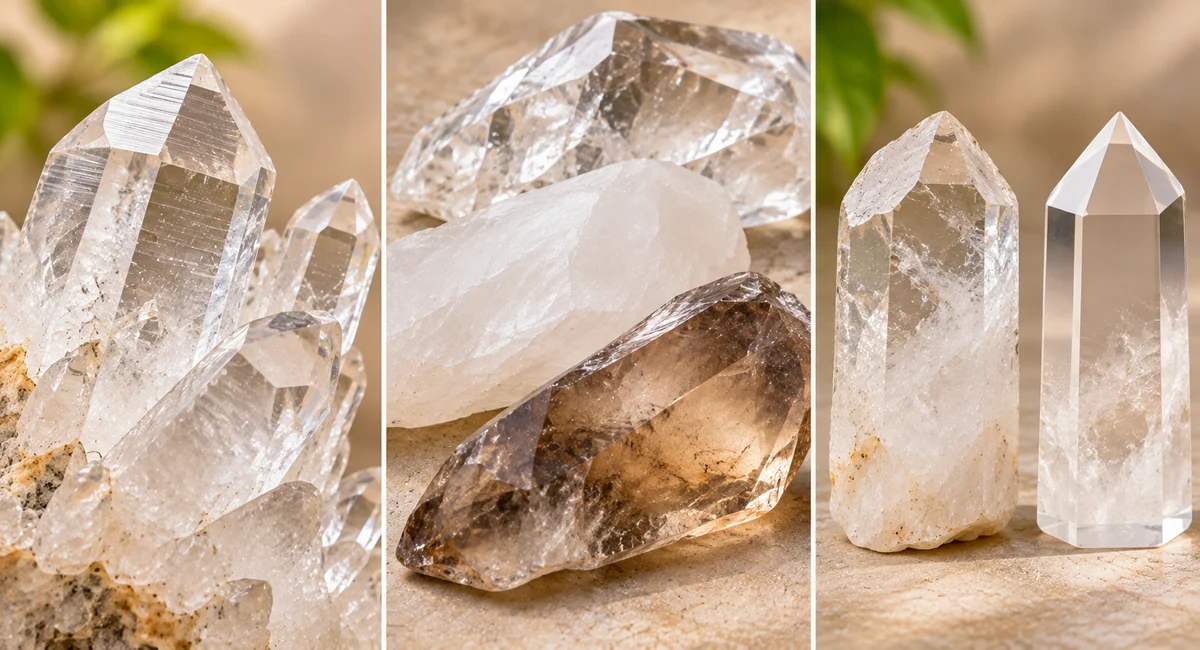
A cluster of clear quartz can look almost transparent at its tips, a milky quartz specimen can resemble white ice, and smoky quartz may have soft tea-brown or nearly black points. Seen together, they appear to be three different materials. Mineralogically, however, they belong to the same mineral species: quartz (SiO₂). What changes is how the crystals transmit light, what they contain or have experienced during geological growth, and how that history appears in the finished specimen.
For someone choosing a natural cluster, colour is only the beginning. A desirable specimen should also be accurately identified, genuinely crystal-bearing rather than simply rough stone, properly represented in photographs, and suited to its intended display. This guide compares the three appearances as natural mineral specimens—not quartz beads, wire gemstone trees, polished pyramids or carved towers—and explains which differences matter when buying one for collecting, a home, a workplace or a Vastu-inspired setting.
Clear, milky and smoky quartz at a glance
| Feature | Clear quartz, often called rock crystal | Milky quartz | Smoky quartz |
|---|---|---|---|
| Usual appearance | Colourless to nearly colourless; transparent or locally translucent | White to cloudy; translucent to opaque areas | Grey, tea-brown or dark brown to almost black |
| Main reason for appearance | Relatively little light-scattering material along the viewed path | Microscopic fluid or gas inclusions and other internal structures scatter light | Radiation-related colour centres involving trace impurities, especially aluminium |
| Mineral species | Quartz, SiO₂ | Quartz, SiO₂ | Quartz, SiO₂ |
| Typical natural cluster look | Glassy prisms and points, often with internal veils or fractures | White points and frosted-looking areas, sometimes clear at their ends | Brownish transparent or translucent points, sometimes darker toward tips or zones |
| Main buying question | Are the terminations natural, and how much is genuinely transparent? | Are visible individual crystals present, or is this massive white rough stone? | Is the colour natural or treated, and are any associated minerals correctly named? |
| Display concern | Points chip; brilliant surfaces readily show dust | Porous or unidentified matrix requires care | Prolonged strong light or heat may alter some colours; matrix may be delicate |
These descriptions are typical appearances, not reliable identification tests. A colourless point might be quartz, but it could also be another transparent mineral. A brown specimen is not automatically smoky quartz, and a white piece is not necessarily a milky cluster. Reliable labels depend on the visible crystal habit, provenance, associated minerals and, where needed, professional testing.
One mineral species, several appearances
Quartz is a silicon dioxide mineral with a three-dimensional crystalline structure. In the familiar lower-temperature form found at Earth's surface, it belongs to the trigonal crystal system. Well-developed crystals often appear as roughly six-sided prisms, with a pointed termination of several intersecting faces. Crystal points may be long and slender, short and stout, or crowded against their neighbours. Their outline reflects both crystallographic structure and the conditions in which they grew.
A natural quartz cluster is a group of physically associated crystals. Some grow from a common rock matrix; others intergrow closely enough to stay together after extraction. A seller should distinguish such a group from a single detached point, a solid massive lump of quartz, and an object assembled from separately sourced points. A cluster does not become a new species because it has a particular colour.
Why natural points are not all the same shape
Silica-bearing fluids can supply material for growing quartz crystals in veins, fractures and rock cavities. Where there is open space, crystal faces may develop freely. Where crystals crowd together, one face may be interrupted by another crystal or the host rock. Different generations of growth may leave zoning, inclusions, overgrowths and unusual forms.
That variability is normal. A specimen with crystal tips of different lengths is not automatically inferior to a tidy-looking one. Conversely, a piece with rows of identical smooth points needs inspection: some regular shapes are the result of cutting, polishing or assembly rather than undisturbed crystal growth.
The matrix can matter as much as the visible quartz
Matrix is the rock or mineral base supporting the points. It may be quartz-rich, feldspar-bearing, or a mixture of minerals. The matrix may determine how the specimen stands, how easily it breaks, whether a cleaning method is appropriate and whether there is a meaningful locality association. A quartz point can be relatively durable while the surrounding material is friable or water-sensitive. Treat the whole specimen according to its least robust part, not just the Mohs hardness of quartz.
Clear quartz clusters: transparency and natural growth
The term clear quartz commonly refers to colourless crystalline quartz. Particularly transparent specimens are also known as rock crystal; in Indian retail and spiritual contexts, clear quartz is frequently called Sphatik or Sphatika. These are familiar commercial and cultural names, although an accurate product description should still state the mineral identity as quartz.
What natural clarity actually looks like
A clear quartz cluster does not require every point to be perfectly transparent. One crystal may show a nearly colourless tip and a white or cloudy base. Another may contain internal fractures, veil-like inclusions, growth lines or reflective planes. Under a lamp, these structures can become more visible even while the exterior remains glassy and attractive.
The best photograph is not always the one with a pure white background and very bright backlighting. Request daylight and neutral-light images, a view against a dark or mid-tone background, and close-ups of the terminations. These reveal whether the transparency is continuous, whether there are chipped tips and how the crystals join the base.
Clear does not prove untreated
Transparency is not a certificate of origin, and it does not reveal every possible treatment. Some genuine quartz specimens have been cut to make a level base, repaired after extraction or coated for appearance. A sawn underside does not invalidate naturally grown points, but the product description should say when substantial preparation has been done. If a seller describes a specimen as unworked, expect no concealed polishing or assembled additions.
When clear quartz is the right choice
Clear quartz is useful when a customer wants easily visible prism faces, natural terminations and a light, open-looking display. For a small shelf or study table, a low, broad cluster may be easier to position securely than a tall specimen. Prioritise the actual point condition, dimensions and stability rather than a generic promise that the clearest cluster is automatically the most valuable or the most spiritually effective.
Milky quartz clusters: cloudiness, inclusions and form
Milky quartz is crystalline quartz with an opaque to translucent white appearance. Its cloudiness often comes from countless tiny inclusions—commonly fluid or gas inclusions—or internal features that scatter incoming light. The light-scattering effect is different from a separate white mineral coating and different again from a deliberately frosted, sandblasted or acid-etched surface.
The cloudiness can vary inside one crystal
A single point may have a white core, a nearly clear outer growth zone, or the reverse. Cloudy regions can occur alongside transparent windows. Some specimen bases are milky because the crystals are crowded with tiny inclusions, while later points appear clearer. Such mixed appearance is not proof that clear quartz was glued onto white rock, nor does it rule out assembly; inspect the growth joins and the specimen's underside.
A good listing shows the natural transitions instead of making the entire cluster look uniformly white through exposure settings. For collectors, internal veils and milky regions can be attractive evidence of a specimen's complex growth, not flaws to erase from the description.
Milky quartz cluster versus milky quartz rough
This is a critical product-naming distinction. A mass of white quartz, even a naturally formed mineral chunk, is not automatically a cluster. The word cluster should be used when individual crystal faces, points or recognisable growth units are genuinely present. White rough without clearly defined points is better named milky quartz rough specimen or massive milky quartz, as appropriate.
Similarly, a white rock sprinkled with sparkling crystals might be a druzy coating rather than an array of larger quartz points. The size and organisation of the crystals determine the more useful name. In close-up images, a true cluster should show how separate faces intersect or grow from the matrix.
What to check before choosing a milky specimen
Ask for a photograph from the side and base, since white surfaces can hide breakage. Confirm whether it is predominantly quartz or includes other pale minerals such as calcite or feldspar. A seller should not identify a white specimen as Sphatik simply from colour; Sphatik in this context generally suggests quartz, often the clear variety. Where the specimen is deliberately sold for its cloudy white appearance, milky quartz is the more informative name.
Milky quartz can be visually restful on a dark wooden stand or within a display of contrasting mineral colours. Its appearance, rather than an unverified grade label such as “highest power,” should guide a decorative purchase.
Smoky quartz clusters: brown colour, radiation and disclosure
Smoky quartz is the grey-to-brown or almost black colour variety of quartz. In naturally coloured smoky quartz, the colour is linked to radiation-induced defects in the crystal structure, typically involving trace aluminium. Over geological time, radiation from surrounding minerals can create those colour centres. The colour may be pale grey, warm brown, dark tea-brown or very deep, sometimes described as morion for nearly black material.
Importantly, laboratory irradiation can also produce smoky colour in quartz. The visual colour by itself does not prove which process occurred. A dark colour is not a certificate of natural irradiation, and an untreated-looking cluster cannot be authenticated from a website thumbnail. Treatment history needs a reliable supplier declaration, followed by specialist assessment where commercially warranted.
Natural radiation history is not the same as a hazard claim
The geological process that can colour smoky quartz should not be confused with a blanket assertion that every smoky quartz crystal is itself dangerously radioactive. Neither should a shop claim safety for a poorly identified mineral assemblage without knowing what other minerals are present. The appropriate consumer information is the specimen's mineral identity, any known associated minerals and its treatment history, not alarmist language about the word radiation.
Look for genuine zoning and realistic surfaces
Some smoky quartz points are unevenly coloured, lighter toward the base or darker in certain zones. Others look more uniform. Neither pattern alone verifies natural colour. Review close photographs of the points and matrix, looking for credible growth contacts, repairs, applied colour on fractures, and overly regular polished ends. If the cluster contains pale feldspar, mica or another mineral, those should be listed separately rather than silently included under the word quartz.
Natural smoky quartz can occur with multiple mineral species; a contrast between brown quartz points and a pale host matrix is entirely plausible. However, the exact locality of an individual piece must be supplied from documentation, not inferred because a similar-looking museum specimen came from a famous deposit.
Choosing between pale smoky and very dark points
Pale smoky quartz may reveal more internal structures and let light pass through the crystals. Very dark quartz gives a stronger visual contrast with a pale matrix but can hide some internal contacts and condition details. A collector may value a particular form, rarity or documented locality; a home buyer may simply prefer the colour. Neither preference establishes superior authenticity or Vastu results.
If treated material is offered, the label should clearly state the known treatment. Where the information is unknown, say so. Avoid declaring a very dark cluster naturally coloured on the basis of appearance alone.
Colour changes, combined zones and lookalikes
The three varieties need not occur in neatly separated boxes. An individual quartz specimen can contain transparent and milky areas, smoky colour bands, and crystals of different intensity on the same matrix. This complexity is often more interesting than a tidy retail category.
| What the piece looks like | Possible explanation | What the listing should establish |
|---|---|---|
| Clear tips over a cloudy white base | Changes in inclusions or successive quartz growth | Same or different growth generations; visible natural junctions |
| Brown points with a white quartz or feldspar base | Smoky quartz crystals on a pale matrix | Identify the white matrix rather than assuming it is quartz |
| One point with clear and smoky zones | Variable colour-centre development within quartz | Treatment history and photos of zoning under neutral light |
| Uniform white lump with no faces | Massive milky quartz or another white mineral | Avoid the word cluster unless natural crystal points can be seen |
| Shiny surface covered in tiny points | Druzy crystals on a rock or mineral surface | Distinguish druse from large, discrete prismatic crystals |
| Six equal polished points glued to a base | Handmade or assembled display | Disclose assembly, polished faces and materials accurately |
A colour name should not override crystal habit. A brown mineral in a blocky or bladed habit is not automatically smoky quartz, even if the colour matches. Calcite and other minerals may appear colourless or white; fluorite can be colourless or coloured; feldspar may form pale angular crystals. Professional examination is appropriate where a more valuable specimen has uncertain identity.
Natural terminations versus polished points
On natural quartz, prism faces meet in characteristic terminal faces. They may be imperfect, intergrown or partly broken. A polished tower, by contrast, has been cut to create a deliberately consistent outline. A natural cluster can be professionally mounted or have a level sawn base without changing the origin of the visible crystal terminations. Disclose both the natural growth and any later work.
Look particularly at the backside. Some specimens are displayed only from the front, which can hide repairs, uneven matrix or a precarious balance point. For a tall cluster, ask whether the display base seen in the photograph is included, permanently attached or a temporary prop.
Buying checklist: which quartz cluster offers real value?
When comparing actual stock, material identity comes first. After that, judge the individual specimen rather than only its colour. A smaller, stable, well-documented quartz cluster can be more suitable for a home than a much larger but damaged or poorly mounted piece.
Photographs of the exact item
Ask for front, rear, side and underside images of the actual piece, plus a close view of the points. Include a ruler or scale reference, preferably with measurements in millimetres or centimetres. Confirm whether the website shows an individually numbered specimen or a representative photograph for a variable batch. Exact-to-stock images are especially important for large geodes and unusual natural arrangements.
Mineral and treatment disclosure
The product description should state whether the prominent crystals are quartz, whether any associated species are known, and whether the specimen has been repaired, stabilized, heated, irradiated, dyed or assembled. For smoky quartz, the origin of the brown colour can be material to the purchase. Where no reliable information is available, acknowledge uncertainty rather than guessing.
Condition of crystal terminations
Chipped or bruised ends, natural contacts, growth steps and repairs are not the same phenomenon. Ask for close photographs showing chips or missing tips. A “natural point” label concerns its original growth form; it does not guarantee that the point reached the customer completely undamaged.
Stability and packing
Record the complete dimensions and weight. Heavy clusters need a sufficiently broad base and cushioning that does not press on their most delicate terminations. A matrix containing other minerals may be much less tolerant of washing or physical pressure than quartz alone. The same basic rule applies when displaying it on a shelf or preparing it for shipping.
Origin and price
A named mine or district matters when documented, but a generic reference to Brazil, Madagascar, India or the Himalayas is not proof of specimen provenance. An honest “locality not confirmed” label is preferable to an invented origin. Price depends on size, condition, crystallization, rarity, aesthetic quality, treatment, repair and documentation—not on any universal potency scale for clear, milky or smoky colour.
Three practical use cases
A bright study or meditation shelf. A modest clear quartz cluster can provide visible natural crystal faces without dominating the shelf. Choose a stable base, avoid locations where people brush past the tips, and consider a protective cabinet if it is fragile.
A warm-toned reception or living room. A smoky quartz cluster may suit wood, metal and neutral colours. Pale smoky points reveal the crystal structure more easily than almost black ones. Avoid strong heat or prolonged direct sun, particularly where the treatment and colour stability are uncertain.
A contrasting mineral collection. A milky quartz cluster beside clear and smoky specimens can illustrate how inclusions and colour centres affect appearance. Label each with mineral name, verified locality where known, actual dimensions and any preparation or treatment. If a white piece is massive rough quartz, label it as such rather than forcing it into the cluster category.
Quartz clusters in Vastu and Indian devotional spaces
In Indian religious and spiritual vocabulary, Sphatik is a familiar name associated with clear quartz. Sphatik malas, small devotional objects and transparent crystal forms are appreciated in a range of practices for their luminosity and symbolism of clarity or purity. That established cultural context deserves respectful treatment. A natural, uncarved quartz cluster, however, is not identical to a Sphatik mala, a prescribed Yantra or a consecrated image.
In contemporary Vastu-oriented home arrangements, people may select clear quartz for a bright, open visual character, milky quartz for a soft and calm appearance, or smoky quartz for its earth-toned, grounding symbolism. The latter associations often belong to modern crystal culture or household preference; do not present them as uniform rules in every classical Vastu text. Appearance, intended devotional practice, proportions, safe placement and room use should all be considered together.
If a family follows a particular puja tradition, the relevant religious practice takes priority over a generic internet instruction to place a crystal in a certain direction. A stable mineral specimen can decorate a prayer or meditation area without replacing a traditional object. Avoid automatically assigning a single compass direction to every quartz colour or promising that a cluster will independently change wealth, relationships or health.
For home display, maintain cleanliness and respectful placement, keep sharp points away from children's reach, and avoid areas where the specimen can fall. Quartz should not be routinely immersed in salt water, smoke-drenched or coated with oils as an improvised ritual cleaning method—especially when the matrix and any treatments are unknown. For further collection context, see the Vastu collection.
Care differences: quartz tips are hard, whole specimens may be fragile
All three colour varieties share quartz's approximate Mohs hardness of 7. Hardness measures resistance to scratching; it does not mean a pointed cluster is unbreakable. A glassy termination can chip, a fragile contact may separate, and the matrix may contain softer minerals. The safest default for an unidentified or mixed specimen is minimal handling and a dry, dust-protected display.
| Care question | Clear quartz cluster | Milky quartz cluster | Smoky quartz cluster |
|---|---|---|---|
| Dust | Use a very soft, clean, dry brush where stable; avoid catching tips | Same, with attention to cloudy crevices and any friable base | Same; dust can be particularly visible on dark, glossy faces |
| Water | Do not soak an unknown or mixed-mineral specimen | Do not assume a white matrix is waterproof | Do not soak without verified composition, treatment and secure mounting |
| Strong heat or sunlight | Avoid thermal shocks and unnecessary prolonged exposure | Avoid heat and rapid changes; protect other minerals on matrix | Avoid excess heat and prolonged intense light because some smoky colour may change |
| Handling | Lift under the base, not by points | Lift under the base; cloudy contacts may conceal cracks | Lift under the base; dark tips can hide fractures |
| Storage | Keep dry, stable and separated from hard objects | Support irregular rough edges and matrix | Keep protected from strong heat and unintended pressure |
Never use an acid test, household bleach, salt-water bath, ultrasonic cleaner or abrasive scrubbing as a routine way to identify or refresh a collector specimen. If cleaning beyond gentle dry dusting is necessary, obtain material-specific advice and check for repairs or protective coatings first. A polished bead and an intact cluster with a mixed matrix are not equivalent cleaning problems.
Frequent naming and buying mistakes
Mistake 1: treating clear, milky and smoky quartz as different mineral species. They are quartz varieties distinguished principally by appearance and colour-forming processes.
Mistake 2: advertising every white chunk as a milky quartz cluster. Massive rough quartz may have no developed cluster of crystal points.
Mistake 3: claiming smoky quartz is necessarily untreated because it is brown. Natural radiation can create smoky colour, but laboratory irradiation can do so as well.
Mistake 4: assuming that colour alone establishes origin. A colour does not identify a mine, district or country. Locality belongs on the label only when evidence supports it.
Mistake 5: confusing natural contacts with a repaired tip. Growth-contact surfaces can be part of natural development. Fresh breaks, glue and reconstructions require separate disclosure.
Mistake 6: equating Mohs 7 with indestructibility. Quartz tips, attached crystals and host matrix can all break under pressure or impact.
Mistake 7: replacing clear photographs with mood lighting. A product listing should help a buyer evaluate its real colour, point condition, back and base.
Frequently asked questions
Are clear, milky and smoky quartz different stones?
They are different appearances or varieties of quartz, the mineral silicon dioxide. The names describe transparency, cloudiness and colour, not three separate species.
Is milky quartz less natural than clear quartz?
No. The cloudy appearance can arise naturally from many minute inclusions and internal features. Clear and milky regions may even appear in the same quartz crystal.
Why does some smoky quartz look nearly black?
The strength and distribution of smoky colour centres can make some quartz very dark. Very dark smoky quartz is sometimes called morion, although a retailer should use that name carefully and confirm the material is actually quartz.
Can a seller prove natural smoky colour from a photograph?
No. Both natural geological processes and laboratory irradiation can produce smoky colour. Photographs document the appearance and condition but normally cannot establish treatment history alone.
Is a white massive quartz piece a crystal cluster?
Not necessarily. If distinct crystals or natural points are absent, massive milky quartz rough is usually the more accurate description. The word cluster should correspond to visible associated crystal growth.
Can transparent and smoky quartz grow together?
A specimen can contain clear and smoky zones or associated quartz crystals with different appearances. Such zoning is not automatically proof of glue or artificial assembly; inspect the growth contacts and documentation.
Does clear quartz always mean Sphatik?
Sphatik commonly refers to clear crystalline quartz in Indian commercial and devotional usage, but a transparent appearance alone does not identify the mineral. The specimen should still be correctly identified as quartz.
Which is best for Vastu: clear, milky or smoky quartz?
There is no single historically universal choice for every room. Consider the household's tradition, the intended purpose, the object's stable placement and the mineral's appearance. Claims that one colour guarantees a particular life outcome should not replace thoughtful selection.
Is smoky quartz radioactive because of its brown colour?
Its colour can result from past exposure to natural radiation, but that fact alone does not establish that the quartz itself is a radiation hazard. Any unusual associated minerals or uncertain source should be assessed separately, rather than judged by colour.
Can I wash a quartz cluster in water?
Do not assume so. Even when the quartz points themselves are relatively durable, a matrix, repair, coating or associated mineral may be water-sensitive. Use gentle dry dusting as the default until the full specimen is identified.
Should I buy a large cathedral geode or a smaller cluster?
Choose according to the actual piece's condition, size, weight, stability, room proportions, documentation and shipping requirements. Large geodes demand more planning; their scale alone does not make them better than a well-preserved smaller cluster.
A final way to compare the three
Start with mineral identity, then the real natural growth form, then colour and clarity, followed by condition, treatments, exact-item photos and display suitability. Clear quartz offers transparency and visible growth faces; milky quartz offers varied internal cloudiness; smoky quartz offers grey-to-brown colour produced by specific crystal defects. All three may be beautiful natural clusters, provided the name matches the specimen.
For OmmRudraksha's future collection, the strongest presentation is not a claim that one colour is categorically superior. It is a transparent, individually documented mineral specimen that lets customers appreciate both its geological character and its chosen place within an Indian home or Vastu-inspired setting.
Related reading
- What Is a Crystal Cluster? Crystal Growth and Natural Forms
- Geodes, Druzy Specimens and Agate Nodules: What Is Different?
- How to Buy a Natural Mineral Specimen Online
- Natural Crystal Clusters and Geodes in Vastu: Traditional Placement and Meaning
- Cleaning and Storing Natural Crystal Clusters and Geodes
- Amethyst Crystal Clusters and Geodes: Formation, Vastu Traditions and Care
- Citrine-Colour Quartz Clusters: Heat-Treated Amethyst and Accurate Labels


