

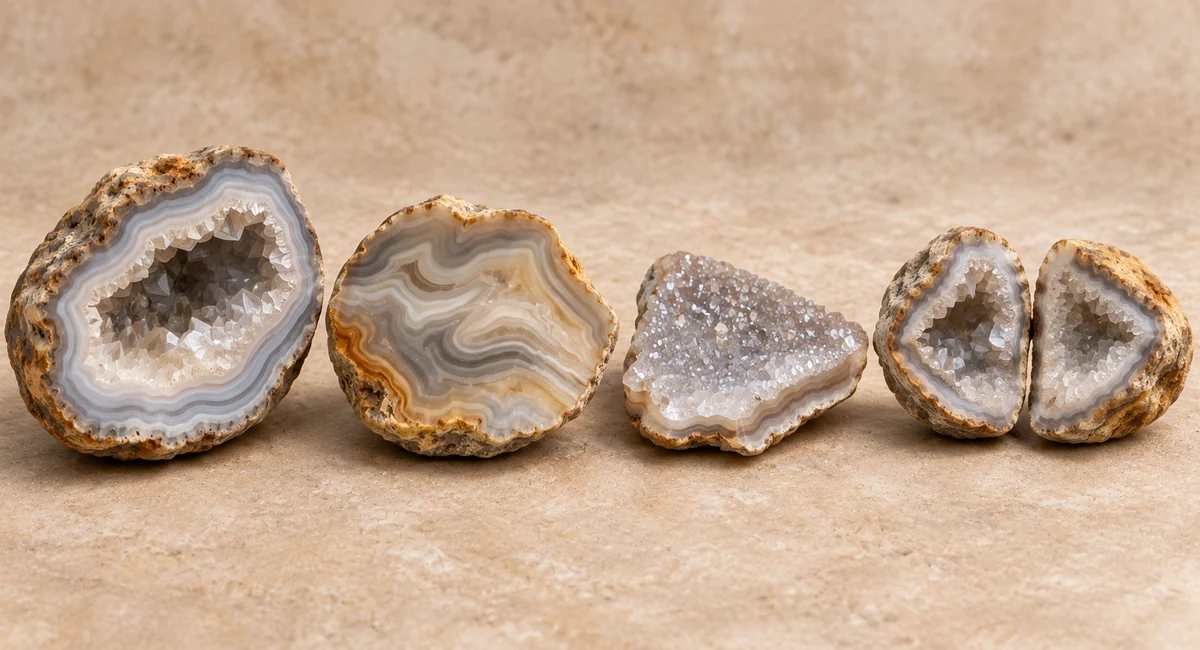
A cut agate stone can reveal a ring of translucent bands, a glittering interior and a pocket of quartz points. Another piece may display similar bands but be solid from edge to centre. A third might have no rounded cavity at all—only a thin carpet of miniature crystals on the surface of a slab. All three are attractive natural mineral specimens, yet they should not automatically be sold under the same name.
Geode, druzy (also spelled drusy) and agate nodule describe different aspects of mineral formation. A geode is associated with a cavity and its mineral lining; druzy describes a surface covered by numerous small crystals; and a nodule is a more-or-less solid, discrete mineral mass. Agate identifies a type of chalcedony, commonly recognized by banding. Because these words refer to structure, surface and material respectively, one piece can accurately be described as an agate geode with a druzy quartz lining. Other pieces cannot.
This guide explains what each term means, how the specimens develop, what a sawn face reveals, and how to choose honest, useful descriptions for a mineral collection or a Vastu-inspired display.
The difference at a glance
| Name on a listing | What the term describes | What you should actually see or verify | Frequent naming error |
|---|---|---|---|
| Geode | A cavity-bearing rock body with a mineral lining | A rounded or irregular enclosing shell and evidence of an original cavity, often with inward-growing crystals | Calling any glittering flat stone a geode |
| Druzy or drusy | A close covering of many tiny crystal faces | A sparkling crystalline crust on a cavity wall, cut surface or exposed rock | Assuming druzy is a mineral species or always a geode |
| Agate nodule | A generally solid, discrete mass containing agate/chalcedony | Banded or patterned silica filling most of the interior; sometimes a very small pocket | Calling a completely filled nodule a hollow geode |
| Agate slice | A piece cut from an agate-bearing mass | A flat cut face, often polished, showing bands, translucent areas or a pocket | Assuming a flat slice reveals whether the original object was a geode without more context |
| Crystal-lined cavity or vug | An opening in a larger host rock | Minerals lining a hole that may remain attached to substantial host rock | Calling every crystal-lined vug a detached geode |
A seller can use more than one of these terms if each is supported by the actual piece. For example, “polished agate half with druzy quartz cavity” is far more informative than “natural crystal geode” for a small banded specimen.
What is a geode?
A geode is a geological body in which mineral matter has developed along the walls of an internal space. Many familiar geodes are rounded or egg-shaped and have a weathered outer shell that looks ordinary until it is broken or cut open. Their interior may contain crystalline quartz, amethyst, chalcedony, calcite or other minerals. The original cavity might remain visibly open, become partly filled with crystals, or—depending on geological history and terminology—be almost completely infilled.
The clearest retail example is a cut geode half with an exterior rind, inward-facing mineral crystals and a remaining open centre. It shows the cavity structure in a single view. A narrow cavity can be visually less obvious than a large hollow chamber, so an image of a very small cut piece does not always settle the description. When the object is substantially solid, “agate nodule” or “quartz-filled nodule” may be the clearer listing title.
The outer shell, the lining and the open centre
Look at a typical cut geode from the outside inward:
- Outer host or rind. A weathered or resistant exterior surrounds the mineral-bearing interior. Its colour and texture need not resemble the crystals inside.
- Early lining. Silica or other minerals may have accumulated on the cavity wall. In agate-bearing pieces, this can include translucent chalcedony bands of differing colour or thickness.
- Later crystal growth. Quartz points or fine drusy crystals can project toward the centre where open space remains.
- Residual pocket. A dark or open-looking region may be the remaining cavity. The cavity need not be large for the specimen to be informative.
A geode is not defined by purple colour. Purple amethyst is only one possible mineral lining, and a white quartz or pale calcite geode may be equally characteristic of cavity growth. Nor does a geode require enormous crystals. A small, fine drusy interior can be entirely natural.
How geological cavities become geodes
Geodes form by more than one geological process. An opening may begin as a gas bubble in volcanic rock, a void or replacement site in sedimentary material, or another pocket through which mineral-bearing fluids can move. Mineral matter can be deposited along the walls in successive episodes. If space remains, outward-facing crystal surfaces can grow into the interior; if mineral deposition fills the opening, the result can become a largely solid mass.
The Kentucky Geological Survey illustrates a sedimentary sequence in which mineral replacement, chalcedony lining, repeated silica deposition and later quartz growth produce either a hollow geode or a solid nodule. The San Diego Natural History Museum also documents geodes developing in different settings. Not all geodes share one identical formation story; the host rock, fluids, chemistry and history matter.
A dramatic photograph of a split geode cannot, by itself, establish the mine, age, country of origin or precise formation sequence of the stone being sold. Those are separate evidence questions.
What is druzy or drusy?
Druzy describes a surface densely covered with very small crystals that catch light on their many faces. The word is a texture or growth description; it is not a gemstone species. Quartz druzy is common in the trade, especially on chalcedony and agate, but other minerals can also form fine sparkling crystal coverings.
Think of a fine sugar-like crust of individual crystal faces. From a distance the surface may seem uniformly glittering; under a loupe, tiny projections and a more complex texture become visible. A polished agate rim can surround a druzy patch, and an intact geode cavity can be lined with druzy quartz. Equally, a flat mineral specimen can carry a druzy coating without being a geode at all.
Druzy on a cavity wall versus druzy on an open surface
A geode and druzy answer two different questions:
- Geode: What kind of rock body and cavity arrangement is present?
- Druzy: What is the crystal texture on a particular exposed surface?
A half geode can therefore be both a geode and a druzy specimen. A sawn agate slab with a glittering patch may be an agate slice with quartz druzy. A quartz-covered rock face may be described as a druzy quartz specimen without implying it came from an intact round nodule.
The sparkle is useful for photography, but it should not dominate the buying description. Customers also need to know the substrate mineral, approximate coverage, surface condition, thickness and whether the crystals are natural or have received a visible coating.
Why “druzy” alone does not identify the mineral
Some listings use “druzy crystal” as though druzy were a single stone. In fact, the underlying mineral can be quartz, calcite, garnet or another species. This affects care. Tiny quartz crystals on a comparatively durable chalcedony base behave differently from fragile drusy on softer or more easily cleaved minerals.
Coatings can add metallic or iridescent colours to natural drusy material. An artificially coloured surface can still have a natural mineral base, but the treatment must not be described as naturally occurring colour without evidence. A well-focused close-up should show the texture and make any coating or damage easier to assess.
What is an agate nodule?
A nodule is a distinct rounded, oval or irregular mass of mineral material, commonly more solid than a geode. An agate nodule consists substantially of chalcedony/agate material, often revealing curved, concentric or otherwise distinctive bands when cut. Many nodules are nearly solid from their outer edge to the centre. Others have a small central pocket or crystal-filled opening, creating some overlap in informal geological and retail terminology.
The distinction is especially clear when comparing two split stones of similar size:
- One has a broad open pocket, with inward-pointing crystals around its walls. Geode is a useful description.
- The other is full of coloured bands, without a substantial cavity. Agate nodule is usually more precise.
Neither form is automatically superior. One emphasizes crystal-lined space; the other can showcase exceptionally beautiful silica banding and patterns. A small drusy centre does not invalidate an agate nodule description, and agate bands around a geode do not make that geode a solid nodule.
Agate, chalcedony and quartz are related—but not identical labels
Chalcedony is a fine-grained silica material associated with the quartz family. Agate is a patterned form of chalcedony, commonly characterized by distinct bands. Quartz can also occur as larger visible crystals alongside fine-grained chalcedony. On a cut specimen, a smoothly polished agate border may encircle a sparkling quartz interior.
This is why “agate with quartz” can be a meaningful combined material description. It does not mean the entire specimen is one large quartz crystal, and it does not make a solid banded slice a natural quartz cluster.
Buyers should not confuse jasper, generally more opaque microcrystalline silica material, with a translucent agate simply because both appear in the same retail collection. Our existing agate/jasper guide addresses those material comparisons in more detail; this article is about physical specimen form, not a replacement for gemstone identification.
How a geode and an agate nodule can come from similar geological conditions
The same broad geological environment can yield different-looking results because the amount of available space and the sequence of mineral deposition vary.
- An initial opening or mineral-replacement site exists in the host rock.
- Mineral-bearing solutions reach the site, sometimes through tiny fractures and pores.
- Chalcedony, quartz or other minerals grow along the boundary or fill part of the opening.
- Where open space remains, larger crystals may develop freely into the cavity.
- Where deposition fills most or all of the space, the result may be a solid or near-solid nodule.
- Later cutting reveals the internal pattern: layered bands, a sparkling lining, an open hollow, or a combination.
These stages are a teaching model, not a universal history for every agate nodule. Some mineral nodules also form by accretion or replacement pathways that differ from the cavity-filling example. Accurate labels describe what can actually be examined rather than guessing a complete geological story from appearance.
What changes when a geode or nodule is cut and polished?
Cutting reveals interior features that the rough outside may conceal. A saw can produce a matched pair of halves, a thin slice, or a broad face. Polishing can improve visibility of translucent bands, bring out natural colour contrasts and create an attractive display surface. The exposed crystals inside a cavity are often left unpolished to retain their natural structure.
These are human finishing steps applied to natural mineral material. A natural geode with a sawn face remains a natural geode, but it is not an entirely unworked stone. Listings should state the actual preparation: “cut and polished face, natural cavity,” “split geode pair,” “rough exterior,” or “flat-cut base for standing display.”
Single half, matching pair and thin slice
| Sale format | What is usually included | Important checks |
|---|---|---|
| Geode half | One cut portion of a formerly whole cavity-bearing stone | Actual exterior, open pocket, cut-face finish, stable display position |
| Matching geode pair | Two corresponding parts of the same split object | Are these truly matching halves? Are both included and photographed? |
| Agate nodule half | One part of a largely solid banded mass | Banding, full cross-section, any small cavity and treatment disclosure |
| Druzy agate slice | Thin cut piece displaying an area of fine sparkling crystals | Thickness, delicate edges, retained crystal coverage and any dye/coating |
| Standing agate section | Thick piece with a trimmed base or stand | Whether it stands without support, actual included stand and weight |
A thin slice is not a premium geode merely because its surface sparkles. Likewise, a large natural geode is not necessarily safer to display: a heavy half requires a secure base and adequate shelf depth.
Dyed agate and enhanced surfaces
Agate and chalcedony may be colour-enhanced. Intense blue, violet, green or pink commercial slices are not automatically synthetic stone, but the colour may be dyed. Some druzy specimens also have artificial coatings that produce vivid metallic reflections. Treatment should be recorded separately from whether the base rock is natural.
A careful description might say “natural agate, dyed blue, with quartz druzy centre” if that is verified; or “agate/chalcedony specimen—treatment status not confirmed” if reliable information is absent. An “all natural colour” claim should not rest solely on photography. The buyer should be able to distinguish a dyed natural specimen from a naturally coloured specimen and from an entirely manufactured imitation.
No at-home scratch, acid, solvent or flame test should be recommended for a finished retail specimen. Such testing can damage the polished face, coatings or delicate crystals and may not settle an identification question anyway.
Identifying the specimen in photographs
For a buyer choosing online, a good image sequence is more informative than a dozen repeated glamour photographs. Examine the following views before deciding whether a listing deserves the words geode, druzy or nodule.
Front or cut-face view
Does the interior show an open cavity with inward-growing crystals, a thin sparkling surface, or mostly solid banded material? Can you see the full perimeter of the stone, not just the brightest patch? If the centre is dark because of shadow, request a second image with more even lighting.
Side and reverse views
A side view reveals thickness and whether the object is a thin slice or a substantial half. A reverse view shows the exterior rind, any saw marks, support adhesive, coatings or repairs. A matching pair should be photographed both open and closed—or at least positioned to demonstrate how the halves correspond.
Scale and condition
A ruler or verified dimensions help establish real size. Photograph chips, loose crystal faces, fractures, repaired surfaces and delicate edges. One-of-a-kind mineral specimens should be represented by photographs of the exact item offered, not a generic illustration of the type. The actual piece may have mineral inclusions or variations that are part of its natural character; these are not automatically faults.
Geodes, agate and druzy specimens in Vastu-inspired interiors
Natural stone and Sphatik-related objects have a place in Indian devotional and domestic settings, while many current Vastu-oriented interiors also use amethyst geodes, agate slices, mineral clusters and decorative crystal displays. These objects are valued for colour, natural form, symbolism and the atmosphere of an intentionally arranged space.
In contemporary practice, a clear quartz or pale druzy display may be selected for a calm study or puja area; an amethyst-lined geode may be chosen for its deep purple appearance and contemplative associations; an agate nodule may be appreciated for its successive natural layers and stable sculptural form. Such choices belong to personal and modern Vastu-inspired practice. The specific retail categories “druzy agate slice” and “geode half” should not be presented as universal prescriptions from classical Vastu Shastra.
Practical placement is part of a considered Vastu setting: give a heavy geode a stable support, avoid unstable wall shelves and glass edges, allow space for cleaning, and keep pointed interiors away from small children or frequent handling. A specimen placed in a home mandir should not obstruct lamps, offerings, cleaning or the customary devotional arrangement. Fire, falling objects and circulation remain ordinary physical concerns regardless of the symbolic intent.
If a family follows a particular direction, deity, ritual or lineage tradition, their own context should guide the placement; the physical geode/agate terminology does not determine a single mandatory compass direction. For the wider collection and other forms of traditional and decorative objects, see our Vastu collection.
Care, display and packaging: what is safe to assume?
Quartz and chalcedony are comparatively durable minerals, but the complete specimen may contain fragile crystal tips, porous matrix, coatings, cement, glue or an attached stand. A polished agate face is not a reason to submerge the entire object. Where mixed minerals or treatment history are unknown, a clean, soft, dry brush and a protected display location are safer default choices than soaking or chemical cleaning.
A cut geode half has two very different surfaces: a polished, comparatively smooth face and a vulnerable crystal-lined interior. Lift it by a stable outer portion or supported base—not the points. Wrap against impact, prevent one half from striking another, protect thin edges separately and use a rigid box for transport. A geode pair should never be packed with their crystal-lined cavities directly grinding together.
If a specimen is displayed near a window, consider the material's response to sustained heat or light, especially for coloured minerals. A separate care guide will address specimen-by-specimen differences; do not apply one “water cleansing” routine to all minerals merely because they are sold under the same Vastu category.
A practical description checklist for OmmRudraksha catalogue pages
For each actual mineral specimen offered, a precise title and specification block should answer:
- What is it? Geode half, geode pair, druzy slice, agate nodule or another form.
- Which minerals are present? Agate/chalcedony, quartz, amethyst, calcite or other reliably identified constituents.
- Is an open cavity visible? Describe it rather than assuming one from the trade name.
- What has been worked? Cut face, polished edge, sawn base, coating, dye, repair or stabilization where known.
- How big and heavy is this item? Record actual dimensions and weight for a unique specimen.
- What is included? One half or both halves, stand, box, label and any accessory actually supplied.
- How does it stand and travel? Flat base, optional support, fragile points and packing requirements.
- Which photographs show the sale item? Identify actual-stock photographs separately from illustrative editorial images.
Suitable examples of naming patterns, not assertions of current stock, include “Agate Geode Half with Quartz Druzy,” “Matching Split Agate Geode Pair,” “Polished Banded Agate Nodule Half,” and “Quartz Druzy Agate Slice.” These distinguish the product forms without relying on vague promises about rarity, energy or origin.
Frequently asked questions
Is every agate geode hollow?
Many have a visible residual cavity, which is the easiest feature to recognize. Geological terms can become less clear when the original opening is almost or completely filled. For a mostly solid sale item, “agate nodule” or a more descriptive cut-section name may avoid confusion.
Is druzy quartz the same as a geode?
No. Druzy describes numerous tiny crystals on a surface; geode describes a cavity-bearing body. Druzy can line a geode or cover another exposed rock surface.
Can an agate slice have both bands and druzy crystals?
Yes. A polished banded agate border can surround a sparkling centre or support a crystal coating. The listing should state the visible parts rather than choose one word and omit the others.
Does a cut or polished face make a specimen artificial?
No. Cutting and polishing are preparation processes applied to natural rock. A buyer should nevertheless be told what has been shaped, coloured, coated, repaired or assembled.
Is naturally bright blue or pink agate always dyed?
Not every bright stone can be diagnosed from colour alone. Dyeing is common in commercial agate, so unusually vivid colours warrant a treatment question and reliable supplier disclosure rather than certainty from photographs.
What matters more when buying a geode: size or the open cavity?
Both can matter, but the purpose comes first. A collector may prize mineral growth and condition; a display buyer may prioritize safe standing, colour balance, shape and the available space. A large stone with an unstable base can be less practical than a smaller well-supported piece.
Can I place a geode or druzy stone in a puja room?
A natural mineral display may be included in a devotional or Vastu-inspired room when it suits the family's practice and does not interfere with puja items, lamps or safe movement. Do not assume a particular geode type has one mandatory classical placement rule.
The simplest way to remember the terms
A geode tells you about a mineral-lined cavity. Druzy tells you about many tiny crystals covering a surface. An agate nodule tells you about a largely solid, discrete agate-rich mass. A cut slice tells you about how a piece has been prepared for viewing.
The terms can overlap, but they are not substitutes. When a listing accurately names the geological form, mineral material, visible cavity or crystal texture, finishing and condition, buyers can choose confidently—and appreciate the remarkable natural pattern without confusing appearance with identification.
Related reading
- What Is a Crystal Cluster? Crystal Growth and Natural Forms
- How to Buy a Natural Mineral Specimen Online
- Natural Crystal Clusters and Geodes in Vastu: Traditional Placement and Meaning
- Cleaning and Storing Natural Crystal Clusters and Geodes
- Agate Geodes and Druzy Slices: Natural Cavities and Cut Surfaces


