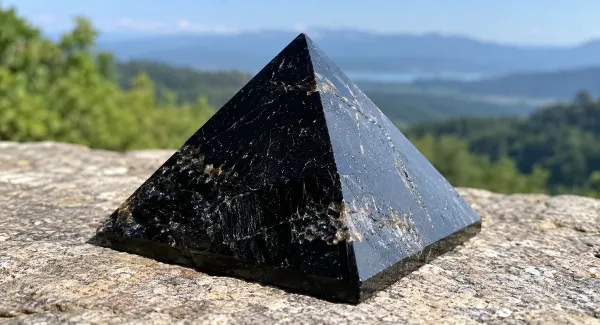
This black tourmaline pyramid is designed as one carved pyramid. Its value as a decorative offer lies in the material’s own pattern, the carved geometry and a stable finished base.
Appearance and physical form
An opaque black body with visible mineral character distinguishes this form from glassy obsidian. Fine seams or lighter intergrown areas may remain visible after polishing. A buyer who prefers a restrained mineral surface can appreciate those differences without expecting an artificially uniform black finish.
Material and construction questions
Confirm whether the body is one carved piece, repaired or filled. Review the least polished-looking face and the underside. Ask for an explanation of open seams near the apex and any glossy repair areas, and do not accept a protection grade as a substitute for material identification.
| Specification | Buying information |
|---|
| Design | Black Tourmaline Pyramid |
| Physical form | one carved pyramid |
| Material | Black Tourmaline |
| Dimensions and weight | Provided for the selected piece before purchase |
| Colour and pattern | Natural or finish-related variation; refer to the actual piece |
| Treatment and origin | Refer to the disclosure for the selected piece |
Care and handling
Keep it away from impacts and forced water cleaning. Gentle dry dusting is a sensible routine when seams or treatment are uncertain; protect each edge during packing.
Traditional significance
Protection is a modern crystal association; the object is presented as a decorative and optional contemplative form.
Product questions
Can pale inclusions occur? Yes, depending on the rough. Do seams prove imitation? No, but construction needs disclosure. Does the carving block electronic exposure? That is not established by its tourmaline name.
Helpful reading