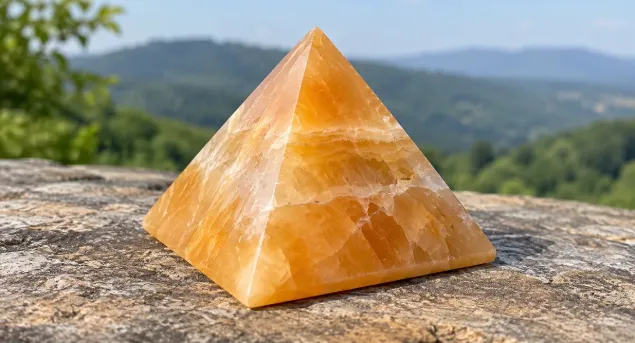
Orange Calcite Pyramid
Honey-orange colour and pale bands create a warm translucent appearance. One carved pyramid.
Call for pricing
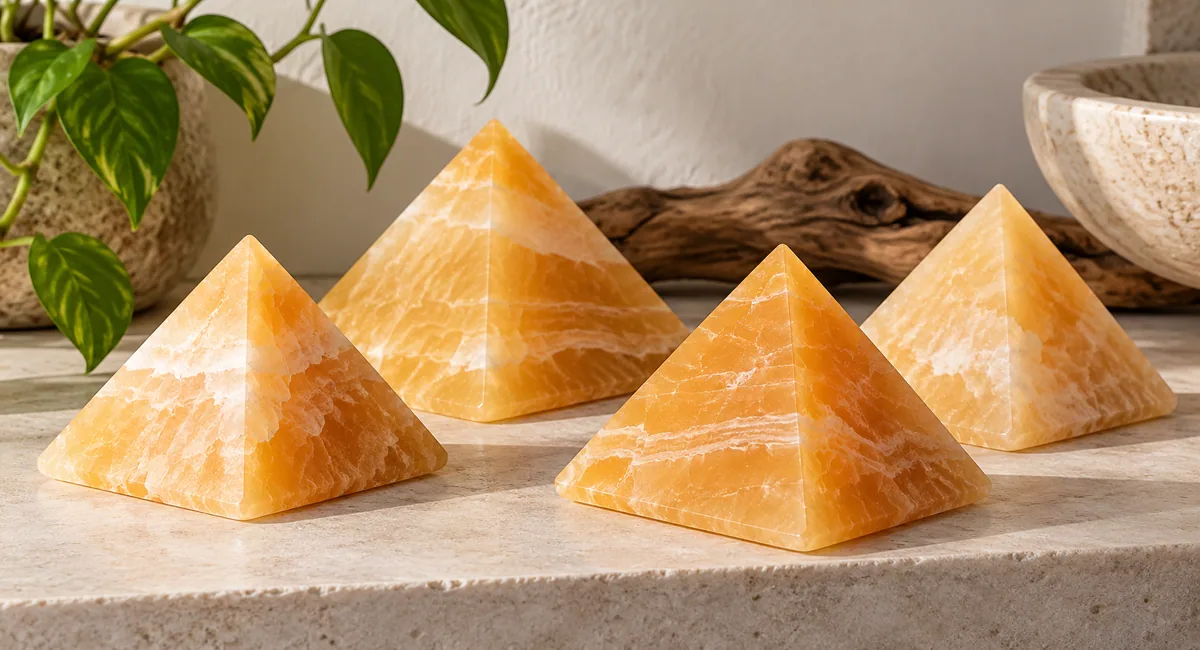
Orange calcite pyramids can have honey, peach or deeper orange areas, often crossed by pale bands. Their translucency can look inviting under side light. Calcite is a different material from quartz: a similar orange colour does not make an orange calcite carving interchangeable with carnelian or a yellow quartz product.
Calcite is relatively soft and has pronounced cleavage. Inspect the point, thin edges and any planar internal lines. An intact carving may show internal structures, but a fracture opening at the base or apex needs an honest condition note. Ask for a neutral-light image rather than judging only a glowing backlit view.
Avoid vinegar, lemon juice, acidic ritual mixtures and harsh household cleaners. Start with a soft dry cloth and minimal pressure. If the supplier permits a light damp wipe, dry promptly and do not soak. Protect the faces from harder stones and keep the pyramid out of a sink or wet display tray where residue and grit can collect.
Can calcite be cleaned like quartz? The same routine is not safe by assumption. Does a pale band mean a crack? It may be colour or structure; ask for close views. Is a quartz-hardness scratch test appropriate at home? No: it damages a finished carving and does not replace proper identification.
Read the Orange Calcite pyramid guide and Rock Salt vs Carved Stone Pyramids: A Humidity and Care Comparison.

