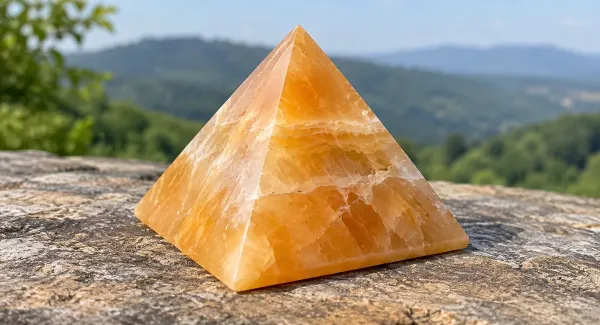
This orange calcite pyramid is designed as one carved pyramid. Its value as a decorative offer lies in the material’s own pattern, the carved geometry and a stable finished base.
Appearance and physical form
Honey-orange colour and pale bands create a warm translucent appearance. The broad faces can show a softer look than carnelian’s chalcedony body, despite some overlap in colour. Calcite’s lower hardness and cleavage mean the display location should be protected from repeated touching and hard impacts.
Material and construction questions
Confirm calcite identity and any coating or repair. Inspect planar internal lines that reach corners, the underside and the apex. Ask for ordinary-light photographs as well as backlighting so the colour is not judged only at its most luminous.
| Specification | Buying information |
|---|
| Design | Orange Calcite Pyramid |
| Physical form | one carved pyramid |
| Material | Orange Calcite |
| Dimensions and weight | Provided for the selected piece before purchase |
| Colour and pattern | Natural or finish-related variation; refer to the actual piece |
| Treatment and origin | Refer to the disclosure for the selected piece |
Care and handling
Keep vinegar, lemon juice and other acids away. Start with a soft dry cloth; only use a light damp wipe if suitable for the actual finish, then dry promptly.
Traditional significance
Enthusiasm is a modern colour association; no treatment of fatigue or improvement in health is promised.
Product questions
Can calcite share a quartz cleaning routine automatically? No. Is a pale band necessarily a crack? It needs inspection. Is scratching a useful buying test? It damages the carving.
Helpful reading