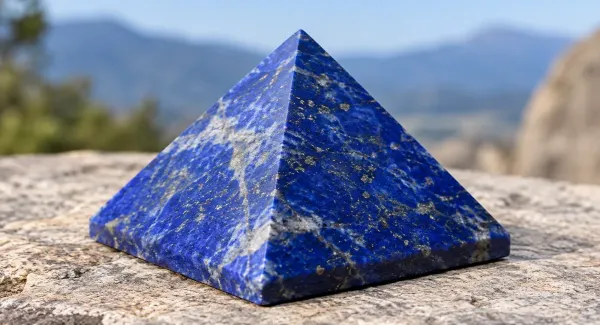
This lapis lazuli pyramid is designed as one carved pyramid. Its value as a decorative offer lies in the material’s own pattern, the carved geometry and a stable finished base.
Appearance and physical form
Rich blue areas contrast with pale veining and occasional brassy-looking flecks. A pyramid exposes a broad section of the lapis rock on each face, allowing a varied pattern to become the main decorative feature. Sparse metallic grains are part of the visual mixture rather than a promise of gold content.
Material and construction questions
Check the palest side as well as the bluest one. Ask whether the rock is dyed, waxed, impregnated or reconstructed, and whether the image represents the supplied carving. Any geographical origin claim should have its own evidence rather than follow automatically from the lapis name.
| Specification | Buying information |
|---|
| Design | Lapis Lazuli Pyramid |
| Physical form | one carved pyramid |
| Material | Lapis Lazuli |
| Dimensions and weight | Provided for the selected piece before purchase |
| Colour and pattern | Natural or finish-related variation; refer to the actual piece |
| Treatment and origin | Refer to the disclosure for the selected piece |
Care and handling
Use a soft lightly damp cloth only when suitable, then dry. Keep acids, solvents, steam and ultrasonic cleaning away, especially where surface treatment is uncertain.
Traditional significance
Wisdom and expression are familiar contemporary associations; the rock’s pattern and workmanship remain the concrete buying features.
Product questions
Are the flecks gold? They may be pyrite and are not a gold claim. Is every blue stone lapis? No. Do pale areas automatically mean damage? They can be constituents of the rock.
Helpful reading