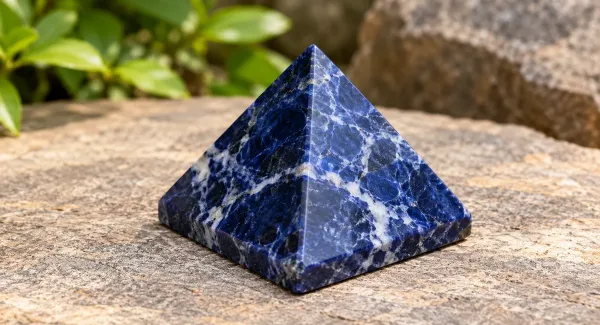
This sodalite pyramid is designed as one carved pyramid. Its value as a decorative offer lies in the material’s own pattern, the carved geometry and a stable finished base.
Appearance and physical form
Deep denim-blue areas and irregular white veins give this carving a clear graphic character. The pattern can change substantially between faces, making the reverse as important to inspect as the front. Sodalite is offered under its own material name rather than as a substitute identity for lapis lazuli.
Material and construction questions
Ask for the proportion of pale veining expected in the actual piece. Confirm the body and known treatment, and examine any straight join, filled cavity or crack that meets the base. Colour resemblance is not enough to identify either sodalite or lapis.
| Specification | Buying information |
|---|
| Design | Sodalite Pyramid |
| Physical form | one carved pyramid |
| Material | Sodalite |
| Dimensions and weight | Provided for the selected piece before purchase |
| Colour and pattern | Natural or finish-related variation; refer to the actual piece |
| Treatment and origin | Refer to the disclosure for the selected piece |
Care and handling
Dust gently and protect the polished edges. Avoid acidic cleaners, strong solvents and steam; if light moisture is suitable, dry the surface and any openings promptly.
Traditional significance
Sodalite is linked with reflection and communication in modern crystal interpretations, without a promised effect on behaviour.
Product questions
Must sodalite contain gold flecks? No. Does white veining make it fake? No. Is the product made from quartz? Sodalite is a different mineral material and should be identified accordingly.
Helpful reading