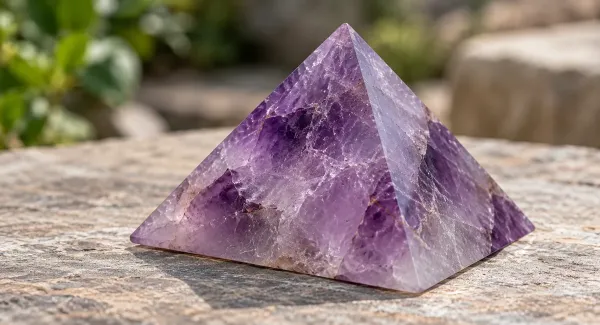
This amethyst pyramid is designed as one carved pyramid. Its value as a decorative offer lies in the material’s own pattern, the carved geometry and a stable finished base.
Appearance and physical form
Purple zones give this carved form its character. Pale veils can interrupt the violet, and neighbouring faces may reveal different portions of the same rough. The broad triangular surfaces suit a buyer who enjoys seeing variation across a compact geometric object rather than expecting a uniform purple block.
Material and construction questions
Compare the front and reverse under similar light. Ask about natural or laboratory-grown origin and any filling or colour modification. Check the point and the base corners independently of the richest colour area; a striking face should not distract from a surface-reaching crack.
| Specification | Buying information |
|---|
| Design | Amethyst Pyramid |
| Physical form | one carved pyramid |
| Material | Amethyst |
| Dimensions and weight | Provided for the selected piece before purchase |
| Colour and pattern | Natural or finish-related variation; refer to the actual piece |
| Treatment and origin | Refer to the disclosure for the selected piece |
Care and handling
Keep it on a protected shelf in diffuse light. Remove dust gently, use only suitable mild moisture and dry afterwards. Avoid steam, hot water and prolonged intense sunlight.
Traditional significance
Amethyst is associated with contemplation in modern crystal practice. The association is symbolic and does not promise a health effect.
Product questions
Will all four faces be equally purple? Usually the pattern varies. Does a dark centre prove higher quality? No; condition and identification also matter. Is a report automatically included? Only an actual stated offer can establish that.
Helpful reading