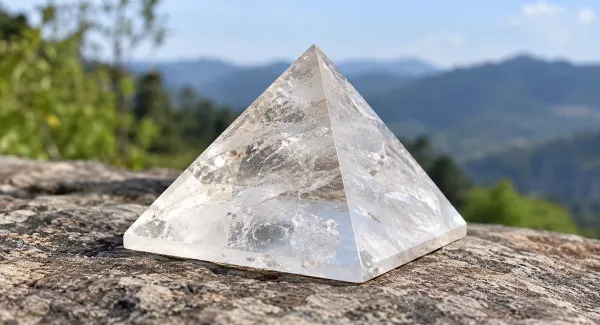
This clear quartz pyramid is designed as one carved pyramid. Its value as a decorative offer lies in the material’s own pattern, the carved geometry and a stable finished base.
Appearance and physical form
The transparent body allows internal veils and reflected edges to become part of the display. Each face changes the view through the carving, particularly against a simple uncluttered background. Sphatik is the familiar cultural trade term, while a precise offer should also identify the body as clear quartz.
Material and construction questions
Ask whether the body is natural quartz, laboratory-grown quartz or an imitation, and whether any fractures are filled. Judge the base for stability and the point for damage. Clarity is an appearance preference; it does not by itself certify origin or establish an untreated specimen.
| Specification | Buying information |
|---|
| Design | Clear Quartz Pyramid |
| Physical form | one carved pyramid |
| Material | Clear Quartz (Sphatik) |
| Dimensions and weight | Provided for the selected piece before purchase |
| Colour and pattern | Natural or finish-related variation; refer to the actual piece |
| Treatment and origin | Refer to the disclosure for the selected piece |
Care and handling
Wipe carefully without loading the apex. Keep away from sudden temperature changes and abrasive cleaners; use gentle moisture only when appropriate for the actual finish.
Traditional significance
Sphatik is familiar in Indian devotional settings. A chosen spiritual use does not turn optical clarity into a measure of efficacy.
Product questions
Does flawless clarity prove natural origin? No. Are internal rainbows always added colour? Reflections at fractures can produce them. Is the square-based shape naturally grown? A display pyramid is ordinarily carved.
Helpful reading