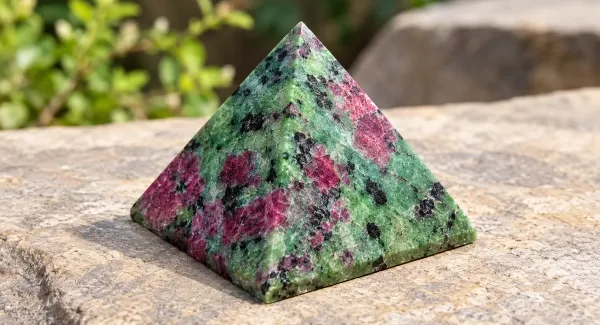
This ruby zoisite pyramid is designed as one carved pyramid. Its value as a decorative offer lies in the material’s own pattern, the carved geometry and a stable finished base.
Appearance and physical form
Green rock, red ruby areas and dark inclusions create an irregular contrasting pattern. The pyramid form displays that intergrowth over several faces rather than presenting one uniform gemstone colour. It is the combination that defines this offer; a visible red patch does not make the complete carving a ruby.
Material and construction questions
Ask for identification distinguishing ruby zoisite from other red-and-green rocks, and review all faces. Inspect boundaries where constituents meet, including any filled cavity or open seam. The hardness of ruby does not describe every other part of the body.
| Specification | Buying information |
|---|
| Design | Ruby Zoisite Pyramid |
| Physical form | one carved pyramid |
| Material | Ruby Zoisite |
| Dimensions and weight | Provided for the selected piece before purchase |
| Colour and pattern | Natural or finish-related variation; refer to the actual piece |
| Treatment and origin | Refer to the disclosure for the selected piece |
Care and handling
Treat the entire mixed rock gently. Avoid acids, steam and ultrasonic equipment, and use minimal appropriate moisture followed by drying. Protect the apex from knocks.
Traditional significance
Harmony is a contemporary colour association; no heart, circulation or relationship outcome is asserted.
Product questions
Is the whole body ruby? No. Will each face have equal red content? No. Can a ruby report identify every constituent? Read the document’s actual scope.
Helpful reading