
A purpose is more useful than a shopping label
Someone may ask for a yantra while wanting help with a devotional routine, a traditional association, a chart-related question or the arrangement of a worship space. These are different requests. Begin with what you wish to understand rather than assuming the name of the object has already answered the question.
For example, “I would like to understand a yantra used in my family practice” gives useful context. “I need the most powerful one” does not explain the practice, the question or the person's circumstances. A careful guide should make the conversation clearer, not use unfamiliar words to make the customer feel that an immediate purchase is essential.
Name the tradition and keep its scope visible
Spiritual diagrams, devotional objects and the practices associated with them belong to particular teaching contexts. Instructions can vary. A respectful explanation identifies that context and avoids claiming that one brief shop description contains every tradition's procedure. A familiar family practice and a general educational introduction may need different kinds of help.
If you follow instructions from a teacher or a household tradition in Odisha or elsewhere, mention it when seeking follow-up help. The standard birth-data form does not collect that history or assume it. The yantra selection checklist helps you separate the traditional association from the physical item's material, dimensions and intended setting.
Understand when a birth chart is relevant
Some requests specifically ask for a personal astrological assessment. In that case the method needs the relevant recorded inputs, supported chart findings and a reviewed explanation. Other requests are simply about the meaning or ordinary use of a yantra. Birth information should not be collected as though it automatically makes a general description personal.
The free Yantra consultation form prepares a standard personal report from your name, email and recorded birth date, time and selected birthplace. There is no purpose questionnaire or requirement to choose a diagram first. General questions about meaning, an existing object or family instructions can go to the team separately. The report explains its method, why each option was considered and what qualifies the interpretation.
Ask what practice or placement is being suggested
A symbolic association, an instruction for worship and a recommendation about a physical room are separate statements. Each needs its own basis. If the request concerns a home, explain the available space and practical limits. A chart does not show the real position of a shelf, a doorway or a window.
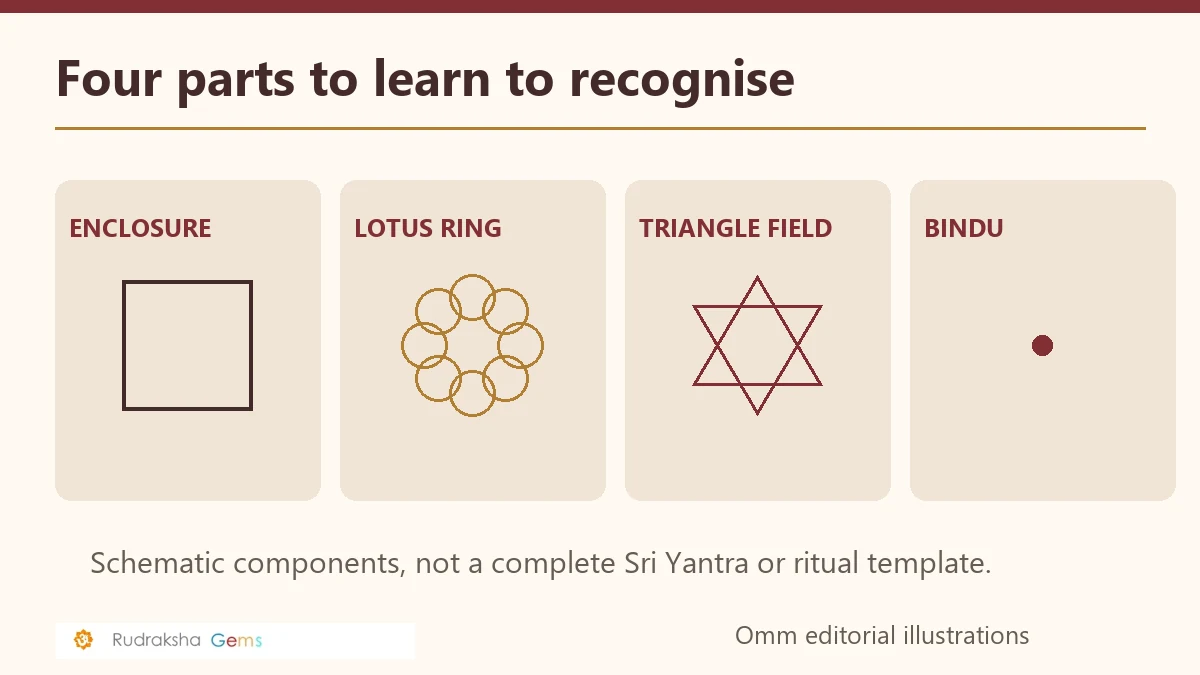
The placement and care guide offers a useful preparation checklist. It also distinguishes learning illustrations from an actual object or a prescribed ritual diagram. A drawing used to explain parts should not quietly become a template that claims to perform a practice on its own.
Leave room for a simple answer
Sometimes the most useful outcome is an explanation of what you already have, a clarification from the appropriate teacher or a modest adjustment to an existing routine. A report can also say that no new object is necessary. None of those outcomes makes the free guidance less complete or creates a reason to withhold the explanation.
The OmmRudraksha system was developed with Rasmita Nayak, and a personal report identifies its actual preparation and review. You can read the purpose-based guidance overview if you prefer to begin with learning. Take time to understand the reason, alternatives and instructions; a high price or a promised guaranteed result should not take their place.
Sri Chakra, Lakshmi and Kubera need distinct explanations
Sri Chakra, also called Shree Yantra, has a particular Sri Vidya context associated with Lalita Tripurasundari. Its interlocking geometry is not an interchangeable label for every diagram marketed for prosperity. Mahalakshmi and Kubera-labelled diagrams need their own identification, inscriptions and teaching context. A three-dimensional Meru is also a different physical form from a flat print or engraved plate.
The report's tradition directory introduces these differences alongside Ganesha, Saraswati, Shiva, Durga and Navagraha. It is a directory for learning, not a prescription to acquire them all. An attractive illustration can help explain visual order without becoming a ritual construction plan. Formal worship should follow an appropriate identified source rather than a sequence assembled from unrelated product descriptions.
What the personal planetary comparison actually does
The retained Ascendant and house ownership provide the starting frame for a small planetary contemplation shortlist. The explanation considers qualifications such as mixed duties and recorded planetary conditions. Moon and Nakshatra, supporting divisional observations and the saved Dasha path add context. These are declared practitioner interpretations of the chart, not a classical universal formula linking every person to one object.
Planetary contemplation, a formal graha-shanti rite and gemstone strengthening are distinct ideas. A running Dasha alone does not require a Yantra, and a difficult label does not prove an urgent ritual need. The comparison does not determine your Ishta Devata or confer initiation. That leaves room to learn from the reading while continuing the practice you already know.
Sources and Method Notes
These references provide cultural, practical or material context. Traditional guidance does not establish a guaranteed personal outcome.
- Himalayan Institute: Yantras for Meditation (opens a new tab) — A teaching on geometric symbols and attention within its own yoga tradition; not a universal ritual or a birth-chart selection formula.
- Gérard Huet: Sri Yantra Geometry (opens a new tab) — Original research into Sri Yantra construction and geometric variants; not evidence of guaranteed personal effects.
- OmmRudraksha guidance privacy and service information (opens a new tab) — First-party information about submitted details, report access, service communication and the free guidance process.
