

Amethyst Crystal Clusters and Geodes: Formation, Vastu Traditions and Care
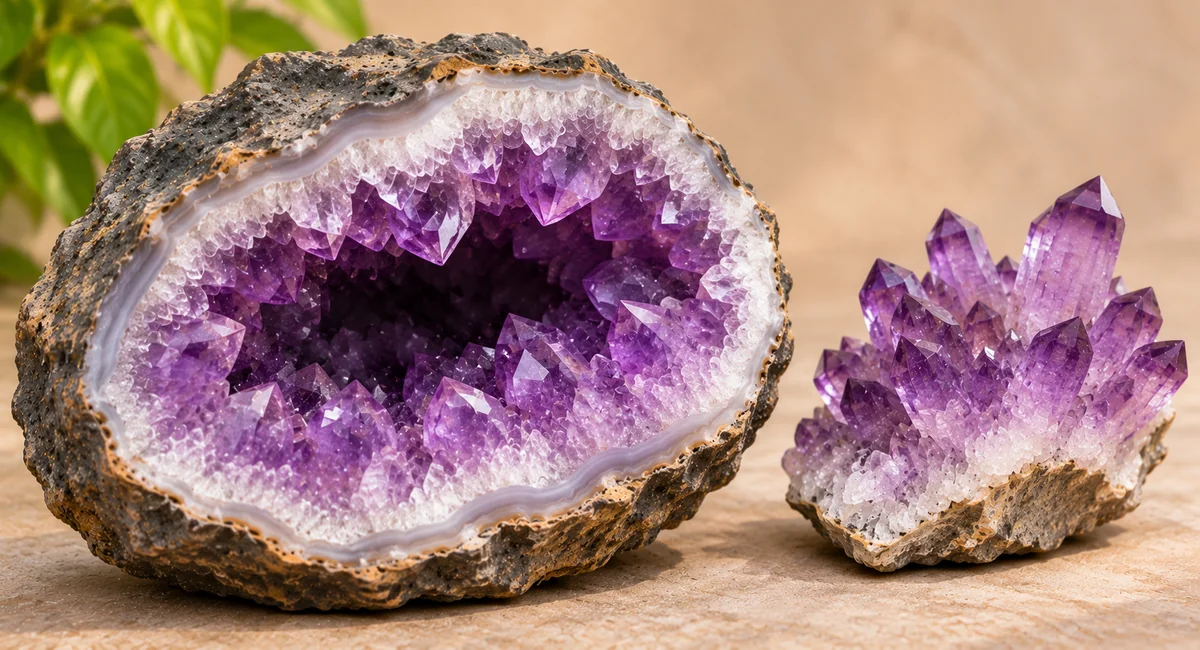
Amethyst is the purple variety of quartz, but the way it appears in a natural mineral specimen is often more remarkable than the colour alone. A small amethyst crystal cluster can show dozens of violet points growing together on a rocky base. A cut amethyst geode can reveal an enclosed chamber lined with quartz crystals, sometimes surrounded by pale quartz or agate-like bands. A tall amethyst cathedral geode presents a large opened cavity as a freestanding display piece. These forms may share a mineral, yet they have different geological structures, buying considerations, handling needs and uses in a home.
For OmmRudraksha's planned gemstone-rock collection, this distinction matters. A natural cluster is not a polished amethyst pyramid; a cavity-lined geode is not an ordinary rough purple stone; and a heavy standing cathedral is not simply a larger version of a small hand-held specimen. The name, photographs and description of each piece should tell the customer which physical form they are seeing.
Amethyst also has a place in contemporary Vastu-inspired decoration and meditative settings. Its purple colour is often associated with calmness, reflection and a contemplative atmosphere. Those associations can be described with respect for Indian spiritual practice while distinguishing them from specific classical Vastu instructions about architecture and space. This guide brings together formation, genuine specimen identification, traditional and contemporary placement, purchasing decisions and sensible care.
What makes amethyst a form of quartz?
Quartz is a crystalline form of silica, with the chemical composition SiO₂. Amethyst is quartz that appears violet, lilac or purple because of colour centres involving traces of iron and natural irradiation during its geological history. The proportion and distribution of colour may vary within one crystal or across the same geode. A relatively pale outer zone and deeper purple terminations do not, by themselves, make a specimen artificial.
Amethyst has a Mohs hardness of approximately 7. That is useful when considering scratches, but it does not mean a geode is unbreakable: a slender crystal point can snap, a rock matrix can crumble and an attached base can fail. Hardness measures resistance to scratching; it does not measure every kind of impact resistance, mounting strength or stability.
Quartz commonly grows with prismatic crystal faces and pointed terminations. In a cluster, the crystals may lean, intersect, be crowded together or have different lengths. Colourless quartz can appear beside amethyst within the same specimen. In a geode, the opening exposes crystals that grew inward from part of the cavity wall. A single item may legitimately be described as an amethyst geode with a dense crystal-cluster lining.
Amethyst is not a different mineral species from quartz, and not every purple decorative item is amethyst. Glass, resin, dyed materials and other purple minerals exist. A confident identification must consider actual mineral properties and supplier evidence, not a colour impression from a screen.
Amethyst cluster, geode and cathedral: how do they differ?
The familiar trade names point to different physical structures, not a universal scale of spiritual strength or commercial quality.
| Form | What it physically is | What should be visible | Buying and display priority |
|---|---|---|---|
| Amethyst crystal cluster | Several natural amethyst crystals growing together, sometimes on matrix | Individual quartz terminations, varied heights and shared growth contacts | Verify tips, repairs, base and the exact piece |
| Amethyst geode half | A section of a mineral-lined natural cavity | A shell or enclosing wall, open interior and inward-growing crystals | Verify the real cavity, cut edge, colour and support |
| Amethyst cathedral geode | A large, commonly upright opened geode | Tall cavity profile, substantial wall and dense internal crystals | Check real weight, depth, centre of mass, stand and freight |
| Amethyst druzy specimen | A surface covered in very small amethyst crystals | Fine glittering crystals on a natural or cut substrate | Confirm material and whether there is an actual cavity |
| Loose amethyst point | An individual crystal or part of one | Prism and termination, or a disclosed polished end | Distinguish natural growth from a carved point |
| Carved amethyst pyramid or tower | Amethyst/quartz cut and polished to a chosen geometry | Regular manufactured faces and edges | Describe the carving honestly rather than calling it natural cluster growth |
One geological cavity may later be cut into two halves, and a commercial dealer may sell each half separately or as a matched pair. The cutting changes the presentation of the geode, not the natural origin of its crystals. Some specimens are trimmed, given flat bases or fitted with stands so they can be displayed safely. These ordinary preparation steps should be disclosed when relevant.
Is an amethyst geode always hollow?
The defining feature of a geode is its cavity-bearing origin, but the visible chamber may be narrow or partly filled with mineral deposition. The presence of amethyst alone does not prove that a rounded rock was originally a geode. Equally, a detached slab of densely packed amethyst crystals may have come from a much larger cavity but no longer display the original shell. The most accurate listing identifies the visible form actually being offered, rather than guessing the full history.
Is a cathedral an ancient mineralogical term?
Cathedral is chiefly a merchandising and display term for a tall, upright geode whose cut opening resembles an arched alcove. It is not a separate mineral species or a certified geological grade. A cathedral may be a genuine amethyst geode, but it should also be described by real dimensions, weight, condition and structural support. A particularly tall specimen may need a professional base or floor stand.
How amethyst geodes form inside rock
Geodes are associated with open spaces in rock that later receive mineral deposits. Major amethyst-producing districts in southern Brazil and northern Uruguay contain geodes in volcanic rocks linked with the Paraná volcanic province. The geology is more specific than the common retail phrase “crystals grew inside a bubble.” A bubble or other original cavity may provide space, while mineral-bearing fluids, changing chemical conditions and repeated deposition control what fills that space.
Stage 1: an opening exists in the host rock
As lava cools, gas-rich portions can leave voids. Other openings can form through cracks and geological changes. Not every opening becomes a geode, and a collector should not assume the same origin for every amethyst specimen worldwide. The host rock and local formation history determine which explanation is appropriate.
Stage 2: silica-rich fluids move through the system
Water and mineral-bearing fluids can carry dissolved silica into existing openings. Under suitable conditions, silica precipitates on available surfaces. A thin chalcedony or fine-quartz lining may develop before larger inward-pointing quartz crystals. The mineral sequence is not identical in every specimen.
Stage 3: the cavity acquires layers and crystals
Some opened amethyst geodes show an outer rock wall, a pale grey or white zone, banded chalcedony or fine quartz, and a crystalline purple interior. These are the products of mineral deposition, not evidence that the stone was assembled layer by layer by a craftsperson. The layered rim may be natural even when one face has subsequently been sawn or polished to improve visibility.
An actual geological study of amethyst geodes at Ametista do Sul, Brazil, describes sequences including celadonite, chalcedony, fine-grained quartz and larger amethyst crystals. This is useful evidence for that deposit; it should not be imposed as an identical recipe on every geode offered for sale.
Stage 4: crystal growth records local conditions
Quartz crystals grow into available space, developing faces and terminations. The relative supply of silica, fluid chemistry, temperature and growth history affect their size and appearance. Some points are pale, others intensely purple; some are long and glassy, others short and densely packed. Such differences are intrinsic to natural specimens, although treatment can also alter appearance.
In 2024, a Göttingen University-led research team reported a model for amethyst geodes in the Los Catalanes district of Uruguay, including crystallisation temperatures of about 15–60 °C inferred for the investigated material. That finding is especially interesting because it refines older simplified accounts of geode formation. It does not mean every amethyst geode on the market formed at that temperature or under identical conditions.
Stage 5: the specimen is recovered and prepared
Geodes may be extracted from host rock, transported, opened by sawing, trimmed and stabilized for sale. Small cluster fragments can separate naturally or during removal. A tall geode may be cut to sit upright. The customer therefore encounters a combination of natural mineral growth and, quite often, human preparation of the display form.
Why some geodes are dark purple and others pale lilac
Colour differences are an important part of amethyst's appeal. Some crystal tips show deep violet while the crystal bases are lighter. A geode can also show uneven patches of colour across its interior. Viewing conditions matter: intensely coloured material can appear nearly black in a poorly lit photograph, while bright light may make the same piece look more transparent.
There is no single colour that proves an amethyst geode is more authentic than another. The purchase decision should consider whether the colour is natural or treated, whether the listing photograph is faithful and whether customers are being shown the exact item. Consistent lighting across front, side and detail photographs is more informative than heavy colour enhancement.
| Appearance | What it may mean | What it does not establish |
|---|---|---|
| Pale lilac points | Naturally light amethyst or brighter illumination | That the piece is inferior, synthetic or unworthy of display |
| Dark violet crystal tips | Strong colour concentration in visible growth zones | Guaranteed locality, untreated status or spiritual potency |
| White or grey bands around cavity | Quartz/chalcedony-rich wall layers | A fixed number of geological stages without examination |
| Orange or yellow points sold as “citrine geode” | Could be heated amethyst or another colour-modified quartz presentation | Naturally yellow quartz or absence of treatment |
| Strikingly uniform purple coating | Requires inspection for natural colour versus dye or surface treatment | Proof of dye solely from a photograph |
GIA notes that purple quartz may be dyed and that heating can alter amethyst colour. However, not all treatment history is diagnosable from listing photographs. The responsible seller records supplier disclosures and additional testing where warranted. Colour does not substitute for a mineral report or verified provenance.
Brazil, Uruguay and provenance: what labels can prove
The amethyst geodes of Rio Grande do Sul in Brazil and northern Uruguay are internationally recognized mineral specimens. Museum collections display documented examples, and the International Union of Geological Sciences has identified the Los Catalanes amethyst district in Uruguay as a site of geological importance. Their existence supports the legitimacy of the product type—not the origin of an individual item listed online.
A geode that resembles a Brazilian specimen cannot responsibly be sold as “Brazil origin” solely because its crystals and wall look similar. Reliable provenance begins with the supplier's documentation, mine or district information when available, records associated with the exact specimen and consistency across invoices or labels. Sometimes the defensible entry is “origin not independently verified.” That is better than an attractive but unsubstantiated locality.
Likewise, Uruguayan is not a universal guarantee of dark colour, small crystals or premium quality. Individual specimens vary; their condition and actual preparation remain essential. OmmRudraksha's eventual product data should distinguish known origin, supplier-stated origin and unknown origin rather than assigning the same country to an entire group.
Natural amethyst, heat treatment, repairs and colour enhancement
A natural geode can be a genuine geological object while still having been modified for retail display. The key is to distinguish what nature formed, what a lapidary or seller changed, and what remains unknown.
Cut surfaces. A sawn opening reveals the crystals. A trimmed or polished edge does not automatically make the interior artificial. However, a statement such as “completely untouched” would be inaccurate for a cut specimen.
Repaired points. A crystal may have been reattached after extraction or shipping. Adhesives, infill, or repairs should be described, especially on an expensive collector piece.
Mounted bases. Some cathedrals are attached to metal or other bases for stability. Determine whether the attachment is permanent, whether the base is included and whether it alters total displayed dimensions.
Dyed or coated material. Purple colour may sometimes be enhanced in quartz or associated materials. A natural-looking photograph alone cannot definitively rule out a coating or other modification.
Heated material sold as citrine. Commercial yellow-to-orange “citrine” clusters may originate as heat-treated amethyst. This deserves a separate accurate label. A colour-converted geode should not be offered as an untreated natural-purple amethyst geode; nor should a natural purple geode be assumed to have undergone heating without evidence.
Assembled pieces. Glued fragments or a composite display are different from an intact geode. Assembly is not inherently prohibited, but it must not be passed off as one naturally attached specimen.
For a premium one-of-a-kind product, these attributes belong in the description alongside exact dimensions, weight and photographs. An identification statement, source of verification and disclosure of limits are more valuable than marketing superlatives.
Choosing the right amethyst form for a space
The best form depends on the size and purpose of the place, the specimen's physical stability and how much attention a person wants to give to its natural detail. A heavy cathedral makes an architectural statement; a small cluster offers a close view of growth forms; a modest geode half exposes cavity layers without requiring the footprint of a floor display.
| Intended setting | Suitable form | Practical consideration |
|---|---|---|
| Home study or reading desk | Small cluster on stable matrix | Keep points away from books, elbows and repeated movement |
| Meditation corner | Small geode or stable cluster | Use a secure low shelf away from direct sun and ritual liquids |
| Living-room console | Medium geode half | Check support contact, polished cut edge and sightline |
| Reception or professional office | Securely mounted geode | Allow room for viewing without inviting handling of sharp points |
| Large lobby or display hall | Cathedral geode on engineered support | Calculate full weight, base footprint, transport and tipping risk |
| Educational mineral collection | Labelled cluster or cut geode section | Document material, treatment, locality confidence and exact specimen |
Heavy specimens should never be balanced on narrow glass shelves, loose brackets or furniture that may be pulled by children. A floor-standing geode needs a base capable of safely supporting it, including protection against accidental contact. A photograph of an impressive display does not establish that it is secure in another home.
Amethyst in traditional Indian and Vastu-inspired settings
Minerals and stones occupy many places in Indian craft, ornament and devotional life, but the tradition associated with a polished Sphatik mala is not identical to the modern retail practice of placing a purple amethyst geode in an office. Sphatik commonly means clear rock crystal or clear quartz in Indian retail and devotional usage. Amethyst is a purple variety of the same mineral species, but its purple appearance does not make it a transparent Sphatik object for purposes of identification or worship.
In contemporary Vastu-themed interiors, amethyst specimens may be selected to create a reflective, serene or visually balanced environment. People associate violet stones with contemplation, restraint, spiritual attention or a peaceful mood. These are meaningful symbolic and design associations; the presence of a geode does not by itself demonstrate a measurable change in a building's physical energy or guarantee a personal outcome.
Classical Vastu Shastra attends to site, orientation, proportional relationships, entrances, circulation, use of rooms and the arrangement of built space. The familiar Ishanya direction refers to the northeast, and Agneya, Nairitya and Vayavya name the southeast, southwest and northwest respectively. Directional consideration may be part of an individual's broader Vastu practice, but there is no sound basis for claiming that one fixed amethyst-cathedral placement is a universal requirement from every classical Vastu text.
Prayer spaces and the home mandir
A clean, uncluttered devotional area can include an attractive mineral specimen if it suits the household's practice. Keep the geode separate from food offerings and liquids, and do not substitute a decorative purple cluster for a consecrated Yantra, a prescribed deity image or the central object of worship. The household's sampradaya and actual rituals take precedence over a generic commercial display suggestion.
Meditation, study and contemplation
A small amethyst cluster can serve as a visual focus near a reading chair or quiet sitting area. Its natural crystal faces can be observed as a specimen of geological order and as a beautiful object. When a person prefers the northeast corner for reflective activities, the whole room's light, openness, privacy and usability should be considered before placing a stone there. One need not assign a separate, guaranteed effect to every visible crystal point.
Office and reception areas
A well-chosen geode may communicate attention to natural materials, artistry and a considered interior. It should not obstruct work surfaces or customer movement. If it is large, support and shipping decisions are particularly important. Contemporary Vastu-inspired interpretations may connect amethyst with composure or thoughtful decision-making; the claim should remain framed as an association, not a measurable promise of wealth, improved business or a medical result.
Why a natural geode is not the same as an amethyst pyramid
A pyramid is made or finished to a deliberately chosen shape; a geode presents the irregular outline of an opened mineral cavity. In Vastu merchandising, these may carry different contemporary symbolic associations, but neither category should overwrite its mineral description. People seeking a natural specimen may value geological features and individual variation. People seeking a geometric decorative object may prefer the uniformity of a polished pyramid. Clear product classification serves both audiences.
Display and cleaning: protect the crystals and the matrix
Amethyst is comparatively durable in a cut and polished gemstone, but the complete geode may include delicate thin points, multiple mineral layers, porous rock, stabilizers, repaired areas or a separate mount. Advice for washing an amethyst ring should therefore not be copied automatically into the care sheet for a thirty-kilogram cathedral.
Light. Some amethyst can fade with long exposure to strong light. Choose a location away from permanently intense direct sun, including a bright window ledge. Gentle ambient indoor light is generally more suitable for a long-term display. Do not infer future colourfastness from a short photographic session.
Heat and temperature changes. Avoid heating a geode to “recharge” it, placing it beside hot appliances or exposing it to rapid temperature changes. Sudden temperature stress may crack or weaken the mineral and any matrix or repairs.
Dust. Prevent dust by selecting a protected shelf or case. When cleaning is needed, use a soft, dry brush only where the surface and repairs allow it, with the base supported throughout. Never catch or pull a delicate point while brushing.
Water. GIA's care guidance permits warm soapy water for some amethyst gemstone jewellery, but that is not a blanket permission to soak a natural geode. Water may reach matrix, adhesives, hidden fractures or a stand. If the full specimen's composition and condition are uncertain, start dry and seek item-specific conservation advice.
Chemicals and rituals. Avoid acid-based cleaners, saltwater baths, fragrances, sprays, oils, incense ash rubbed into the crystals and abrasive powders. In a devotional home, honour ritual customs while keeping physically aggressive substances away from the specimen. A prayer, mantra or respectful placement need not involve wetting the geode.
Moving. Always lift from a supported, structurally sound part of the rock or from a designed handle on a certified mounting system, never by gripping exposed amethyst points. Large cathedrals require a planned lifting route, appropriately rated help and packaging for the exact weight and shape.
Storing or shipping an amethyst geode
For temporary storage, photograph the item, record its weight and dimensions, and identify the stable base. Keep crystal points clear of hard surfaces and store the piece where it cannot topple. Avoid direct sunlight and repeated high humidity or temperature fluctuations. In humid conditions, monitor packing material and metal mounts for corrosion or moisture problems.
Shipping needs protection against both impact and movement. Delicate points should occupy protected void space without bearing the weight of the package. A fitted support should contact sound rock or a suitable stable base rather than delicate crystal terminations. Heavy pieces may require custom supports, a strong inner container and a separately cushioned outer carton or crate. A clearly photographed condition record before dispatch supports a proper arrival check.
Never assume that the courier label “fragile” replaces real immobilization. The individual geode's protrusions, depth, wall thickness, base, and any repairs determine the actual packing solution.
A buyer's checklist for an exact amethyst specimen
Before purchasing, confirm the answers to the following questions. They are particularly important for one-of-a-kind specimens rather than uniform manufactured objects.
- Which form is offered? Natural cluster, geode half, matched pair, druzy slice or standing cathedral?
- Is it the photographed piece? Are the front, side, rear, cavity, crystal details and base shown?
- What are the real measurements? Record width, depth, height and weight; if a stand is included, distinguish specimen size from mounted size.
- What is known about mineral identity? Is it amethyst quartz; are the shell and other mineral associations named only when verified?
- What is the treatment statement? Record any known dyeing, heat treatment, coating, filling, stabilizing or repairs; record uncertainty where documentation is absent.
- What is known about origin? Separate confirmed locality, supplier-declared locality and unverified claims.
- How intact are the tips? Ask about fresh chips, contact surfaces, fractures, detached pieces and repairs.
- How will it stand? Is the base flat, supplied separately, attached or custom fabricated?
- How will it travel? Does the packing plan isolate tips from pressure and immobilize the entire specimen?
- What care instructions apply to this item? The complete mineral and matrix assembly governs cleaning and long-term placement.
A listing that cannot answer essential questions should remain a draft until the actual specimen has been checked. Representative educational images can explain the mineral type, but they must not substitute for photographs of the exact product shipped to the buyer.
Frequently asked questions
Are amethyst geodes natural?
Many are natural mineral-lined cavities that have been cut or trimmed for display. The interior crystal growth is geological, while the opened face, polished edges, mounting base or repairs may involve human work. A particular seller's claim must be verified against the actual specimen.
What is the difference between an amethyst cluster and a geode?
A cluster is a group of associated crystals; a geode is a cavity-bearing rock body with a mineral lining. The terms can overlap when a geode contains dense inward-growing amethyst crystals. Not every cluster retains a recognizable geode shell.
Does a dark-purple colour guarantee a genuine geode?
No. Strong purple is not proof of natural origin, lack of treatment, exact locality or condition. Look for accurate material identification, treatment disclosure and photographs of the actual piece.
Can I put an amethyst geode in the northeast corner under Vastu?
Some contemporary Vastu-inspired practices favour a quiet northeast area for prayer or contemplation. Whether an amethyst geode belongs there depends on the household's tradition, room use and safe support. It is not appropriate to present a universal purple-geode rule as a direct prescription of every classical Vastu source.
Is amethyst the same as Sphatik?
Both belong to quartz, but Sphatik usually refers to clear rock crystal in Indian devotional and retail contexts. Purple amethyst and colourless Sphatik should be named distinctly, especially for an item offered for specific ritual use.
Should I keep an amethyst cathedral in sunlight?
Avoid long-term exposure to intense direct light. Some amethyst can fade, and the matrix or mount may have additional environmental sensitivities. A secure indoor location with gentle ambient light is preferable.
Can I wash an amethyst cluster in running water?
Do not assume it is safe for a whole cluster. Even where the amethyst itself tolerates careful washing, an unknown host rock, glued base, associated mineral or fragile tip may not. Check the full composition and condition first.
Why do some geodes have white bands around the purple crystals?
Many cut geodes expose quartz or chalcedony-rich layers formed before or alongside the purple crystals. Those natural bands are not necessarily artificial additions, although cuts, polishing and repairs must be identified separately.
What is an amethyst cathedral geode used for?
It is primarily a large natural-mineral display specimen. It may also be included in a contemporary Vastu-inspired interior or reflective setting, where its meaning is symbolic and personal. Practical safety is essential because large examples can be heavy and top-heavy.
Does every amethyst geode come from Brazil or Uruguay?
No. Those countries have famous deposits, but amethyst occurs in other regions and geological environments. The origin of an individual specimen requires credible evidence and must not be assigned solely from its colour or appearance.
Is a polished amethyst pyramid less genuine than a cluster?
Not necessarily: a carved object can still be made from genuine amethyst. The distinction is whether the visible shape grew naturally or was fashioned by a person. A product listing should state which form it is selling.
Final perspective: choose the specimen, not just the colour
An amethyst cluster shows the relationships of natural quartz crystals. A geode exposes a mineral-lined chamber, often with layered walls and an intricate interior. A cathedral turns that geological form into a substantial architectural display. Their lasting appeal depends on mineral identification, individual character, clear preparation disclosures, safe placement and appropriate care.
For an OmmRudraksha Vastu or mineral collection, the strongest approach is to respect both sides of the subject: explain amethyst's geological nature accurately and give space to the living Indian traditions in which beautiful natural objects may carry devotional or contemplative significance. The result should be a product description and educational article that are neither mechanically generic nor careless about the facts of the actual specimen. For other mineral and decor forms, visit the Vastu collection.
Related reading
- What Is a Crystal Cluster? Crystal Growth and Natural Forms
- Geodes, Druzy Specimens and Agate Nodules: What Is Different?
- How to Buy a Natural Mineral Specimen Online
- Natural Crystal Clusters and Geodes in Vastu: Traditional Placement and Meaning
- Cleaning and Storing Natural Crystal Clusters and Geodes
- How to Pack Fragile Crystal Clusters, Geodes and Mineral Specimens
- Citrine-Colour Quartz Clusters: Heat-Treated Amethyst and Accurate Labels
- Agate Geodes and Druzy Slices: Natural Cavities and Cut Surfaces


