

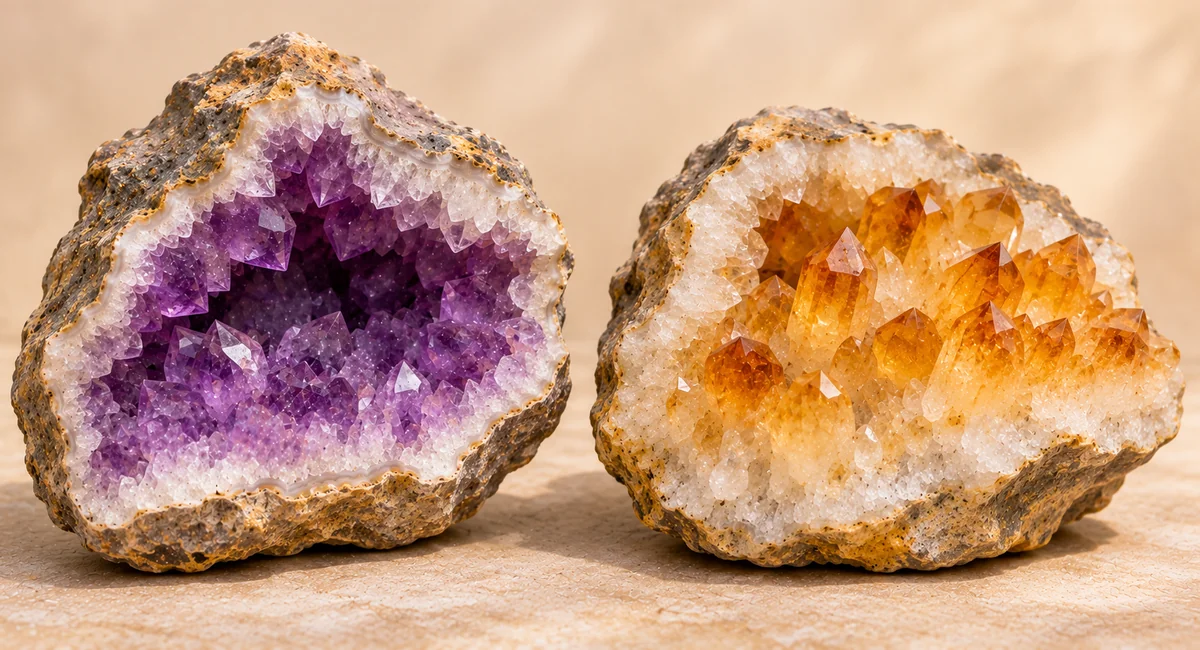
A brilliant golden-orange cluster can look very different from the purple amethyst geode beside it. Yet the two pieces may have begun as the same kind of natural mineral specimen. Much of the yellow-to-orange quartz sold in crystal-lined geode sections, clusters and tall display cathedrals is amethyst that was heated after extraction. The quartz crystals themselves are real mineral material; the important distinction is whether their present colour developed in nature or was deliberately changed.
This matters when buying a natural specimen for a collection, a reception area, a home mandir or a Vastu-inspired interior. A listing called “natural citrine cluster” can leave several questions unanswered. Is the quartz naturally grown? Is the yellow colour untreated? Does the piece preserve part of a genuine geode cavity? Has its base been cut, painted, filled or mounted? And will the customer receive the exact specimen shown?
A good description can answer those questions without diminishing the beauty of the object. This guide concentrates on whole clusters and geode pieces, not faceted citrine gemstones, bracelets or tumbled stones. It explains the physical forms, trade treatments, signs worth investigating, practical labels and appropriate display and care.
What exactly is citrine-colour quartz?
Quartz is the mineral species silicon dioxide (SiO₂). Clear rock crystal, purple amethyst, smoky quartz and yellow-to-orange citrine are familiar colour varieties of crystalline quartz. Colour names do not make them separate mineral species.
In gemology, citrine is the familiar trade and variety name for yellow to orange or brownish-orange transparent quartz. Naturally coloured citrine exists, but natural yellow coloration is less common than the large volume of citrine-coloured material sold in the trade. The Gemological Institute of America (GIA) explains that much commercial citrine is made by heating suitable amethyst. Some smoky quartz can also be altered toward yellowish colours through treatment.
For a mineral-specimen listing, the phrase “citrine-colour quartz” can be a useful provisional description when the colour is visible but the treatment history is not yet established. It is not a substitute for verifying the mineral species. Once the supplier identifies the starting material and treatment, use the more specific and informative name.
A piece can therefore be:
- Natural-colour citrine quartz: naturally crystallized quartz whose yellow or orange colour developed geologically, supported by credible documentation if sold with that claim.
- Heat-treated amethyst: naturally crystallized purple quartz whose colour was deliberately changed by heating; it can legitimately be described as citrine-coloured or commercially as citrine, provided the treatment is stated.
- Heat-treated smoky quartz: another possible treated-quartz source of yellowish colour; do not assume all treated citrine began as amethyst.
- Quartz with unresolved colour history: a real quartz specimen for which the available records do not establish natural versus induced colour. Describe that uncertainty instead of asserting “unheated” or “natural-colour”.
- Imitation or altered surface material: a different substance, a manufactured assembly or quartz with a separate coating or dye. Colour alone cannot rule these possibilities in or out.
The word natural must be attached to a clear claim: natural quartz concerns the mineral's growth; natural colour concerns how its present colour originated. They are different statements.
Why amethyst geodes are heated to make golden clusters
Many spectacular amethyst geodes develop in cavities within volcanic rocks. Mineral-bearing fluids deposit layers of chalcedony and quartz on cavity walls, and inward-growing crystals line the remaining space. A fragment broken from that lining may be sold as an amethyst crystal cluster; a sawn half can become a geode display; a tall upright section may be marketed as a cathedral geode.
When suitable purple quartz is heated under controlled conditions, changes in colour-producing centres can shift the visible appearance toward yellow, gold, orange or brownish orange. The result varies with the starting material and treatment: not every amethyst reacts the same way, and there is no single final colour shared by every heated piece.
In a treated geode, the underlying geometry remains recognizably related to its original specimen. The cavity, host rock and natural quartz points did not suddenly grow as orange crystals after treatment. What changed was principally the apparent colour. This is why an orange cluster may exhibit the short, densely packed terminations and light-coloured basal zones familiar from many amethyst geode fragments.
Large, golden-looking cathedrals are an especially important example. GIA explicitly notes that substantial amethyst geodes can be heated and offered as citrine cathedrals. A seller should identify the treatment without hiding the genuine geological character of the original geode.
The shape was geological; the presentation may be partly prepared
Several different processes can affect the finished display:
- Natural geological growth produced the quartz crystals and original cavity or vein occurrence.
- Mining separated the specimen from its host rock, sometimes leaving fractures or broken edges.
- Cutting, sawing and polishing exposed the chamber and produced an attractive face or stable foot.
- Heating, when performed, changed the colour of susceptible quartz.
- Filling, painting, mounting or a display base may have been added to prepare a large geode for sale.
A product can be naturally crystallized, heat-treated, sawn and mounted at the same time. A description that says only “100% natural” is not detailed enough to communicate all these facts.
Cluster, geode half, cathedral and druzy: what should the label say?
A colour name should never replace the physical-form name. A tight group of orange points, a hollow half-geode and a polished slab may all contain similar quartz, yet they have different structures, shipping risks and display needs.
| Physical form | What makes it distinct | Appropriate qualified label when heat-treated | What needs checking |
|---|---|---|---|
| Quartz crystal cluster | Multiple associated natural quartz points | Heat-treated amethyst crystal cluster, citrine-colour | Actual points, matrix, broken or repaired tips |
| Geode half | Part of a geological cavity with inward-facing crystal lining | Heat-treated amethyst geode half, golden-orange quartz lining | Cavity evidence, cut face, dye and mounting |
| Cathedral geode | Tall displayed section of a substantial cavity, often set on a base | Heat-treated amethyst cathedral geode | Total weight, centre of mass, filler, paint, support |
| Druzy geode fragment | Fine, densely grouped crystals on part of a cavity wall | Heat-treated amethyst druzy geode fragment | Actual cavity context and fragility of fine points |
| Druzy quartz plate | Tiny crystals coating a substrate; may not be part of a geode | Treated citrine-colour quartz druzy plate, if verified | Substrate, coating or dye, no assumed geode origin |
| Polished or carved quartz | Human-shaped rather than naturally terminated exterior | Polished citrine-colour quartz carving; treatment stated | Whether the points are carved rather than grown |
Not every orange druzy surface is a geode. Druzy describes many tiny surface crystals; geode describes a cavity-bearing form. Both can apply to the same specimen, but neither word should be used simply because it attracts more searches.
Likewise, cathedral is a commercial display-form term, not proof of a new mineral species or any particular mine. If a geode has been cut and mounted on a concrete or resin base, the mounting material belongs in the product specifications.
Recognizing treatment clues without treating them as proof
Photographs can prompt useful questions, but they cannot reliably certify untreated natural colour. Sellers sometimes present visual rules as absolute: that naturally coloured citrine is always pale, that every orange tip is heated or that one colour zone proves a particular treatment. Mineral colour has more complexity than those rules allow.
Nevertheless, a buyer can investigate several observations:
Intense orange tips over pale bases
Many heat-treated amethyst geode fragments show vivid yellow-orange or burnt-orange areas toward their terminations, with paler white or colourless quartz nearer the base. This pattern can be a reason to request treatment information, especially when accompanied by a familiar amethyst-geode shape. It is not a laboratory verdict by itself.
Crystal density and host-rock structure
Closely packed, fairly short inward-facing points within an agate- or quartz-lined cavity can be consistent with amethyst geode material. Shape helps explain the specimen's geological origin; it does not independently establish why the present colour is yellow.
Uniform yellow or smoky-yellow points
A comparatively uniform, pale yellow colour does not automatically prove an untreated origin. Natural quartz can show zoning, and some treated quartz varieties can produce different colour distributions. For a high-value natural-colour claim, ask for traceable evidence rather than a colour-chart promise.
Orange coating, dye, paint or photography
An unusual surface sheen, coloured material collecting in cracks, or mismatched colour between the crystal faces and base should prompt a closer inspection. External painting on the back of a geode is a different preparation issue from colouring the crystals themselves; both may need disclosure. Warm lighting, white-balance settings and heavily saturated edits can also distort photographs.
What a gemological report can and cannot settle
A laboratory can investigate mineral identity and sometimes obtain treatment-related evidence. However, not every heating history is conclusively detectable in an ordinary quartz report. A report identifying a specimen as quartz does not automatically certify that its yellow colour formed naturally. Read the exact conclusion, date, specimen description and stated limitations. The document should match the item offered, not merely another piece from a supplier's lot.
A seller should never imply that a photograph, UV torch, scratch test, magnet, home heating experiment or ordinary colour comparison establishes an untreated origin. Heating a specimen yourself can destroy the colour, crack the crystal or damage the base.
A buyer's comparison: labels and the information they actually convey
| Listing phrase | What it tells the buyer | What is missing or risky | Better wording where applicable |
|---|---|---|---|
| “Natural citrine cluster” | Suggests genuine quartz and possibly natural colour | Ambiguous: natural growth or natural colour? | “Natural quartz cluster, heat-treated amethyst, golden-orange colour” when documented |
| “Untreated natural-colour citrine” | Strong claim about colour history | Requires reliable provenance or evidence, not just an attractive photo | Retain only if documented; explain the evidence basis |
| “Heat-treated citrine cluster” | Acknowledges deliberate treatment | May not identify starting material or physical form | “Heat-treated amethyst crystal cluster (citrine-colour quartz)” when verified |
| “Citrine cathedral” | A commercial name for a tall golden-colour display | Treatment, cavity origin and base construction unclear | “Heat-treated amethyst cathedral geode, cut and mounted” |
| “Raw citrine geode” | Implies minimal preparation | May hide cutting, heating and painted backing | Itemize original cavity, sawn faces and any treatment or added support |
| “Citrine colour, treatment unknown” | Candidly describes an unresolved record | Does not support a natural-colour premium | Keep as an internal or clearly qualified retail label; investigate before sale |
| “Certified natural citrine” | Sounds authoritative | “Certified” may not explain colour origin or report scope | Quote the actual laboratory finding; do not expand its meaning |
For OmmRudraksha's planned specimen catalogue, the safest default is to separate identity, form, treatment and preparation into different product data fields. A full title can remain readable while the detailed fields do the precision work.
Three practical title examples
Example 1: verified heated cluster
Heat-Treated Amethyst Crystal Cluster — Golden-Orange Quartz, Natural Points.
The description would disclose the actual dimensions, treatment, base, photographs of the exact piece and visible condition.
Example 2: verified treated geode half
Heat-Treated Amethyst Geode Half — Citrine-Colour Quartz Lining.
The accompanying specifications would clarify the cavity, sawn edge, polished areas, support and the actual item's weight.
Example 3: unverified source material
Citrine-Colour Quartz Cluster — Colour Origin Under Review.
This is a working draft label, not an approved sale listing. A supplier or trained reviewer must resolve the mineral and treatment history, or the offer must plainly describe the unresolved treatment before it can proceed.
No title should imply that every item called citrine was originally amethyst; some yellow quartz has other colour histories.
What must be photographed for the exact cluster or geode?
Natural mineral specimens are not uniform manufactured products. Two pieces with the same mineral name can vary greatly in height, point shape, matrix, weight and stability. Representative images can illustrate a material category, but the actual specimen being purchased needs its own images.
A useful image set contains the overall front; a second view showing the entire interior or crystal group; side views revealing depth; the base or cut edge; close-ups of important terminations; and any broken, repaired, painted or filled areas. A simple scale card or ruler photograph helps the buyer understand physical size. Show the actual base or stand included in the order, not a photogenic stand used only during styling.
For a tall cathedral, photograph the rear finish and any added support. State overall height, width, depth and total shipped weight as measurements of that exact piece, with reasonable measurement tolerances. A statement such as “Brazilian geode” should be based on records for the particular lot, not inferred from the familiar outline of a cavity.
A neutral lighting setup is helpful for showing true colour. If warm lighting is used for a lifestyle photograph, keep at least one accurate, colour-balanced image with no intense saturation enhancement. Do not publish an AI-generated illustration as the stock photo of a one-of-a-kind specimen.
Why mineral identity, colour treatment and natural shape are separate value questions
The quality of a natural mineral specimen is more than colour saturation. A heated quartz geode may be a beautiful, substantial and well-prepared decorative object. Its price should still reflect the true material, treatment, size, point condition, visual appeal and degree of human preparation—not an unsupported premium for rare untreated citrine.
Consider these factors separately:
- Mineral identity: Are the visible crystals actually quartz? Are there other minerals on the matrix?
- Natural growth quality: Are terminations intact? Are there interesting growth contacts or unusual structures?
- Treatment: What is known about heating, irradiation, dye, coatings or other changes?
- Preparation: Has the cavity been sawn, polished, filled, reinforced or mounted?
- Condition: Are there fresh chips, repairs, unstable supports, loose crystals or stains?
- Documentation: Is there a credible locality record, traceable supplier statement or a report covering this exact specimen?
- Display practicality: Can it be kept secure in its intended setting? Is professional freight needed?
A well-identified, honestly priced treated specimen may suit a buyer better than a poorly documented stone claimed to be rare or untreated. There is no need to disparage treated material; the real issue is clear description and informed choice.
Citrine-colour clusters in Vastu and Indian spiritual settings
Yellow, golden and honey-coloured stones are frequently selected in contemporary Vastu-inspired interiors for their symbolic associations with warmth, auspiciousness, generosity and prosperity. Such colour choices can complement a home, workspace, puja area or reception desk. Some modern crystal traditions describe citrine as a “prosperity stone,” but that popular expression should not be presented as a guaranteed financial result.
Classical Vastu evaluates a building through its site, orientation, proportions, spatial relationships, circulation and use. There is no sound basis for asserting that a specifically heat-treated amethyst cluster must occupy a particular corner under an ancient universal rule. Where a practitioner recommends a directional arrangement, it is helpful to identify whether the guidance comes from an established spatial principle, a particular teaching lineage or a more recent crystal-placement convention.
In Jyotish, Guru or Brihaspati (Jupiter) is traditionally associated with yellow and with Pukhraj (yellow sapphire) in many gemstone-remedy lineages. Citrine and yellow quartz are not identical to yellow sapphire. A merchant should not automatically market heated amethyst as an equivalent planetary gemstone simply because the finished object is yellow.
For devotional settings, keep the distinction equally clear. Clear quartz is often called Sphatik in Indian spiritual commerce and may have specific uses as a mala or worship material. A golden heat-treated amethyst geode is a different object. Its use as a decorative, symbolic or contemplative element is a personal or tradition-guided choice, not a substitute for the relevant prescribed puja objects.
Safe and attractive placement
For a compact cluster, choose a stable shelf away from the edge and from places where its points may catch clothing or hands. Large cathedral geodes need a sound base, adequate floor loading and protection from tipping. Keep them away from children's play routes and door swings. Avoid strong, prolonged direct sunlight where colour change or fading is a concern, and do not expose the specimen to diya flames, incense embers or rapid temperature fluctuations.
A yellow-orange specimen may visually suit natural wood, brass tones or warm neutral interiors. Its appearance can support the atmosphere of a study or meditation room without any claim that it changes measurable physical energy or guarantees a particular outcome. Respect an individual household's devotional practice without using a mineral label as a substitute for religious instructions.
Caring for heated quartz clusters and prepared geodes
Quartz has a Mohs hardness of about 7, but this figure measures resistance to scratching, not protection against broken points or fragile matrix. A hard quartz termination can still chip, a heavy geode can topple, and a glued backing may react differently from the mineral.
Dust a secure specimen conservatively with a soft dry brush only if its surface and matrix tolerate contact. Never grip a cluster by protruding points. Avoid repeated soaking, salt-water immersion, harsh cleaners and abrasive scrubbing of whole mixed-material pieces. Even where warm soapy water is acceptable for a sound, loose citrine gemstone, that advice must not be copied automatically to a geode with unknown matrix, adhesives, painted backing or filling.
Strong light and extreme temperatures can affect the colour of some quartz varieties. Avoid steam cleaning, applying direct heat or attempting to “recharge” the piece in an oven. If a specimen has a stable, separate support, keep it dry and inspect it periodically for cracks or loosening. When in doubt, obtain care advice for the full material combination, not just the quartz itself.
For Vastu or devotional use, physical cleaning and ritual observance are separate decisions. A household may wish to accompany a display with a prayer, mantra or simple respectful handling, but immersion in milk, salt water or other offerings may damage a porous host rock or mounted base. Ritual meaning does not require exposing the specimen to a method known to harm the material.
OmmRudraksha's proposed stock-approval checklist
Before the planned GR10 concept becomes a purchasable product, its record should contain:
- A supplier statement identifying the mineral as quartz and, where known, the original amethyst or other source material.
- A positive heat-treatment disclosure, or a defensible statement that the colour history remains unknown; no unverified natural-colour claim.
- The actual physical form—cluster, geode half, cathedral, druzy fragment or another accurately described specimen.
- Exact-specimen images of front, sides, base, terminations and visible preparation or repairs.
- Actual dimensions, weight, structural condition, mounting materials and stable display orientation.
- Locality information only where documented for the lot or specimen; no inference from colour or silhouette.
- A shipment method appropriate to the specimen's mass, sharp points and fracture risk.
- Pricing and metadata that do not create a duplicate of an existing amethyst product or claim certification outside the scope of a report.
Until these checks are satisfied, GR10 remains a held concept. An article about treated material can be prepared and published separately after editorial approval; an unverified sale listing should not be activated merely because the educational article is ready.
Frequently asked questions
Is heat-treated amethyst genuine citrine?
It is genuine quartz, and citrine is widely used as the trade name for yellow-to-orange quartz produced by heating amethyst. A careful seller should disclose the treatment and, where known, the original amethyst source. This is different from asserting that the colour developed naturally.
Are all citrine clusters heat-treated amethyst?
No. Natural-colour citrine exists, and other quartz treatment histories occur. However, many orange geode clusters in commercial circulation began as amethyst. Request specific treatment documentation instead of trusting a universal colour rule.
Does heat treatment mean a specimen is synthetic?
No. Heating naturally grown amethyst changes its appearance without making its original geological crystal growth laboratory-created. Synthetic quartz and glass imitation are separate identity questions.
Can a photograph prove that citrine is untreated?
No. A photograph can show form, visible condition and useful colour clues, but not definitively establish the origin of the colour. Supplier records and appropriate gemological evidence are needed for strong untreated claims.
Is an orange crystal cluster necessarily a geode?
No. A cluster can grow on a rock matrix or in a cavity. A geode requires the relevant geological cavity structure; a surface druse alone is not enough.
Why are some golden clusters orange at the tips and white near the base?
The distribution can reflect pre-existing colour zoning in amethyst and its response to heat. This is a helpful reason to ask about treatment, not an absolute diagnostic test.
Can a citrine-colour cathedral have a painted exterior?
Yes. Some prepared geodes have painted, reinforced or mounted backs. These additions should be documented separately from the mineral's own colour treatment and natural cavity origin.
Is a treated cluster worth buying?
Yes, if its material, treatment, dimensions, condition, preparation and price suit your purpose. A treated natural quartz specimen can be attractive and collectible without being represented as rare untreated citrine.
Is a citrine-colour cluster the same as Pukhraj?
No. Pukhraj refers to yellow sapphire in conventional Jyotish gemstone practice, while citrine-colour quartz remains quartz. Do not replace a tradition-specific prescription merely on the basis of similar colour.
Which Vastu direction is compulsory for a yellow quartz cluster?
There is no single universal classical direction established specifically for heated amethyst geodes. Consider the room's layout, relevant tradition and safe physical placement rather than applying an unsupported rule to every object.
Can a golden quartz geode be washed or placed in salt water?
Do not assume so. Individual quartz crystals may tolerate gentle washing, but a complete geode can include porous rock, adhesives, painted finishes and supports. Identify the full construction before introducing water or chemicals.
Should I choose a cluster or a cathedral geode?
Choose according to display space, structural stability, verified specifications and packing needs. Small clusters usually need less floor space; cathedrals are heavy one-of-a-kind objects whose supports and handling matter as much as their appearance.
Choosing an accurately described specimen
When the choice is between a captivating orange cluster and a pale natural-colour quartz specimen, colour alone is the least reliable basis for a premium claim. Start with what the mineral actually is, then determine what humans have done to it, and finally assess whether the exact piece is suitable for the intended display. A natural quartz cluster whose amethyst colour was altered by heat can remain a worthwhile mineral object when the treatment is explained clearly.
That approach benefits collectors, Vastu-conscious households and responsible sellers alike. A product description should make the visible beauty of a golden specimen easy to appreciate—and its identity, treatment and condition easy to understand.
Related reading
- What Is a Crystal Cluster? Crystal Growth and Natural Forms
- Geodes, Druzy Specimens and Agate Nodules: What Is Different?
- How to Buy a Natural Mineral Specimen Online
- Natural Crystal Clusters and Geodes in Vastu: Traditional Placement and Meaning
- Cleaning and Storing Natural Crystal Clusters and Geodes
- Amethyst Crystal Clusters and Geodes: Formation, Vastu Traditions and Care
- Clear, Milky and Smoky Quartz Clusters Compared
- Agate Geodes and Druzy Slices: Natural Cavities and Cut Surfaces


