

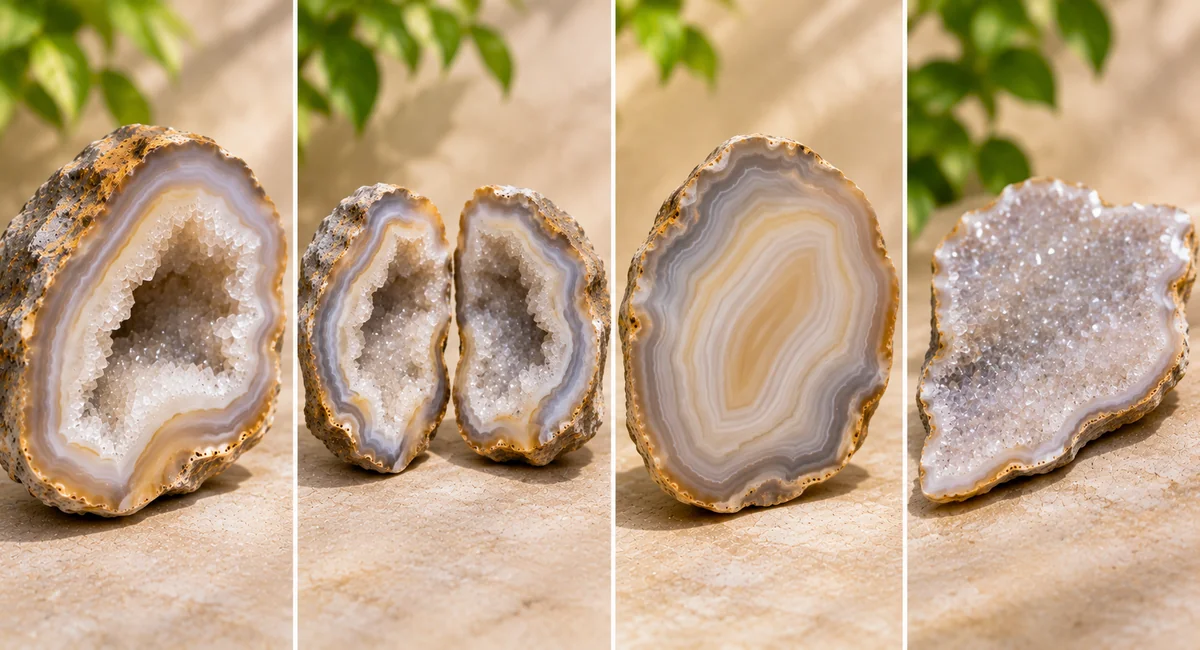
A polished agate geode can show three different textures within the same stone: a rough outer rind, translucent ribbons of chalcedony, and a hollow centre sparkling with tiny quartz crystals. A second slice may have graceful bands but no open centre. A third piece may resemble a glittering slab, yet its druzy crystals developed on an exposed rock surface rather than inside a rounded geode. These pieces can all be genuine geological material, but their structure, preparation and correct product names are not identical.
For a buyer, that difference matters. A photograph of only the polished face cannot tell you whether the back is natural, whether a pair consists of two matching halves, how deep the cavity is, or whether an unusually vivid colour has been added. This guide concentrates on the actual cut surfaces and specimen forms: what the bands reveal, how to distinguish geode halves from slices and druzy plates, what treatments should be disclosed, and how to choose a secure display for home, collection or a Vastu-inspired interior.
Read the stone from the outside towards the centre
Many familiar agate geodes preserve a sequence of features. Starting at the edge, a specimen may show a weathered rock exterior, a finer-grained chalcedony-rich rind, curved bands of agate, and finally an interior lined with quartz crystals. The order and mineral identities vary by locality and growth history. Not every specimen has all four features, and not every band indicates a separate mineral species.
The outer rind is part of the story
The rough outside can preserve the original shape of the cavity-bearing body. In a cut geode, an uneven brown or grey exterior is not automatically dirt or poor workmanship. It may be deliberately left unpolished to contrast with the interior. An artificially flattened base, a sawn back or a mounting adhesive is a different matter: those are preparation details worth describing in the listing.
Do not infer a mine or country solely from the rind colour. Similar-looking specimens can come from different geological settings, and the appearance of a weathered exterior also changes after cutting, grinding and cleaning.
The banded zone is usually fine-grained silica
Agate is a variety of chalcedony distinguished in common gem and collecting usage by characteristic bands or zones. Its fine-scale silica structure is different in appearance from the larger, easily visible crystal points projecting into a cavity. Under suitable lighting, grey, white, brown, amber or other bands may look translucent, whereas opaque zones remain more subdued. Patterns can be concentric, fortification-like, irregular or nearly parallel.
The cut direction matters. One slice through a body may reveal rings around a centre; another angle may show elongated curves, a stretched opening or bands that look almost straight. Consequently, two slices from the same rough stone can have different patterns without either being an imitation.
The centre may be open, crystal-lined or filled
A classic display geode retains an open cavity, often with mineral crystals growing inward from the walls. In some geodes, continued mineral deposition filled nearly all the original space. Geological surveys explicitly describe partly or completely filled geodes, although retail buyers commonly expect an open hollow when the word geode appears on a decorative listing.
For an online product, use the visually accurate wording. “Agate geode half with open quartz-lined cavity” tells the buyer something measurable. “Banded agate nodule slice, solid centre” is better when the piece has no demonstrable open cavity and its geological classification is uncertain. Do not label every circular agate slab a hollow geode simply because a central pattern resembles an opening.
How the cavity and bands develop
The formation of an agate-bearing cavity is a geological process, not a carving process. The starting space might be a gas vesicle in volcanic rock or an opening in another suitable rock. Mineral-bearing fluids can enter, react with the surroundings and deposit material over time. The pathways and chemistry differ from deposit to deposit; a single neat sequence should not be imposed on every geode in the world.
- An opening exists. A cavity, pocket or other void provides room for later deposits. Its original shape influences the finished specimen.
- Silica-bearing material develops around the walls. Layers of fine-grained silica can build a chalcedony or agate lining. Changes in supply and growth conditions contribute to the visible zones.
- Coarser crystals may grow inward. When space remains and the relevant conditions persist, quartz or other crystals can extend towards the centre. Fine crystals create a sparkling druzy lining; larger terminations produce a more obviously pointed interior.
- Growth may end with a cavity—or continue until it fills. The mineral body can later be exposed, broken, mined, sawed or polished. The geological growth and the commercial preparation are separate events.
A geode may contain minerals other than quartz, including calcite in some geological settings. Its care therefore depends on what is actually present, not merely on the retail word geode. A naturally formed band does not prove that any modern surface colour is untreated.
Agate geode half, druzy slice and polished slab: the practical comparison
The following names describe observable forms rather than interchangeable marketing keywords.
| Specimen or listing form | What the buyer should see | Preparation that may be present | A frequent naming problem |
|---|---|---|---|
| Agate geode half | A cut-open cavity-origin body, normally showing its outer shell and an interior cavity or fill | Saw cut, polished face, sometimes flattened base | “Geode” used without showing the interior structure |
| Matched geode pair | Two complementary halves of the same original piece | Split or sawn matching faces, possibly polished | Two separate geodes sold as a “matched pair” |
| Banded agate slice | A cross-section exposing natural bands; may be mostly or fully solid | Sawing, grinding and polishing on one or both sides | Every banded slice described as hollow |
| Druzy agate slice | A slice with a visible coating or centre of very small crystals | Cut backing or border; druzy surface ordinarily left unpolished | Smooth glitter coating or added sparkle mistaken for natural crystals |
| Druzy plate or rock-face specimen | Tiny crystals coating an exposed surface or matrix | Trimming and mounting, not necessarily a geode cut | Calling a flat druzy plate a geode without cavity evidence |
| Polished agate freeform or stand-up | Shaped decorative form chosen to reveal colour and pattern | Shaped outline, polished faces, cut standing base | Represented as entirely unworked natural rock |
A geode half can also be a druzy specimen; the two terms are not mutually exclusive. Similarly, a thin agate cross-section may contain a central vug with fine crystals, or it may be entirely solid. The correct description uses more than one term when necessary, such as “polished banded agate slice with central quartz druzy.”
What is a druzy surface, exactly?
Druzy and drusy are alternative spellings for a close covering of many small crystals on a mineral or rock surface. The word describes a crystal habit or surface texture, not an independent mineral species. Quartz druzy is common, but other minerals can form similar coverings. The fineness, uniformity and mineral identity influence how a surface looks and how fragile it is.
When a natural druzy surface catches light, many tiny crystal faces reflect it in different directions. Under magnification, you should be able to recognize a grain-like crystalline texture rather than a flat sheet of metallic glitter. However, a phone photograph is not proof that no coating, dye or sparkle treatment has been applied. Ask what mineral forms the crystals and whether any surface treatment is known.
Why a smooth polished border and rough centre can coexist
Stonecutters often polish a solid agate border while leaving the tiny crystals inside a central pocket untouched. The contrast is deliberate: the flat cut area displays banding, and the rough interior displays growth. Such a specimen is partly worked and partly naturally crystalline. It is misleading to describe every visible surface as untouched, but equally misleading to call the mineral assembly synthetic simply because the edge was cut.
Druzy does not automatically mean quartz
Quartz is a frequent druzy mineral and comparatively durable, yet some druses consist of calcite or another material that requires gentler care. A seller should not decide species from sparkle alone. Coatings can also change a natural quartz druse into a highly metallic or iridescent-looking decorative surface; the underlying quartz may be genuine even though the final colour is treated.
Sawing, polishing and finishing: what is still natural?
Natural mineral material and unmodified exterior form are two different claims. A naturally formed agate can be sawed into slices without becoming artificial agate. A polished face can make fine bands clearer, while a rough rear surface may show how the stone originally occurred. What changed was the geometry of the display, not necessarily the geological identity of the mineral.
A transparent product description can separate the work into observable parts:
- Natural growth: banding, crystal lining, cavities, inclusions and matrix that developed geologically.
- Mechanical preparation: cutting, grinding, rounding edges, drilling or polishing.
- Display preparation: flattening a base, attaching a stand, mounting a bracket or stabilizing a fragile area.
- Colour or surface modification: dye, coating, electroplated finish, paint or another known enhancement.
- Repair or assembly: joining broken pieces, reattaching a crystal or combining otherwise unrelated sections.
No treatment should be implied merely because the piece is polished. Conversely, a bright purple or blue face should not be marketed as an unaltered natural colour without support. Honest disclosure protects the buyer and permits an attractive, worked stone to be sold accurately.
Why the two faces of a slice can look different
A polished front tends to amplify optical contrast; the back may be only sawed, lapped, rough or uneven. Translucency depends on thickness and light direction. Small fissures can become more obvious under transmitted light. The rear surface may also show mounting marks or earlier repairs. A product listing that shows only the most flattering front cannot establish all these features.
A complete piece may include a hole at the centre or an opening that reaches the back. That affects the way it can be supported, lit and handled. For an open druse, fingertips and packing materials should never press directly against the fragile crystal lining.
Natural colour, dye and metallic coatings
Agate is known for natural bands and varied earth-toned or muted colours, but the market also contains extensive dyed material. Colour enhancement is not the same as mineral imitation: a dyed agate remains agate if that is truly the substrate, while its display colour is modified. GIA documents both dyeing of chalcedony and coatings of druzy surfaces.
Clues that invite questions—not home-test verdicts
Very vivid electric blue, hot pink, intense purple or uniformly saturated green can justify asking about dye, especially when colour seems concentrated in porous zones or fractures. These appearances are indicators to investigate, not a conclusive test. Some natural chalcedony has unusual colours, and a digital image is affected by lighting, camera processing and screens.
Avoid destructive or unreliable internet “tests”: scratching a specimen, applying acetone, heating it, soaking the geode in chemicals or testing it with acid can permanently damage a valuable stone or its coating. Ask for supplier disclosure and, if the distinction materially affects the price, appropriate gemological examination.
A metallic rainbow surface is a different treatment issue
Some druzy quartz pieces receive thin metallic or other coatings to create an iridescent, bright blue or mirror-like appearance. Such an item may have a natural quartz crystal substrate with a treated surface. A precise title could read “titanium-coated quartz druzy on agate” when the coating is reliably known; when not established, the supplier should not guess a treatment method.
Suggested listing language
| Evidence available | Better description | Wording to avoid |
|---|---|---|
| Banded agate and central quartz cavity, treatment unknown | “Agate geode half with quartz druzy; colour treatment not confirmed” | “100% untreated” without evidence |
| Supplier confirms dye | “Dyed banded agate slice with quartz druzy” | “Rare naturally bright blue agate” |
| Natural banding, cut front | “Natural agate material, sawn and polished display face” | “Completely uncut natural geode” |
| Two halves from one photographed original | “Matched agate geode pair; both halves included” | “Pair” where only one piece is supplied |
| Metallic coating confirmed | “Coated quartz druzy on agate matrix” | “Naturally metallic blue crystals” |
| No open pocket established | “Banded agate nodule slice” | “Hollow geode” |
“Treatment not confirmed” is a useful internal uncertainty statement, but it should not be a permanent substitute for appropriate supplier checks when a product is being offered as untreated or priced on that basis.
How to inspect a geode half or slice online
A photograph of an attractive centre is only the first part of inspection. For a one-of-a-kind specimen, the most useful listing is an exact-item visual record. The customer should be able to judge what will actually be delivered.
Ask for four views, plus one macro
Front: the complete cut face, bands, crystal cavity and any chips around the rim. Use neutral lighting without excessive colour saturation.
Back: the original rind or preparation marks, any repair, label, drill hole or backing material.
Side: overall depth, shape, cavity depth and whether a slice is thin enough to require a stand.
Base: the standing surface and whether an included stand or mount is essential.
Close-up: the druzy crystals and any suspiciously coloured seams, coating, break or reattached part. A second macro of the edge is helpful when the polish transitions into a rough cavity.
Include a ruler or measurable scale and provide overall length, width, depth and exact weight. A hand-held photograph alone is not a reliable scale because hands differ. If pieces are offered as a pair, show both halves together and separately and state whether both are included in the price.
Does the pair truly match?
Two halves of a single geode can share the same outer profile and complementary internal band geometry. A well-photographed pair should show how the cut faces relate. However, cutting loss and unequal thickness can make exact visual symmetry impossible. Matching halves should be documented as coming from one original body; two unrelated similar-looking agate pieces are a coordinated set, not necessarily a geological matched pair.
Pairs are also easy to miscount in fulfilment. A product described as “pair” must have a bill of materials consisting of two physical halves, an inventory identity for the set, a total or per-piece weight convention, and packing that prevents their polished faces from rubbing together.
Is a geode slice the same as a druzy plate?
Not always. A thin cross-section from a rounded geode body usually exposes a perimeter and the relationship of banded rind to central cavity. A druzy plate may be trimmed from a rock face or other substrate without retaining the enclosing body. Both may legitimately be decorative and natural mineral products. Their specimen forms should be sold under the most specific accurate names, with the edge and reverse views used to establish the distinction.
Practical buying questions before purchase
Use these questions to evaluate the actual item rather than trusting a broad category label:
- Is this the exact specimen photographed, or a representative example from assorted stock?
- What mineral is the banded body, and what mineral makes up the druzy surface?
- Does it have an open cavity, a largely filled centre or merely a surface crystalline crust?
- What work has been done: cut, polished, flattened, glued, repaired, stabilized or mounted?
- Has the agate been dyed or has the druzy received a coating? If unknown, what is the evidence limit?
- What are the exact dimensions and weight, and can the piece stand safely without a support?
- If described as a matched pair, are both halves included, and are they from one original stone?
- Is any locality claim documented, rather than inferred from colour or a generic market name?
- How will the interior crystals be protected in transit, and how are returns for damaged specimens handled?
A stone with modest colours, stable preparation and honest condition records can be more suitable for a collection than a highly saturated item whose origin, treatment or photograph does not correspond to the actual stock.
Displaying agate geodes and druzy specimens in Vastu-oriented spaces
Agate, with its visible layers and natural stone character, is used by some contemporary Vastu practitioners and homeowners as a meaningful decorative object. Banded agate may be chosen for visual associations with steadiness, the earth element and orderly layers; an open geode may be appreciated as a natural focal point for contemplation. These are symbolic and modern placement associations, not proof that a specific dyed slice or quartz druzy plate appears as a prescribed remedy in a particular classical Vastu treatise.
Traditional Vastu considers the configuration and function of spaces, circulation, direction, proportion and the appropriate organization of a dwelling. Readers may explore related decor categories in the Vastu collection, while keeping the identity of each natural mineral specimen clear. For a shelf or a quiet room, the practical arrangement is as important as the stone: keep surfaces clean, leave doors and pathways unobstructed, and avoid placing a sharp-edged geode where a child might reach into a crystalline cavity or knock the stand down.
A small neutral agate half can be displayed near a study or meditation area as a chosen natural object. A larger pair may suit a reception shelf when the load-bearing support is secure. Some owners choose the northeast (Ishanya) as a contemplative area; that does not mean every agate form has a universally established directional rule. A stone on a puja shelf should not be represented as a consecrated Yantra or substituted automatically for an object specified in a family's worship tradition.
The strongest display decisions balance actual weight, stability, lighting, mineral care and the household's own spiritual context. Dyed agate may be used decoratively when its colour treatment is clearly disclosed. Treatment alone does not determine a person's symbolic preference, but it does matter to accurate identification and care.
Cleaning, handling and safe storage
A cut agate surface and a druzy-lined cavity should not be treated like one uniformly smooth polished stone. Even where the banded body is made mainly of durable silica, small crystal tips can snap, coatings can scratch or detach, and associated minerals may be more sensitive than quartz.
- Dust with minimal contact, preferably using a clean, very soft dry brush only when the specific mineral and surface permit it. Avoid brushing across delicate coated or loose druses.
- Keep dyed or coated pieces away from cleaning solvents, alcohol, acetone, bleaching agents and strong sunlight. Do not deliberately “test” colour using liquids.
- Avoid routine soaking, salt-water baths, acids, steam or ultrasonic cleaning for mixed, mounted or treatment-unknown specimens.
- Lift a geode half from its solid outer body rather than from a thin druzy lip. Support larger halves from beneath with both hands.
- Keep a thin slice in a padded, stable stand. Do not squeeze two polished faces together for storage, and do not allow small quartz tips to scrape another piece.
- In a humid environment, store specimens dry, protected from dust and away from sudden temperature changes. Verify whether the full piece includes non-quartz minerals before giving any water-based cleaning instructions.
For devotional display, respectful placement and dry dust prevention are compatible with good conservation. Applying oil, kumkum paste, water or incense residue directly to an unverified crystal cavity may permanently stain it, so any ritual materials are better kept on a separate, easily cleaned surface unless the specimen's care has been specifically assessed.
How to catalogue these forms accurately
An organized collection benefits from distinct product types because a buyer searching for a hollow geode half may be disappointed by an opaque slab, while a collector looking for a thin agate slice may not want a heavy two-piece set.
Agate geode half: provide cavity evidence, specimen-specific dimensions, weight, standing view and treatment disclosure.
Matched agate geode pair: one set identity for the two halves, photographs of both pieces, condition notes for each half and protective packing for two polished faces.
Quartz druzy agate slice: disclose whether the druzy is a central cavity lining or a surface crust; photograph the thickness and reverse, and state any coatings.
Chalcedony druzy specimen: use a separate listing only when the actual mineral identity, structure or individual specimen is materially distinct from the quartz-druzy agate slice. The word chalcedony by itself is not a sufficient reason to duplicate a near-identical product page.
The underlying mineral can be natural even when its display face is polished. The catalogue should describe those two facts separately. If actual stock has not been photographed or treatment information is missing, the product remains a draft rather than an immediately purchasable exact-specimen offer.
Frequently asked questions
Is every agate slice a geode slice?
No. A slice may come from a solid agate nodule or a cavity-bearing body. A genuine geode origin is best supported by the observed structure and reliable specimen history, not just by circular bands on the polished face.
Does every geode have a hollow centre?
No. A cavity may have been partly or completely occupied by later mineral growth. Geological surveys describe filled geodes, even though decorative retailers often use geode to mean a visibly open piece. A seller should state whether the particular specimen has an open cavity.
What is the difference between druzy and drusy?
They are alternative spellings of the same descriptive term for a coating of numerous tiny crystals. Neither spelling tells you the mineral species or whether the surface is treated.
Can a geode be natural if the face is polished?
Yes. The mineral body may have formed naturally while its face was subsequently cut and polished. Describe it as natural mineral material with a cut or polished face, not as an entirely unworked stone.
Are bright blue or pink agate slices always dyed?
Many strongly coloured commercial agates are dyed, but colour alone does not establish treatment in every individual piece. Ask about the supplier's treatment history and seek competent testing when the distinction matters. Do not use destructive home tests.
Is a druzy slice the same as a quartz cluster?
They overlap only in the broad sense that both show crystals. Druzy usually describes a dense coating of small crystals, whereas a cluster commonly has more distinguishable individuals or growth units. The actual specimen may contain both appearances.
Why is the front polished but the back rough?
Polishing the cut face improves the visibility of bands, while leaving the rear rough may preserve the natural rind or simplify preparation. The back can also contain repairs or mounting features, so it should be photographed.
What is included in a matched geode pair?
A true two-half offer includes both complementary pieces. The listing should confirm the piece count and show each half. Two unrelated but aesthetically coordinated geodes are better called a set unless their common original body is established.
Can a coated quartz druzy still be real quartz?
Yes. A genuine mineral druse may receive a metallic or coloured coating. The natural substrate and the treated surface should each be described accurately, and the coating may require gentler handling.
Where should an agate geode be placed according to Vastu?
There is no single established classical rule assigning every modern agate geode, dyed slice and druzy plate to one direction. Contemporary Vastu-inspired placement may use the objects symbolically, while the actual room, safety, weight, light exposure and devotional practice determine an appropriate position.
Should I wash an agate geode with water or salt?
Do not assume that the entire specimen tolerates immersion. Crystal tips, a porous rind, a coating, dye, adhesive or non-quartz mineral can be vulnerable. Start with dry dust prevention and follow care advice suited to the identified whole specimen.
Final buying principle: name what the exact stone shows
The most reliable way to shop for agate geodes and druzy slices is to describe the mineral, the form and the preparation independently. Ask whether the stone is a geode half, a genuinely paired set, a solid banded slice or a thin druzy plate. Then look at the actual cut face, rear surface, edge and base, not just a spectacular frontal image. Disclose dye, coating, repairs and polishing in plain language.
A beautiful agate specimen need not be perfectly hollow, completely unworked or visually identical to another piece. Its value as a natural object comes from accurately understood geology, distinctive natural pattern and careful presentation. When purchased for a Vastu-inspired space, the same accuracy allows its cultural significance to be appreciated without obscuring its material identity or practical care needs.
Related reading
- What Is a Crystal Cluster? Crystal Growth and Natural Forms
- Geodes, Druzy Specimens and Agate Nodules: What Is Different?
- How to Buy a Natural Mineral Specimen Online
- Natural Crystal Clusters and Geodes in Vastu: Traditional Placement and Meaning
- Cleaning and Storing Natural Crystal Clusters and Geodes
- Amethyst Crystal Clusters and Geodes: Formation, Vastu Traditions and Care


