A winter routine can change where a mala spends its day: under a woollen scarf, beside a room heater or in a closed bag between journeys. Check those ordinary changes before assuming that the beads need a new oiling or soaking routine.

The condition of your actual strand matters more than the season's name. A cool room is different from a hot shelf above a heater; a dry bead surface is different from damp thread tucked into a pouch.
Move the storage place away from direct heat
Choose a stable place where the strand is not pressed against a radiator, heater, hot appliance or strong direct sunlight. Support it loosely and keep it clear of sharp jewellery. There is no reason to “warm” a devotional object before use by placing it near a heat source.
If a mala becomes damp during travel or wear, let it dry in a shaded, ventilated place before closing its pouch. Do not speed the process with a hair dryer. Cord, coatings, adhesive and fittings may need different care from the seed beads themselves.
Notice what heavier clothing catches
A tassel or cap that moved freely against a light shirt may catch on a scarf, zip or knitted loop. Remove the strand carefully when changing clothes. If it catches, support the item and free the snag rather than pulling the whole mala through it.
Inspect the cord where it enters the beads and beside any fitting. Repeated friction at one point is a reason to ask about the assembly. Buying a different mukhi type would not resolve a sharp edge or a worn string.
Do not diagnose a crack from colour alone
Indoor light, a darker background and surface residues can change the way the same bead looks. Compare it with an earlier clear photograph under similar lighting. A different shade does not establish that the seed has dried out, lost religious value or needs a replacement.
A newly opening gap, detached piece or insecure fitting is a more concrete observation. Set the item aside and use the damage and replacement guide to record it. Do not pry into a line to see how far it goes.
Should you apply oil?
Do not add an unspecified oil just because an article mentions dry weather. First check the maker's instructions for the exact piece and tell them about any finish, caps, elastic or other materials. An instruction intended for a loose unmounted bead may not suit the strand you own.
If a previously supplied care routine names a product and method, clarify anything uncertain before applying it. More is not automatically better. An excessive coating can make handling messy and complicate later inspection of the original surface.
A useful check after a journey
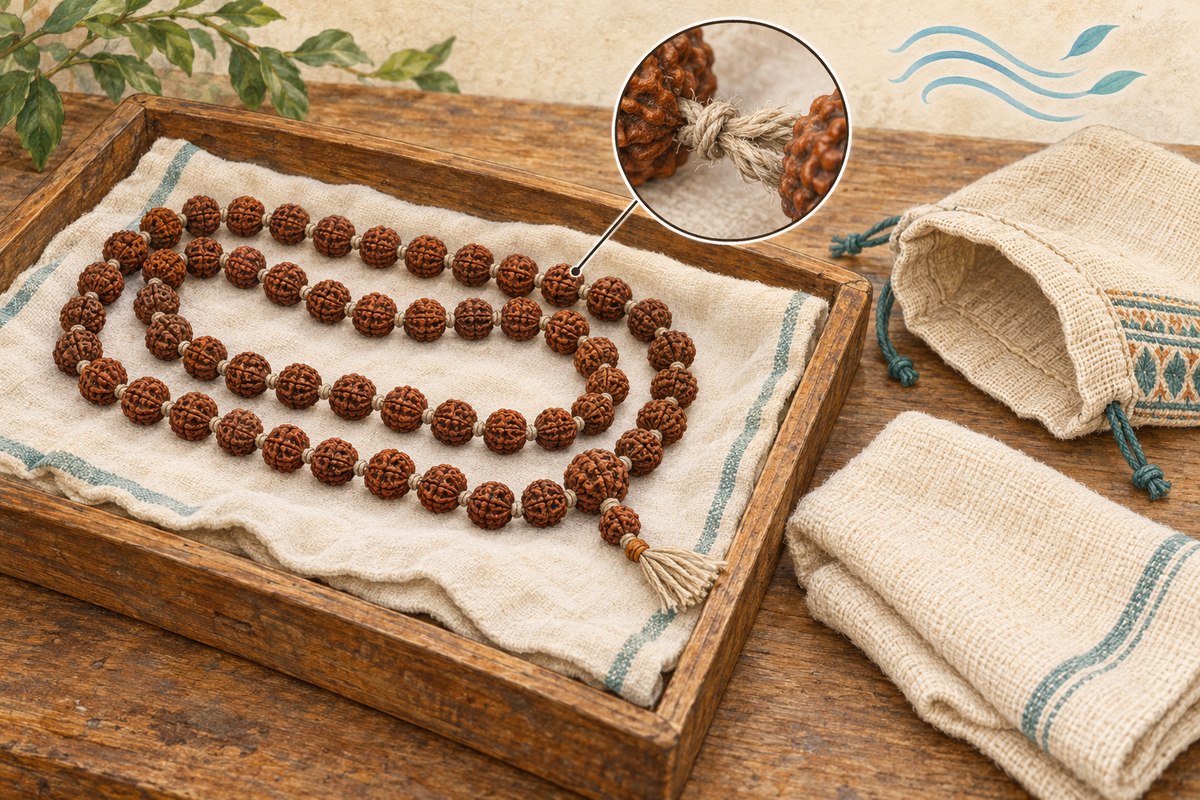
Suppose you have travelled with the mala inside a bag and worn it over a scarf. Lay it on a clean cloth when you return. Check whether the tassel or cord is damp, whether a knot has shifted and whether the bag's zip has caught a fitting. If everything is sound and dry, ordinary careful storage may be all that is needed.
This is an illustrative handling situation, not a report of product damage or a claim that all winter travel harms Rudraksha. Use the observations to decide what requires attention.
Keep a repair question specific
“The thread is fraying beside the marker” is more useful than “the winter has weakened my mala.” Send a photograph of the problem, the complete strand and the order reference. Ask whether the item needs restringing, a fitting adjustment or physical examination.
The general care guide provides the background. Our post-festival inspection article deals separately with residues and storage after a busy observance. Winter care adds attention to heat sources, layered clothing and changing daily handling; it does not require a new commercial product by default.
Winter Rudraksha Care: A Complete Guide to Wearing, Cleaning, Storage and Inspection
A Rudraksha mala is both a traditional devotional object and a physical assembly. Its beads are hard botanical fruit stones; its other parts may include cotton or silk thread, nylon cord, elastic, metal caps, clasps, decorative spacers and a tassel. All those materials share the winter journey, but they do not respond identically to warmth, dampness, friction or cleaning. A sound winter routine therefore begins with identifying the actual item rather than applying a single treatment to every Rudraksha.
During Shiva japa, meditation or daily wear, a well-fitted mala should be comfortable to handle and straightforward to maintain. Winter does not change its mukhi count or the traditional identity of the bead. What changes is the surrounding environment: a warm room after a cold commute, a woollen shawl over a pendant, a damp collar after foggy travel, or a pouch left beside a heater. Observe these changes, protect the assembly, and use an item-specific care method when intervention is needed.
Quick winter-care checklist
- Before wearing: look for loose knots, an unevenly hanging tassel, sharp caps, fraying thread and beads that catch against clothing.
- While wearing: keep the mala clear of zips, coat buttons, scarf loops, heater vents, steam and perfume sprays.
- After wearing: wipe away ordinary surface dust with a soft dry cloth; if the strand is damp, allow it to air-dry in the shade before storage.
- For storage: choose a clean, moderate, stable environment, away from radiators, damp walls and direct sunlight; give the strand physical support.
- When concerned: take clear photographs and ask the maker whether the problem concerns the bead, its finish, the string or the fitting before using liquids or oils.
1. What actually changes in winter?
In some northern Indian locations, winter combines fog, damp air and very cold outdoor conditions. In a centrally heated home, indoor air may become comparatively dry. A coastal location may remain humid even when evenings feel cool. A Bengaluru winter may have chilly mornings without the extreme indoor heating seen elsewhere. The practical question is not simply whether the calendar says December or January; it is whether the mala experiences repeated moisture, heat, compression or abrasion.
Natural and manufactured components can change differently when the environment shifts. The bead surface may collect dust or temporary moisture. A cotton tassel may absorb water. A synthetic cord may be less absorbent yet still abrade at a sharp hole. A metal cap may be cool to the touch and later develop condensation if brought into warm, humid air. A glued fitting may have cleaning limits entirely unrelated to the bead. These differences explain why a blanket soaking recipe cannot safely cover every assembled product.
| Winter situation | What to inspect | Sensible first action | Avoid |
|---|---|---|---|
| Heater or hot-air vent nearby | Warm bead, warm cap, dry or stiff cord | Move the item to a stable, moderate location | Placing it on the heater to dry |
| Fog, rain or damp commuting | Damp tassel, cord, pouch or seams | Lay flat in a shaded, ventilated spot | Sealing damp materials immediately |
| Thick wool or layered clothing | Snags, pulled loops, displaced caps | Free the strand gently and inspect | Tugging it through a zip or knitted loop |
| Rapid indoor/outdoor changes | Moisture on fittings and inside pouch | Allow the item to acclimatise naturally | Sudden heating or direct sun |
| Longer periods without use | Tangling, crushed tassel, storage humidity | Support loosely in a clean cloth-lined space | Tight compression near chemicals |
| Daily japa and frequent handling | Worn hole edges, shifted knots, oily residues | Inspect, dry-wipe and seek repair if necessary | Assuming every visual change is a crack |
2. Recognise the parts of your Rudraksha item
A loose natural Rudraksha bead presents fewer material interfaces than a heavily capped pendant. A traditional japa mala contains many potential wear points along the cord and near the meru or guru bead. A bracelet may rely on elastic that needs its own periodic replacement. A silver-capped pendant brings a bail, chain, attachment ring and possibly an adhesive into the picture. Identifying the construction determines the safest care advice.
The bead's longitudinal mukhi lines are natural structural features. Do not confuse them with every light surface mark, polishing variation or deeper separation. Likewise, a small hole around stringing may be an original manufacturing feature or a point of wear; its appearance alone does not establish the cause. Check for changes over time rather than diagnosing the item from a single dramatic photograph.
| Component | Typical issue after winter wear | What to observe | When to request service |
|---|---|---|---|
| Rudraksha bead | Accumulated dust, residue or visible separation | Same-angle photos, movement, missing fragments | Opening split, detached material or altered string hole |
| Cotton or silk thread | Fraying or persistent dampness | Fuzzy fibres, knots, stretching, odour | Loose or thinning sections at stress points |
| Synthetic cord | Abrasion or hardening | Glossy worn patch, flattening, cutting near caps | Cord weakness or insecure closure |
| Elastic bracelet | Loss of recovery | Gaps, slipping knots, slack fit | Stretching that no longer recovers |
| Metal cap and bail | Snagging or loose joint | Sharp edge, wobble, opened ring | Moving cap, separated bail or sharp contact |
| Tassel | Tangling, snagging or delayed drying | Loose strands, fraying, damp core | Detached or badly worn attachment |
A repair that deals with a frayed thread should not be presented as proof that the entire Rudraksha bead needs replacement. Conversely, a strong new thread cannot repair a bead with a serious structural separation. The inspection needs to identify the specific component.
3. Dry indoor air and direct heater exposure are different problems
Low humidity and direct radiant heat are not interchangeable. A beaded object may tolerate normal dry indoor conditions but suffer from prolonged contact with a heater or hot surface. Heat can also affect surrounding thread, glue, protective finishes or decorative parts. Museum conservation guidance for mixed-material objects emphasises moderate, stable environments rather than repeated heating and cooling.
Choose a storage shelf that remains comfortably away from air-conditioning exhaust, electric heaters, radiators, kitchen appliances and sunlit window ledges. Do not hang the mala from a hot lamp or above an incense flame. In a puja room, place the item away from the immediate heat of a diya, camphor flame or agarbatti. The devotional significance of a prayer area does not make an exposed flame a suitable storage environment.
Avoid extreme humidity interventions as well. A sealed container filled with highly aggressive drying agents is not automatically better than a clean drawer. Likewise, spraying water over a bead merely because a room feels dry may dampen the cord without addressing an actual maintenance need. Stability, cleanliness and checking the actual piece are preferable to frequent environmental experiments.
4. Damp winter mornings, condensation and safe drying
Dampness can arise from fog, rain, bathing, perspiration under a woollen scarf, condensation on cold fittings or a pouch that was packed before the item dried. A mala that merely feels cool is not necessarily wet. Confirm whether there is visible moisture, a damp tassel, a wet pouch lining or a change in smell; do not rely on touch alone.
If the assembled item becomes damp, place it on an absorbent, clean cloth in a shaded area with ordinary ventilation. Spread the strand gently so that knots and tassels are not compressed. Air-drying does not require sunlight, a hair dryer, an oven, a heater or forceful rubbing. Once the item and its storage pouch are dry, return it to storage. If prolonged dampness has produced persistent odour, unusual surface growth, dye transfer or weakened cord, avoid improvised chemical treatment and ask for examination or professional restringing.
A frequently encountered mistake is to dry a wet pouch while leaving the mala inside it. A fabric pouch can retain moisture even when the outer surface seems dry. Check the pouch separately; replace one that remains damp, musty or stained.
5. Wearing Rudraksha with sweaters, scarves and winter coats
Clothing causes more everyday problems than winter temperature alone. Open-knit wool, coarse seams, zips, hooks, backpacks and fasteners can trap a cap or tassel. A pendant that sits well against a cotton shirt may twist under several layers, especially if its chain is too short or its bail is narrow.
Before leaving home, put the mala over a smooth inner layer or adjust it so that a cap cannot enter a zip. When changing clothes, pause and remove the item separately rather than pulling a sweater over it. For a long mala, support the loop with both hands while dressing. Do not make a tight knot in the strand to shorten it unless the maker has expressly designed that method.
For japa, an appropriately sized mala can be used in the hands without being worn beneath a heavy jacket. A separate practice mala may reduce clothing contact if daily commuting repeatedly catches a devotional strand. Whether to wear or keep the item near a puja place remains a matter of one's established practice and comfort.
Choosing an appropriate winter fit
- Check that a pendant falls freely and that the cap is not pressed into the neck by a high collar.
- Check whether a large bead or long meru bead strikes coat buttons when walking.
- Make sure a neck cord does not sit directly under a sharp backpack strap or fastener.
- Inspect bracelet elastic when removing gloves or sleeves; do not stretch it over the fabric.
- If a mala catches daily, adjust its wearing position or discuss a more suitable cord length rather than forcing the existing assembly.
6. Cleaning: what to do and what not to assume
A soft, clean, dry cloth is the simplest first step for ordinary surface dust. Use gentle, supportive handling, not hard scrubbing across the natural lines. Cleaning with an untested chemical, detergent, alcohol, sanitizer, perfume, jewellery dip, abrasive brush or ultrasonic cleaner can affect some components even when other components appear unaffected.
There are different traditional and commercial routines for conditioning unmounted Rudraksha beads, including some that mention ghee, milk or particular oils. Those methods are not universally interchangeable, and a routine for a simple seed does not automatically apply to a capped pendant, dyed cord, glued jewellery or elastic bracelet. Avoid a new soak or oil application just because the season has changed. Refer first to the maker's written care instructions for your specific piece and confirm the method if the surface treatment or construction is unknown.
Over-oiling may attract dust, transfer to clothing, make knots slippery, obscure surface inspection and affect adjacent fibres. A thick layer is not evidence of better preservation. If an item has a pre-existing care schedule, do not increase the frequency simply because someone describes winter as a "dry season." Treat any established devotional conditioning separately from routine dust removal and ensure it is suitable for all attached materials.
| Proposed treatment | Safer decision rule | Reason to pause |
|---|---|---|
| Dry wiping with a soft cloth | Suitable first check for ordinary dust | Still support loose or cracked pieces |
| Plain-water rinsing | Only when maker confirms compatibility with complete assembly | Cord, tassel, glue or metal may retain water |
| Milk, ghee or oil conditioning | Follow item-specific method and instructions, if applicable | Potential residue, trapped moisture and staining |
| Soap or detergents | Avoid unless specifically approved for all parts | Surfactants can affect finishes and fibres |
| Hair dryer, heater or direct sun | Do not use as drying accelerators | Local overheating and uneven drying |
| Metal polish or jewellery dip | Treat detachable metal only per specialist guidance | Product may contact natural bead and thread |
| Alcohol, perfume, sanitizer or bleach | Keep away from the entire mala | Unwanted chemical exposure to mixed materials |
7. Winter storage at home and during travel
A clean, roomy pouch or lined box that supports the strand is often more useful than a tightly sealed decorative case. Place a long mala in a gentle loose loop rather than forcing it into a tiny pocket. Do not hang a heavy mala indefinitely by the tassel; this loads the same point. Keep rings, metal chains and sharp devotional objects in separate compartments to prevent scratching, pulling and tangling.
A puja shelf can be appropriate if it is stable, dry and not directly above a flame or immediately under incense smoke. Store away from bathrooms with persistent moisture and kitchens with steam, cooking oil and temperature fluctuations. In a winter travel bag, use a separate soft pouch and keep it away from water bottles, toiletries, hand sanitizer and metal keys.
When bringing a mala home from a cold outdoor environment, allow it to return to ordinary indoor conditions gradually. Opening a pouch and inspecting any visible moisture is preferable to putting the cold item immediately on a warm appliance. For extended storage, inspect occasionally for dampness, insect activity in textile materials, broken stitching or a newly loose joint.
Practical storage setups
| Item and use | Appropriate layout | What to keep separate |
|---|---|---|
| Daily japa mala | Loose loop on clean cloth or roomy pouch | Sharp jewellery and damp fabric |
| Capped pendant | Individual soft-lined compartment | Tangling chains and abrasive metal objects |
| Rudraksha bracelet | Lay flat without tension on elastic | Heavy items that deform the loop |
| Long occasional-use mala | Supported flat in a box | Compressed tassel and tight knots |
| Travel mala | Soft pouch in dry compartment of luggage | Toiletries, water bottles and hot surfaces |
8. How to distinguish cosmetic changes from a repair issue
Not every shade difference is a failure. A photograph taken under warm incandescent light may show a darker brown than the same bead photographed in daylight. Surface oil, dust, shadow, polishing and normal handling can also alter appearance. A seasonal colour change alone cannot establish a specific structural condition, nor can it prove that a devotional object has lost its traditional significance.
More actionable observations include a newly visible gap, a fragment that has separated, a string hole with signs of cutting, a loose cap that twists independently of the bead, a broken knot or a tassel attachment that slips. Record these clearly. Avoid forcing the sides of a suspicious line apart, inserting tools into a mukhi groove or adding glue to a potentially repairable fitting.
A useful photo set includes the entire piece in neutral daylight, both sides of the affected bead, a close view of the string hole or mount, and a ruler or common-size scale where helpful. The maker can then determine whether to recommend simple restringing, a metalwork repair, a bead examination or replacement under the applicable service terms.
Stop, inspect or continue?
| Observation | Practical decision | Next step |
|---|---|---|
| Looks slightly darker under indoor light | Continue observing | Compare under the same lighting as an older photo |
| Light surface dust | Ordinary gentle care | Dry wipe with soft cloth |
| Tassel wet after travel | Pause storage | Air-dry tassel and pouch naturally |
| Knot visibly slipping | Stop wearing until checked | Request restringing or knot repair |
| Sharp or detached metal fitting | Stop wearing | Seek competent fitting repair |
| Newly opening crack or loose fragment | Stop stressing the bead | Photograph and request individual assessment |
| Persistent musty odour or visible growth | Isolate from other textiles | Seek specialist advice rather than brushing indoors |
9. Devotional handling during Shiva japa and daily puja
Rudraksha is traditionally associated with Lord Shiva and is widely used for mantra japa, including "Om Namah Shivaya" and other practices taught by a family or guru. Care is compatible with devotion: clean hands, a stable seating arrangement and a safe place for the mala help prevent unnecessary pulling and accidental damage. They are practical choices rather than newly imposed ritual requirements.
During winter puja, a warm shawl or blanket may be worn for comfort. Keep loose tassels away from an open diya. When using the mala for counting, move one bead at a time without tugging at the string-hole edges. Many japa traditions turn at the meru or guru bead rather than crossing it. Follow the counting instructions of the practice you have adopted.
Some households keep a mala only for japa; others wear a Rudraksha pendant throughout ordinary activity. A special practice mala may be stored on the puja shelf, and a daily-wear item may be handled differently. Neither pattern means that the bead requires seasonal consecration merely because the weather changed. If a particular family or lineage has a distinct observance, maintain it without treating it as a universal product-maintenance instruction.
10. Buying a Rudraksha item for winter use
When choosing a winter-wear item, do not focus only on the mukhi number. Examine the complete construction. A sound bead with an ill-fitting cap, a weak string or an awkward pendant length can be inconvenient regardless of the bead's traditional significance. Ask for actual bead diameter, finished pendant drop, overall mala length, strand material, cap metal, clasp design and care instructions.
For a japa mala, ask whether the count excludes the guru or meru bead, whether knots separate beads, whether the strand is intended for practice or everyday wear, and how restringing is handled. For pendants, distinguish the diameter of the Rudraksha alone from the total dimensions including cap and bail. For bracelets, ask whether the sizing is measured as internal circumference or a flat length. These details matter especially under layered winter clothing.
When authenticity documentation is supplied, read what it actually verifies. A gemstone or Rudraksha report may describe observed physical features; it does not establish that a chain will fit, the tassel is durable or the piece will never require maintenance. The appropriate questions combine identification, construction, practical fit and honest after-sales arrangements.
Winter buyer's review worksheet
| Question for seller or maker | Why it matters | Record before purchase |
|---|---|---|
| What is the bead type and measured size? | Controls physical proportions and handling | Diameter, mukhi description, photographs |
| What is the finished length or pendant drop? | Determines placement under winter layers | Overall dimensions and wearing position |
| What carries the load? | Thread, elastic and chain have different wear points | String or metal specification |
| How is the cap fixed? | Loose caps can catch on clothing | Attachment and service method |
| What care is approved for this exact product? | Avoids contradictory treatment advice | Written care instructions |
| What happens if thread or fitting fails? | Routine wear is distinct from bead authenticity | Repair/restringing procedure |
| What is included in documentation? | Different reports address different questions | Scope of tests and identifiers |
11. A seasonal inspection schedule that does not overcomplicate care
A quick glance before wearing and another after unusual exposure are often more valuable than an arbitrary daily ritual. If a mala is worn continuously, use the moments when removing a sweater, returning from travel or placing it in storage to check the same few points. A stored occasional-use mala should be examined before its next use. Do not set a rigid oiling frequency just because the calendar enters winter.
Before first regular winter use: photograph the overall item, inspect the cap and knots, check size under outerwear, locate a stable storage place and read the maker's instructions. During routine use: keep clear of heater vents and snags, handle with dry hands and allow damp textile components to dry. After unusual exposure: assess moisture, seams, knots and metal joints. If a problem develops: stop stressing the affected component and document the defect before arranging repair.
| Checkpoint | Less than a minute of observation | Escalate when |
|---|---|---|
| Before putting on a coat | Tassel, zip clearance, pendant movement | Repeated snagging or sharp fitting |
| After japa | Thread tension, residue, visible moisture | Slipping knot or bead movement |
| After travel | Dryness of both mala and pouch | Odour, dampness or damaged clasp |
| Before long-term storage | Loose loop, clean support, cool location | Fraying or persistent moisture |
| Before reuse after storage | Compare appearance and fitting to prior state | Opening crack or insecure mount |
12. Common winter care mistakes and their better alternatives
Mistake: put the mala on a radiator to remove moisture. Better: air-dry in the shade with ordinary ventilation. Direct heat may stress the whole assembly rather than only the damp portion.
Mistake: apply oil whenever the weather feels dry. Better: check the exact item, finish and maker-supplied care schedule. A devotional conditioning tradition is not an automatic cleaning rule for every finished product.
Mistake: seal a damp mala in its pouch after commuting. Better: separate and dry the strand and pouch before packing them. Cloth can retain moisture after the bead surface feels dry.
Mistake: pull a caught pendant through a zip. Better: support the bead, release the snag and inspect the bail, loop and mounting ring afterward.
Mistake: diagnose authenticity or failure from a winter photograph. Better: use neutral lighting, compare with the same piece and ask for physical examination if a structural defect is visible.
Mistake: treat thread wear as a spiritual issue. Better: distinguish practical repair from devotional practice. A worn knot calls for stringing work, not an unsupported claim about the bead's energy.
Mistake: wash the whole assembly using advice intended for an unmounted seed. Better: verify compatibility with the cap, cord, adhesive, stone spacers and surface finish before using any liquid.
Frequently asked questions about winter Rudraksha care
1. Can winter weather damage a Rudraksha mala?
Normal cool weather does not by itself mean the mala is damaged. The practical risks are exposure to direct heat, persistent moisture, abrasive clothing and stress at stringing or mounting points. Assess the actual item: if its bead, cord and fitting remain sound and dry, ordinary careful handling is generally the sensible response. Do not assume all winter climates create the same conditions.
2. Should I oil my Rudraksha more frequently in December or January?
Not automatically. Some traditional conditioning methods are intended for particular beads and circumstances, but the correct method depends on how the piece was supplied and constructed. If a maker has provided written instructions, follow them; otherwise ask before applying any oil. A cap, glue, textile thread or elastic component may make an unmounted-bead recipe unsuitable.
3. Is coconut oil suitable for every Rudraksha bead?
No single oil is automatically appropriate for all assemblies. The bead's previous treatment, surface finish, attached thread and metalwork can change the answer. Do not experiment with coconut oil, almond oil, ghee or any other substance on a valuable or unusual bead without item-specific advice. Excess residue can attract dirt and complicate inspection.
4. Is it safe to dry a mala in direct winter sunlight?
Shaded natural air-drying is the more conservative first choice for a damp assembled mala. Intense sun can warm the bead and surrounding materials unevenly, and some decorative threads or finishes may be light-sensitive. If an item requires special drying after accidental soaking, obtain its maker's guidance rather than applying prolonged direct sunlight as a universal treatment.
5. Can I put Rudraksha near a room heater to warm it?
Do not intentionally warm the item on or directly beside a heater, radiator, hot-air outlet or heated shelf. A sudden local temperature rise is unnecessary for devotional use and may affect cords, adhesives and fittings as well as the bead. Store it in a moderate area where a person could comfortably keep a delicate jewellery item.
6. What if the mala becomes wet in winter rain?
Remove it from the wet garment or bag and lay it gently on a clean absorbent cloth in a shaded, ventilated area. Check the tassel, knots and pouch as well as the bead surfaces. Avoid heaters, hair dryers and vigorous brushing. If you see a loose fitting, persistent odour or visible damage after drying, pause wearing and arrange a specific inspection.
7. Can I wear Rudraksha under a woollen sweater?
Yes, if it fits comfortably and does not snag or press against sharp seams. Coarse knitted loops and zips can catch bead caps, tassels or cords. Check the wearing position before dressing and remove the strand separately when changing clothes. A recurring snag is a fit or construction issue worth adjusting rather than simply pulling harder.
8. Why has my bead become darker during winter?
Light conditions, background colour, ordinary handling and surface residue can alter appearance. Take a photograph under similar neutral lighting to an earlier reference image. Colour alone does not establish damage, authenticity or religious significance. If the change accompanies a new gap, unusual surface deposit, odour or insecure fitting, document those physical observations for assessment.
9. How can I tell a natural mukhi line from a new crack?
An established mukhi division is part of a bead's visible natural structure. A newly opening separation, loose fragment or widening area is a different observation. Do not pry the line apart with a pin or blade. Compare clear photographs, check for actual movement and seek examination where uncertain; remote colour-based identification alone may be inadequate.
10. Should I soak the entire mala in milk or ghee for winter conditioning?
Do not apply a soaking method to every finished mala. Some devotional traditions prescribe specific conditioning for particular Rudraksha beads, but a complete assembly may include absorbent thread, dye, adhesive, elastic and fittings that require different handling. Follow instructions for the exact piece and confirm that every attached material is compatible before undertaking a treatment.
11. How should I store a Rudraksha mala after Shiva japa?
Place it loosely on a clean cloth or in a roomy protective pouch, once it and the pouch are dry. A stable puja shelf or drawer away from direct heat, dampness and smoke is preferable to a cramped place near a flame. If the family follows a dedicated japa-storage custom, it can be respected while still protecting the item physically.
12. Is an airtight plastic bag good for winter storage?
A tightly sealed bag is not necessarily better. If the mala or its thread is even slightly damp, trapped moisture can become a problem. Choose a clean, supportive container or breathable cloth pouch suited to the actual environment. If long-term protective packaging is required, make sure all parts are dry and avoid compression or contact with incompatible chemicals.
13. What if the tassel stays damp after the beads feel dry?
The tassel may retain moisture longer than a smooth bead surface. Keep the mala out of closed storage, spread the tassel gently on a clean cloth and allow natural ventilation. Do not apply an open flame or hot air. If the tassel remains musty, discoloured or structurally weakened, ask about replacement rather than masking the problem with fragrance.
14. Do silver or gold caps need special winter care?
Metal fittings should be checked for looseness, sharp edges and snagging. Metal-specific polish or chemical dip may be unsuitable for an assembled bead because it can contact the Rudraksha, cord or adhesive. For tarnish, loose soldering or a damaged bail, use a competent jeweller or the maker and ask what can safely be treated without exposing the bead.
15. Why does my pendant catch on my winter scarf?
A scarf's knitted loops can trap the cap, bail or attachment ring. The pendant may also hang at an awkward height when layered clothing changes the neckline. Try a smoother inner layer or suitable length adjustment. If the cap has an exposed wire end or sharp edge, stop wearing it until the fitting is repaired; do not force it through the scarf.
16. Can a Rudraksha bracelet become loose in cold weather?
An elastic bracelet may feel different over changing layers or wrist positions, but persistent looseness often points to elastic wear or knot movement rather than winter temperature alone. Check whether it returns to its original size and whether beads separate excessively. Ask about replacing elastic if it has lost resilience or its closure is insecure.
17. Do I need to remove Rudraksha when bathing in winter?
For a complete assembled mala, removal before bathing is often the simpler way to avoid soaps, hot water, shampoo and prolonged wetting of cords or fittings. The precise practice may depend on the product's materials and a family's devotional custom. If the maker has special instructions for the item, follow those rather than treating all jewellery as waterproof.
18. Can perfume or hand sanitiser touch the beads?
It is better to prevent direct exposure. Fragrance sprays, sanitizer and cleaning chemicals can contact surface finishes, adhesives or fibres, even when the bead itself appears unchanged. Apply personal-care products before handling the mala, allow hands to dry and avoid spraying the pendant while it is worn. If a spill occurs, seek material-specific cleaning guidance.
19. Is a woollen cloth suitable for cleaning a mala?
A coarse or shedding woollen cloth may catch on rough bead surfaces and snag jewellery fittings. A clean, soft, lint-minimising cloth is preferable for gentle dry wiping. Support the item rather than rubbing forcefully along all the mukhi grooves. If dust is embedded or a coating is uncertain, ask about appropriate cleaning rather than switching to an abrasive brush.
20. What should I do after carrying a mala in an overnight travel bag?
Take it out and inspect the separate pouch, string, tassel, caps and beads. Look for moisture, compression, trapped zips, shifting knots and sharp contact with keys or jewellery. If it is dry and intact, return it to an appropriate storage location. If a component has been pulled or damaged, record the issue before wearing it again.
21. Can I hang a full 108-bead mala from a hook all winter?
It depends on the construction, weight and hanging point. Long-term suspension can load the same knot, cord segment or tassel. For a heavy strand or one with delicate attachments, a flat, supported loose loop is usually safer than hanging it by a tassel. If it is displayed vertically, ensure the support is designed for the weight and does not pinch the beads.
22. What if I find mould-like material on the thread?
Keep the item separate from other textiles and do not shake or brush suspicious material around an occupied room. Continued dampness can affect organic fibres. Seek assessment and appropriate cleaning or restringing guidance. A fragrance spray or extra oil is not a substitute for resolving persistent moisture and addressing a compromised thread.
23. Should a newly bought Rudraksha pendant be conditioned immediately?
Not solely because it arrived in winter. Determine whether the bead is unmounted, capped, sealed, previously treated or supplied with product-specific care instructions. Some products need no immediate treatment; others are supplied with a defined routine. Ask the seller before soaking or oiling a newly received fitted pendant, especially when the cap or bail may rely on adhesives.
24. Can a winter colour change prove that a Rudraksha is fake?
No. Lighting, surface residue, handling and prior polishing can affect colour, and neither colour nor one casual photograph provides reliable proof of origin. Assess mukhi structure and relevant documentation through an appropriate identification process. If the concern is physical damage rather than authenticity, document a newly opening separation or loose fragment separately.
25. Is it necessary to re-energise or reconsecrate Rudraksha every winter?
Winter itself does not impose a universal reconsecration requirement. Rudraksha is traditionally associated with Lord Shiva, and devotional observances vary among families and lineages. One may continue an established japa or puja practice without inventing a seasonal ritual obligation. Physical maintenance such as fixing a loose knot remains a distinct practical task.
26. What should I photograph before requesting a winter-care repair?
Take one clear image of the complete item, one of the affected area under neutral light, and close views of the cord entry, knot or metal fitting if relevant. Include an earlier photograph, actual size and purchase reference if available. Describe the change precisely—for example, a knot slipping after snagging on a scarf—rather than making assumptions about its cause.
27. When should a damaged thread be restrung?
Seek restringing if fibres visibly fray, a knot slips, the strand loses structural integrity, or a high-stress area near a heavy bead or cap looks insecure. Do not wait for beads to scatter. The appropriate thread and knot pattern depend on the assembly and devotional use. An experienced maker can retain the original beads while renewing the carrying material where feasible.
28. Will placing silica gel in the pouch improve winter care?
Not every winter environment needs a drying agent, and uncontrolled desiccation is not a universal solution for mixed organic materials. If the item is damp, first remove it from the pouch and allow appropriate natural drying. For long-term storage, a stable environment and periodic inspection are more useful than adding desiccant without understanding moisture conditions and material compatibility.
29. Can I use the same cleaning method on Rudraksha, Sphatik and gemstone spacers?
Not necessarily. Botanical Rudraksha, quartz crystal, other gemstones, metal spacers and textile cords have different material properties and finishes. An assembled multi-material mala must be treated according to its most vulnerable components. Ask for product-specific instructions before using liquids, polishing agents, heat or ultrasonic cleaning on the whole strand.
30. What is the simplest reliable winter routine for my Rudraksha?
Keep it away from direct heat and repeated dampness; avoid snagging it on layered clothing; handle with clean, dry hands; dry-wipe ordinary dust gently; store it supported and completely dry; and check knots, caps and the tassel regularly. If a new crack, loose fragment or weakened thread appears, stop stressing that part and request a focused assessment. Do not add an unverified oiling or soaking regimen merely because the weather is colder.
Final winter care checklist
A carefully maintained Rudraksha can remain part of ordinary winter life and regular Shiva worship. Choose a stable place, guard against friction and heat, let damp components dry naturally, and deal with observable defects rather than assumptions about a season. Keep the care method appropriate for the complete item—bead, thread, cap, finish and tassel—not just for the natural seed at its centre.
For more specific issues, use the existing links above to the care, inspection and cracked-bead articles. When asking OmmRudraksha for advice, share photographs of the entire piece and the particular concern so that the recommended action can address the actual construction.