Gita Jayanti can be a good occasion to begin reading the Bhagavad Gita, return to a passage or join a community study session. You do not need to finish a complete commentary in a single day to make the occasion meaningful. A clear edition, a manageable reading period and a way to record questions will serve a beginner better than rushing through unfamiliar words.

What does Gita Jayanti commemorate?
In the devotional tradition, Gita Jayanti marks the giving of the Bhagavad Gita's teaching by Krishna to Arjuna. The text presents their dialogue within the Mahabharata. Its religious setting should be distinguished from a claim that the calendar independently establishes the historical date of the dialogue.
For the local 2026 planning example, ISKCON Bangalore lists Gita Jayanti on 20 December 2026. Follow your community's calendar for an observance and confirm any event's current arrangements directly. This article does not announce an Omm-sponsored event or provide a temple booking.
Choose an edition you can actually read
The Gita is arranged in eighteen chapters. A printed or digital edition may contain the Sanskrit text, a transliteration, a translation and a commentary. Those are different layers. A long page may include extensive explanation even when the underlying verse is short.
INFLIBNET's learning chapter on the Bhagavadgita explains its dialogue setting, eighteen-chapter structure and interpretive context. Keep the text, translation and explanation distinct when choosing an edition. Different translators and commentators may interpret a passage differently; keep their names and the edition in your notes.
A four-step method for one reading session
- Locate: write down the chapter and verse range so you can find the passage again.
- Read: use a translation in a language you understand; add the Sanskrit or transliteration if it is useful to your practice.
- Compare: read a commentary, noting where explanation begins and where the translated passage ends.
- Reflect: record one question and one observation in your own words, without treating your first interpretation as final.
If you have only a short period, choose a small section. Do not treat speed, the number of pages completed or a difficult pronunciation as a test of personal worth. A teacher-led group can help with context and terminology, while a private reading can proceed at a comfortable pace.

An eighteen-session reading plan
The following is an organizational suggestion, not a religious requirement or a claim that every chapter takes the same time. Use one session per chapter as a starting structure, then split a longer chapter or repeat a difficult section when needed.
| Sessions | Reading task | What to record |
|---|---|---|
| 1–3 | Begin the text in order and establish its dialogue setting | Questions raised by the speakers; unfamiliar terms |
| 4–6 | Continue with the same edition and commentary | Recurring words and the commentator's explanation |
| 7–12 | Maintain the chapter-by-chapter sequence | Connections with earlier passages; points needing a teacher's guidance |
| 13–18 | Complete the sequence, then revisit your notes | Questions that changed and passages to read again |
These groupings organize the reading workload; they are not a scholarly division of the Gita's philosophical contents. If your teacher recommends a different sequence, note that method rather than mixing several reading plans without explanation.
Reading, recitation and japa are different activities
Reading a translation for understanding is different from reciting a Sanskrit passage. Japa of a chosen mantra is another practice. You may combine them if that is part of your tradition, but they do not have to be forced into one simultaneous task.
If you use a mala for a separate japa period, check the bead-count guide and choose an assembly you can handle. The current mala collection offers formats to compare; buying a new strand is not a condition of reading the Gita.
Prepare a reading space and preserve your notes
Choose enough light to read comfortably, keep liquids away from a book or device and arrange a place for questions. If a household observance also uses a lamp, keep paper and cords clear of it. A simple notebook can contain the edition, session date, passage reference and your own summary.
Avoid forwarding an isolated quotation as though it captures an entire argument. Check the reference and read the surrounding dialogue first. If sharing a modern translation or commentary, respect its copyright; linking to an authorized edition is often more useful than circulating an unattributed image.
What if I cannot read Sanskrit?
Begin with a reliable translation in a language you understand. Transliteration can help you follow sounds, but understanding and accurate recitation are different skills. For pronunciation, use a competent teacher or a clearly identified recording rather than assuming every video label is reliable.
What can I continue after the festival?
Return to the next planned session, revisit an unanswered question or join a study group whose approach you understand. The lasting value of the plan lies in returning to the text with attention. It does not depend on completing a shopping list or promising a particular result from one day's reading.
Gita Jayanti 2026: date, meaning and the right starting point
In 2026, Gita Jayanti is observed on Sunday, 20 December, in conjunction with Mokshada Ekadashi, the eleventh lunar day of the bright fortnight of Margashirsha. ISKCON Bangalore lists 20 December 2026 for its observance; the date also appears in the 2026 Gita Jayanti panchang. Check the calendar of your temple or sampradaya for any local recitation programme or associated Ekadashi rules. The date is a festival observance in the living religious tradition, not a modern documentary proof of when a historical conversation occurred.
The Bhagavad Gita is the celebrated dialogue between Sri Krishna and Arjuna in the Bhishma Parva of the Mahabharata. Arjuna's crisis of responsibility provides the dramatic setting. Krishna teaches discernment, action, devotion, the nature of the self, disciplined attention and liberation. The commonly studied text has 18 chapters and approximately 700 verses, though editions and numbering conventions can vary. A beginner benefits from knowing where a passage sits in that conversation before trying to apply it to daily life.
You can honour the day by reading one carefully chosen section, participating in a Gita-patha, listening to an exposition, offering a respectful prayer before a copy of the text, or beginning a longer course of study. A twenty-minute attentive reading is more useful than racing through eighteen chapters without grasping their themes. For someone who wishes to undertake a full recitation, obtain the correct text, pronunciation support and sequence from their teacher or temple.
An accessible home observance
- Wash, put on clean clothes and prepare a quiet, well-lit reading place according to family custom.
- Place your authorised copy of the Bhagavad Gita on a clean stand or protected surface. If desired, add a simple flower or devotional image of Krishna.
- Begin with an invocation or a brief prayer familiar to your family. This guide does not require an invented universal mantra.
- Read the selected verse in Sanskrit if you can, then read the translation and a clearly attributed explanation.
- Close by writing a question and an intention for further study. If you observe Ekadashi fasting, follow appropriate household or teacher guidance rather than making a reading exercise into a dietary requirement.
| Reading arrangement | Time to reserve | A suitable objective | What to leave with |
|---|---|---|---|
| One short passage | 10–15 minutes | Read four to six verses in context | One clear question |
| One thematic section | 20–35 minutes | Follow a speaker's argument | A paragraph in your own words |
| One chapter | 30–90+ minutes | Read the complete exchange without rushing | Chapter outline and key terms |
| Study-group meeting | 45–90 minutes | Discuss a passage and compare interpretations | Notes separating text from comments |
| Full organised recitation | As organised locally | Follow the prescribed text and pace | A future study plan, not just completion |
These are planning estimates, not prescribed muhurta timings or a religious ranking. The length of a chapter and depth of a commentary can change the time needed dramatically.
The four layers of a reliable Gita edition
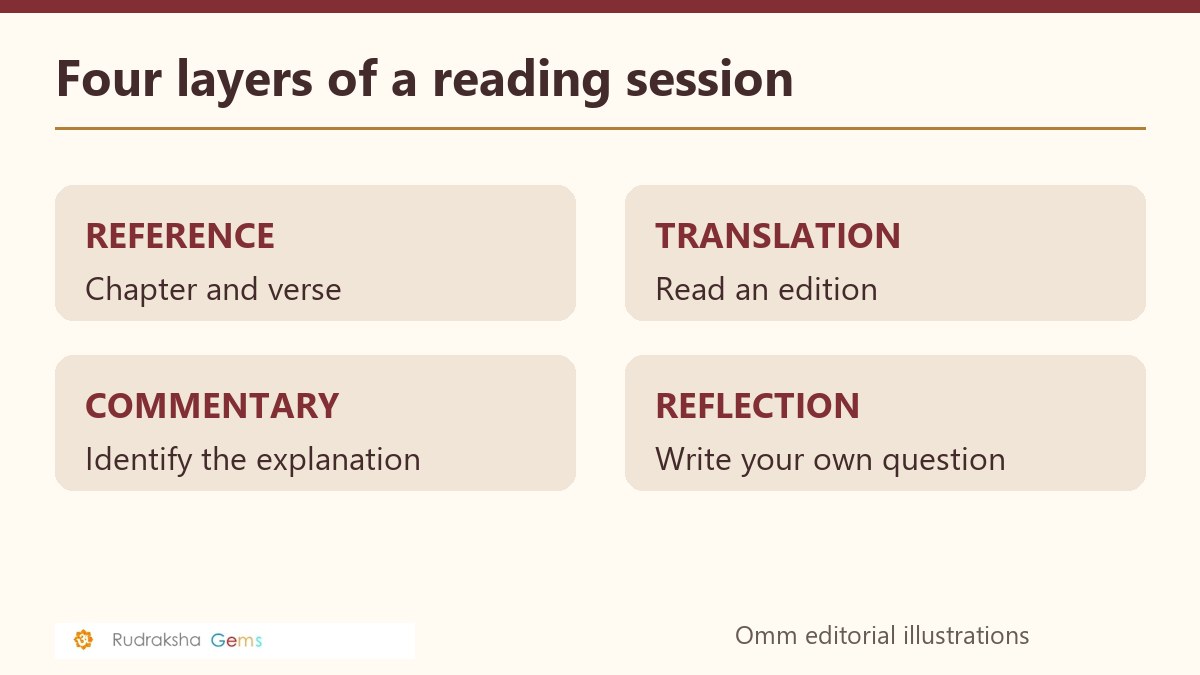
Before choosing a book or application, inspect a sample page. Sanskrit text is the base verse; transliteration represents its sounds in another script; translation communicates the sense in the target language; and commentary presents the interpretation of a named teacher or philosophical school. An editor's introduction, devotional note or footnote is another distinct layer. Do not present a commentator's explanatory sentence as though it were literally in the Sanskrit verse.
Look for clearly printed chapter and verse numbers, an identified translator, publication details, consistent transliteration and reasonably readable type. If you use an audio recording, confirm which edition and recitation text it follows. A translation in Kannada, Odia, Hindi, Telugu, Tamil, Bengali or English can serve a sincere reader; Sanskrit fluency is not a prerequisite for beginning to study the meaning.
Several important commentarial traditions read the Gita through different philosophical frameworks. Advaita Vedanta, Vishishtadvaita Vedanta, Dvaita Vedanta, Gaudiya Vaishnava traditions and other Krishna-bhakti lineages may emphasise different relationships between the individual self, divine reality, duty and grace. Compare interpretations respectfully and name the source. A passage may share a central narrative setting while receiving different technical explanations in these schools.
A straightforward rule for your notebook is to separate four lines: the verse reference; the translation's main point; the teacher's interpretation; and your personal reflection. This prevents a modern motivational quotation from erasing the context of the original conversation. If an explanation conflicts with what you read, put a question mark beside it and revisit the preceding verses.
An 18-chapter roadmap for the complete Bhagavad Gita
The table below gives an orientation to each chapter. It is designed as a study map, not a substitute for reading the chapter. Chapter names appear with familiar English transliterations; spelling and English subtitles differ across editions. Each question is a study prompt, not a claim that one sentence captures the entire chapter.
| Chapter | Common traditional title | Main reading focus | Reflection prompt |
|---|---|---|---|
| 1 | Arjuna Vishada Yoga | Arjuna's moral crisis and grief | What duties feel in conflict here? |
| 2 | Sankhya Yoga | Self, steadiness, action and discernment | What is meant by performing one's work well? |
| 3 | Karma Yoga | Right action, service and responsibility | How can action be performed without selfish fixation? |
| 4 | Jnana–Karma–Sannyasa Yoga | Knowledge, teaching and the relation of knowledge to action | Why does informed action differ from habit? |
| 5 | Karma–Sannyasa Yoga | Renunciation and active life | What does inner renunciation mean? |
| 6 | Dhyana Yoga | Meditation, self-mastery and the balanced path | How is a wandering mind gently redirected? |
| 7 | Jnana–Vijnana Yoga | Knowing Krishna and the nature of reality | What is theoretical versus realised understanding? |
| 8 | Akshara Brahma Yoga | The imperishable, remembrance and life's end | What does sustained remembrance ask of the practitioner? |
| 9 | Raja Vidya Raja Guhya Yoga | Divine presence, devotion and accessibility | What kind of intention matters in an offering? |
| 10 | Vibhuti Yoga | Manifestations of divine splendour | How are examples used to point beyond themselves? |
| 11 | Vishvarupa Darshana Yoga | The universal form and Arjuna's response | How does the vision affect his understanding? |
| 12 | Bhakti Yoga | Loving devotion and qualities of devotees | Which qualities describe a compassionate devotee? |
| 13 | Kshetra–Kshetrajna Vibhaga Yoga | Field, knower and discernment | What difference is drawn between experience and its knower? |
| 14 | Gunatraya Vibhaga Yoga | Sattva, rajas and tamas | How do the three gunas frame behaviour? |
| 15 | Purushottama Yoga | The ashvattha image and the supreme person | Why is a tree used as a teaching image? |
| 16 | Daivasura Sampad Vibhaga Yoga | Divine and contrary dispositions | Which conduct patterns deserve examination? |
| 17 | Shraddhatraya Vibhaga Yoga | Threefold faith, food, discipline and offering | Why does motive matter with an outward practice? |
| 18 | Moksha–Sannyasa Yoga | Synthesis, duty, surrender and freedom | How do the chapter's conclusions relate to chapter 1? |
The table offers one reading session per chapter, but longer chapters—particularly 2, 11 and 18—will often need several meetings. One reader may take eighteen days, another six weeks, and a serious study group much longer. Do not treat the calendar as the measure of understanding.
A practical three-week beginner schedule
For readers who want a date-based plan, the following is a voluntary reading schedule beginning on Gita Jayanti, Sunday 20 December 2026. It is not a special ritual requirement. It allows a day for chapter 1 and a longer pause for chapter 2, then groups the remaining chapters by realistic reading load.
| Suggested period | Readings | Practice focus | Output to record |
|---|---|---|---|
| 20–22 December | Chapters 1–2 | The crisis, self and action | Two questions about Arjuna and Krishna |
| 23–26 December | Chapters 3–5 | Action and renunciation | One example of responsible work |
| 27–30 December | Chapters 6–8 | Mind, knowledge and remembrance | Notes on meditation terminology |
| 31 December–3 January | Chapters 9–11 | Devotion and the universal form | Distinguish teaching images from literal claims |
| 4–7 January | Chapters 12–15 | Devotion, field/knower and gunas | Three related terms with references |
| 8–10 January | Chapters 16–18 | Character, faith and final synthesis | Revisit the question from chapter 1 |
If the schedule becomes too fast, continue without restarting. You may devote a day solely to verses 2.47–2.50 or to the devotional qualities in 12.13–12.20. A shorter recurring routine is often more sustainable than an ambitious plan abandoned after the festival. Readers using a school or office schedule can divide each chapter into two sessions with one rest or review day per week.
Passage-by-passage introduction: what to read first
1.28–1.47: Arjuna's crisis. Before extracting a maxim about courage, understand the situation: Arjuna sees teachers, relatives and allies on the opposing side and confronts competing loyalties. The episode creates a moral question, not merely a lack of confidence. Note which concerns Krishna later addresses directly and which require more careful reading.
2.11–2.30: the self and grief. The teaching introduces a distinction between the enduring self and changing embodied conditions. Its interpretation belongs to philosophical traditions; avoid collapsing it into a claim that human grief is unimportant. Write down the translator's terminology for atman, dehin and related expressions before interpreting them.
2.47–2.50: work and fruits of action. The much-discussed relation between action and results is not a licence for negligence, failure to plan or escaping accountability. Compare the description of skill in action with the surrounding teachings on equanimity. Record the difference between performing a duty well and trying to control every possible outcome.
3.19–3.30: acting without fixation. Krishna discusses work in relation to duty, exemplary conduct and dedicating action. A useful reflection is to identify a real obligation and ask how intention, quality and concern for others shape it. This is more precise than treating karma yoga as a generic productivity slogan.
4.7–4.8 and 4.34: restoration and learning. The chapter's discussion of divine manifestation is a major theological passage; its meaning is explained differently across traditions. Verse 4.34 also brings in learning through respectful inquiry. Note the connection between asking questions and receiving instruction without confusing enquiry with blind repetition.
6.5–6.6 and 6.26: mind and discipline. The section invites reflection on training the mind, not on forcing immediate perfect concentration. The instruction about repeatedly returning a wandering mind is particularly useful for a reader who loses focus during study. Make a brief note of how your edition translates manas and atma.
9.26 and 12.13–12.20: offerings and devotional character. The Gita discusses offering with devotion and attributes of the devotee. Read the passages as a unit before treating a flower or lamp as the entirety of worship. The text's emphasis on disposition can illuminate why simple home observances matter to many practitioners.
13.1–13.3 and 14.5–14.9: terminology for philosophical study. These passages introduce the field and knower, along with the three gunas. Some editions number the opening verses of chapter 13 differently. Use the exact citation printed in your edition, especially when comparing translations from different traditions.
18.63–18.66: discernment and surrender. Read the closing discussion in context: Krishna tells Arjuna to reflect carefully and then sets out a teaching concerning surrender. Schools differ in how they interpret the relation between free deliberation, duty and divine refuge. A careful reading respects both the narrative sequence and the philosophical interpretations.
Important Sanskrit terms to recognise without oversimplifying
Dharma may denote duty, sustaining order, ethical obligation or a more specific role-dependent responsibility, depending on context. The phrase svadharma deserves attention within a verse and within the interpretive framework of its edition. Do not translate every occurrence as an identical modern career instruction.
Karma means action and, in related discussions, action and its consequences. Karma yoga points toward a disciplined orientation to action, including intention and attachment. Jnana concerns knowledge; bhakti concerns devotion; dhyana concerns meditation. Their meanings interact across the chapters and are not three competing product categories.
Yoga is used in several linked senses of discipline, union, practice or spiritual method, not just physical postures. Samatva concerns evenness or equanimity. Sattva, rajas and tamas are the three gunas discussed systematically in chapter 14. Moksha concerns liberation. Different commentators explain the ontological and practical significance of these terms differently.
| Term | A useful initial orientation | Common reading error to avoid |
|---|---|---|
| Dharma | Duty, right ordering and responsibility in context | Reducing it to a single modern job description |
| Karma yoga | Discipline of action and intention | Assuming outcomes and competence no longer matter |
| Atman | Self; philosophical interpretation depends on school | Treating one English rendering as universally exact |
| Bhakti | Devotional orientation toward the divine | Equating devotion solely with ritual objects |
| Dhyana | Meditation and disciplined attention | Assuming a beginner must immediately master a technique |
| Guna | Constituent quality or mode in a wider philosophical account | Using three labels as casual diagnoses of people |
| Moksha | Liberation or spiritual freedom | Treating it as a short-term material reward |
| Shraddha | Faith, commitment or trust in a particular context | Assuming it means asking no questions |
Keep a glossary page with each term, the verse where you first meet it, your translator's choice and one question. This creates a useful comparison record without forcing doctrinal agreement on every edition.
How to read one verse carefully: a six-line notebook method
Try this method with Bhagavad Gita 2.47 or another passage selected by your teacher. First, write the exact chapter and verse as printed in your edition. Second, identify who is speaking and why the conversation has reached this point. Third, copy a few key Sanskrit terms or the transliteration without copying pages of modern copyrighted translation. Fourth, paraphrase the translation's central idea in your own words. Fifth, separate what the commentator adds, including comparisons to other scriptures. Sixth, write a lived example and one unresolved question.
For 2.47, a beginner might record: “Krishna discusses action and its fruits. My translation highlights the practitioner’s responsibility to act without ownership of results. I want to understand how this fits with planning responsibly.” This is a study note, not a replacement translation. The goal is traceability from reflection back to the verse.
A useful weekly review asks: Which verse did I take out of context? Which term changed meaning when I read surrounding verses? Which commentator added an interpretation I had assumed was stated directly? Which question should I bring to a teacher? Answering even one of these carefully demonstrates progress.
Compare editions without confusing interpretation and quotation
Choose one primary edition to read consistently during your first cycle. Add a second edition only when you encounter a genuine question about meaning or terminology. When comparing, keep the chapter/verse constant and write down both translators' names. Do not assemble a sentence from several translations and label it an ancient verbatim verse.
For a verse such as 12.13, notice how English words for compassion, lack of animosity and friendliness can be nuanced differently. Compare the explanatory prose separately from the core translation. If the second edition represents a particular sampradaya, note that; disagreement between schools is not automatically an error. Academic translations and devotional commentaries may serve different purposes while still being useful when properly attributed.
Do not post scans of entire contemporary books or paid commentaries to a group. Use authorised editions, brief appropriately attributed references and your own notes. For a Sanskrit recitation programme, also check whether the chosen recording follows your book's chapter division and verse variants.
Gita Jayanti family study, temple gatherings and children
A family reading may include one short introductory summary, a short passage and a respectful discussion. Children can ask what Arjuna is worried about before adults introduce abstract terms. Avoid presenting a complex war-context teaching as a simple moral slogan. Older participants may compare the relation between right action and responsibility; younger readers may draw a map of the two speakers or make a chapter tracker.
At a temple Gita-patha, follow the organiser's recitation order, seating and participation rules. Some events include all eighteen chapters, guided chanting, discourse, book distribution or devotional offerings. Confirm programme details with the organiser rather than assuming that a public webpage guarantees a particular session or a particular form of attendance. If joining digitally, verify the original publisher or temple channel.
For a study group, assign someone to confirm verse references, someone to summarise the author's commentary, and someone to collect questions. Rotate roles. A group can read a single passage across two sessions without treating that as a failure to complete the festival's work.
If you wish to combine reading, nama-japa and simple puja
For many households, Gita Jayanti is a devotional occasion as well as a reading anniversary. One can begin with a customary prayer to Krishna, Vishnu or the chosen form of the divine, read a selected passage, and conclude with a familiar nama-japa or kirtana. Exact mantras and ritual details should be aligned with a family's practice or instruction from a qualified teacher; the Bhagavad Gita reading itself does not require purchasing gemstones or a particular Rudraksha arrangement.
A Rudraksha mala can be used for a separate japa practice where customary, but it is not an instrument for counting Gita verses unless a particular group has chosen that arrangement. A 108-bead mala commonly represents 108 counted repetitions, while 54 and 27 counted-bead formats require two or four passes respectively to reach 108. The guru or meru bead is usually treated separately rather than counted as an ordinary repetition. A japa period and a Gita reading period can be separate so that attention is not split between two activities.
Keep any diya safely away from books, cloth, loose tassels and children. A battery-operated lamp or a clean reading space without flame is a practical alternative where open flames are unsuitable. Food offerings, flowers and Tulsi leaves may have particular devotional customs; never assume every household performs identical offerings.
Common mistakes that make a reading plan less useful
The first is reading only disconnected motivational quotations. Quotes can be memorable, but they can also obscure the speakers, the literary setting and the chapter's argument. Locate the full verse and at least the nearby passage before sharing an interpretation.
The second is mixing translations and commentaries without names. A commentary might say what a teacher believes the verse implies, while the base verse contains a more compact statement. Maintain the distinction.
The third is treating numerical completion as understanding. Eighteen chapters in a day may suit a well-practised reciter, but a new reader will often gain more through a slower sequence. A later review is not a setback.
The fourth is treating devotional observance as a commercial requirement. A clean copy of the Gita and an attentive reader are sufficient to begin; a new accessory, special metal, particular gemstone or costly altar is not a prerequisite.
The fifth is assuming that one school's translation is neutral across all schools. Each edition should be understood on its own terms. If you want a cross-tradition survey, compare identified sources rather than blending doctrinal conclusions into a single anonymous summary.
The sixth is claiming a precise ancient historical anniversary based solely on a modern festival calendar. Gita Jayanti is observed according to a religious calendar; it does not by itself function as a modern archaeological timestamp for the battlefield dialogue.
A printable reading-session log
| Field | Sample entry | Why it helps |
|---|---|---|
| Date and length | 20 December 2026, 25 minutes | Makes a repeatable habit visible |
| Edition | Translator, publisher, year | Lets you revisit wording accurately |
| Passage | Chapter 2, verses 47–50 | Keeps discussion anchored in text |
| Key term | Karma, yoga, samatva | Helps build a usable glossary |
| Passage summary | Two sentences in your own words | Checks comprehension |
| Commentarial observation | Named teacher's reading | Distinguishes interpretation from verse |
| Open question | What does detachment permit or forbid? | Directs future study |
| Next reading | Chapter 3, opening verses | Prevents the plan from stalling |
You may copy the structure into a notebook or spreadsheet. A private record is enough: there is no need to send sensitive personal reflections to a shopping form, comment thread or unfamiliar public service.
Frequently asked questions about Gita Jayanti and reading the Bhagavad Gita
1. When is Gita Jayanti in 2026?
Gita Jayanti is observed on Sunday, 20 December 2026. It coincides with Mokshada Ekadashi in the Hindu lunar calendar. ISKCON Bangalore and 2026 panchang listings agree on the date; check your local temple for any specific programme or ritual timing.
2. Is Gita Jayanti the same as Mokshada Ekadashi?
They coincide as calendar observances. Gita Jayanti commemorates the teaching of the Bhagavad Gita in devotional tradition; Mokshada Ekadashi carries a broader Ekadashi-vrata context. A person may participate in reading without necessarily performing every fasting practice.
3. Do I need to read all eighteen chapters in one day?
No. Full recitation is meaningful for some established traditions, but a beginner can read one passage attentively and continue over days or weeks. Keep a record of what you understood and what still needs explanation.
4. How many chapters does the Bhagavad Gita contain?
The standard Bhagavad Gita contains 18 chapters. The commonly circulated count is approximately 700 verses, with some textual traditions and editions differing in counts or chapter-verse numbering. Use the numbering shown in the edition you are reading.
5. Who speaks the Bhagavad Gita and to whom?
Sri Krishna teaches Arjuna within the Mahabharata narrative. The conversation is conveyed in the epic through Sanjaya's report to Dhritarashtra. Remembering the speakers helps distinguish Krishna's teaching, Arjuna's questions and the narrative frame.
6. Can I start without knowing Sanskrit?
Yes. Read a credible translation in your strongest language and consult Sanskrit or transliteration when helpful. Recitation and interpretation are related but different activities; begin with comprehension instead of imitating unfamiliar sounds without guidance.
7. Is one translation always the correct one?
Different editions express nuances differently and may reflect identifiable Vedanta or bhakti traditions. Choose a clearly attributed edition, read it consistently and compare another reliable translation for questions rather than mixing them anonymously.
8. What is the difference between a translation and commentary?
A translation renders the verse into another language. Commentary is an interpreter's explanation, often drawing on a philosophical system and other scriptures. Label each separately in study notes so an explanation is not mistaken for literal verse wording.
9. What should I read first if I have fifteen minutes?
Begin with the chapter 1 setting, or a short contextual section of chapter 2. Read several connected verses, note who is speaking, summarise the passage and write one question. One coherent passage is preferable to five unrelated slogans.
10. Which chapter is best for understanding karma yoga?
Chapter 3 is a natural central reading, with important preparation in chapter 2 and further discussion in chapters 4 and 5. Follow the argument across chapters before interpreting one celebrated verse as an instruction to ignore outcomes.
11. What does chapter 2 verse 47 teach?
It addresses one's relation to action and its fruits. Interpret it alongside the surrounding discussion of equanimity, skill and duty. It should not be used to justify careless work, lack of responsibility or disregard for consequences.
12. Which chapter discusses meditation?
Chapter 6, often titled Dhyana Yoga, gives a substantial treatment of discipline, the mind and meditation. Reading verses 6.26 and surrounding passages can help a beginner understand the recurring effort of bringing attention back.
13. Where should I start to study bhakti?
Chapters 9 and 12 are useful starting points, with related themes elsewhere. Chapter 12 discusses qualities of devotees in a broader ethical and spiritual setting; it is not limited to a list of ritual items or outward devotional symbols.
14. What is the Vishvarupa chapter?
Chapter 11, Vishvarupa Darshana Yoga, describes the vision of Krishna's universal form and Arjuna's response. Read it within the dialogue, including the passages immediately preceding and following the vision.
15. What are the three gunas in the Gita?
Sattva, rajas and tamas are explained systematically in chapter 14 and explored elsewhere. They are technical categories of Indian philosophy, not quick labels for judging a stranger or diagnosing a person.
16. Why is chapter 18 important for a beginner?
The final chapter revisits duty, knowledge, action, renunciation and surrender. Reading it after the earlier chapters lets you notice how the opening moral crisis is addressed. Starting directly with its most quoted conclusion may miss the earlier reasoning.
17. Is the Gita only about the Kurukshetra war?
The battlefield is the narrative setting and is central to interpreting Arjuna's conflict. The Gita also addresses enduring questions of ethical action, knowledge, devotion and liberation. Do not erase the war context when using its teachings in other situations.
18. What is a guru's role in studying the Gita?
A knowledgeable teacher can explain technical vocabulary, a lineage's interpretation and recitation conventions. A beginner should be able to ask respectful questions and verify chapter references. Learning from a teacher does not require abandoning careful reading.
19. Can children participate in Gita Jayanti readings?
Yes, with age-appropriate passages and explanations. Start with who Krishna and Arjuna are, ask why Arjuna is troubled and invite questions. Do not pressure a child to memorise abstract vocabulary before understanding the story.
20. Should I chant verses or read a translation?
You may do either, or separate both activities into two short sessions. Chanting attends to the original recited text; translation-based reading focuses on understanding. If pronunciation matters to your practice, learn it from an identified qualified source.
21. Do I need a Rudraksha mala for Gita reading?
No. Reading the Bhagavad Gita does not require a mala. Some devotees use a Rudraksha or another approved mala for a separate mantra-japa period; the choice of mala should follow one's spiritual practice, not a product requirement imposed on readers.
22. Can I use a digital edition or phone application?
Yes. Verify the edition, publisher, chapter and verse references. Choose a distraction-free display, preserve citation details and avoid assuming every anonymous quotation in an application is an accurate rendering of the Sanskrit text.
23. How do I compare two very different translations?
Open the same chapter and verse in both editions, identify the translators and compare the original Sanskrit term if possible. Keep commentary differences separate from wording differences. A teacher can help explain when interpretations reflect distinct philosophical frameworks.
24. What if I miss a day in my reading schedule?
Resume with the next manageable passage. A reading schedule is an organisational support, not a spiritual penalty system. If you are consistently behind, reduce the amount per session and add a weekly review period.
25. How can I take notes without copying a whole book?
Record the verse number, a short original-language term, your own summary, the named commentator's main point and a question. Respect copyright when sharing modern translations or printed commentaries; references and personal reflections are usually more useful than unattributed reproduced pages.
26. Can a reading group study a single verse for an entire meeting?
Yes. A full meeting on one verse can be worthwhile if the group reads its surrounding context, compares translation and commentary, examines a term carefully and records unresolved questions. There is no requirement to finish a chapter per meeting.
27. Is Gita Jayanti necessarily a fasting day for everyone?
The festival coincides with Mokshada Ekadashi, which has fasting customs in many traditions. Not every reader observes the same vrata. Follow your community's religious guidance and personal circumstances rather than treating fasting as a condition for studying scripture.
28. How do I keep a lamp safe near a Gita book?
Place any open flame on a secure nonflammable surface, away from paper, textiles, tassels and cables. Never leave it unattended. If space or household circumstances make a flame unsuitable, use a safer symbolic alternative; devotional reading does not depend on creating a fire hazard.
29. What should I do after completing chapter 18?
Review your first questions, return to passages you found difficult and select a commentary or guided course for a second reading. The next cycle can be slower and more thematic, focusing on action, devotion, meditation or a particular philosophical tradition.
30. What makes a Gita Jayanti reading plan successful?
A successful plan builds a repeatable relationship with the text: accurate references, careful attention to context, respect for commentary, thoughtful questions and a realistic next step. The number of pages read, accessories purchased or public posts shared is not a measure of understanding.
Final preparation and continuing-study checklist
Before Gita Jayanti, confirm the 20 December 2026 date for your locale, select an authorised edition and bookmark the chapters you intend to read. Decide whether you are attending a temple gathering, reading at home, or joining a study group. Arrange a notebook and a safe reading space, and identify an experienced person who can answer questions about your chosen edition.
During the observance, distinguish the original verse, translation, commentary and your reflection. Read a whole contextual passage wherever possible. End with gratitude appropriate to your tradition and with a clear next reading session. If participating in nama-japa, keep its count and purpose separate from the number of Gita verses studied.
In the weeks afterward, revisit your notes and the sequence of the eighteen chapters. The goal is not a single-day reading performance but informed, attentive study of Krishna's teaching to Arjuna, with enough care to recognise the text's context, vocabulary and living interpretive traditions.