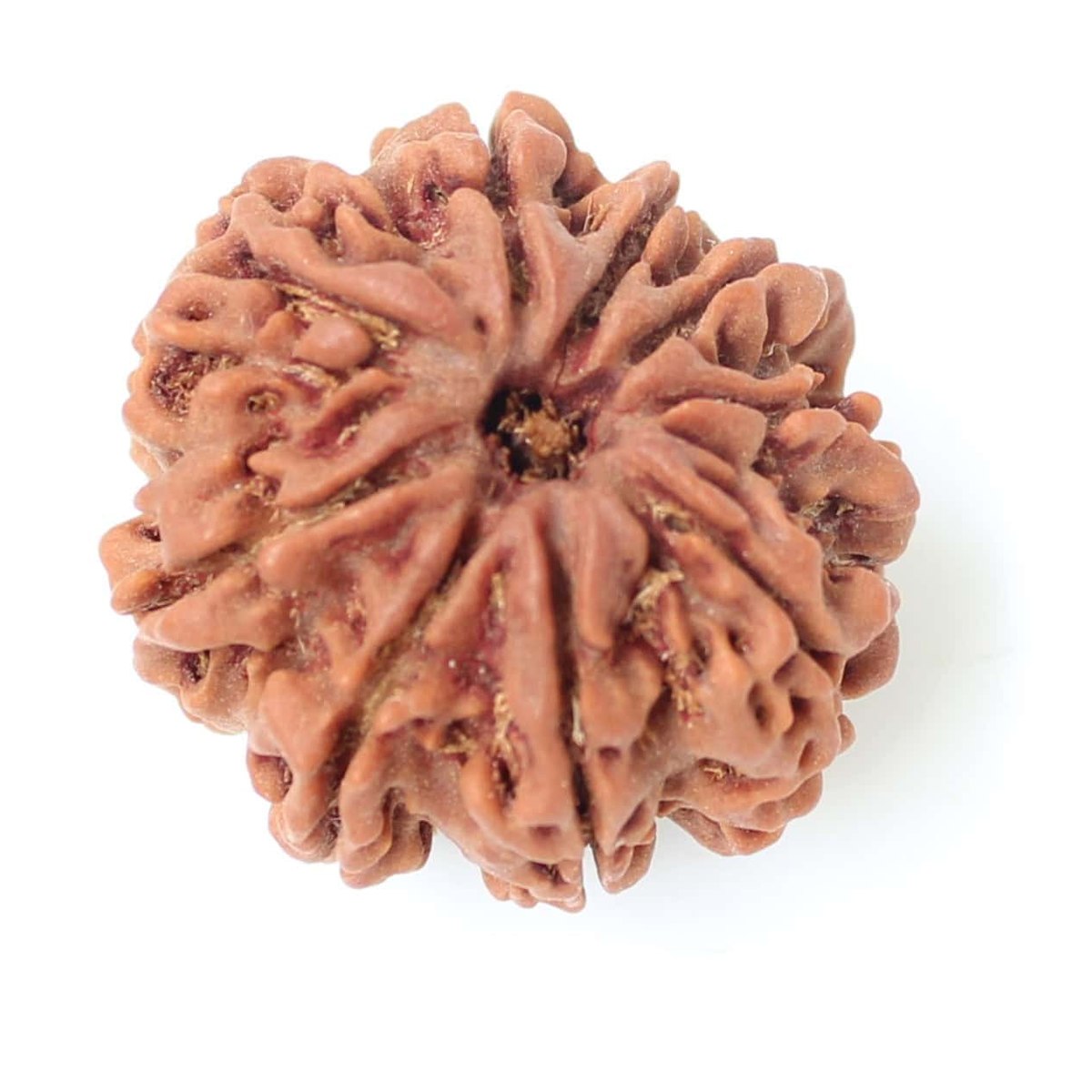
Nine nights, nine forms of Durga and a nine-mukhi bead make an appealing association during Navratri. It helps to understand what each number describes. The festival, the devotional sequence and the physical classification of a bead are connected in some traditions, but they are not interchangeable.
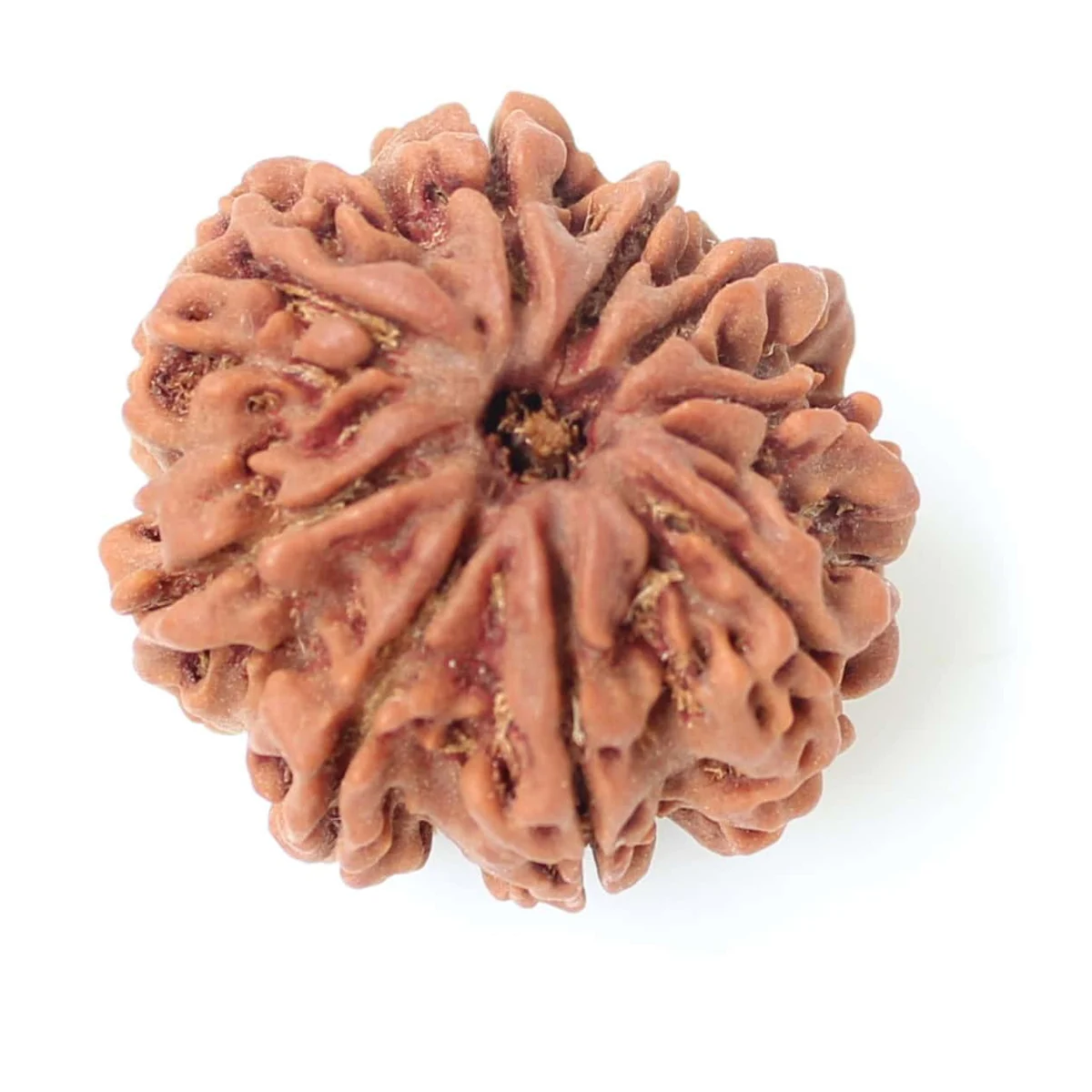
If you are considering a nine-mukhi Rudraksha for this reason, start with the meaning of the choice. Then give the actual product the same careful attention you would give any other purchase.
What the Navadurga association means here
Ommrudraksha's existing devotional guides associate nine-mukhi Rudraksha with Durga or Navadurga. A devotee may choose it as a reminder of that worship. This is the religious context in which the shop presents the bead; it is not a laboratory conclusion about what wearing it will accomplish.
The higher-mukhi guide places that association beside other mukhi traditions. When reading any such guide, distinguish a statement of belief from an item specification. The name of a deity does not establish the bead's origin, dimensions or condition.
Nor does a bead need to have nine separate faces representing nine miniature portraits. Mukhi describes the bead's natural divisions or lines in the product classification. The association with the goddess belongs to its devotional interpretation.
Do you need one to observe Navratri?
A purchase is not a condition established by this article for prayer, reading or attending a celebration. A family may already have the devotional items it uses. If you follow a teacher's particular practice, ask what that practice involves rather than allowing a shopping page to supply a new obligation.
You can also study the Navadurga forms without buying a bead. Learning to recognise forms such as Kalaratri, Mahagauri and Siddhidatri through a reliable devotional reference addresses a different question from choosing an object to wear. There is no need to turn every step in that reading into a shopping decision.
Choose between a loose bead and a wearable item
A loose bead gives you a component. It does not automatically include a cord, chain, cap or completed pendant. A wearable item adds choices about the fixing and fit. Read the selected option rather than relying on a catalogue photograph that may show several arrangements.
For a pendant, ask how the bead is held, what metal touches it, whether there is an adhesive and how the piece should be cleaned. If you intend to use an existing chain, the fitting must suit that chain. The finished pendant's height can exceed the bead measurement because the cap and loop add length.
What to ask about the exact bead
- Is the photograph of the supplied item or an example of the selected type?
- What measurements and stated origin are recorded for this option?
- What document accompanies it, and how is that document connected to the item?
- Has the surface, hole or fitting been altered or repaired?
- What are the applicable delivery and return arrangements before custom work begins?
The nine-mukhi product page is a place to begin that enquiry. Confirm the current selected option and the document supplied for it. Do not transfer a size or report shown for another specimen to the one in your order.
A meaningful choice still needs a budget
Set a comfortable amount for the complete item, including any fitting or chain. There is no spiritual ranking demonstrated here in which a higher price guarantees a better Navratri observance. A particular bead may appeal to you because of its appearance, association or the way it fits your existing practice.
If a seller's explanation becomes a promise about health, protection from every danger or a guaranteed change in fortune, ask what kind of claim is being made. A bead identification document cannot certify those outcomes.
After the festival
A devotional item need not become a disposable seasonal accessory. If you plan to keep wearing it, choose the construction and care accordingly. The post-Navratri care article offers an inspection routine for strands; the same attention to thread, fittings and moisture is useful when discussing a pendant's own instructions.
Nine-Mukhi Rudraksha and Navratri: a complete devotional and buying guide
A nine-mukhi Rudraksha (nava-mukhi or nau-mukhi) is valued in many modern Rudraksha traditions for its association with Maa Durga and the nine forms of the Divine Mother. During Navratri, this creates a natural link between the nine-night observance and a bead distinguished by nine natural facial divisions. That link can give an individual bead personal meaning; it does not make a special bead a required ingredient of Navratri puja. This guide explains both sides thoroughly: the religious tradition a devotee wishes to honour, and the precise characteristics of an object a buyer should verify.
There are three different meanings of nine here. Navratri comprises nine nights of worship, although particular regional calendars and observances may handle tithis differently. Navadurga names nine forms of Devi in a familiar sequence. Nine-mukhi is a classification of a particular Rudraksha's physical divisions. These meanings can inform one another symbolically without becoming identical technical definitions. No reliable identification of a gemstone, seed or religious object follows from the numerical symbolism alone.
A thoughtful decision starts with the proposed use. A devotee may want a loose bead near the puja space, one bead set in a pendant to wear, a bead incorporated into an existing mala, or simply better understanding before purchasing. Those are four different practical requirements. The right recommendation should be based on the actual objective and on the specific piece shown, not on a universal claim that every worshipper needs the same purchase.
At a glance: what this article answers
| Question | Practical answer | What needs confirmation |
|---|---|---|
| Why is nine-mukhi associated with Navratri? | Many devotional and Rudraksha traditions link it with Durga or Navadurga | The tradition, interpretation and mantra followed by the household or teacher |
| Does the bead depict nine goddesses? | No: mukhi refers to natural facial divisions on a botanical bead | The number and continuity of grooves on the exact specimen |
| Is a purchase compulsory for Navratri? | No; prayer, reading and community worship do not depend on owning this item | Whether a personal or lineage-based observance specifies particular materials |
| Can it be worn after Navratri? | Yes, subject to suitable construction and individual observance | Strength of the mounting, comfort and care instructions |
| Does a product photograph verify my bead? | Only if it is identified as the photograph of the exact item supplied | Specimen ID, size, weight, finish and any accompanying report |
| What is more important than a promotional promise? | Authentic material, documented specifications, workable fit and transparent cost | Seller's exact-item details, policies and documentation |
The nine forms of Durga: scriptural sequence and meaning
The well-known Navadurga enumeration appears in the Devi Kavacha, traditionally recited with the Durga Saptashati or Devi Mahatmya. It names Shailaputri, Brahmacharini, Chandraghanta, Kushmanda, Skandamata, Katyayani, Kalaratri, Mahagauri and Siddhidatri, in that order. These names provide an anchor for understanding the nine-day symbolism. Local calendars, household customs and temple practices give them different emphases. The list does not establish a one-to-one map from each natural groove of a Rudraksha to a physically depicted goddess.
| Navadurga order | Name | Traditional association or image | Reflection for the devotee |
|---|---|---|---|
| 1 | Maa Shailaputri | Daughter of the mountain; an image of rooted devotion | Begin with steadiness and a clear intention |
| 2 | Maa Brahmacharini | Penance, discipline and devoted practice | Value patience more than display |
| 3 | Maa Chandraghanta | Protective, courageous presence; bell-like lunar emblem | Meet ordinary challenges with composure |
| 4 | Maa Kushmanda | Creative cosmic energy and auspicious beginnings | Bring warmth and attention into service |
| 5 | Maa Skandamata | Mother of Skanda; maternal care and responsibility | Act with compassion toward dependants |
| 6 | Maa Katyayani | Warrior form of the Goddess | Join courage with ethical action |
| 7 | Maa Kalaratri | Fierce form traditionally associated with removing darkness | Examine fear without exaggerating it |
| 8 | Maa Mahagauri | Luminous, serene aspect of Devi | Make room for simplicity and renewal |
| 9 | Maa Siddhidatri | Bestower of spiritual accomplishments in the traditional account | Conclude with gratitude rather than demands |
The table is a reader's orientation, not a substitute for the specific mantras, dhyana verses or offerings of a family tradition. The same deity's name may be transliterated differently, and the form's stories and iconography are discussed in several devotional lineages. Some families celebrate Durga Puja with a principal emphasis on the Mahishasuramardini narrative; others explicitly worship the Navadurga form of each night; still others use the nine days for recitation of the Saptashati, Lalita traditions, or customary domestic rituals. A single shop article should not imply that these observances are identical.
What the name nine-mukhi means, and what it does not
Rudraksha is the hard endocarp of a fruit produced by trees in the Elaeocarpus group, especially the species commonly identified in commerce as Elaeocarpus ganitrus. It is not a mineral crystal. A mukhi is one of the visible natural divisions of the hard seed surface. Sellers generally describe lines running along the outer bead between its polar regions. A nine-mukhi bead is a specimen sold as having nine such divisions; these are not nine separate stones glued together, nor are they nine beads in a strand.
The exact shape varies. A natural bead may be roundish, ovoid, elongated, slightly asymmetric or irregular. Natural texture includes ridges, pits, high and low areas and differences in colour. An attractive glossy photograph cannot establish whether those features are undisturbed, whether a groove has been cut, or whether a hole has been modified. Physical appearance may suggest questions; a competent examination of the actual bead resolves identification questions more reliably than a social-media image.
Not every carved line is a mukhi, and not every shallow crease should be ignored. An examination should trace each plausible major division continuously around the seed's surface, with attention to where it emerges at each end. The buyer should ask what method was used to count the faces and whether the report corresponds to the very same specimen. A high-mukhi label is a reason for careful checking, not a reason to abandon it.
The devotional association: Durga, Shakti and variations among traditions
Nine-mukhi Rudraksha is commonly connected with Maa Durga, Navadurga or the power of Shakti in contemporary Rudraksha teaching. Some catalogues also mention Bhairava or Ketu associations. These correspond to different religious or astrological explanatory systems; they should not all be presented as one universally accepted scriptural command. A teacher may employ a particular deity name, bija mantra or graha framework, while another may simply dedicate japa to Durga using a familiar prayer. Identify the system being followed before choosing its associated practice.
For a Devi devotee, the important devotional message is not that the seed performs nine separate actions by itself. Rather, it can serve as a personal reminder of the Goddess during recitation, meditation, travel or ordinary life. Its presence may help somebody maintain a chosen daily practice because it is a concrete symbol associated with that intention. That is meaningfully different from guaranteeing immunity from danger, a medical cure, success in legal matters or inevitable changes in a horoscope.
The same care applies to the word siddhi. In Sanskrit devotional literature it can describe attainment or spiritual accomplishment in different contexts. The ninth Navadurga form is Siddhidatri; that fact does not turn every nine-mukhi commercial bead into a certified device for attaining supernatural results. Respecting the tradition means describing its terms accurately, not equating a sacred name with a product specification.
Is nine-mukhi required for the nine nights?
No universal Navratri requirement says a household must purchase a nine-mukhi Rudraksha. An established altar, a picture or murti of Devi, a clean lamp, flowers, a selected stotra and regular attention may be all that a family has planned. The purpose of the vrata, the person's situation and the family's inherited custom govern what they actually do. If a guru has advised a particular object or initiation, the devotee should follow that guidance rather than substitute a generic retail description.
Conversely, somebody may decide to buy a nine-mukhi bead specifically for an ongoing devotional practice. That is a legitimate personal choice. Purchase remains optional; it is not evidence of greater spiritual merit or seriousness. A carefully chosen Panchamukhi mala used consistently for japa and a single higher-mukhi bead chosen as a devotional symbol are separate types of objects that can coexist.
Choosing a loose bead, a pendant or a mala component
The word Rudraksha on a listing does not tell the buyer what comes in the package. A loose seed is a component; the same seed fitted with a cap and loop becomes a pendant; beads arranged in a strand create a mala or neckpiece. Their costs and physical requirements differ considerably.
| Format | Main use | Check before ordering | Common oversight |
|---|---|---|---|
| Loose nine-mukhi bead | Personal collection, puja placement or later custom fitting | Exact bead photograph, hole status, surface condition, size and any report | Assuming a chain or cap is included |
| Threaded single-bead pendant | Simple daily wear, lightweight devotional reminder | Cord thickness, stopper knots, cord material and adjustable length | Treating bead diameter as total pendant height |
| Metal-capped pendant | Structured wearable jewellery | Cap coverage, fastening method, metal description, bail opening, finish and weight | Failing to test the intended chain through the bail |
| Bracelet element | Daily wear in a wrist arrangement | Number of other beads, elastic or cord construction, stretch, wrist clearance | Believing the bead will fit any standard bracelet |
| Mala or necklace component | Japa or a combination of devotional beads | Total bead count, guru bead, knot spacing, length, pendant placement and repairability | Confusing decorative bead count with counting beads |
If the item is for regular japa, one lone nine-mukhi bead is not a substitute for a 108-bead counting mala. The person can use a suitable japa mala while retaining a separate symbolic bead, or employ a counting method appropriate to their practice. A jewellery neckpiece with mixed-size beads may be beautiful but could be uncomfortable as a rapid counting strand. The appropriate design follows the task.
Exact finished size: bead, cap and bail
Ask for at least three dimensions: bead width, bead height and the complete pendant height including any cap and bail. A bead measuring 18 mm in one direction will not necessarily produce an 18 mm-long pendant. A cap may add thickness, and a loop may add several millimetres to the overall drop. The seller should distinguish an estimate from a measured specification of the actual item. If a chain is included, request its finished length and closing mechanism as separate details.
A simple fitting example illustrates the issue. Suppose an illustrative bead is 19 mm high, the cap visibly adds 3 mm beyond the bead and the loop adds 6 mm beyond the cap. The resulting drop could be about 28 mm, depending on overlap, while the bead remains 19 mm. These numbers are an example only; they are not measurements of an OmmRudraksha product. Likewise, a bail opening of 3 mm does not guarantee passage of a chain with a bulky end ring. The largest point of the clasp and end fitting must fit.
For a metal-mounted item, request the actual metal and hallmark or assay details when applicable. “Gold-coloured,” “silver finish” and “925 silver” are not interchangeable statements. A hallmark describes the precious metal standard; it does not identify the botanical bead or establish a spiritual effect. If adhesive is used in the mounting, ask whether the seller discloses that and whether future servicing is possible.
How to examine a nine-mukhi bead before buying
A careful inspection does not require damaging the bead. Begin by reviewing clear photographs of both ends, several side angles, the complete circumference and the actual drill hole if one exists. A short, well-lit rotation video may answer questions that a single photograph cannot. If the listing uses a catalogue example rather than the exact item, explicitly request exact-item images for a valuable specimen.
Look for nine coherent primary divisions rather than nine marks selected opportunistically from surface texture. Note unusual tool-like cuts, heavy coatings, patched surfaces, a drilled opening placed across a significant groove, or a bead whose end shape makes a groove hard to trace. Any one of these features is a prompt for careful examination, not automatic proof of wrongdoing. Variability is natural and restoration or jewellery work may be disclosed legitimately. The question is whether the specific specimen is accurately described.
| Evidence supplied | What it can help establish | What it cannot establish by itself |
|---|---|---|
| Side and pole photographs | Visible groove pattern, colour, shape, condition | Internal structure or all hidden alterations |
| Exact-item rotation video | Continuity of lines around the bead | Independent laboratory identification |
| Dimensions and weight | Whether the bead matches the listed size and jewellery design | Deity association, origin or authenticity alone |
| Identification report with specimen ID | Findings stated by the examining laboratory for the referenced item | Outcomes of prayer, cure claims or future success |
| X-ray or other examination when appropriate | Details of internal compartments or construction, within method limits | A complete guarantee beyond the test and its interpretation |
| Seller's written treatment disclosure | Whether drilling, caps, coatings, repairs or similar work is declared | Undeclared features not checked independently |
| Return and customization terms | The commercial decision and post-purchase options | Any physical property of the seed |
A report has to match the specimen. Check the report issuer, identification or certificate number, dimensions, photograph and any available issuer verification service. If the report describes a different bead or a broad sample category, do not quietly treat it as a specimen-specific certification. Laboratory methods and competence vary, and the interpretation should remain within what the document actually says. Do not remove a mounted bead or subject it to hot needles, boiling water or chemicals to conduct an improvised authenticity test.
Indian, Nepalese, Indonesian and other origin descriptions
Trade descriptions often refer to Nepal or Indonesia and sometimes to other producing areas. Geographic provenance is a distinct question from a mukhi count. Country of dispatch does not necessarily equal country of harvest. A bead sold from an Indian workshop may have been sourced elsewhere; the reverse can also occur. Request reliable documentation if geographic origin is important to your selection and avoid deducing it only from bead diameter, darkness or a country-themed listing title.
There is no reason to assume all natural beads from one region have identical shape or that all small beads are of one origin. Botanical material varies by specimen and production conditions. Price comparisons become meaningful only when size, face count, condition, documentation and mounting are described on comparable terms.
A simple nine-night worship routine with or without a nine-mukhi bead
A home Navratri routine can be meaningful without becoming difficult to maintain. Clean the prayer space, place the customary image or murti of Devi, prepare an appropriate lamp safely, offer flowers or another customary item when available, recite a familiar prayer and close with gratitude. Families may also keep a kalasha, read from Devi Mahatmya, perform Durga Saptashati patha, observe fasting practices, or visit temples. Such practices differ by region and household. This article does not prescribe a new mandatory ritual for everyone.
If the nine-mukhi bead is part of your worship, place it on a clean, stable surface before the prayer or wear it in a secure mounting according to your tradition. Avoid immersing a finished pendant in liquids because metal parts, dyes, cords and adhesives may be affected even if the hard bead itself appears sound. Never put a bead or its string close to a burning diya, hot incense tip or open flame. After worship, return the item to its protective case or resume wearing it after any applicable family observance.
The commonly recited simple Durga invocation ॐ दुं दुर्गायै नमः (oṃ duṃ durgāyai namaḥ) appears in devotional usage, although mantras and pronunciation can vary by lineage. Other households recite the Durga Gayatri, Ya Devi Sarvabhuteshu verses, Sarva Mangala Mangalye, the Navadurga names or prayers taught by elders. A devotee should follow their established mantra practice, especially where a specific bija, initiation or formal ritual has been prescribed. The physical bead is not a substitute for correct intention, understanding and consistency.
Nine-night reflection plan
| Night | Devotional focus | Short reflection or action | Bead-related consideration |
|---|---|---|---|
| 1 | Shailaputri | Set a modest, sustainable intention | Photograph or inspect the exact bead only if purchase is planned |
| 2 | Brahmacharini | Practise a little daily discipline | Choose a comfortable repetition count |
| 3 | Chandraghanta | Invite courage and calm | Check that a pendant does not snag on clothing |
| 4 | Kushmanda | Offer gratitude for nourishment and work | Keep the puja area clean and dry |
| 5 | Skandamata | Extend care to family and community | Review whether the cord or clasp needs attention |
| 6 | Katyayani | Apply good judgement to a pending decision | Compare documented options without pressure |
| 7 | Kalaratri | Acknowledge fear and return to prayer | Avoid dramatic promises in sales language |
| 8 | Mahagauri | Simplify surroundings and commitments | Wipe a fitting gently if suitable for its material |
| 9 | Siddhidatri | Complete the observance with thanksgiving | Decide how the item will be stored or worn afterwards |
This is an optional reflection schedule, not a scriptural requirement. For festivals determined by lunar tithi, follow a reputable local panchanga for the appropriate start, end and day-specific observances; dates can differ by location and religious convention. The nine named forms are a useful organising framework, but they do not prove that a particular daily colour, bead cap or purchase date is universally mandated.
Japa counting: one symbolic bead versus a full counting mala
Japa means repeated recitation or remembrance of a mantra or name. A traditional counting mala commonly has 108 counting beads, with a guru or meru bead distinguished from the counted beads. Smaller strands may have 54 or 27 counting beads. In traditions that turn at the meru, the practitioner reverses direction rather than crossing it. Ask a teacher when your family's japa method differs. A single nine-mukhi seed can be a focus of remembrance, but it cannot alone provide the sequence of 108 individual markers that a standard mala offers.
The mathematics is straightforward: one 108-count pass gives 108 recitations; two 54-count passes give 108; four 27-count passes also give 108. With a target of nine rounds of a 108-bead mala, the count is 972 recitations, not 1,008. When someone uses a target of 1,008, that is a different numerical goal and should not be quietly substituted for nine standard rounds. A phone-free notebook or a separate counter may be used if preferred. Comfort, clarity and an achievable practice matter more than impressive counts written on a shopping page.
For japa, choose strand length, knot size and bead diameter so each bead can be moved individually. When a high-mukhi bead is placed among other beads as a focal component, confirm whether it replaces a counting bead or is positioned separately, because that changes the practical count. If a pendant is worn while japa is done with a separate mala, the two objects serve complementary roles without introducing counting ambiguity.
Traditional Jyotisha and the Ketu association
Some modern Rudraksha reference lists associate nine-mukhi with Ketu; others emphasise the Goddess or Bhairava instead. These lists belong to differing interpretive lineages. In Jyotisha, Ketu is treated as one of the lunar nodes, but a general product label does not amount to a personalized birth-chart recommendation. An individual astrological consultation considers the birth details, chart, dasha and wider interpretive context according to the practitioner's school. That assessment cannot be replaced by matching a face count to a single graha name in a generic table.
A devotional choice also need not be an astrological prescription. Someone may honour Durga during Navratri and select a symbolic object for that reason alone. If an astrologer makes a specific recommendation, retain the distinction between their explanation of the symbolism and the separate evidence of the bead's physical identity. There is no requirement here to combine gemstone remedies, yantras, Vastu objects or additional products simply because nine-mukhi Rudraksha was discussed.
Construction, durability and everyday wear
Natural Rudraksha has an uneven hard surface. A drilling hole, if present, should be examined for cracks or excessive enlargement. Where a bead sits inside a metal cage or cap, the mount should hold it without compressing vulnerable ridges. Thread or elastic should not cut into a sharp edge of the hole; a suitable spacer or professionally finished fitting may be useful. For pendants, check how the bail is joined and whether the item has sharp solder points or an exposed adhesive seam.
Wear decisions depend on more than symbolic association. A heavy pendant may pull on a thin chain, a long pendant may strike a desk during work, and a bead carried under clothing may experience friction, sweat and contact with perfume or lotions. Someone who handles water, chemicals or machinery regularly may choose to remove jewellery before those activities, storing it safely rather than allowing the bead or chain to catch. This is a practical fitting decision, not a test of devotion.
If a seller describes a metal as silver, gold or a plated alloy, the material description and any applicable metal-purity mark should be supplied for the actual piece. Bead identification and metal-purity identification are separate processes. A jewellery workshop can often replace a cord or assess a loose bail, but it should inspect an expensive bead before applying force, heat, solvents or repair techniques near the seed.
Handling and storage after Navratri
Keep the bead away from radiators, prolonged direct sunlight, steamy bathrooms and standing water. Do not assume that repeated soaking, boiling, oil immersion, detergent scrubbing or strong chemical cleaning is appropriate for a mounted specimen. For a lightly dusty loose bead, careful dry brushing with a soft clean brush may be reasonable; use the seller's precise instructions for the actual surface treatment and construction. An ordinary loose bead and a glued, capped, coloured or corded pendant can require different care.
After sweat or accidental moisture exposure, remove the item from direct skin contact, blot the accessible parts gently and allow suitable air-drying away from heat. Check whether the cord, tassel or metal fitting remains damp. Store dry in a breathable protective pouch or compartment that does not crush the grooves, preferably separate from harder jewellery that can scratch or strike it. Inspect periodically for fibre wear, loosening end caps, cracks, corrosion and changes at the drilled hole. Ask a jeweller to repair a failing connection before it breaks during travel.
Avoid imposing a universal oiling schedule. Sellers and traditions give different guidance, and oil may darken or stain a bead, attract residue or affect thread, plated surfaces and adhesives. If oiling is contemplated, first determine whether it is compatible with that particular finished item. Likewise, never interpret a change of colour after wearing as a precise reading of a person's fortune or health. Physical handling, moisture, surface residues and finishing methods can all affect appearance.
Pricing, documentation and a complete buying comparison
An informed quotation separates the base bead price from jewellery work and other charges. Ask whether the photograph is specimen-specific, whether a report is included, which metal and cord are supplied, how customization is priced, whether shipping or taxes are included, and what happens if the finished size differs from the order. A claim that an item is rare is not enough by itself to establish the value of a particular piece; dimensions, condition and identification evidence are relevant.
| Buying line item | Questions to settle | Written record to keep |
|---|---|---|
| Nine-mukhi bead | Exact specimen? Face count? Size? Weight? Hole and surface condition? | Invoice line, images and specimen reference |
| Verification | Who examined it, and what exactly was tested? | Laboratory or seller report with matching ID where supplied |
| Cap and bail | Actual metal, construction and finished drop? | Metal description, weight where relevant and design sketch |
| Cord or chain | Is it included, and will the clasp clear the bail? | Length, gauge, clasp specification and price |
| Tax and delivery | Are duties, GST and shipping already included? | Complete payable amount and delivery terms |
| Customization | Can work be revised or returned once started? | Approved size and customization policy |
| Aftercare | How should the bead and fitting be cleaned or serviced? | Product-specific care instructions and repair contact |
When comparing two offerings, align the specifications before declaring one a better value. A bare, unmounted bead with a report and a finished precious-metal pendant without a detailed specimen report cannot be evaluated only by their headline price. Prefer clear disclosures over urgency, countdowns, guaranteed outcomes or claims that a Navratri ritual will fail without an expensive object.
A simple decision process works well: first identify the devotional or practical purpose; second decide whether any purchase is needed; third select the physical format; fourth ask for exact-item evidence and complete cost; fifth confirm care and return terms; finally make the decision without pressure. If a seller cannot explain which bead or metal is being supplied, defer the order until the specification is clear.
Mistakes to avoid with nine-mukhi Rudraksha
One common mistake is treating nine natural grooves as nine miniature pictures of Durga. Another is assuming that because Navratri spans nine nights, every devotee must wear nine-mukhi Rudraksha. A third is mistaking a decorative design, bead colour or merchant's country address for proof of origin. Another is counting a guru bead as one of the japa counting beads without checking the strand's construction. Some buyers confuse the diameter of a seed with the finished size of a pendant, while others accept a report that belongs to a different specimen.
The converse mistake is dismissing the devotional meaning simply because it cannot be measured by a laboratory. A laboratory examines physical material; a sacred association is described and practised within a religious tradition. Both discussions can be accurate in their own domains. Good guidance identifies which question it is answering, making the devotee's choice clearer rather than trying to force the two into one kind of proof.
Frequently asked questions about nine-mukhi Rudraksha and Navratri
1. What is a nine-mukhi Rudraksha?
It is a Rudraksha bead classified as having nine natural facial divisions, commonly called mukhis. The name describes the individual seed's surface structure. In devotional catalogues, nine-mukhi is often associated with Maa Durga or Navadurga. Always confirm the count and condition of the particular bead offered, especially when a listing uses a representative photograph. The name alone says nothing definite about its size, geographic origin or finished jewellery construction.
2. Why do people connect nine-mukhi with Navratri?
Navratri honours the Divine Mother over nine nights and the Navadurga tradition names nine forms. Nine-mukhi Rudraksha also uses the number nine in its classification, and some traditions symbolically associate the bead with Durga's power. The connection is devotional, not a scientific finding that each groove depicts a goddess. People may honour the association through prayer or an object they choose to wear; neither requires a compulsory purchase.
3. Which goddess is associated with nine-mukhi Rudraksha?
Maa Durga and Navadurga are the prominent associations in many contemporary guides. Some lineages mention other divine or planetary associations, including Bhairava or Ketu. These interpretations should be attributed to their respective traditions rather than presented as if every textual school gives exactly the same instruction. A devotee following a specific teacher's practice can ask which deity, mantra and ritual form that teacher recommends.
4. Does every devotee need a nine-mukhi bead during Navratri?
No. A traditional household may observe Navratri with a deity image, lamp, customary offerings, readings, prayers, temple visits or charitable service, without any nine-mukhi item. The bead is an optional personal devotional object unless a particular initiated practice prescribes otherwise. A purchase decision should follow the person's existing observance and budget; it should not be driven by claims that the festival is incomplete without a new accessory.
5. Is nine-mukhi only for the ninth day of Navratri?
Not necessarily. The ninth Navadurga form is Siddhidatri, but nine-mukhi's general association is often with Durga or the Navadurga sequence as a whole. A nine-mukhi bead is not automatically restricted to Navami, nor is every bead presented as Siddhidatri-specific. Follow the calendar and worship method of your household for day-specific rituals. Do not infer a mandatory wearing date from the face count alone.
6. Can the bead be worn all year?
Many owners keep a well-made Rudraksha pendant or bead beyond a festival because its meaning is not confined to nine evenings. Whether to wear it continuously is a matter of personal custom, comfort and safe construction. Remove jewellery for activities in which it might catch, be crushed, overheat or encounter harsh chemicals. Inspect the cord, mounting and bead periodically rather than assuming a one-time festival purchase never needs maintenance.
7. Is one loose nine-mukhi bead equivalent to a 108-bead japa mala?
No. A loose bead can be a focus for remembrance or a component of a pendant, but it does not contain 108 separate counting markers. A standard japa mala usually provides 108 counting beads plus a distinguished guru or meru bead where that tradition uses one. If you wish to count recitations, choose a suitable counting strand or another reliable method and keep the single devotional bead as a separate item.
8. How should I count nine natural mukhi lines?
Photograph both poles and rotate the bead in even light. Trace each principal division along the outer surface, noticing where it begins and ends. Minor wrinkles, scratches and drilling marks should not be added merely to reach nine. On a valuable or hard-to-read specimen, ask for a competent in-person examination or a report using an appropriate method. The buyer should not carve, cut or sand the seed to make the count more visible.
9. Does a dark or large bead prove it is genuine?
No. Rudraksha colour, size, finish and surface relief vary naturally and can also change through handling or treatment. A large bead is not automatically of a particular origin, and a darker bead is not automatically older or more powerful. Evaluate groove structure, the actual item, its construction, and credible records together. Claims of guaranteed authenticity based solely on colour or diameter are insufficient.
10. Can a genuine nine-mukhi bead have an irregular shape?
Yes. Botanical material need not be perfectly spherical. A natural bead may be uneven, oval, flattened at an end or asymmetrical, with ridges and variable depths. Shape alone does not invalidate it. However, strong irregularities can make face counting difficult; a detailed examination may be appropriate. A well-described irregular specimen can be preferable to a suspiciously uniform product whose origin and alterations are not disclosed.
11. Should I buy an unmounted bead or a pendant?
Choose according to use. A loose bead gives flexibility for later puja placement or customized fitting, but it may require additional work before wearing. A finished pendant offers immediate usability if its metal, cord or chain, bail and measurements are suitable. Ask for the total price and exact contents. Do not assume the catalogue image of a capped bead means every listed option includes a cap or chain.
12. What does a report establish for a nine-mukhi bead?
A report can record the tests, observations and identification conclusions reached by its issuer for an identified specimen. Its value depends on the laboratory, methods and connection between the document and the actual bead. It cannot establish a particular future event, a person's spiritual merit or guaranteed protection. Compare the certificate number, photo, dimensions and seller's exact-item record before treating it as relevant to your purchase.
13. Are X-rays required for every purchase?
Not necessarily. Imaging can be useful in difficult identification questions, including internal structure or possible construction features, but method selection depends on the specimen and the question being asked. A low-cost everyday item may be handled differently from an unusually expensive or disputed specimen. Do not assume that one photographic image or one X-ray automatically answers every authenticity or provenance issue. Request the actual report findings rather than simply a testing label.
14. Can I identify Nepalese or Indonesian origin by size?
Not reliably. Country descriptions in commerce can refer to production, supply, sorting or dispatch, which are not the same thing. Natural bead sizes overlap and individual appearance varies. If provenance matters, seek explicit supporting records from the supplier. A merchant's location, a broad regional reputation or the colour of the bead is not conclusive proof of where that particular seed grew.
15. What if my bead has a drilled hole?
Drilling is common for jewellery and malas, so a hole does not by itself mean the seed is unnatural. Ask whether the hole was added or modified, inspect its edges for cracks and assess whether the cord or fitting places stress on it. A well-constructed pendant should not pull against a fractured edge. A bead with a heavily enlarged or repaired hole should be disclosed and priced with its condition in mind.
16. Can the nine-mukhi bead be combined with Panchamukhi Rudraksha?
Some people combine different Rudraksha beads in a personal piece or use a separate Panchamukhi japa mala while wearing one symbolic nine-mukhi bead. Such arrangements depend on tradition and practical design. If you intend to count japa with a mixed strand, confirm the number of counting beads and any focal or guru bead separately. A design choice should not be presented as a universally mandated nine-bead formula.
17. Which mantra should I chant with this bead?
For general Durga devotion, many households use a simple invocation such as ॐ दुं दुर्गायै नमः. Other lineages use their own Durga mantras, stotras or initiated practice. If you have received a mantra from a teacher, that instruction takes precedence. The bead's face count alone does not determine one exclusive mantra for all practitioners, and complex bija-mantra practices should not be improvised from a retail page.
18. How many repetitions should a beginner do?
A short daily routine that you can keep consistently is often more useful than announcing a demanding target you cannot sustain. If a 108-count mala suits your practice, one pass gives 108 recitations; two passes on a 54-count strand or four on a 27-count strand also give 108. Consult your established tradition for any specific sankalpa or prescribed count. Do not count the guru or meru bead as a regular marker when your tradition excludes it.
19. Does nine-mukhi always represent Ketu in Jyotisha?
No universal rule should be inferred from that statement. Ketu appears in some modern Rudraksha correspondence systems, while many devotional explanations centre on Durga or Shakti. A natal-chart recommendation is individual and considers far more than a single product association. The seller should distinguish a general cultural tradition from a personalized astrological reading rather than treating either as a material identification test.
20. Is a nine-mukhi bead more spiritual because it costs more?
There is no sound basis for judging the quality of someone's Navratri worship by the price paid. Commercial value can reflect rarity claims, measured size, condition, testing, craftsmanship and demand, but high cost does not guarantee a stronger prayer. A sensible choice aligns the devotee's intention, the exact item's documented quality and a comfortable budget. Complete observance without buying anything new is also a valid choice.
21. How do I check a pendant's total length?
Ask the seller for bead height and width separately from the fully assembled pendant drop. A cap and loop extend beyond the hard seed, and a decorative cage may increase thickness. Request a ruler photograph or a written drawing of the final design. If you already have a chain, verify the bail's usable opening against the largest end fitting or clasp, not only against the chain's nominal thickness.
22. Is 925 silver the same as a silver-coloured fitting?
No. “925” refers to a silver-alloy fineness description, whereas silver-coloured or silver-finished language may describe plating or appearance only. Ask what the actual metal is and what evidence supports the claim, including applicable hallmarks or bills. The metal's identification is separate from the Rudraksha's identity. A high-quality bead mounted in poorly described metal still leaves important buying questions unanswered.
23. Can I wear it under winter clothing?
Yes, if comfortable and consistent with the person's practice, but thick fabric, zippers, scarves and collar seams can pull on cords or loosen caps. A shorter pendant may sit more securely than a long swinging one. Check for snagging when putting on a jacket and inspect the connecting loop periodically. Avoid placing the item against a direct heat source or storing it damp inside clothing.
24. Can I bathe, swim or exercise wearing it?
Activities exposing the bead to persistent water, soap, chlorine, heavy sweat, pulling or impact can affect thread and fittings. For many finished pieces, removal before swimming, chemical cleaning, contact sport or machine work is a practical precaution. Follow the actual maker's instructions because a plain threaded bead, a glued cap and a precious-metal mounted pendant have different vulnerabilities. Dry exposed components safely if accidental moisture occurs.
25. Should I soak or oil a nine-mukhi Rudraksha?
Do not assume that oil immersion or repeated soaking is required. Practices vary, and a treatment suitable for a particular loose bead may stain a thread, loosen adhesive, affect a plated cap or change appearance. Start with the maker's care instructions and a gentle approach. Avoid boiling, solvents, strong detergent and aggressive brushing. If there is a significant crack or failed fitting, seek professional inspection rather than an improvised home treatment.
26. How should a loose bead be stored?
Store it dry, away from direct heat and prolonged sunlight, in a clean small compartment or soft pouch that protects the natural grooves from pressure and rubbing. Avoid mixing it with heavy metal jewellery, abrasive stones or damp items. A labelled package with the specimen photographs and accompanying report also helps maintain identification records. Inspect occasionally for changes in the hole, surface and any existing thread.
27. What if a cord or cap becomes loose?
Stop relying on the worn connection for daily use until it has been checked. A weakening knot, frayed cord, opening jump ring or moving cap may let the bead fall. A competent jeweller can assess whether replacement is possible without harming the seed. Keep any report and existing measurements available to match the repaired object. Do not apply strong glue or heat near the bead without understanding the construction.
28. Can I give nine-mukhi Rudraksha as a Navratri gift?
It can be a thoughtful gift for someone who appreciates the tradition, provided their preferences are understood. Some recipients may prefer a picture of Devi, a devotional book or a practical puja item instead. If gifting the bead, give accurate details of its material, mounting, size and care, and include the relevant purchase records. A gift should never be framed as a compulsory remedy or a guarantee of a particular life outcome.
29. What documents should I retain after purchase?
Keep the invoice, dated product description, exact-specimen photographs, any laboratory document, metal-purity information, customization approval, return terms and care instructions. Record the seller's product reference and distinguish a report on the bead from paperwork about the fitting. These documents make future service, resale discussion or a question about the supplied item much easier. Keep digital backups rather than depending on a fragile paper slip alone.
30. What is the simplest way to make a considered choice?
Clarify whether the goal is worship, japa, personal collection or regular wear. Decide whether the existing items already meet that need. If buying, select a loose bead or a finished format, inspect the exact specimen, match any reports, confirm dimensions and materials, and review the total cost and care terms. Let the Navadurga symbolism enrich a genuine devotional intention while letting verifiable specifications guide the commercial decision. Both deserve proper attention.
Final guidance: preserve the meaning, verify the item
Nine-mukhi Rudraksha can be a meaningful personal symbol during Navratri because many devotional traditions associate it with Maa Durga and the nine forms of the Goddess. The Devi Kavacha gives the familiar sequence of those forms, while the number of mukhis describes the separate physical identity of a particular seed. An accurate article should be clear about both, without pretending that devotional association is a laboratory measurement or that a product document can predict spiritual outcomes.
For an actual purchase, inspect the exact bead, its nine natural divisions, dimensions, surface condition, supporting documents, mounting, size and cost. For practice, choose prayers and japa methods appropriate to your home and lineage. After the festival, care for the object if you keep it. A deliberate purchase—or a deliberate decision not to purchase—can sit comfortably within a sincere Navratri observance.