

How many rods should a wind chime have? A buyer often sees three-, five-, six-, seven-, eight- or nine-rod models, sometimes advertised with specific directions or auspicious outcomes. The number is easy to compare, but it does not establish the chime's pitch, musical tuning, volume, material or suitability for a particular house. Understanding both its physical construction and its traditional associations makes for a better choice.
This guide explores metal tubes, solid rods, bamboo sections and bells; the acoustic role of tube length, wall thickness, support and striker; and the meaning various contemporary Feng Shui and Vastu-inspired guides attach to different rod counts. We distinguish established acoustic principles from traditions that vary between schools.
1. What exactly counts as a wind chime rod?
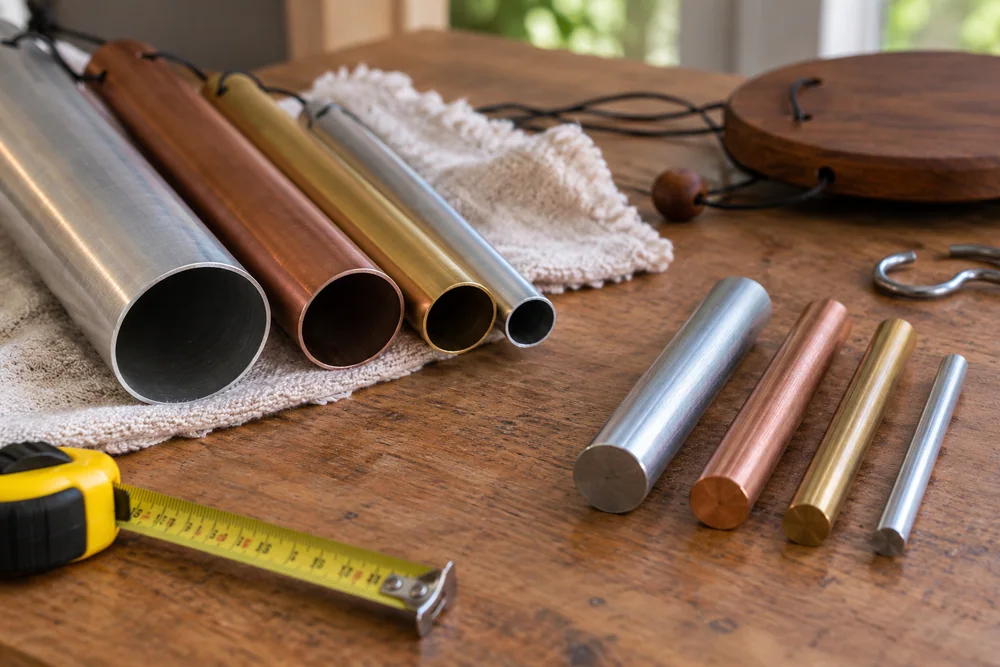
A common tubular wind chime has several sounding elements suspended around a centre. In everyday shopping, the terms rod and tube are often used interchangeably, but technically a tube is hollow and a rod is solid. Bells, flat plates, shell discs and ceramic pieces are different types of sound-producing elements. Decorative crystal beads, coloured spacers, a top cap, the striker and wind sail should not be counted as additional sounding rods.
A typical assembly includes a hanging ring, upper support, suspension cords, multiple sounding tubes or rods, a moving striker (sometimes called a clapper) and a lower windcatcher or sail. As the wind moves the sail and the central unit, the striker touches the sounding elements. Some decorative hangings lack a striker and are not functional wind chimes at all. A clearly photographed and accurately described construction matters more than an attractive numeric label.
2. Five, six, seven, eight and nine rods: what are the traditional associations?
Number symbolism is particularly prominent in Chinese Feng Shui and in modern retail advice that blends Feng Shui with Vastu terminology. One school may associate a six-tube metal chime with a northwest or west sector, while another may choose a different rod count in a specific Flying Stars interpretation. These are not guaranteed effects, and they should not be advertised as universal requirements of Sanskrit Vastu Shastra.
| Rod count | Interpretations shoppers may encounter | What the count actually tells you |
|---|---|---|
| 3 or 4 | Less consistently prescribed in popular wind-chime guidance; sometimes chosen for a small space or particular symbolic preference. | Only the number of sounding pieces. A compact arrangement may still be loud or poorly tuned. |
| 5 | Some retail guides associate five rods with five-element symbolism. In Flying Stars practice, other practitioners prefer six hollow metal tubes for the Five Yellow and explicitly reject five rods. These are differing traditional interpretations. | Five elements to be assessed for material, pitch, tuning and construction—no guaranteed balancing effect. |
| 6 | Frequently linked with metal-phase symbolism and west or northwest placement in contemporary Feng Shui-oriented guidance. | Six sounding pieces, not a certificate of a particular musical scale or household result. |
| 7 | Sometimes connected in popular descriptions with creativity, symbolism or seven-fold decorative designs. | Seven pieces; they do not automatically correspond to seven chakras or seven verified musical notes. |
| 8 | Often considered auspicious in Chinese culture, and featured in modern prosperity-oriented retail explanations. | Eight sounding pieces; any relationship to prosperity is a traditional attribution, not an established physical outcome. |
| 9 | May be used to express completeness or long-lasting good fortune in popular Chinese number symbolism. | Nine pieces; acoustic quality still depends on the actual design and tuning. |
These associations are examples of variable interpretations, not a ranked list and not a prescription. Advice regarding the five-rod “Five Yellow” differs substantially among practitioners, so do not mix such a remedy with a general six-rod recommendation without understanding the chosen school. The number is not a substitute for a building assessment, devotional practice or real product inspection.
3. Wind chimes in Vastu Shastra versus Feng Shui
Vastu Shastra traditionally concerns the organization of built spaces: orientation, access, spatial order, light, movement and proportion, discussed through concepts including the Vastu Purusha Mandala and Pancha Mahabhuta—Prithvi, Jala, Agni, Vayu and Akasha. Sound has an established cultural place in Indian ritual and philosophy, including the ghanta and nada. But a modern suspended tubular wind chime with a specified number of rods should not be attributed to classical Sanskrit Vastu texts without a direct and reliable textual basis.
Feng Shui has its own framework of qi, bagua, yin–yang and Chinese five phases (wood, fire, earth, metal and water). Modern practitioners often recommend metal chimes for west or northwest sectors, and bamboo or wood in east or southeast sectors. This is Feng Shui or blended contemporary advice; it should not be confused with the Indian elemental classification, in which “metal” is not one of the same five great elements.
If you are following a specific Vastu or Feng Shui consultation, clarify its system, compass method and location before choosing a rod count. In an ordinary home, whether the sound suits the entrance, balcony or room—and whether the installation is safe—remains essential. For broader foundational context, read Vastu Shastra: traditional principles and spatial balance.
4. What makes wind chimes sound different?
A wind chime is an assembly of vibrating parts. The sound you hear depends on the energy of a strike and on how each element vibrates. Comparing two products with the same number of rods but different dimensions can reveal very different pitch, loudness, duration and timbre. Instrument maker Bart Hopkin discusses tube geometry, suspension points and striker choices as central determinants of tubular chime sound.
Tube length
For otherwise comparable freely vibrating tubes, longer tubes generally have a lower fundamental pitch. This does not mean that two arbitrarily different products can be ranked by length alone; their diameter, wall thickness, alloy and support may also differ. More tubes do not automatically mean a deeper sound.
Diameter and wall thickness
The geometry and stiffness of a tube affect how it bends and vibrates after impact. A thicker wall or larger diameter changes the vibrational behaviour, but not in a way that should be reduced to “thicker always sounds better.” Tube length-to-diameter proportions affect whether the intended fundamental or more prominent higher modes are heard.
Material
Aluminium, brass, copper, steel and bamboo differ in density, stiffness, construction methods, corrosion behaviour and surface finish. These differences influence how a chime can be made and how it behaves, but an alloy name alone does not determine a specific musical note. A brass-coloured aluminium tube is not a solid-brass tube; the actual material and any coating should be described separately.
Suspension and striker
The point and method of suspension affect which vibration modes ring freely. Designers commonly place support near a vibration node for the desired mode; it is not necessary for a shopper to calculate the node, but it is useful to look for secure, smooth suspension holes or attachment methods that do not damp the tube or abrade the cord. The striker's material, weight, shape and contact point affect the attack, resonance and tone. A soft striker may make a different sound than a hard one, even when the tubes are unchanged.
Wind, room and listening distance
The wind sail sets the moving centre assembly in motion. Wind strength and direction govern how often and how forcefully the striker touches the tubes. The same chime may sound intermittent in a sheltered veranda and almost continuous on an exposed balcony. Nearby walls, floors, glass and other reflective surfaces can change how sound travels. A recording also depends on microphone distance, recording level and the listener's speakers.
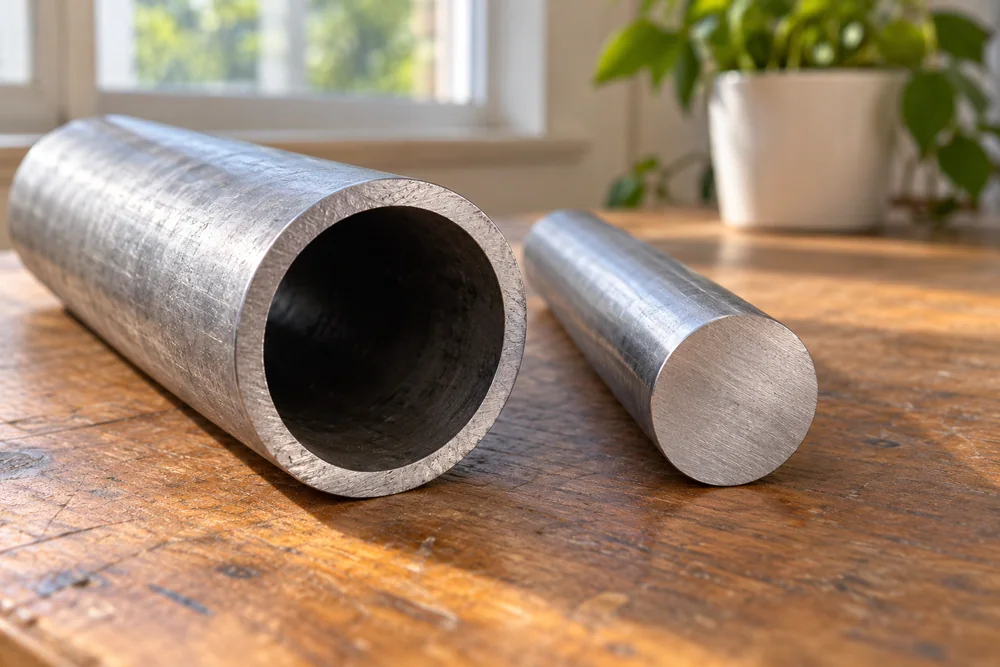
5. Hollow metal tubes versus solid metal rods
Hollow tubes and solid rods are both capable of producing musical tones, but their geometry, mass distribution and vibrational properties differ. A maker can tune either design when the material, shape and length are controlled. A hollow tube is not inherently more sacred, beneficial or suitable for every room; the choice is architectural, acoustic and aesthetic.
Some Feng Shui approaches strongly favour hollow metal tubes for particular symbolic uses. This is a school-specific traditional preference, not a universal statement about all wind chime construction or a scientific claim that solid rods fail to produce sound. A seller should clearly identify whether the product contains hollow tubes, solid rods or small bells.
| Sounding design | Typical sound and construction considerations | Buyer check |
|---|---|---|
| Hollow metal tubes | Capable of sustained ringing when suspended and struck effectively; tube geometry is critical. | Ask for length, diameter, metal, finish and tuning details. |
| Solid metal rods | Different mass and mode behaviour; may be used in compact designs. | Confirm they are solid and that the striker reaches the intended rods. |
| Bamboo or wooden sections | Often perceived as a drier or softer percussive texture, depending on design. | Check splitting, moisture protection and cord condition. |
| Bells, shell discs or ceramic pieces | Sound varies by shape, clapper or collision mechanism; may be decorative rather than tuned. | Confirm how sound is produced and whether all pieces are secure. |
6. Tuned, pentatonic and decorative chimes: are they the same?
Tuned means the sounding pieces have deliberately selected pitches or pitch relationships. A manufacturer may describe a pentatonic scale (a five-note collection), another named scale, a particular interval structure or a set of measured notes. A five-rod chime is not automatically a pentatonic chime; conversely, a musical arrangement can have more sounding elements than distinct pitch classes. Musical scale, number of pieces and traditional numeric symbolism are separate concepts.
Some products are intentionally tuned by cutting or selecting tube lengths, while others use assorted lengths without a declared scale. A decorative, untuned chime can still sound attractive. If a product advertises a note set, request a credible maker specification and representative recording. Claims such as “432 Hz healing,” “seven chakra frequencies” or “guaranteed prosperity vibration” should not be inferred merely from tube count or decorative colour.
Where a sound sample is available, compare the whole sequence rather than only one isolated strike. Ask whether the recording reflects the supplied design and remember that outdoor acoustics and smartphone recordings may change perceived volume.
7. Choosing a rod count for your particular space
Begin with the location and sound you want, rather than selecting the largest available number. For an apartment balcony, choose a modest assembly with controlled movement, a sound acceptable to neighbours and a strong fixing. For a spacious sheltered garden or veranda, a larger tuned set might be practical if its full drop and swing area are clear. For an entrance that requires quiet, a fabric toran, gemstone hanging or other silent ornament may be more appropriate.
Measure from the upper ring to the lowest point of the wind sail—**not only the longest tube**. Check the overall width, total mass, included hardware, swinging clearance and intended exposure. Observe the wind at different times of day, including when the household is sleeping or studying. A structure that allows a tube to strike a door, window or wall repeatedly is not a suitable installation.
Browse OmmRudraksha's Metal Wind Chimes collection and compare the Aluminium Tube Wind Chime and Brass Tube Wind Chime as separate design families. The exported records do not establish a verified rod count, scale, size or alloy for those specific stock units; confirm specifications with the seller rather than inferring them from their titles.
8. Rod counts, directions and traditional consultation
A commonly repeated suggestion is a metal chime in the west or northwest and a bamboo or wood design in the east or southeast, particularly in Feng Shui-oriented advice. Some sources tie six metal rods to west/northwest associations or assign meanings to five or eight rods. Such statements need to be understood in the context of the practitioner or school, and they do not guarantee a financial, health or relationship outcome.
If the question concerns Vastu Dosha, a home or temple's arrangement cannot be assessed from rod count alone. Entrance position, circulation, structural safety, light, ventilation, architectural context and household customs deserve attention. We should distinguish this architectural discussion from a Jyotisha remedy: birth-chart-based planetary interpretation is not established merely by choosing seven or nine rods.
Households may value a gentle sound as a reminder of the devotional significance of nada. But do not describe a decorative wind chime as a replacement for the ghanta used in puja, mantra japa or traditional temple service.
9. Inspect the object before purchasing
- Actual count: Count tubes or rods, not beads, sails or ornaments.
- Actual material: Identify base metal, plating, varnish or surface finish; colour alone is insufficient evidence.
- Acoustic details: Ask about tube dimensions, tuning, striker, suspension and a genuine sound sample.
- Complete size: Verify hook-to-sail length, widest span, overall weight and intended fixing type.
- Condition: Inspect smooth edges, cord wear, secure knots, closed connectors and all small decorative parts.
- Placement: Allow full door clearance and consider neighbours, bedrooms, puja areas and monsoon exposure.
- Care: Follow material-specific instructions; wood, lacquer, cords, brass and aluminium may need different treatment.
- Product claims: Distinguish a traditional association from guaranteed benefits, medical claims or unverified “tuning” descriptions.
Frequently asked questions
Is a six-rod wind chime better than a five-rod wind chime?
Not inherently. Six rods appear frequently in popular metal-phase Feng Shui recommendations, while five rods receive varied and sometimes contested symbolic interpretations. Neither count is automatically acoustically superior or appropriate for every home.
Do seven rods represent seven chakras?
Not automatically. Seven chakra colours and symbolism are separate from musical tuning and the number of sound-producing elements. A seven-rod product needs actual material and pitch information if such claims are made.
Why do two wind chimes with five tubes sound different?
Differences in tube length, diameter, wall thickness, material, striker, suspension and wind exposure can change pitch, sustain and tonal character even when the count matches.
Is an eight-rod wind chime guaranteed to attract wealth?
No. Eight may be considered auspicious in some Chinese cultural or Feng Shui interpretations, but this does not guarantee a life outcome.
Does the number of rods tell me the musical notes?
No. A named scale or tuning requires a manufacturer specification, measurement or reliable sound reference. Count alone cannot establish the notes.
Can I use a wind chime inside a bedroom?
Only if the occasional sound is comfortable for the occupants and the assembly is secure. Silence or a stationary ornament may better suit a place of rest.
Are hollow tubes always louder than solid rods?
No. Their geometry and vibration differ, but loudness depends on the complete design, strike and surroundings. Avoid claiming a universal volume ranking without comparing actual models.
How do I know whether a wind chime is really tuned?
Ask for the declared notes or scale and a sound sample of the exact product design. Statements such as “tuned” or “healing frequency” without specifics do not by themselves verify acoustic tuning.
Explore related OmmRudraksha guides and collections
Compare Metal Wind Chimes, explore Hangings & Chimes and review the Vastu Shastra overview for the wider spatial and traditional background. The broader Vastu collection provides other objects for home entrances and decorative arrangements.


