

What are the parts of a wind chime, and how do they work together? The familiar tubular wind chime has a hanging hook or loop, an upper support, several suspended sounding tubes, a central striker and a lower wind sail. When air moves the sail, it can move the striker into contact with the tubes. The tubes vibrate, creating the ringing sound. Every component matters: a lovely-looking tube arrangement will not behave as intended if its cords, striker or mounting are poorly designed.
Not all chimes have this same layout. Bamboo hangings, decorative bell clusters, shell chimes and spiral designs may work differently. This guide explains the common arrangement, distinguishes it from alternative constructions, and provides practical checks for sound, durability, placement, care and repair. It also explains why the number of rods or their colour does not establish musical tuning or a Vastu remedy.
1. Anatomy of a conventional tubular wind chime
Imagine following the hanging from the roof or beam downward. At the top, a hook, ring or loop carries the entire assembly. Beneath it, an upper support or suspension platform keeps the sounding pieces at the intended spacing. Individual cords or wires hold the tubes around the centre. A striker, sometimes called a clapper, moves among them, while a lower wind sail catches the breeze and transfers movement through the central suspension.
Manufacturers use slightly different names. Some call the upper support a top ring, canopy, suspension disk or cap. The central moving piece may be called a striker, clapper or hammer. The lower wind catcher is also known as a sail or windcatcher. These names describe functions, and their exact shapes vary considerably between models.
| Part | Primary job | What to examine |
|---|---|---|
| Hanging hook or loop | Transfers the complete hanging weight to the mounting point | Strength, wear, opening and secure attachment |
| Top support, ring or cap | Holds the sounding pieces in their intended spacing | Cracks, holes, weathering, levelness and fastening |
| Tube strings or suspension lines | Allow tubes to hang freely and vibrate | Fraying, knots, abrasion and correct suspension locations |
| Sounding tubes, rods or bells | Vibrate after contact to produce audible sound | Material, length, condition, spacing and actual notes if claimed |
| Central striker or clapper | Contacts the sounding parts as it moves | Size, alignment, finish and clearance |
| Wind sail or wind catcher | Receives airflow and helps move the striker or other mechanism | Movement, attachment, shape and excessive motion |
The full height of a product is usually greater than the length of its longest sounding tube: it includes the upper connection and any lower hanging sail or decoration. Ask for the complete hook-to-lowest-point dimension before choosing a space.
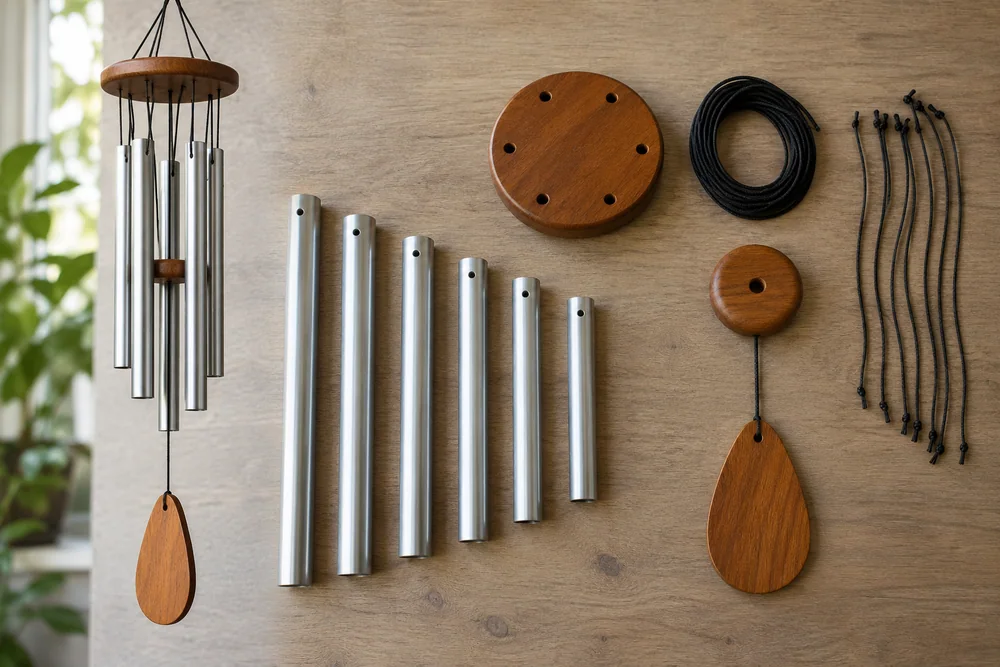
2. The top hook, main ring and mounting support
The top connection is easy to overlook because it contributes little to the appearance in a product photograph. Yet it carries the combined weight of the tubes, support, central mechanism, sail and decorative attachments. Wind motion and repeated swinging can add changing forces. Use a mounting system rated for the complete weight, substrate and expected movement. For heavy or uncertain overhead installations, seek competent advice; do not rely on curtain rods, decorative trim or unsuitable adhesive hooks.
Some designs use a single top ring; others have a cord loop, chain or purpose-made hook. Identify which is supplied with the actual item and whether additional hardware is required. The hardware must allow the intended movement without repeatedly scraping the connection point or allowing the entire hanging to strike a ceiling, wall or door.
Inspect the top at regular intervals. A rusty hook, opened ring, deteriorated knot or cracked cap can be more dangerous than a slightly discoloured tube. Where an overhead connection is uncertain, keep people clear below it and arrange safe removal; seek a qualified installer if the location or load is difficult to manage.
3. The upper support: canopy, disk or platform
The upper support establishes where the tubes hang relative to one another. A conventional chime may use a circular wooden disk, metal frame or another supporting form with holes or attachments arranged around its perimeter. Good spacing keeps the sounding pieces close enough to be reached by the striker while allowing them to vibrate separately after contact.
Wood, bamboo, metal and mixed-material upper supports age differently. A wooden cap may crack around drilled holes when exposed to changing moisture; a metal ring may develop corrosion or sharp burrs; a painted surface may wear where the cord rubs. Inspect the entire support, including the hidden upper and underside connections.
The visual form of the support does not establish what the sound-producing tubes are made from. For example, a wooden cap over metal tubes remains a metal-tube sound design; a copper-coloured frame does not prove that the tubes are copper. Material identity should be recorded component by component.
4. Tubes, rods, bars and bells: different sounding components
A tube is generally hollow; a rod is commonly solid; a bar may have a different cross-section; and a bell is a shaped resonant object, often sounded by an internal clapper. All can function as sounding elements, but their geometry and suspension differ. The term “wind chime” can describe a broad product family rather than one universal mechanism.
Metal tubular designs commonly use aluminium, brass, copper or steel-family components. Bamboo tubes can also sound when struck, while shell and ceramic hangings may create smaller clicks or ringing depending on their shapes. A decorative bird, lotus, Om symbol or bead is not necessarily a sounding element simply because it hangs near a chime.
Count the pieces that actually produce sound separately from beads, motifs, rings and spacers. A seven-colour bead decoration does not imply seven musical notes. Equally, five hollow tubes are not necessarily tuned to a pentatonic scale; a scale refers to selected pitches, not merely the number of physical components.
5. Why tube dimensions and suspension change the tone
Metal wind-chime tubes usually ring because the metal itself flexes and vibrates after impact. The most important audible modes are often bending vibrations of the suspended tube, rather than simply an air column inside the hollow section. The pitch and character of that sound depend on length, diameter, wall thickness, material stiffness, density and the way the tube is supported.
For otherwise similar tubes, a longer free-sounding piece generally has a lower fundamental bending pitch than a shorter one. Yet the length alone cannot establish a precise note when the tubes use different diameters, metals or wall thicknesses. The striker and surrounding room also influence how loud or bright the finished hanging sounds.
Suspension location matters. In many purpose-tuned tubular designs, makers hang the tube near a vibration node of the intended mode so that the cord interferes less with ringing. The best point depends on construction and the mode targeted. It is not safe to move or drill suspension holes arbitrarily on a maker-tuned chime.
Specialist manufacturers may document the individual pitches or scale of a set. If a retail listing says “tuned,” request the exact model's verified tuning description or representative sound sample rather than inferring a key from tube count, colour or material. For related materials see the Metal Wind Chimes collection and the Aluminium Tube Wind Chime.
6. The striker or clapper: the part that starts the sound
The striker is the moving component that contacts the tubes in many conventional chimes. Often suspended near the centre, it may be made from wood, a polymer, metal or a combination of materials. Its size, mass, shape, firmness and position affect the contact with each tube. A striker that is too small for the spacing may miss the sounding parts; one that is oversized or poorly aligned can jam or rest against them.
A tube must usually be free to vibrate after impact. If the striker remains pressed against it, the tone can be damped or shortened. The location of contact also influences how strongly the tube's different vibration modes are excited. Manufacturer design matters more than a general rule that a heavier striker always gives a better tone.
Do not confuse an internal bell clapper with the disc-shaped striker of a tubular chime. In a bell hanging, the clapper typically strikes the inside of a bell body; in a tube arrangement, a central striker often contacts the outside of several independently suspended tubes. The terms may overlap in consumer descriptions, but the physical layout differs.
7. The wind sail: how a breeze becomes movement
The wind sail is typically a lower hanging element that presents an area to the moving air. In many designs it is joined to the central striker by a suspension line, so that breeze-driven movement causes the striker to reach the sounding tubes. Sails can be flat, rounded, shaped or decorative. Some provide space for an engraving; others blend into the visual theme.
The sail's size, weight and position influence how readily the assembly responds to airflow. A larger sail may increase activity in some breezes, but it can also make a chime ring too often or swing into nearby objects. More movement is not automatically better. Wind River's guidance describes wind-sail size as one means of influencing a chime's activity, while maintaining appropriate clearance around the installation.
Not every dangling ornament is a functional sail. A decorative pendant may contribute little to movement, and some alternative chime constructions do not use a central sail at all. Identify the actual mechanism before claiming a particular wind response or changing components. Where a manufacturer provides an adjustment or replacement, follow those instructions rather than improvising a heavier hanging weight.
8. Cord, wire, knots and rings: small parts with major responsibilities
Separate suspension lines carry each sounding piece. Other cords may connect the striker, wind sail, upper support and top ring. Their materials and knots must be appropriate for the weight, movement, abrasion and weather to which the chime is exposed. A thin line can become weakened by repeated rubbing at a drilled hole even if the tube remains in excellent condition.
Look for fraying, hardening, cracking, slipped knots, opened rings and sharp tube edges. Examine hidden sections where the cords pass through a wooden cap or sit under a knot. Persistent wetting, strong sunlight and coastal weather can affect cords and fittings differently from the sounding tubes.
When restringing a tuned model, preserve the manufacturer's tube order, suspension points, relative heights and component positions. Replacing a line with an arbitrary thread or making new holes may affect both safety and sound. For complex or heavy hangings, manufacturer-approved repair or replacement is preferable to an improvised load-bearing connection.
9. Compare common chime mechanisms
| Type of hanging | Typical sound-producing action | Key difference |
|---|---|---|
| Conventional tubular metal chime | A moving striker contacts several suspended metal tubes | Tube geometry, suspension and striker determine notes and response |
| Bamboo or wooden-bar chime | A striker or another moving piece contacts bamboo tubes or genuinely sounding wood | Materials, construction and moisture sensitivity differ |
| Bell cluster or bell string | Clappers strike bell interiors or bells contact nearby parts | Sound comes from bell-shaped resonators, not a shared tubular array |
| Shell, ceramic or mixed hanging | Movement produces contact among shells, ceramic pieces or other elements | May sound more like clicks or small bells than long metal tubes |
| Spiral metal wind chime | Sounding pieces are arranged on descending levels, with mechanism dependent on model | Extra care with clearance, cord separation and tangling |
| Silent spinner or suncatcher | May rotate or refract light without a working chime mechanism | Decorative movement or light is not proof of audible wind-chime action |
Many mixed products combine a metal chime with glass prisms, beads or small bells. Describe which parts are responsible for sound, visual interest and light effects instead of assigning every component the same function.
10. How to inspect a wind chime before purchase
- Check the main hook. Confirm that it supports the entire item and that its supplied fixing method matches the intended surface.
- Examine the top support. Look at drilled holes, joins, cracks, sharp edges and weather-sensitive finishes.
- Count the sounding pieces. Distinguish actual tubes or bells from decorative beads and motifs; request the correct material list.
- Inspect the central mechanism. Determine whether a striker or clapper actually contacts the sounding elements without becoming stuck.
- Identify the wind sail. Confirm that it moves appropriately and does not collide with a frame, door or railing.
- Check all cords and rings. Watch for fraying, loose knots, broken links and rubbing against sharp holes.
- Measure full dimensions. Record the hanging drop from top ring to lowest piece, the widest swing span and the complete weight.
- Verify sound and tuning claims. Ask for an authentic recording or the maker's notes when a scale or tuning is advertised.
- Confirm actual retail details. Ask the seller to confirm actual photographs, weather suitability, included hardware, price and availability.
For a shared apartment or a bedroom-adjacent balcony, listen to how often the sound occurs under normal local airflow. A beautiful chime can become intrusive if it rings throughout the night or strikes a wall in stronger winds.
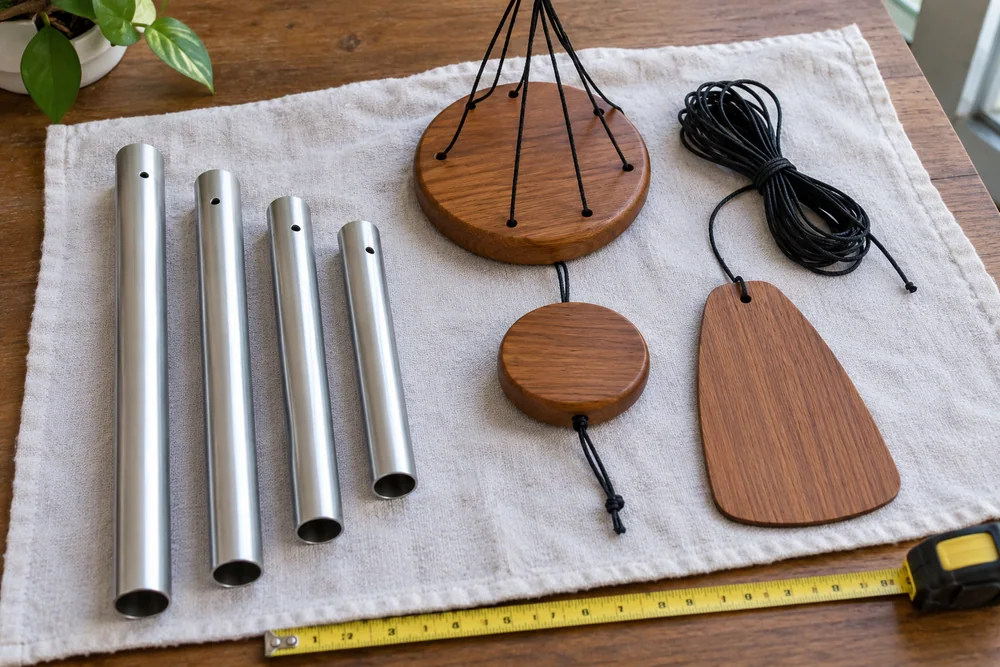
11. Installation, cleaning and repair: preserve the working design
Before hanging a chime, make sure the support is structurally appropriate, the door can open fully and the sounding parts have room to swing. Keep the hanging clear of glass, walls, rails, fans, lamps and accessible small components. Consider neighbours and choose a quieter location when regular ringing would cause disruption.
For cleaning, support the elements and begin with gentle dry dusting. Do not soak a mixed-material assembly or use abrasive polish until the actual metal and coatings are identified. Wood, bamboo, plated metal, cords, decorative stones and glass may each require a different method. Strong wind and monsoon rain can harm the hanging connections even where the metal tubes themselves remain usable.
If a chime becomes tangled, take it down safely and set it over a soft surface. Gently separate each suspension line rather than pulling on one tube. If the striker or sail is missing, verify the actual replacement part and its dimensions. Arbitrary changes to striker size or tube suspension can alter movement, sound and safety. For regular maintenance guidance, see the Hangings & Chimes collection, and retain the model's original instructions whenever available.
12. Wind chimes, traditional bells, Vastu and Feng Shui
Indian devotional traditions use bells such as the ghanta deliberately during worship and describe sound through terms such as nada in wider musical and contemplative settings. A moving household chime is a decorative object with a physical sounding mechanism, not the same as a consecrated puja bell or an automatically performed mantra.
Vastu Shastra addresses orientation, entrances, proportions, light, ventilation and the arrangement of built spaces. Some contemporary Vastu-inspired explanations connect breeze-driven movement with Vayu and sound with Akasha, two of the Pancha Mahabhuta concepts. This does not establish a classical instruction that a certain striker or number of tubes must be installed to remedy every building.
Popular metal-chime placement advice for west or northwest often draws from Chinese Feng Shui's distinct five-phase system. The Indian five great elements and Chinese metal-phase model should not be merged into one supposed scripture. In practice, safe mounting, free movement and household comfort matter whatever decorative significance a family attaches to the sound. Read the Vastu Shastra overview for wider architectural context.
Frequently asked questions
What makes the sound in a wind chime?
Sounding tubes, rods, bells or other resonant components vibrate after being struck. In a familiar tubular design, a moving central striker makes contact with the suspended tubes.
Is the striker the same as the wind sail?
No. The sail catches airflow and helps move the mechanism; the striker contacts the sounding pieces. Their forms and connections vary by model.
Do all wind chimes have a central striker?
No. Bell, shell, ceramic and alternative hanging designs may use clappers or direct contact among parts rather than a single central striker.
Does the number of tubes tell me the musical scale?
No. Tube count cannot establish a scale without the actual pitches or a manufacturer's documented tuning system.
Can I tune a wind chime just by changing cord length?
Changing suspension can affect movement or sustain, but it is not a reliable way to establish a chosen musical scale. Follow the maker's design and tuning guidance.
Why does my striker sometimes stick against a tube?
The striker may be misaligned, tangled, too large for the spacing or positioned incorrectly. Check the mechanism with the chime supported and do not force it apart while hanging overhead.
Does a bigger wind sail always produce a better sound?
No. A larger sail may increase activity in some conditions, but can also cause excessive ringing or collision. Match the actual design to the intended airflow.
What should I check if a tube hangs lower than before?
Examine its suspension cord, knot, tube hole and upper support. A changed position may indicate slipping or wear and should be assessed before rehanging.
Can I replace a broken top ring or suspension cord myself?
Only if the correct replacement specification and fitting method are known. Heavy, tuned or complicated designs may require approved parts or professional attention.
Related OmmRudraksha wind chime products and resources
Browse the Metal Wind Chimes category and compare Aluminium Tube Wind Chime, Brass Tube Wind Chime or other material families. For silent and mixed decorative hangings, visit the Vastu Hangings & Chimes collection; for broader home placement ideas, explore the Vastu collection.


