

Wind chime finishes, patina and weather exposure determine how a hanging looks and how safely it continues to function. A copper tube that slowly darkens is not the same as a flaking painted coating, and a brown spot on stainless steel does not always have the same significance as corrosion that has weakened a supporting ring. Correct care begins by identifying the materials and examining the whole assembly, not just polishing the visible tubes.
This guide explains the differences between bare and coated metals, intentional patina and damage, stainless steel tea staining, aluminium finishes, weather-sensitive cords and wood, and the conditions of Indian balconies, verandas and monsoon seasons. It includes practical inspection tables, cleaning guidance, storage steps and advice on when not to use a damaged chime.
1. Identify the actual finish before cleaning
The visible colour of a wind chime may describe the surface rather than its base material. A copper-coloured aluminium tube remains aluminium. A brass-plated ornament has a coating over a different underlying metal. A “bronze finish” might mean a coloured paint or lacquer instead of a bronze alloy. Even one hanging can combine aluminium sounding tubes, a wooden upper support, plated fittings, painted decorative elements, strings and glass beads.
Before choosing any cleaner, ask what each major part is made from. Identify whether its surface is bare, polished, patinated, painted, powder-coated, anodised, lacquered, plated or otherwise sealed. These terms are not interchangeable. Each surface may require different care, and an abrasive product that can brighten exposed copper may damage a thin decorative coating.
| Surface or construction | Typical appearance | Care consideration |
|---|---|---|
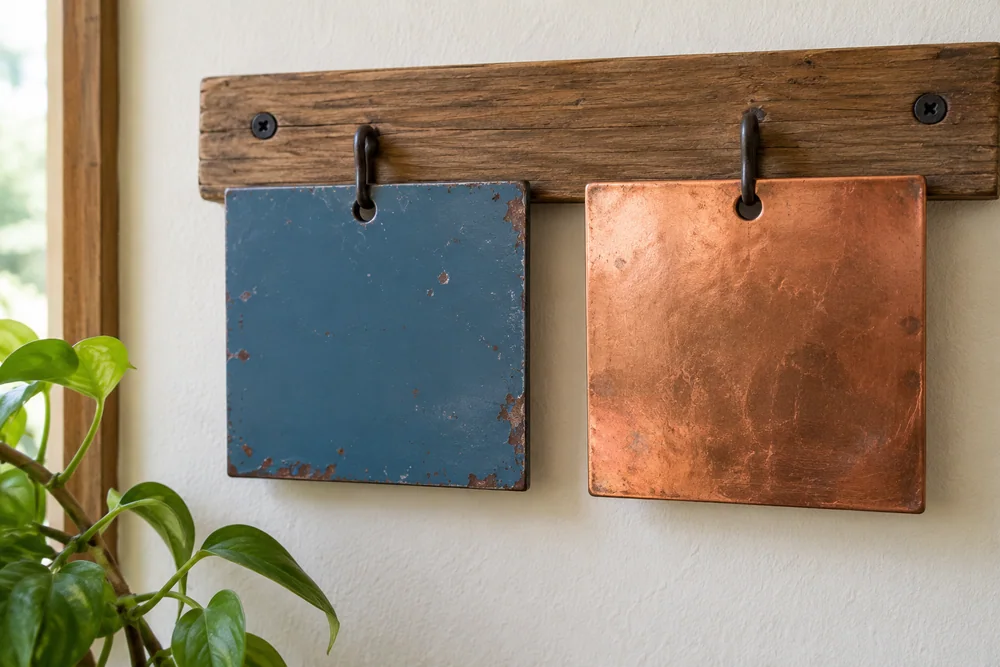
| Bare copper or brass | Metal colour can darken or form a patina with exposure | Decide whether the aged appearance should be retained before considering polish |
| Lacquered copper or brass | Bright or deliberately coloured metal protected by a clear film | Metal polish can abrade or lift lacquer; follow the coating maker's instructions |
| Plated metal | A thin surface layer over a different base metal | Repeated abrasion can expose the base; verify plating before attempting restoration |
| Painted or powder-coated metal | Opaque or decorative coloured surface | Inspect chips, flaking and wear at hanging points; do not use bare-metal polish |
| Anodised aluminium | Controlled oxide finish, sometimes coloured | Use finish-appropriate gentle cleaning; harsh abrasion can damage appearance |
| Stainless steel | Brushed or polished metallic finish; grade may vary | Clean deposits and check for tea staining, crevice attack or contaminated fittings |
If the finish is unknown, begin only with gentle dry dusting, supported so that the tubes do not strike one another. Obtain the seller's surface and material details before trying acid, abrasive compounds, household metal polish or solvents.
2. Patina, tarnish, oxidation and corrosion: what is the difference?
Patina commonly describes a surface colour and texture that develops through age, exposure or deliberate treatment. On copper or copper alloys, it may be valued as part of an object's visual character. Tarnish usually refers to a thinner discoloration resulting from chemical reactions at the surface. Corrosion is the broader chemical or electrochemical deterioration of a material. These concepts overlap in everyday descriptions but should not be treated as identical.
Not all ageing is hazardous. A uniform darkening of bare copper may be an expected appearance change, while a cracked suspension ring, deep pitting, loss of material around a hole or flaking coating that exposes a corroding base demands closer attention. Loose, powdery green corrosion that recurs after cleaning may be a sign of active corrosion and warrants specialist assessment rather than polishing. A surface can look pleasantly weathered while its cords or fasteners have weakened.
In conservation, an original or intentionally aged finish may be important and should not be polished away without a reason. The Canadian Conservation Institute warns that polishing removes material and can alter protective coatings or historically valued surfaces. For a household chime, the same general principle supports identifying what is present before attempting to restore shine.
3. Copper wind chimes: when reddish metal turns brown or green
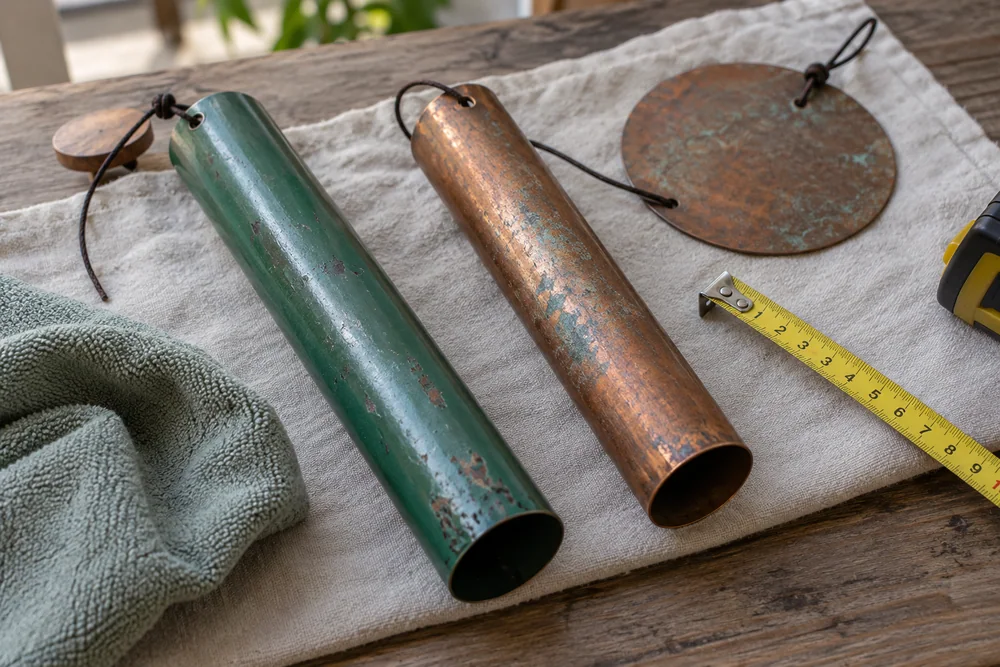
Uncoated copper begins with a reddish metallic appearance and can gradually darken under atmospheric exposure. Depending on moisture, air chemistry and time, more complex greenish or blue-green surface products may develop. But there is no standard timetable: a sheltered copper tube in a dry room may darken without developing a green patina, while an object in a damp or polluted setting can change differently.
Some owners prefer the older look, while others want a brighter surface. The correct decision depends on whether the metal is actually copper, how it is finished and whether the visible surface is stable. Polishing away oxidation may also remove an intentionally formed surface or protective treatment. A “copper finish” painted onto aluminium should never be cleaned as though the entire part were bare copper.
For a design comparison see the Copper Tube Wind Chime; ask the supplier which parts are copper, plated or made from another metal.
4. Brass and copper-alloy chimes: golden colour is not an alloy test
Brass is a family of alloys composed principally of copper and zinc. Its golden appearance can be imitated by plating, coloured lacquer or other finishes. Bare brass can tarnish and change colour, and a protective lacquer may age, scratch or wear at edges. When a lacquered area becomes damaged, uneven appearance can arise as exposed regions age differently.
It is important to distinguish normal surface ageing from more serious deterioration. Some brass alloys can experience dezincification under particular corrosive conditions, in which zinc is preferentially removed from the alloy. A pinkish or porous surface combined with damage or loss of strength deserves expert evaluation; a simple photograph cannot establish the mechanism. Do not assume that a polishing paste can repair weakened metal.
If bright brass is wanted, follow a supplier-approved method only after establishing whether the object is bare, plated, waxed or lacquered. The Canadian Conservation Institute's guidance on brass and copper explicitly treats cleaning, polishing and protective coatings as different tasks. Compare the Brass Tube Wind Chime for a related material family without assuming every gold-coloured chime is brass.
5. Stainless steel: why “stainless” does not mean rust-proof
Stainless steel relies on a protective chromium-rich passive surface layer, but corrosion resistance varies with grade, finish, fabrication and environment. The term “stainless” does not guarantee unchanged appearance beside the sea, in an industrial area or under neglected fittings. In coastal settings, salt deposits and persistent moisture can contribute to brown surface discoloration commonly called tea staining; tea staining is generally cosmetic, but pitting or crevice corrosion are distinct forms of localised attack that warrant separate inspection.
Surface grooves, folded joints and water-trapping crevices deserve attention. So do ordinary steel particles introduced by unsuitable brushes or contaminated tools, which may create apparent rust marks. The British Stainless Steel Association and Australian Stainless Steel Development Association recommend appropriate cleaning and avoiding chlorine-based cleaners or contamination that can damage the passive surface.
Grades 304 and 316 are widely discussed; 316 is commonly selected for improved resistance to some chloride exposures. However, that general fact cannot prove that an unverified wind chime uses either grade. The metal sounding tubes, connecting rings and upper mounting hardware might not be identical alloys.
For a product-family comparison see the Stainless Steel Tube Wind Chime. The actual grade, condition and intended weather exposure must be checked for the supplied model.
6. Aluminium coatings, anodising and colour wear
Aluminium is widely used for tubular wind chimes, sometimes with silver, gold, copper-coloured, bronze-coloured or painted finishes. Aluminium develops an oxide surface of its own, and commercial finishes can provide colour or additional surface protection. Anodising creates a controlled oxide layer, whereas paint or powder coating adds a different type of external film.
These treatments are not equal. A thin colour finish may scratch at points where tubes, striker or suspension hardware touch. Sunlight, salt and water exposure can affect coatings in ways that differ from the underlying aluminium. Dark spots or faded colour do not by themselves establish that a tube has become structurally weak, but chips around support holes should prompt inspection for wear or sharp edges.
Do not scrub a coloured or anodised aluminium tube with abrasive polish intended for bare brass or copper. Identify the coating, use gentle maker-approved cleaning and avoid changing the surface finish during repair. The Aluminium Tube Wind Chime is a related style; its specific treatment should be verified from the actual item rather than inferred from a product photograph.
7. Rain and sun affect the whole hanging—not just metal tubes
Wind chimes are mixed-material structures. A robust metal tube can outlast the cord that holds it. Water may collect under an upper cap or inside a fastener. Wooden supports can swell, crack or lose their protective finish. Fabric strings and some synthetic lines may become frayed or brittle with age, and adhesives can weaken under moisture or heat. Glass prisms and gemstone beads may remain intact while their connecting wires, knots or coatings deteriorate.
Ultraviolet exposure, temperature changes, repeated wetting and strong wind can combine. A sheltered porch reduces direct rain but is not automatically dry; wind-driven rain and humid air can still reach the object. A covered balcony near coastal salt spray can be more demanding than an open terrace in a different climate. A manufacturer's all-weather statement should name the intended conditions and cover the entire assembly, not just one tube.
| Part of the chime | Possible issue | What to inspect |
|---|---|---|
| Sounding tubes, rods or bells | Patina, staining, surface scratches, pitting or sharp edges | Material identity, coating, sound and suspension holes |
| Wooden cap or sail | Swelling, cracking, peeling finish | Grain around holes, exposed end surfaces and split joints |
| Cords and thread | Fraying, abrasion, UV damage, loose knots | All load-bearing sections, especially hidden upper points |
| Metal rings, hooks and screws | Corrosion, opening or bending | Load-bearing contact, moisture traps, fastener strength |
| Glass, beads and decorative ornaments | Chips, scratches, breakage or loosened ties | Edges, secure attachment, contact with other parts |
| Striker and wind sail | Unwanted impact, warping, separation, loss of movement | Clear swing, cord condition and proper sound mechanism |
8. Indian monsoon and coastal balconies: practical exposure choices
Before the rainy season, inspect the entire hanging while conditions are calm. Check the top fixing, every cord and the path of swinging parts. If a manufacturer's documentation does not establish that the full assembly tolerates prolonged rain and strong wind, move it to a sheltered location before severe weather arrives. Do not climb onto wet railings or attempt to remove a hanging during dangerous winds.
For coastal homes, look beyond “stainless” or “weather-resistant” marketing. Salt deposits can accumulate in crevices, and rain or high humidity may keep fittings wet. Manufacturer-specified materials, drainage, smooth finishes and regular gentle cleaning may help, but local exposure can be severe. For painted and plated metals, look for peeling around mounting points as well as large visible surfaces.
Some people enjoy chimes that ring in heavy wind, but repeated violent movement risks collision, tangling and fatigue. Do not improvise stones, weights or additional strings to stop the motion: such changes may increase loads and create new hazards. A deliberately quiet position or temporary indoor storage may be the safer choice.
9. Safe cleaning by finish: a practical method
- Take photographs first. Record the original assembly, tube spacing and positions of knots, striker and sail before disassembling anything.
- Remove loose dust gently. Support the tubes and decorations to avoid collisions. Use a dry, soft, clean cloth for an unknown finish.
- Read the actual maker's instructions. Identify coatings, plating, bare metals and any wood, glass, stones or textiles before using a wet cleaner.
- Test carefully when permitted. For a confirmed compatible finish, try the least aggressive approved method on a discreet area rather than the whole object.
- Keep chemicals away from mixed materials. Acidic home recipes, bleach, abrasive pads and strong solvents can harm metal finishes, coatings, wood, cords or gemstone surfaces.
- Dry permitted damp-cleaned components. Avoid leaving moisture trapped in knots, holes, wooden caps or crevices; follow the maker's directions for that material.
- Recheck after cleaning. Inspect loose fittings, frayed cords, cracked supports and unsafe edges before rehanging the object.
Gentle dry dusting is a conservative starting point, not a universal restoration procedure. Where plating has peeled, a coating has cracked badly or a structural part has lost strength, polishing may conceal rather than solve the issue. Repair or replacement should follow appropriate expertise and the actual product design.
10. When should a chime be repaired or taken down?
Colour alone is not enough to decide. An even patina on bare copper or brass can be acceptable; a superficial mark on intact stainless may be a cleaning issue. By contrast, frayed load-bearing cords, opened hooks, cracked wooden caps, severely pitted tubes, weakened rings, sharp fragments or a loose glass ornament call for immediate attention. A hanging positioned above people presents greater consequences if a support fails.
Keep people clear of a potentially unsafe hanging. Take it down only in calm conditions using safe access and adequate assistance for its weight; if removal is unsafe, arrange professional help. Support the pieces carefully and assess whether the original manufacturer's replacement parts and instructions are available. A substitute cord should not be selected only by colour; strength, material, abrasion resistance and the intended knot arrangement matter. Do not attempt makeshift repairs to load-bearing parts of a heavy hanging above walkways.
If the chime has become noisy due to a broken striker or altered support, repair should restore the intended motion without changing tube positions in a maker-tuned design. Severe structural corrosion is a separate problem from surface appearance and may make replacement the safer choice.
11. Cleaning, drying and seasonal storage
When storing a chime, clean it by the maker-approved method and let all permitted damp-cleaned parts dry thoroughly. Lay out each tube, rod or bell separately on a soft material so surfaces do not rub against one another. Wind sails, decorative beads and delicate figures should be padded where possible. For a descending or spiral design, restrain each hanging level separately instead of allowing the cords to knot into one bundle.
Use a dry location away from prolonged direct sunlight, extreme heat or dampness that could damage the finish and suspension. Avoid sealing wet wood, cords or plated parts in plastic where moisture cannot escape. Reinspect every support before bringing the chime out again; material properties and fasteners can change while the item is not in use.
12. Vastu-inspired placement, sound and household comfort
Traditional Vastu Shastra addresses architecture, spatial relationships, light, air movement and the organisation of a home. The Vastu Purusha Mandala and Pancha Mahabhuta belong to that wider tradition. Modern Vastu-inspired decoration may connect the breeze-driven motion of a wind chime with Vayu and its tone with Akasha. This is not a universal classical prescription to expose a metal hanging to rain or install it in one direction regardless of safety.
Contemporary Chinese Feng Shui uses a distinct five-phase framework including metal. Its popular west/northwest recommendations for metal chimes should not be presented as identical to the Indian five great elements. A suitable placement also depends on a secure hook, sufficient headroom, a clear door swing and the level of sound acceptable to family and neighbours. In a puja or meditation area, some families prefer silence; a decorative wind chime does not replace the deliberate use of a ritual ghanta.
For context, visit OmmRudraksha's Vastu Shastra overview. For additional decorative options, browse the Hangings & Chimes collection and the broader Vastu collection.
Frequently asked questions
Does a weather-resistant wind chime need maintenance?
Yes. A claim about weather resistance should specify the complete assembly and intended exposure. Cords, fasteners, coatings and wooden parts still need inspection and care.
Is a green patina on copper always a problem?
No. Colour change can be part of natural ageing, although the actual chemistry and stability depend on conditions. Inspect structural integrity separately, especially around joints and suspension points.
Should I polish a dark brass wind chime?
Only after confirming that it is bare brass and that the patina or existing protective finish is not intended to be preserved. Plated and lacquered objects can be harmed by metal polish.
Can stainless steel develop brown stains outdoors?
Yes. Under some conditions, especially where salts and moisture accumulate, stainless steel can develop tea staining or localised corrosion. Grade, surface finish and cleaning matter.
Is anodised aluminium the same as painted aluminium?
No. Anodising modifies the oxide surface; painting adds a separate coating. The correct cleaning method depends on the real finish.
Can I use vinegar or lemon juice on every metal chime?
No. Acids can damage unknown finishes and other components. Start with gentle dry dusting and use a supplier-approved cleaner only after identifying the materials.
Can a wind chime stay outside during the monsoon?
Only when its entire structure is rated for the expected conditions. If the design or fixing is not suitable for heavy wind or prolonged moisture, move it before severe weather.
What is more important: metal quality or cord condition?
Both matter, but a weak load-bearing cord or ring can create an immediate falling hazard even when the metal tubes remain in good condition.
When should a damaged chime be replaced?
Significant structural deterioration, unsafe sharp edges, cracked supports or failing suspension may justify replacement if a reliable approved repair is unavailable.
Further reading and related wind chime designs
For material-specific comparisons, explore Metal Wind Chimes, Copper Tube Wind Chime, Brass Tube Wind Chime, Stainless Steel Tube Wind Chime and Aluminium Tube Wind Chime. Ask the supplier to confirm each model’s actual sounding metal, finish and intended exposure before choosing.


