

What makes a wind chime sound different? A chime's character comes from more than its material or the number of tubes. The size and shape of each sounding element, where it hangs, what strikes it, how freely it vibrates, and the strength and pattern of the breeze all contribute. Two chimes that look similar in a photograph may differ in pitch, tone colour, volume, ringing duration and the frequency of their strikes.
This guide explains the science in practical language, including the difference between a vibrating metal tube and an organ-pipe air column. It also shows what “tuned” really means, why a wind chime does not play a fixed melody in every breeze, how to compare recordings fairly, and how to select sound appropriate for a balcony, entrance, study or quiet home.
1. Five aspects of sound that are worth comparing
When someone describes a wind chime as deep, bright, soft, resonant or melodic, those words often refer to different acoustic features. Separating them makes it easier to choose the actual experience you prefer.
| Sound feature | Meaning | What affects it |
|---|---|---|
| Pitch | Whether a sound seems high or low | Sounding-element geometry, material properties and vibrational modes |
| Timbre or tone colour | Why sounds of similar pitch can seem warm, glassy, bright or dull | Different vibration modes, striker contact, material and surrounding resonances |
| Attack | The initial character of the strike | Striker hardness, weight, velocity and contact location |
| Sustain and decay | How a sound continues and fades after impact | Suspension, damping, tube construction and surroundings |
| Rhythm and activity | How often individual pieces ring and in what order | Wind, sail geometry, exposure, spacing and movement of the striker |
Loudness is another separate question. A sound can be low-pitched yet audible across a courtyard, or high-pitched but relatively gentle. The distance from the chime, local reflections, background noise and how the sound is recorded all affect perceived volume. A musical note or a particular alloy does not guarantee that the sound will be quiet.
2. The sounding body: tube, rod, bell, bamboo or shell
Metal tubes, solid rods, shaped bells, bamboo sections, ceramic pieces and shells do not vibrate in the same way. A typical hanging metal tube has bending modes; a shaped bell can vibrate with its own pattern of modes; bamboo and wood have different material behaviour and construction. Seashells or small ceramic pieces may make shorter contact sounds rather than the sustained tone associated with a long tubular chime.
The form also determines how sound starts. A conventional tubular wind chime often has a central striker that touches several separate tubes. A bell may have its own internal clapper. Shells may collide directly. A decorative spinner can rotate silently, while a glass suncatcher may refract light without producing a musical tone at all. The word wind chime alone is therefore not enough to establish a particular acoustic mechanism.
Count the actual sounding components separately from beads, decorative birds, butterflies, Om ornaments, prisms or other motifs. A seven-bead hanging need not have seven musical notes, and a cluster of bells should not be described as a tuned tubular instrument unless its construction warrants that description.
3. Why a metal tube rings: bending vibrations versus air-column sound
In many familiar metal tubular wind chimes, the ringing is produced predominantly by the vibrating metal tube. When a striker hits the tube, it bends by tiny amounts in characteristic patterns. Those vibrations move the surrounding air and create audible sound. Research into wind-chime acoustics often models the suspended tube approximately as a freely vibrating beam, rather than treating its main tone as that of a flute or organ pipe.
A hollow tube also contains air, and an air column can have resonances of its own. Those are not necessarily the dominant sounds heard from a typical freely suspended struck metal chime. Confusing the two mechanisms can lead to incorrect conclusions about musical pitch. A particular manufactured chime may have more complicated behaviour, but the bending model is a useful starting point for comparing ordinary tubes.
Different bending patterns, called modes, can contribute different frequencies to the same struck note. These components do not necessarily form the simple whole-number harmonic series familiar from an ideal string. That is part of what gives tubular chimes their distinctive bell-like or shimmering character. The strongest audible component is not always the mathematical lowest vibration, so listening and measuring the real model are important.
Published acoustics investigations describe multiple damped vibration modes and their dependence on tube length and impact location. These findings explain the general mechanism, but do not establish the notes, sound or material of a particular model.
4. Tube length, diameter and wall thickness
The most noticeable difference among suspended tubular elements is often their length. When other relevant dimensions and materials are comparable, a longer freely vibrating tube generally has a lower bending frequency than a shorter one. In a simplified beam model, the fundamental bending frequency varies approximately with the inverse square of length when cross-section, material and boundary conditions remain the same.
But an arbitrary long tube is not guaranteed to sound lower than every shorter tube: diameter, wall thickness, metal stiffness, density and suspension can also differ. Wider or thicker-walled tubes can have a different stiffness-to-mass relationship from narrow thin-walled ones. There is no reliable pitch ranking from length or metal name alone when the constructions are substantially different.
Tube length also differs from overall hanging length. A wind chime's hook-to-lowest-sail dimension includes supports and connectors. It may be far longer than the largest sounding tube. This distinction matters both for sound comparison and for safe installation near doors and balconies.
For a real model, ask for sounding-tube measurements, actual material and, where a musical note or scale is claimed, the maker's note list or test record. Avoid guessing pitch from a photo, a product title or the number of decorative rods.
5. Does metal type determine which chime sounds best?
Aluminium, copper, brass and stainless steel have different material properties, but the assembled design matters as much as the label on the metal. Tube geometry, the way it hangs, the striker and the intended tuning all influence the final result. A well-designed aluminium model may sound lower or more sustained than one particular brass model; another comparison may reverse that impression.
Metal identity also requires care. Brass is principally a copper–zinc alloy; copper is a different material. Copper-coloured aluminium remains aluminium. A stainless-looking coating does not prove a particular stainless-steel grade. Material declarations should refer to the actual sounding elements rather than only the decorative top or finishing colour.
Some manufacturers use selected aluminium alloys and precise tube dimensions to create intended musical note sets. Others sell decorative copper, brass or steel designs that have no formal tuning claim. The sound of a particular chime should be judged with an authentic recording or demonstration, not promises that one material is universally “most healing,” “richest,” “loudest” or “best.”
Compare relevant families in Metal Wind Chimes, including the Aluminium Tube Wind Chime and Brass Tube Wind Chime. Actual alloys and musical properties must be confirmed separately for each model.
6. The striker: a small part that changes the attack
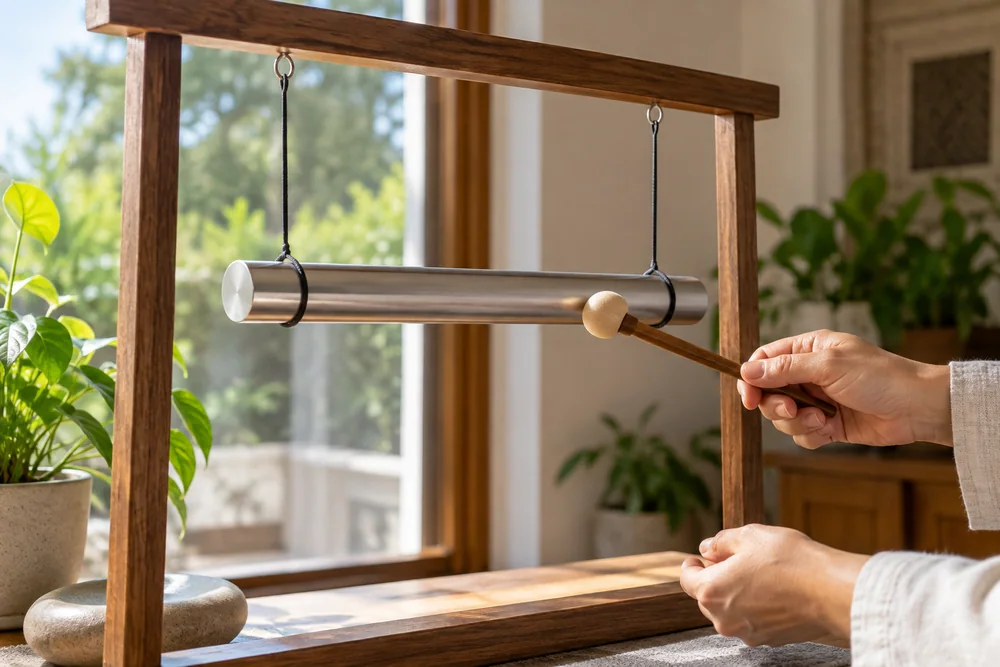
The striker, or central contacting piece, controls how energy is delivered to a tube. A softer material may produce a gentler initial impact, while a harder contact can make the attack seem sharper or excite a different balance of vibrations. Shape, mass and velocity also matter. There is no universal rule that a heavier or harder striker produces a better sound.
Wind-chime manufacturers sometimes engineer the striker specifically to balance contact force and a gentle tone. Its central position must allow it to reach the sounding elements without remaining wedged against them. If it rests against a tube after striking, it can damp the sound. A chipped or misaligned striker can also alter sound or damage the suspended parts.
Where the striker touches the tube affects which vibrational modes it excites. As a simple listening experiment, a single tube suspended safely according to the maker's instructions may sound different when gently struck at different points with a compatible striker. Do not use hard tools or force a sounding element in a way that could scratch it, bend it or damage the support.
7. Suspension points: why a free-hanging tube sustains sound
For a sustained note, the sounding element must be allowed to vibrate. Its support should hold its weight without strongly constraining the vibration that the maker intends to produce. Many purpose-designed tubular chimes use a suspension position near a vibration node of a selected bending mode to reduce damping.
When a cord passes through a hole, its contact with the metal and the arrangement of knots may affect sustain. A string that is taut in the wrong place can inhibit motion or change the sound. Manufacturers use different suspension systems, so no one cord position should be imposed on every design.
This matters during maintenance. Moving the attachment, shortening a tube, drilling a new hole, changing the order of the sounding pieces or replacing the striker without guidance can alter both tonal behaviour and mechanical safety. Keep the original maker's arrangement when restringing. If the model is described as tuned, preserve its documented tube sequence and suspension method.
A nearby wall or a tangled cord can also damp or interrupt vibration. Before deciding that a chime has “lost its tone,” check that every tube hangs freely and has room to ring after each strike.
8. Wind sail, airflow and the timing of notes
The wind sail or catcher receives airflow and helps move the striker in many conventional tube designs. Its size, shape, weight and connection influence how readily a breeze activates the assembly. A larger sail can make a chime more active under some conditions, but it may also create excessive movement, repeated strikes and collisions in stronger winds.
Airflow around a sheltered doorway differs from airflow at the edge of an exposed balcony. Nearby walls, corners, openings, fans and vegetation change the local pattern. A chime that rings occasionally in a shop or quiet veranda may be silent in an enclosed living room or very active in a gusty high-rise position. The same model does not have a fixed, universal ringing rate.
The order of the notes is largely controlled by movement in a normal wind-operated chime. Even when its tubes have been tuned to a selected set of pitches, the wind generally does not play a predetermined song. A chime may produce harmonious combinations without reproducing an organised melody each time.
For homes where quiet matters, the right solution may be a more sheltered position or a different type of ornament, not automatically a supposedly “softest” metal. Listen during ordinary and windy conditions, including evenings when neighbours and family members may be resting.
9. Musical tuning, scales and why tube count is not enough
A tuned wind chime has sounding pieces deliberately selected or adjusted toward an intended pitch set or musical relationship. Specialist makers may specify a key, named notes or scale and test the individual tubes before assembly. That claim is more precise than calling a random decorative chime “musical.”
A five-tube design is not automatically pentatonic. Pentatonic describes a five-note collection; a physical chime may repeat a note, include more or fewer sounding parts, or use an entirely different selection. Likewise, a seven-piece chime does not automatically represent the seven swaras of Indian music or seven chakra frequencies.
Terms such as major, minor, pentatonic, harmonic and meditative need to be used carefully. For a musical claim, obtain the exact manufacturer's intended notes, scale or a trustworthy demonstration. An unverified product title or generic photo is not sufficient evidence for specific pitch frequencies.
Tuning is also distinct from the perceived quality of a particular recording. Two tuned models can have different timbres and ringing durations. For a buyer, the best choice is the actual note relationship and sound character they enjoy, at a volume appropriate to their environment.
10. Loudness, sustain and room acoustics
Sound energy fades after impact as the vibrating object transfers energy into air, its suspension and other materials. The rate of decay and the resulting audible sustain depend on how quickly the construction loses vibrational energy. A long-lasting tone can create a pleasing layered texture when another tube is struck, but it may be less suitable where nearby rooms need quiet.
Sound level changes with strike force, distance, direction and the space around the chime. Hard balconies, concrete walls and narrow courtyards can reflect sound. Soft furnishings, vegetation and open space may change how it is perceived, although the actual outcome depends on the geometry and materials. A recording made near a microphone is not a promise of the sound pressure level a neighbour will hear.
Background sound matters too. A gentle chime may be almost inaudible near busy traffic but conspicuous in a quiet courtyard at night. Test placement with the people who share the space rather than relying only on a seller's description such as “soft,” “deep” or “relaxing.”
11. How to compare two wind chimes fairly
Whether listening online or in person, compare the same types of information. A model recorded close-up on a phone should not be judged against a studio recording with added reverb or a different playback volume. Avoid comparing an isolated single tube with a complete wind-driven performance as though they were identical tests.
| Listening question | Practical comparison method |
|---|---|
| How low or high are the notes? | Listen to individual strikes if available; request the actual pitch specification when tuned notes are claimed |
| Is the attack sharp or gentle? | Listen to the beginning of each strike without changing speaker volume between recordings |
| How long do the tones last? | Notice whether a note continues cleanly or is quickly damped by another part |
| How often does it ring? | Consider the exposure and sail response, not just one edited demonstration |
| What happens in my home? | Check doors, walls, nearby bedrooms, airflow, neighbours and safe clearance |
| Is the claim verifiable? | Confirm exact model identity, material, tuning declaration and authentic recording |
When possible, compare recordings using the same speakers and listening level. If the two recordings have very different microphone positions, wind conditions or editing, treat the apparent differences cautiously. A careful in-person demonstration can be useful, but even that cannot reproduce all the airflow and reflections of the final hanging location.
12. Practical troubleshooting when a wind chime changes sound
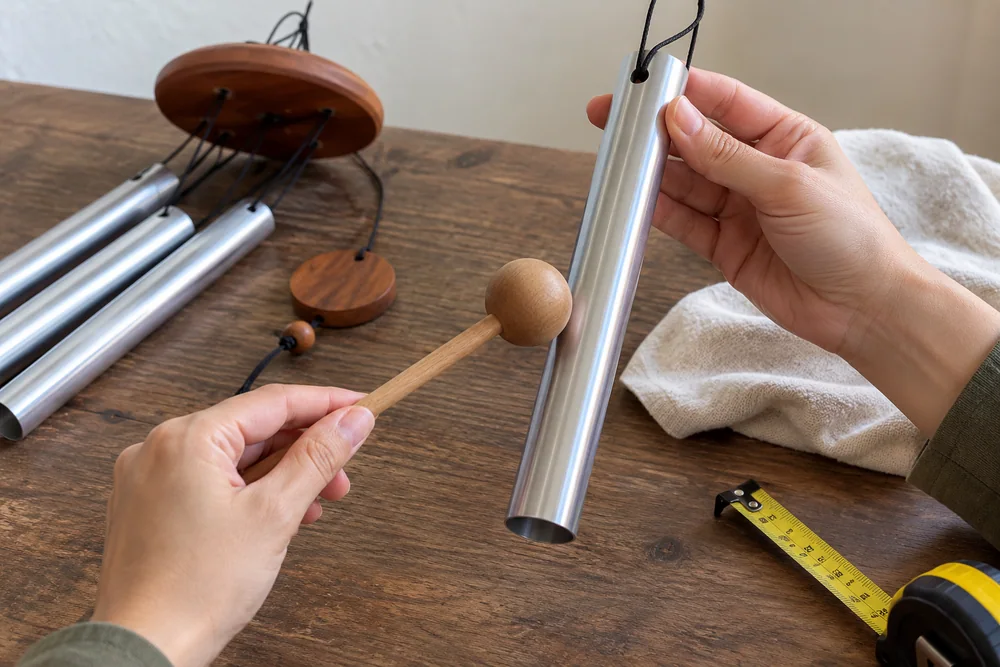
Occasional changes in sound need not mean the metal has become defective. Check whether the striker is off-centre, a cord is tangled, a tube is touching a wall, or the sail has been caught around another part. A cracked support or frayed load-bearing cord is a safety issue: keep people clear of the fall zone and arrange safe removal before repair. Support the assembly, use stable access and seek qualified assistance for a high or heavy hanging.
- Too much clanging: Check clearance from walls and rails, the movement of the sail and the force of local breezes; do not improvise extra weights that increase loading.
- Weak ringing: Examine whether a striker is reaching the tubes and whether the suspension is damping a sounding piece.
- Unexpected rattle: Inspect loose rings, broken decorative parts, wear at tube holes and a detached striker or sail.
- Different pitch or sustain after repair: Confirm the original tube order, hanging height and suspension points, especially for tuned models.
- Uneven volume: Check the real playing pattern and mounting location before assuming one metal tube is faulty.
Dust gently and use the verified maker's cleaning instructions for the actual metal, coating, cords, wood or attached ornaments. Do not cut tubes or re-drill suspension holes to improve tone without the appropriate acoustic design or manufacturer guidance. Browse the broader Hangings & Chimes collection for different construction styles.
13. Sound, Nada and Vastu-inspired placement
Sound is important in Indian religious and musical life through nada, the intentional ringing of a ghanta in worship, and musical systems including svara and raga. Those are rich, distinct traditions. A contemporary tubular wind chime may be chosen for beauty, personal reflection or pleasant incidental sound, but it is not automatically a consecrated ritual bell or an instrument performing mantra.
Vastu Shastra concerns the design and arrangement of spaces, including orientation, openings, light, ventilation and traditional principles such as the Vastu Purusha Mandala. Some modern Vastu-inspired decoration associates breeze-driven movement with Vayu and sound with Akasha. These interpretations do not establish a universal classical rule requiring a specific number of tubes, a named frequency or a precise musical scale in one direction.
Contemporary west or northwest recommendations for certain metal chimes often come from Chinese Feng Shui's separate five-phase framework, rather than the Indian Pancha Mahabhuta model. A safe, comfortably audible location should be prioritised. Avoid claims that one metal, tone, chime count or frequency automatically brings health, prosperity or planetary correction.
For broader Indian architectural context see Vastu Shastra, or browse OmmRudraksha's Vastu collection.
Frequently asked questions
Why do two wind chimes made of aluminium sound different?
Their tube lengths, diameters, wall thicknesses, suspension points, strikers and tuning may be different. Aluminium alone does not specify a finished sound.
Do longer wind-chime tubes always sound deeper?
For otherwise comparable free-vibrating tubes, longer tubes generally have lower bending pitches. Different cross-sections or materials can change the comparison.
Is the main sound the air vibrating inside a metal tube?
In many conventional struck metal chimes, bending vibration of the tube itself is the dominant source. This differs from the principal mechanism of a flute or organ pipe.
Can five tubes guarantee a pentatonic musical scale?
No. Pentatonic refers to the selected notes, not merely the number of tubes. The actual scale requires a maker's verified notes or measured pitches.
Does a heavier striker always give a better sound?
No. Weight, shape, hardness and contact position interact with the particular tubes. Excessive force can damage parts or create unwanted sound.
Why does the same chime ring more often on a balcony than indoors?
The strength and pattern of airflow, wind sail movement and proximity to surrounding surfaces differ between locations.
Does the chime play a fixed melody when it is tuned?
Usually not. A tuned set can contain related pitches, but the wind determines the timing and order of strikes in a conventional design.
Is a recorded sound sample a guarantee of home volume?
No. Recording distance, microphone settings, playback equipment, local reflections, wind and background noise affect what is heard.
Do wind-chime sounds have scientifically established chakra frequencies?
The acoustic frequencies of an actual sounding piece can be measured, but that does not establish a universal chakra, health or astrological effect. Claims of a particular spiritual correspondence need their own clearly identified tradition and evidence.
Explore related OmmRudraksha designs
Compare other formats in Metal Wind Chimes, including the Aluminium Tube Wind Chime and the Copper Tube Wind Chime. For different sounding mechanisms and visual ornaments, see the Hangings & Chimes collection. Confirm the actual materials, tuning and availability of the specific model before ordering.


