

Traditional Kutch bell making is a metalworking and sound-making craft rooted in the pastoral life of western India. Artisans shape iron sheet into a hollow bell, use copper-containing mixtures and firing to create a distinctive surface, fit a clapper and adjust the finished piece by ear and hammer. The result is not simply an ordinary solid-copper bell or a machine-cast brass ornament. Each step—from construction to sound—deserves to be described accurately.
The craft is associated with Kachchh (also written Kutch) in Gujarat, particularly communities and workshops connected with Zura, Nirona and the wider Bhuj area. The bells were historically useful to livestock herders and today also appear in entrance hangings, bell strings, decorative mobiles and some wind-driven arrangements. This guide explores the craft's materials, techniques, sound, history and practical care, while explaining why a rustic copper colour alone is not proof that an individual product was made by a Kutch artisan.
1. What distinguishes a traditional Kutch bell?
Many common shop labels—“copper bell,” “brass bell,” “antique bell” and “handmade bell”—describe a colour or broad retail family rather than a verified craft tradition. Kutch copper-coated iron bells are notable for their shaped sheet-metal construction, characteristic fired metallic surface, manually fitted striking mechanism and the skill of tuning their tone. The documented method is different from casting a bell entirely from molten brass in a mould.
Sources including India's D'Source design documentation and the District Kachchh administration record sheet-metal working, heating, surface treatment and individual sound adjustment. Depending on workshop and documentation, joining details and coating mixtures may vary. It is therefore more accurate to describe a well-documented craft family than to assert that every artisan uses one identical operation or formula.
In a product description, distinguish the underlying bell body, the surface coating, the clapper and the hanging fittings. Copper-toned colour can arise from a metal-rich finish over iron; it does not establish that the bell was cast from solid copper or that its complete assembly contains only one metal.
2. Kutch, Sindh and the pastoral history of the bell
The craft has a close relationship with the livestock-keeping communities of the Kachchh region. The district government's handicraft account and the Khamir craft organisation describe historical connections with Sindh, now in Pakistan, and with families of Lohar or Luhar metalworkers. Pastoral groups including Maldharis, Rabaris and Bharvads were important users of these bells.
Livestock bells have a practical purpose. In an open grazing landscape, the sound of a bell can help a herder attend to the movement and location of animals. Differences in size and tone can contribute to recognition within a herd. Historical accounts describe the dialogue between pastoral clients and bell makers over a desired sound. That relationship between livelihood, material skill and listening is central to the craft's story.
Contemporary accounts often associate workshops with villages such as Zura and Nirona near Bhuj, though craft practice is not confined to a single shop. Modern demand has expanded the use of bells from livestock equipment to interior décor, hanging accents, souvenirs and designed sound arrangements. These new forms can support artisan livelihoods, but the word “traditional” should still be tied to a real source and method.
It is unhelpful to present every bell in Gujarat as the product of one caste, religion or individual family. Identify a verified workshop, maker or craft organisation when known, and otherwise describe the documented regional tradition without claiming an unverified connection.
3. The bell is often iron with a copper-rich finish—not solid copper
A key buying distinction is the bell body's metal. D'Source documents the use of iron sheet shaped into the cylindrical body and domed crown, followed by a surface treatment involving copper- and zinc-bearing powder. Khamir also describes copper and brass powder and a clay-and-cotton firing stage. Formulations and operations may differ by maker and period, but this evidence cautions against calling the entire bell “pure copper.”
Likewise, a warm brass-like or bronze-like finish does not prove a cast brass or bronze body. An artisan may use a recycled iron sheet and then apply a metallic coating; the natural colour variation can be visually appealing. “Copper-coated iron bell” is a useful construction description when the supplier confirms that construction for the actual item.
Metal composition cannot be determined from appearance alone. Even a bell with an attractive mottled red-brown, golden or dark patina might be a commercial imitation, an unrelated metal craft or an industrially finished product. Marketing should not turn a resemblance into a claim of origin or hand technique.
| Product description | What it may actually mean | Evidence to request |
|---|---|---|
| Traditional Kutch copper-coated bell | Iron-sheet bell with craft-applied copper-containing fired finish | Artisan/workshop, actual material declaration, manufacturing method and provenance |
| Solid copper bell | Body made primarily from copper, if genuinely specified | Maker's material declaration or appropriate composition evidence |
| Cast brass bell | Bell body cast from a copper–zinc alloy | Alloy, casting method, maker and finish specification |
| Copper-colour decorative bell | Any base material with a copper-like applied colour | Actual base, whether coating is paint/plating, and clear product photographs |
| Kutch-inspired rustic bell | Modern visual design referencing a regional appearance | Exact, nonmisleading design description; do not assert regional manufacture |
4. Shaping the bell body and upper crown
The process begins with preparation of the metal sheet. In D'Source's illustrated workshop account, artisans mark and cut iron to the required dimensions, shape it into a hollow cylinder and form a separate rounded or dome-like upper crown. A hanging eye or handle must also be attached in a way that can carry the finished object.
Skilled hammering shapes the form, smooths edges and affects how the pieces join. The D'Source case study describes a body and crown carefully interlocked through shaping and hammering without welding in the workshop it documented. Another craft-organisation description discusses a welded connection. These should not be flattened into a universal statement: joining methods may differ in the recorded traditions or individual production settings.
For the buyer, the important result is a structurally sound, correctly formed bell with a secure upper connection. Look for splits, poorly attached loops and dangerous sharp edges. Irregular hand-hammered surfaces can be part of a craft object's character; a weak seam or damaged hanging eye is a separate issue.
5. Mud coating, metal powder and kiln firing
After shaping, the bell enters the characteristic surface-treatment process described by craft researchers. D'Source records dipping the formed metal piece in a mud-water mixture so fine copper- and zinc-bearing powder can adhere. The coated object is wrapped with a preparation of clay and cotton and placed into a heated kiln or furnace. After firing and cooling, the temporary clay covering is removed.
Khamir's account similarly describes coating with powdered brass and copper, wrapping in local clay and cotton, firing and finishing. The exact proportions, heating arrangements, joined construction and finishing steps should not be copied as a rigid recipe for every workshop. These steps describe the craft rather than a home metalworking method; high-temperature firing requires appropriate workshop equipment and expertise.
Firing and surface treatment help produce the distinctive warm and often variegated finish associated with this craft. The finished colour may include yellow-gold, reddish, brown or darker patches, affected by technique and later handling. A maker's own photographs and records are better evidence of authenticity than an unusually uniform antique-style coating.
Do not promise that every traditionally coated bell has identical corrosion resistance, exact alloy composition or permanent gloss. Actual exposure, finishing and maintenance matter.
6. The clapper: why a bell needs the correct striking piece
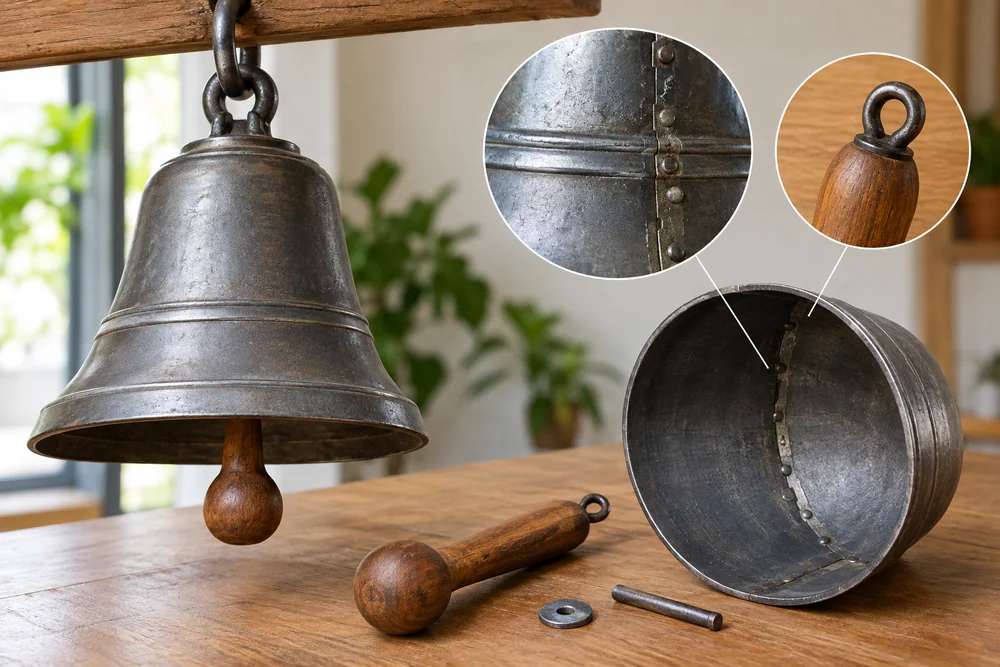
A hollow bell does not ring in the intended way unless something causes its body to vibrate. In many Kutch craft bells, a wooden clapper is fitted inside the metal body, attached by an appropriate connection so it can strike when the bell moves. D'Source documents shaping and fitting a wooden clapper, while Khamir records the use of a dense wooden ringer in its craft description.
Not every bell sold in a shop has the same clapper. Some may have a different timber, a metal clapper, a replacement part or no functioning clapper at all. Verify the clapper material and attachment on the actual bell. A decorative miniature might look like a traditional livestock bell but be intended solely for visual use.
Clapper shape, hardness, mass, length and contact position affect the attack and resulting sound. A very heavy or incorrectly positioned striker may produce harsh impacts or damage a weak bell; a loose clapper can detach. For a home hanging, inspect the fitting before deciding it can ring freely in a breeze.
7. Hammer tuning: listening is part of the craft
One of the most valued skills is tuning the individual bell by hand. The D'Source account describes the artisan adjusting sound through controlled hammering after firing and fitting the clapper. The district government's account also describes conversations with pastoral buyers who had preferences for particular tones. This emphasises that the instrument's usefulness was connected to its audible character as well as its outward form.
Tuning can involve adjustments to the bell's body, shape and vibration, but it does not automatically imply that every decorative bell has a verified concert pitch or forms part of a Western tempered scale. Traditional sound matching, tonal judgement and manufacturer-documented musical-note sets are related but distinct ideas.
A set of three bells may be chosen for contrasting tones, and a craft maker may deliberately coordinate them, but three bells alone do not guarantee three named musical notes. When a retail listing promises a specific scale, pitch, raga or “frequency,” it should cite the actual maker's testing or a measured specification for that very model.
Recording conditions also matter. A phone recording may exaggerate high-frequency contact or fail to capture sustain; volume depends on microphone distance and the environment. An authentic demonstration is useful, but it cannot guarantee how often a bell will sound when hung in a particular balcony.
8. Livestock bells, single hanging bells and decorative chime sets
Historically, a livestock bell is an object intended for use with an animal and its movements. Modern home décor can rearrange related bells into a vertical string, a doorway cluster, a horizontal hanging or an ornamental frame. Such pieces may sound through movement, contact or deliberate touching, but their purposes, mounting and wear conditions differ.
A single bell has one main resonant body; an arrangement of several bells has multiple resonant bodies. A conventional tubular wind chime instead often uses suspended tubes and a central striker moved by a wind sail. A decorative Kutch-style bell cluster can therefore be a bell hanging even if a retailer loosely calls it a wind chime.
Check whether a frame is metal or wood, how many bells are included, whether each bell has a functioning clapper, and how the hanging is intended to move. If a product has rope, leather or textile straps, identify their actual condition and outdoor limitations separately from the bell metal.
| Arrangement | Main use | Critical buying or installation check |
|---|---|---|
| Single Kutch craft bell | One decorative or sounding accent | Maker provenance, clapper, eye strength, material and sound |
| Vertical bell string | Several bells on one hanging line | Combined weight, cord capacity, spacing and lowest drop |
| Doorway bell cluster | Entrance ornament with possible intermittent ringing | Door swing, headroom, strong fixing and neighbour comfort |
| Framed wind-driven bell hanging | Movable group activated by air | Whether bells can ring freely without violent collision |
| Miniature souvenir or charm | Visual craft reference | Actual origin, decorative versus functional clapper, small-parts safety |
9. What makes a Kutch-origin claim credible?
There is a difference between describing the history of a regional craft and asserting that a particular object comes from that craft. A reliable product listing should be able to identify the supplying workshop or artisan, place of manufacture and supporting purchase or maker records. An artisan collective's documentation, invoice or verified supplier chain can help substantiate that origin.
Rustic texture, hammer marks, a copper-coloured finish or a photograph of the Rann of Kutch are insufficient by themselves. A mass-produced imitation might share some visual characteristics without having been made by the documented craft process. Where the source is unconfirmed, use a plain factual name such as rustic metal hanging bell and explain the construction that is genuinely known.
The phrase Kutch-inspired should itself be used thoughtfully. It can honestly describe a design influence if that influence is evident and the wording makes clear that the object is not claimed to originate in Kutch. It should never be a way to avoid proper provenance while making the overall product appear authenticated.
10. Geographical indication claims require extra care
A Geographical Indication (GI) is a legal form of protection for qualifying goods linked to a geographical origin. It is not a general synonym for handmade quality, nor can an ordinary seller attach the term “GI-certified” to an individual bell without appropriate status and authorisation evidence.
In the official Intellectual Property India record retrieved on 26 November 2026, application 1240 for Copper Bell of Kutch (Gujarat) lists its status as “Examination”. The application was filed on 29 April 2024 and its public detail page does not display a registration certificate or valid-until date. The retrieved registry page is not a real-time status confirmation. Check the latest official record before relying on any claim of registration.
Even if an applicable GI registration or later status is established, that alone would not verify the maker, authorised use or origin of every bell sold online. Ask for current primary documentation supporting any GI, origin-certificate or authorised-user claim for the specific bell.
11. Decorative uses that respect the original craft
Kutch bells can be appreciated as individual objects of skilled metalwork or arranged into thoughtfully designed decorative hangings. A single bell can provide a visual focus beside a protected entrance; two or three bells can produce contrasting tones when touched. A group hung in a sheltered veranda may ring occasionally if air can move its clappers.
The choice should consider how loudly and frequently the object rings. A chime above a shared apartment corridor may disturb a neighbour even though its sound is pleasant at a craft stall. In a study, meditation area or puja room, a family may prefer deliberate sound rather than continuous wind-driven motion. A stationary textile toran or bead hanging can express an entrance theme without audible ringing.
When combining craft bells with beadwork, embroidered cloth, mirrors or other ornaments, do not assume every component comes from the same region or workshop. Describe the bell maker and any separately sourced decorative elements transparently. A modern arrangement can celebrate Kutch craft without presenting the entire assembly as a centuries-old original form.
For other sounding and suspended décor, browse Hangings & Chimes and the Metal Wind Chimes collection.
12. Mounting and safety for heavy metal bell hangings
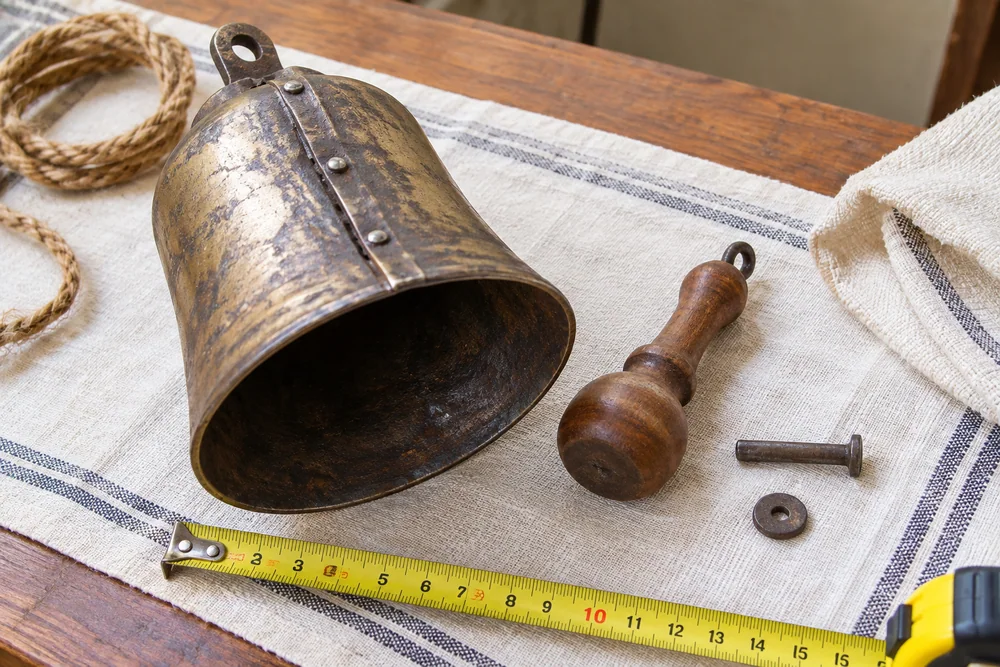
A craft bell can have more weight than its photograph suggests. In a cluster, the total load includes every bell, clapper, cord, frame, ring and decorative element. Wind or door movement produces changing forces on its support. A small adhesive picture hook is not automatically suitable for an overhead moving arrangement, even if it carries a stationary object of comparable weight.
Choose a fixing appropriate to the actual substrate and assembly. Solid wood, appropriate masonry or concrete, a hollow partition and decorative ceiling trim have different requirements. Follow the hook or anchor maker's instructions and seek qualified installation advice where the surface is uncertain. Check that a hanging eye cannot slip or open under normal movement.
Measure from the upper support to the lowest part. Allow enough room for the bell or group to swing without hitting windows, railings, walls, fans, doors or people. Avoid heavy bells above cots, occupied seating or busy walkways where a support failure would create unnecessary danger. Loose cords and detachable small clappers should remain out of children's reach.
For an exposed balcony, verify the complete item's suitability: the iron body, copper-rich surface, clapper, hanging eye, textile, rope and connectors may respond differently to rain or salt air. Plan for safe removal before monsoon storms rather than trying to retrieve the item during dangerous winds. Support the entire assembly and use safe access; seek assistance for a heavy or high-mounted cluster.
13. Caring for the surface without erasing the finish
Part of a traditional bell's appearance can be the uneven warm finish arising from its coating and later use. Aggressive polishing can change that surface, expose a different metal underneath or remove valued patina. Do not assume that a copper-coloured bell should be cleaned like solid bare copper. Identify the actual maker's finishing method and any lacquer, wax or applied coating before using products intended for other metals.
For routine care, support the object and begin with a clean soft dry cloth. Look inside the bell for dust, loose clapper fittings or sharp edges and examine the upper eye for wear. If the surface is corroding or flaking, obtain suitable care advice rather than covering the problem with paint or polish.
Where a bell has an iron core, moisture and damaged coating may expose areas vulnerable to corrosion. A superficial aged finish and structural rust around a joint are not the same thing. Check the load-bearing parts carefully; if there is significant material loss or a failing connection, remove the bell from overhead use.
Wooden clappers may crack or swell with repeated moisture, and cords may fray from wind or abrasion. Follow the actual maker's cleaning and repair guidance where available. Store items dry, with individual bells separated to avoid hard impacts. Avoid tightly knotting multiple suspension strands around sharp metal edges.
14. Handmade work, artisanship and responsible descriptions
Handmade craft can carry variations in tone, dimensions and surface. Those variations are not automatically defects, but neither are they proof of authenticity. Buyers need truthful measurements, the right number of bells, the actual material composition, a clear sound demonstration where relevant and an explanation of what minor finish differences are expected.
The relationship with the maker matters. When a workshop or artisan organisation can be named with permission and supported by documentation, a product story can meaningfully describe its materials, method and contribution to craft livelihoods. Without records, avoid invented family histories, claims that an item was made in Nirona or Zura, assertions of an exact age, or unsupported certifications.
Recycled iron sheet may feature in the documented process, but that does not establish a measurable environmental benefit for every individual bell or prove that an entire decorative hanging is made from recycled materials. Coatings, clay firing fuel, new fittings, packaging and transport are also part of its production. Sustainability claims require their own support.
15. Kutch bells, ghanta and Vastu Shastra
Indian devotional traditions include the intentionally rung ghanta, and broader music and contemplative thought gives significance to nada, or sound. Kutch livestock bells have a documented pastoral craft lineage that is not automatically identical to the making or consecration of a ritual temple bell. A decorative bell can be culturally evocative without performing puja or producing a mantra on its own.
Vastu Shastra concerns the arrangement and interpretation of built spaces, with ideas relating to orientation, entrance, proportion, movement, light and the Vastu Purusha Mandala. A contemporary bell hanging may be selected as an entrance decoration, but there is no universal classical rule that every home requires a copper-coated Kutch bell in a specific direction. Sound, safety and household comfort remain important.
Chinese Feng Shui assigns significance to metal within its distinct five-phase framework. Its popular directional use of certain chimes should not be described as an identical teaching from Indian Pancha Mahabhuta thought. An individual craft bell cannot be promised to correct a building defect, cure illness or guarantee prosperity because of a particular alloy or tone.
For broader traditional architectural context, see Vastu Shastra and the Vastu collection. The documented cultural and artisanal value of Kutch bell making is substantial without assigning unverifiable therapeutic or astrological effects to a retail product.
16. Buying checklist for a Kutch craft bell or bell hanging
- Confirm the real maker: Ask for workshop, artisan, supplier or craft-organisation provenance if Kutch origin is claimed.
- Identify the body metal: Distinguish iron-sheet construction, copper-rich coating, solid copper and cast brass.
- Examine construction: Check body seam, domed crown, hanging loop, joints and absence of dangerous edges.
- Inspect the clapper: Is it wood, metal or another material? Is it securely attached and designed to ring?
- Listen to the actual bell: Request a genuine recording and verified pitch information for any formal tuning claim.
- Check total measurements: Include complete hanging drop, diameter, weight and any cluster or frame components.
- Verify the finish: Understand whether a coating, lacquer, patina or applied colour is present and how it should be cared for.
- Confirm usage limits: Indoor, protected outdoor or exposed balcony suitability must be supported for the whole assembly.
- Check certification and origin claims: Verify current GI registry status and individual maker or authorised-use evidence when relevant.
- Review retail details: Confirm photographs, price, stock, included hardware, packaging and any artisan-attribution permissions.
Frequently asked questions
Are traditional Kutch copper bells made of solid copper?
Many documented Kutch craft bells use shaped iron-sheet bodies with copper- and other metal-containing surface treatments. Confirm the materials of the specific bell separately.
What does ghantadi refer to?
Ghantadi is a term used in craft descriptions of traditional metal bell making in Kachchh, associated with workshops and artisan communities who have supplied bells to pastoral users and other customers.
Where are traditional Kutch bells made?
Craft documentation describes production associated with Zura, Nirona and other parts of the Kachchh/Bhuj region. A particular product's place of manufacture requires individual supplier evidence.
How are Kutch bells given their colour?
Documented workshops use metal-rich powders, clay or mud-related preparation and kiln firing to create a characteristic finish over shaped metal. Exact mixtures and joining methods vary by production setting.
Why do different Kutch bells sound different?
Body geometry, metal construction, clapper, impact and artisan tuning affect the sound. Traditional makers may adjust tone through skilled hammering; a fixed note or scale should be documented for the specific bell if claimed.
Is every rustic bell labelled Kutch genuinely made there?
No. Surface colour or texture alone is not evidence of origin. Ask for the workshop or artisan information and a traceable supplier record.
Is Copper Bell of Kutch already GI-registered?
The registry page retrieved on 26 November 2026 showed “Examination” for application 1240, without certificate details. The retrieved record may lag behind the live registry; check the current official status before relying on a registration claim.
Can I use Kutch bells outdoors during monsoon weather?
Only within the maker's documented exposure limits for the entire hanging, including iron body, coating, loop, wooden clapper and cords. Remove vulnerable items in advance of severe weather while it is safe.
Is a Kutch craft bell the same as a puja ghanta?
Not automatically. The Kutch craft has a strong pastoral and decorative history, while a ghanta used intentionally in worship has its own devotional context.
Explore related OmmRudraksha hanging décor
Explore Hangings & Chimes for bell and decorative hanging styles, or compare a conventional tubular design in Metal Wind Chimes. For wider home-decoration context see Vastu and Vastu Shastra. These internal paths must be matched to active Smartstore canonical URL records before the article is released.


