

Toran, bandhanwar and thoranam are names used for Indian doorway decorations, but no single name guarantees one material, region or ritual pattern. A toran may be freshly tied mango leaves, a marigold festoon, an embroidered Gujarati textile with mirrors, a carefully woven beadwork panel or a reusable arrangement of flowers, bells and fabric. Bandhanwar is especially familiar in Hindi-speaking retail and household contexts; thoranam or toranam is common in southern language settings. Actual local usage overlaps and varies.
This guide explores the histories, motifs, materials and construction of Indian entrance hangings without treating all regional traditions as interchangeable. It explains the importance of welcome, seasonal observances and Śaiva or wider Hindu symbolism where relevant, then turns to practical questions: what is real or artificial, what is handmade, how to measure a doorway, when to replace fresh foliage, how to protect embroidery and how to keep exits fully usable.
1. Three familiar names, overlapping meanings
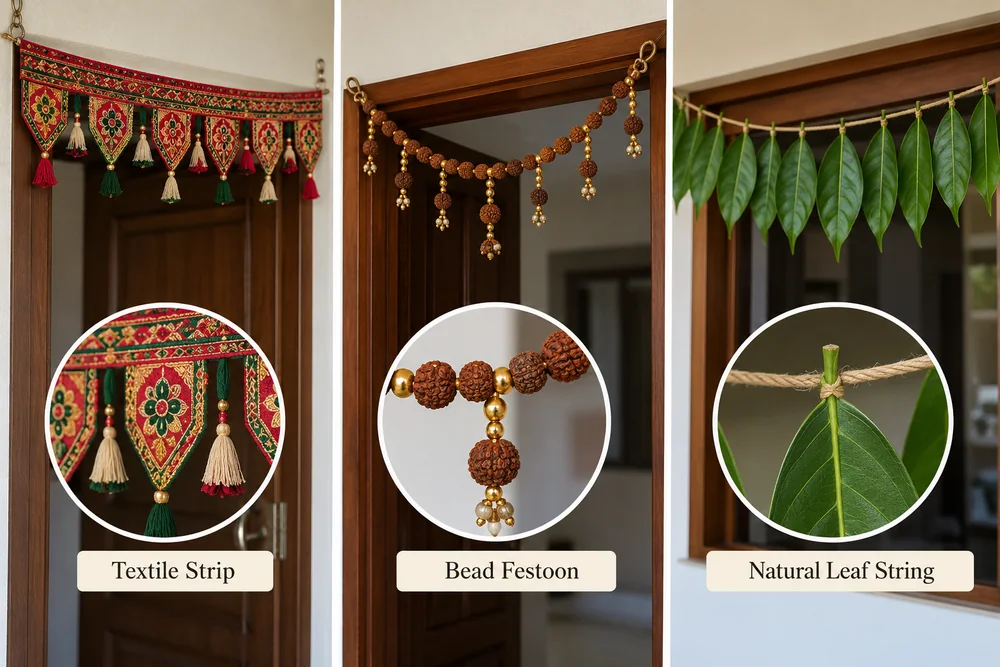
Toran is widely used across western and northern India for a decorative band or festoon placed above an entrance. In Gujarat, the word also identifies sophisticated embroidered or beaded textiles made as part of a home's welcoming display. Bandhanwar is often used for similar decorative doorway garlands, including marigold-style festoons, sewn pennants and beaded strings. Retailers frequently use the two words together because customers understand them as related objects.
Thoranam, toranam and vernacular combinations such as Tamil māvilai thoranam refer to decorative or auspicious festoons in several southern traditions. The mango leaf is a familiar material, and other plant or crafted forms can occur according to region and circumstance. Spellings differ by language and transliteration, so one spelling should not be treated as the only correct name across India.
These are useful cultural and commercial labels, not rigid, mutually exclusive technical product categories. One household may call its stitched doorway piece a toran, another a bandhanwar, and a South Indian family may use a leaf thoranam. The product's material, shape and construction should be described separately so that the name never conceals what is actually supplied.
2. An entrance as a place of welcome
Doorways occupy a significant place in Indian household customs: they mark the transition between outside and inside, between the arriving visitor and the home, and sometimes between ordinary activity and a festive or devotional occasion. The hanging can be a visible sign that the household is prepared to welcome guests or mark an important day. Its placement often accompanies cleaning, flowers, lamps or rangoli, although the combination varies.
The Cooper Hewitt Smithsonian Design Museum describes the Gujarati toran as a decoration suspended over the entrance of a main room to signify welcome. The Textile Museum of Canada also identifies western Indian torans as part of a long tradition of placing ornament above a threshold. These sources establish a history deeper than current e-commerce listings.
Historical use does not mean every household follows one prescribed pattern. A Gujarati beadwork panel, a Maharashtrian garland and a Tamil mango-leaf festoon all participate in entrance traditions but need not share the same motifs, materials or rituals. Avoid presenting one family's preferred direction, leaf count or installation date as an immutable rule for every community.
A modern family may use the object primarily for hospitality, craft appreciation, personal faith or a combination. Each reason can be expressed respectfully without promising that an ornament has measurable power to alter a home's architecture or a person's medical condition.
3. Torana in architecture and toran at the door
There is a useful distinction between a monumental torana or decorative gateway and a domestic entrance festoon. The architectural term appears in historical settings, including religious and ceremonial gateways. A small textile hanging can share vocabulary and an interest in marking thresholds, but it is not literally the same kind of object or automatically governed by every rule associated with an architectural gateway.
Cooper Hewitt notes this relationship when explaining the domestic toran. It is better to acknowledge the connection than to claim that each modern plastic-leaf garland directly reproduces one specific ancient temple portal. Religious gateways, courtly ornament, domestic embroidery and temporary fresh-leaf arrangements have distinct histories.
Likewise, the function of a home's main door differs from that of a temple ceremonial entrance, a commercial shopfront or a wedding mandap. Materials suitable to a short festival display might be inappropriate for a public fire exit or a weather-exposed gate. A meaningful visual symbol is still a physical object subject to the space around it.
4. Gujarati embroidered torans and Kutch textile work
Gujarat has a rich textile doorway-hanging tradition. Museum examples include cotton fabrics bearing silk or cotton embroidery, stitched pendants, mirrors, coloured thread and geometric or figurative patterns. Cooper Hewitt discusses a Gujarati example with mango-leaf-shaped pennants and intricate decorative needlework. The Smithsonian National Museum of Asian Art also documents Gujarati torans using mirror glass, cotton fabric and embroidery techniques.
These preserved textiles show how a toran can become more than a temporary garland: it is an object of skilled making, regional identity and decorative memory. The upper band distributes the hanging's weight, while shaped extensions provide visual rhythm below. Embroidery may be dense, with layered colours and small mirrors catching daylight.
Do not attribute every mirror-work toran to one district, caste, tribe or workshop. Kutch, Saurashtra and other parts of Gujarat have varied styles and communities. A historic museum object establishes that such craft exists; it does not prove the provenance of a contemporary product or make every machine-embroidered imitation an antique.
For a real purchase, ask whether the fabric is hand embroidered, machine stitched, block printed or appliquéd; whether mirrors are genuine glass or reflective plastic; and how pennants and upper loops are attached. Respect for artisans starts with clear and verifiable descriptions of what they actually made.
5. Saurashtra beadwork and woven toran forms
Beadwork has its own place in western Indian entrance decoration. The Textile Museum of Canada records moti bharat beadwork associated with Saurashtra, while the Nelson-Atkins Museum of Art documents a beaded toran that frames the upper part of a doorway with vertical side segments. A Museum of International Folk Art example shows a woven beadwork doorway composition with triangular flaps.
These forms are structurally different from a simple flower garland. Beads may be woven into repeat patterns on thread or backing, joined to textile bands or used to form vertical drops. Their visual rhythm can be striking, but their strength depends on thousands of small connections rather than only one large decorative piece.
When buying beadwork, inspect the backing, knots, loose ends, missing beads and the top support. The small parts may become detached if an old or poorly secured thread fails, so place the hanging beyond young children's reach. A historical museum example can help explain a technique, but a modern product needs its own evidence of origin and craftsmanship.
Do not infer that every white or coloured bead is a gemstone. Glass, wood, ceramic, plastic and natural minerals can all form decorative patterns, and the seller should name the actual material.
6. Maharashtra and Kolhapur's doorway traditions
D'source, the National Institute of Design-linked learning resource, documents traditional toran making in the Kolhapur and Sangli region of Maharashtra. Its descriptions discuss the use of mango leaves, marigolds, coconut, wool threads, mirrors and other decorative materials in varied traditional settings. This makes it clear that even within western India, the doorway hanging is not restricted to one Gujarati embroidery pattern.
Some forms are suitable for festivals or weddings; others are crafted for repeat display. A handmade Maharashtra-style toran may be more robust than a fresh leaf string, but the details still depend on the actual backing and ornaments. It is appropriate to describe a regional style when evidence supports it; claiming that every similar object was made in Kolhapur is a stronger statement requiring sourcing information.
Regional festival practices, household preferences and materials may change over time. New materials and techniques do not erase the older traditions, but they should be explained honestly. A reusable flower-shaped polyester garland, for example, is not the same material as fresh marigold flowers even if both use a familiar colour pattern.
7. Thoranam and mango-leaf festoons in South India
In Tamil and other South Indian contexts, a māvilai thoranam is a doorway festoon associated with mango leaves. Anthropological research on South Indian household ritual life describes mango leaves suspended over a threshold and their importance in domestic symbolism. The manner of tying, shape and occasions vary; additional plant materials such as coconut or palm leaves and flowers may appear in different local practices.
It is common to see such decorations for celebrations, household pūjā, weddings and other auspicious occasions. Specific Tamil, Kannada, Telugu, Malayalam or other household practices should not be collapsed into one fixed southern rule. Language and lineage matter, as do the intended space and the actual person organising the ceremony.
Banana plants or leaves are sometimes placed at or near entrances in festival settings, but this is not identical to a small leaf string fixed at the lintel. The botanical material and installation method differ greatly. A pair of banana stems requires a different stable support and clearance from a light thread of mango leaves.
For a current retail listing, distinguish fresh mango-leaf thoranam from a cloth or plastic representation. The first is perishable and time-sensitive; the second may be reusable but has its own finish and care conditions. Neither material should be misdescribed to make it sound more traditional or more permanent than it really is.
8. Fresh leaves, flowers and herbal descriptions
Fresh mango leaves, marigolds, coconut or palm materials and other regional plant elements may feature in doorway decorations. These plant choices can have ceremonial and seasonal significance, but a plant's familiar name is not by itself evidence of a medicinal treatment. Describing a door hanging as “herbal” should be reserved for real botanical material and should say which plants are present.
A dried or treated herbal-looking garland may contain wood, synthetic fibres, painted ornaments or flowers mixed with natural elements. Its product page should identify the composition rather than describing all green pieces as living leaves. If an item uses an unfamiliar plant, check whether it is appropriate for household exposure, especially around pets or sensitive occupants, without making unsupported claims about insect repellence or air purification.
Fresh foliage naturally loses moisture. Leaves may curl or brown, flowers can wilt and petals may fall. In humid conditions, wet bundled plant matter may deteriorate or support mould. Its useful display life varies with species, harvesting, temperature and handling, so no universally guaranteed freshness period should be invented for all Indian climates.
Replace perishable material when its condition requires it, handle sources responsibly, and keep loose leaves and petals out of busy thresholds. A sacred association need not prevent sensible removal of decaying natural material after a ceremony.
9. Motifs: mango leaves, peacocks, lotuses, mirrors and Om
Decorative motifs can communicate continuity, beauty, protection or welcome according to specific communities and religious interpretations. Mango-leaf shapes are familiar in stitched pennants and botanical festoons. Peacocks, lotuses, flowers, elephants, paisleys and geometric patterns appear in various Indian arts and may also decorate torans. Mirrors can reflect ambient light and add to the visual texture.
Religious symbols such as Om, a kalasha or deity imagery should be described with appropriate respect and cultural accuracy. The fact that a motif appears on a decorative product does not mean every household wants it or that the object has been ritually consecrated. A recipient may prefer a neutral floral toran; another may choose a specifically devotional design for a puja-room entrance.
A maker may create an original modern interpretation of a traditional leaf or peacock motif. That is not inherently inauthentic, but it should not be claimed to reproduce a particular historical pattern or community's work without a verified relationship. When a design combines motifs from multiple traditions, do not invent a single ancient textual source for the entire contemporary composition.
10. Compare the physical forms before shopping
| Type | Typical components | Distinctive use | What to check |
|---|---|---|---|
| Fresh mango-leaf toran / thoranam | Real leaves tied on natural or manufactured cord | Seasonal or ceremonial entrance display | Freshness, exact plant, replacement timing and secure light attachment |
| Fresh flower festoon | Marigolds or other flowers and string | Festival, wedding and household welcome | Condition, shedding, local timely supply and separation from flames |
| Embroidered Gujarati toran | Fabric band, thread embroidery, pennants, possible mirrors | Reusable textile craft and aesthetic welcome | Handmade claim, stitching, edges, widths and dust care |
| Beaded bandhanwar | Woven beads, backing, knots and attached drops | Repeating patterns and elaborate doorway framing | Bead type, loose pieces, weight, thread and child safety |
| Artificial floral or leaf toran | Fabric, plastic, foam, wire or mixed imitation foliage | Reusable alternative to perishable plants | Actual material, sunlight fading, fire separation and finish |
| Bell-and-bead hanging | Metal bells, cords, beads, rings and possible clappers | Visual ornament and perhaps occasional sound | Metal identity, actual ringing, complete load and noise |
| Gemstone or Rudraksha doorway design | Natural or manufactured beads and a support system | Mineral texture or devotional symbolism | Stone or endocarp identity, Mukhi, drilling, care and mounting |
This is a practical classification, not a list of mandated ritual grades or a claim that any particular OmmRudraksha item has been independently tested. A mixed product may belong to more than one row, making its complete material inventory especially important.
11. Constructing a leaf festoon: thread, stems and weight
A fresh leaf toran may appear simple, but its strength depends on how leaves are attached to a cord, the condition of the leaf stems and the security of the two ends. Foliage becomes lighter or more brittle as it dries, sometimes changing the way it hangs. A short daily-use arrangement may be more manageable than an elaborate string stretched across a wide entrance without sufficient support.
Use suitable, undamaged botanical material and a cord that does not tear easily under the intended light load. Avoid piercing or tying so tightly that the leaves immediately split. A ceremonial method may be specified by a household tradition; describe it as that practice rather than the only acceptable method everywhere.
Keep the decoration sufficiently high that visitors are not forced to duck or push it aside, and do not place foliage against a light fixture, open diya or hot lamp. Do not attach the string to door hardware that must move or latch. If the toran has no safe fixing point, select a smaller or alternative display rather than making a hazard.
Freshness should be checked before installation, during the event and when removing the garland. Do not promise that a delivered fresh piece will remain unchanged for a fixed number of days without actual delivery and storage evidence.
12. Textile toran construction: upper band, embroidery and pennants
A well-made textile toran has an upper structure that carries the weight of the embroidered or appliquéd elements beneath it. A reinforced band, sound end loops and securely attached pennants help preserve the shape. Stitched mirrors, bells or beads create additional concentrated loads; they should not hang only from loose decorative threads.
The item may be handmade, machine embroidered or assembled using several techniques. A machine-made band is not necessarily poor quality, and hand stitching is not automatically durable. Ask for photographs of the rear, upper attachment loops, edge finishing and mirror attachment. The back often reveals whether the weight is supported by proper construction or one thin thread.
Textile conservation guidance favours avoiding unnecessary handling, abrasion, excessive moisture, strong light and poorly supported storage. A heavily decorated hanging with mirrors or metallic thread should not be machine washed simply because its basic fabric looks like cotton. Follow the maker's instructions for the actual dyes, threads and embellishments.
A reusable toran can become a long-term household object when its construction suits the room, but “reusable” is not a promise of permanent outdoor colour, immunity to dust or zero maintenance.
13. Beadwork, bells and modern mixed hanging construction
Beaded bandhanwars may use woven strings, multiple strands, sequins, shells, glass, plastic or natural stones. Their durability depends on thread, knots, crimps, connecting rings and the complete load. A single loosened row can release a number of small beads even if the main horizontal band remains attached.
A bell should be identified by its actual metal body and clapper where claimed. A copper-coloured bell may be coated iron, plated alloy, brass or another material, and a bell-shaped charm may be silent. If the product claims musical tuning or hand-crafted Kutch origin, require model-specific or source-specific documentation rather than accepting the shape alone as proof.
A Rudraksha bead is an organic Elaeocarpus fruit endocarp; a specialist natural Mukhi count requires evidence for the actual bead. Clear Sphatik means rock crystal quartz in common Indian gemstone commerce, not any clear glass or acrylic bead. Avoid describing every material in a contemporary bandhanwar as natural, untreated, certified or consecrated without corresponding facts.
Check the sharp edges and drilling of each component, especially where a hard bead contacts delicate thread. A visually elaborate ornament may need an appropriate wall fixture rather than a lightweight removable adhesive tab.
14. Doorway measurements: width, drop and swing clearance
Before ordering, measure the intended mounting span and the usable doorway. The overall width of a toran may include both end loops; the complete drop includes the longest pennant, tassel, dangling bead or bell. Retail photographs sometimes show only the embroidered band or one central element, which is not enough to establish the true fit.
Check the door through its full opening and closing movement. A decoration hanging from the fixed lintel may still contact a door closer or security grille when opened. A vertical drop beside the frame can interfere with handles, locks, intercoms or people carrying bags. Do not assume that a comfortable gap when the door is closed remains adequate when it swings.
Do not prescribe one universal safe height or clearance without the real doorway, people who use it and applicable building requirements. The decoration should not make anyone duck, obstruct mobility aids, reduce a required exit width or interfere with the operation of a door. A lower-profile toran or adjacent-wall hanging is often the better choice when space is limited.
For a rented apartment or common-area entrance, confirm where attachments are permitted. Do not modify a fire-rated door, damage a safety seal or conceal exit signage to mount a decorative textile.
15. Fire, child and pet safety at the threshold
Some torans use dry leaves, cotton cloth, synthetic fabric, foam, glue or painted decorations. These materials can burn or melt if placed too close to open flames or heat. Keep garlands away from lit diyas, incense embers, exposed bulbs, hot fittings and electrical wiring. Decorative light strings also need manufacturer-approved installation and should not be wrapped indiscriminately around perishable foliage.
Required exits must remain unobstructed. Indian fire and building guidance addresses clear means of escape and appropriate doorway operation. Never attach a hanging so that a fire door cannot self-close or latch, an emergency sign is hidden, or a stairwell is narrowed. Specific building restrictions vary by location and building type, and common areas may need management authorisation.
Long accessible cords and detachable small bells or beads can be hazardous around children; glass mirrors may develop sharp edges if broken. Keep fragile, heavy and small-part arrangements out of reach. Pets may chew plant matter or pull on a hanging; do not assume all decorative leaves, dyes and adhesives are harmless if ingested.
Think about visitors too: a guest carrying a suitcase, an elderly person or a wheelchair user should not need to move the toran with their hands to pass through. Traditional welcome is best served by a genuinely welcoming and safe entrance.
16. Caring for fresh, textile and beadwork decorations
Maintenance should follow the material, not the cultural label. A fresh leaf garland needs regular condition checks and timely removal or replacement. A textile piece may need gentle dry dusting, inspection of stitches and careful storage. A beaded decoration requires attention to loose thread, knots, frayed loops and brittle connectors.
Use a soft cloth or brush where suitable, supporting the item on a clean padded surface. Do not scrub antique or delicate embroidery with abrasive cleaner, soak mirrors and metallic thread indiscriminately or attempt to brighten all metal bells with vinegar. If an item is dyed, painted, coated or glued, even mild household liquid may have unintended effects.
Store a reusable toran only after it is dry and sound. Fold or roll carefully without crushing beadwork or mirrors, and protect it from insects, leaks and heavy objects. Photograph complex arrangements before separating any detachable elements. Replace weakened support loops rather than relying on one cosmetic stitch to hold the full decoration over people's heads.
For an organic Rudraksha or gemstone combination, add the material-specific care described for those components. A quartz bead's durability does not make a neighbouring gypsum or pyrite piece safe for soaking.
17. Monsoon, sunlight and outdoor exposure
India's monsoon conditions can be demanding even for a sheltered front door. Wind-driven rain can wet fabric, soften adhesives, corrode metal fittings and damage fragile botanical materials. Extended humidity can affect dyed cords, wood and certain mineral components, while direct sun can fade some textiles and dyes.
Do not equate a photograph of a toran on an exterior gate with proof of all-weather suitability. A durable indoor embroidered toran may not survive weeks of exposed rain or strong sun. A fresh-leaf festoon can be appropriate for a brief ceremony outdoors, but it still needs safe fixing, cleanup and replacement as conditions change.
For balconies and high-rise homes, consider the consequences of a heavy bell or stone falling from an exposed position. Check secure supports and move vulnerable pieces to safety before storms when conditions permit. Do not lean out of windows or climb onto railings to retrieve decorations in severe weather.
Seasonal storage need not remove the symbolic importance of a toran. Families may preserve a treasured reusable piece for special occasions and display fresh material only at a particular time, respecting both tradition and the physical longevity of the object.
18. Festivals, griha pravesha and household differences
Toran, bandhanwar and thoranam forms can accompany Diwali, weddings, gṛha-praveśa, vrata observances, regional new-year occasions and other celebrations. A family's specific practice may call for fresh mango leaves, another plant, flowers or a particular arrangement. If the object is for an important ceremony, confirm that practice rather than buying an unrelated design purely because the shop lists it as “auspicious.”
Some households keep an embroidered toran permanently, while fresh foliage is used only for the festive period. Others may use an entirely reusable arrangement for practical reasons. Do not impose one fixed schedule for installation or removal without the family's context or the actual condition of the material.
For a gift, it is considerate to ask whether the recipient wants a religious emblem or a more neutral textile pattern. A beautiful welcome sign need not carry a deity motif, and devotional households may prefer particular symbols or materials tied to their lineage. The right choice is both respectful and easy to install safely.
The historical record demonstrates a wide range of forms rather than one compulsory product. Honouring a ceremony means learning which form belongs to that occasion, not asserting that a given hanging automatically produces a guaranteed result.
19. Vastu Shastra and the limits of modern decoration claims
Vastu Shastra is a substantial Indian tradition concerned with the design, orientation, proportion and spatial arrangement of built environments. The entrance and threshold can have interpretive importance, and families may combine traditional decoration with wider principles of care and hospitality. But a modern toran listing should not claim that every classical Vastu text prescribes exactly the same fabric, leaf count, colour or compass point in all homes.
Textile torans and fresh thoranams have their own regional and ritual histories; they should not be flattened into a generic “energy remedy.” A household may regard a doorway festoon as auspicious or devotional, and those meanings deserve acknowledgment. They do not constitute scientific proof that a particular product cures illness, guarantees wealth or resolves structural problems in a building.
Similarly, a traditional Indian toran is not identical to Chinese Feng Shui wind chimes or crystal placements. The traditions may inspire contemporary home décor, but their textual backgrounds and practices differ. A carefully written product page identifies its source rather than mixing concepts without attribution.
For architectural context, browse OmmRudraksha's Vastu Shastra overview and Vastu collection.
20. How to describe a toran honestly in a product listing
A trustworthy listing starts with a straightforward name and material description: hand-embroidered cotton toran with mirrorwork, reusable artificial marigold bandhanwar, fresh mango-leaf thoranam or beaded festival doorway hanging. The product should show real or appropriately labelled representative images and identify major components, not hide them behind a generic claim of sacred or premium material.
State the measured overall width, full drop, approximate assembled weight, number of main pennants or strands when relevant, mounting points and whether the hardware is included. Fresh plant items need accurate availability, delivery area, condition and timing; reusable textile items require realistic care and indoor/outdoor guidance. Craft-origin and handmade claims should match the actual maker or supplier evidence.
If a toran includes Rudraksha, gemstones or metal bells, list these separately, including any treatment, genuine material or Mukhi claim that affects value. An embroidered depiction of a mango leaf is not fresh botanical foliage, and a mirror-like plastic disc is not the same as mirror glass. A “Kutch-style” piece is not automatically made by an identified Kutch artisan.
Do not invent a product SKU, exact stock, rupee price, return window, artisan certificate or currently active Smartstore URL from an editorial article. These facts should come from live inventory and policy records before a product becomes publicly purchasable.
21. Final ten-point toran and thoranam buying checklist
- Identify the tradition and intended use. Decide whether the item is for daily welcome, a regional observance, Diwali, a wedding or a particular griha pravesha.
- Name the actual form. Is it fresh mango-leaf thoranam, marigold garland, textile toran, beaded bandhanwar or a mixed modern hanging?
- Verify every material. Distinguish fresh plants, artificial foliage, hand embroidery, machine stitching, glass mirrors, plastic beads, gemstones and metal bells.
- Check genuine craft claims. Ask for actual origin or artisan evidence when the listing names Kutch, Saurashtra, Kolhapur or a specific community.
- Measure full dimensions. Record total span, maximum drop including tassels, full assembled weight and attachment positions.
- Inspect the support system. Confirm upper loops, sewn bands, knotting, beadwork, clips and any required hooks for the actual substrate.
- Protect the entrance. Test the full door swing and maintain clear headroom, handles, locks, closers, exit signs and escape routes.
- Consider household safety. Separate from flames and heat, protect children and pets from cords and small parts, and avoid dangerous overhead weight.
- Plan care and freshness. Confirm replacement for leaves and flowers, safe cleaning of textiles, and weather limits for permanent displays.
- Confirm sale information. Review actual stock, real photos, materials, price, delivery suitability, returns and live public product URL.
Frequently asked questions
Are toran, bandhanwar and thoranam three completely different products?
No. Their usage overlaps across languages and households. Toran and bandhanwar often name decorative festoons at entrances; thoranam or toranam is common in southern settings. Identify the real material and regional context.
Is a traditional toran always made from mango leaves?
No. Fresh mango leaves are important in many customs, but embroidered textiles, beaded panels, flowers and other materials have established traditions. A family may have specific preferences for a particular ceremony.
What is special about Gujarati embroidered torans?
Museum collections document examples with colourful embroidery, mirrorwork, fabric bands and hanging pennants. Styles vary by maker, region, period and community; not every modern imitation is hand embroidered or a historical piece.
What does māvilai thoranam mean?
It is a Tamil term associated with a mango-leaf doorway festoon. Its form and ritual use depend on household and regional practice.
Can an artificial-leaf bandhanwar be used instead of a fresh one?
It can serve as reusable décor when the household accepts that choice. For a specific religious observance, check the family's requirements rather than substituting materials without agreement.
Are beaded torans safe in homes with small children?
They require attention to small detachable beads and accessible cords. Secure the piece above reach, inspect knots and consider a simpler design if safe placement is not possible.
How do I measure a toran for my doorway?
Measure the available attachment span and the complete drop, including the longest tassel or bead. Test full door movement, handle clearance, headroom and any regulated exit requirements.
Can I leave a textile toran outside through the monsoon?
Not automatically. Check the maker's complete material and weather guidance. Rain, wind, sun and humidity may harm threads, dyes, mirrors, metal or adhesive components.
Does Vastu require every household to use the same toran and direction?
No universal classical instruction applies across all households and building types. Choose with respect for the relevant custom, truthful materials and a safe usable entrance.
Explore OmmRudraksha doorway and Vastu collections
Browse the Hangings & Chimes collection for textile, beadwork and mixed-material designs, and use the existing Vastu collection and Vastu Shastra guide for traditional spatial context. Confirm the actual materials, dimensions and mounting requirements before choosing a doorway decoration.


