

Terracotta, ceramic and shell chimes share the appeal of decorative craft, but they are different materials with different ways of making sound and different vulnerabilities. A hollow fired-clay bell may ring when an internal clapper strikes it. Glazed ceramic pieces can sound when they touch, although a shiny surface does not make them unbreakable. Thin shell discs may produce light clicking or fluttering sounds as the breeze moves them, while a shell hanging assembled without audible contact may be primarily decorative.
For an Indian home, these differences matter when choosing an entrance hanging, sheltered veranda decoration or a quiet ornament for a balcony. This guide explains fired-clay construction, glaze and porosity, Capiz and other natural shells, acoustic expectations, safe mounting, the effects of monsoon weather and appropriate cleaning and storage. It also distinguishes traditional Indian terracotta craftsmanship from unsupported claims about the precise origin or spiritual effect of an individual product.
1. First compare the sounding mechanism, not just the colour
An earthy red bell, a brightly glazed ceramic ornament and a row of translucent discs may all be sold under “wind chimes.” Yet the relevant question is what actually produces the sound. Does a clapper hit a hollow ceramic bell? Do individual ceramic pieces collide in the wind? Are shells suspended loosely so their edges contact? Or are the pieces fixed in place with no intended musical movement?
A material name does not prove that the item functions as a chime. Some earthenware bells have decorative clappers that do not move easily. Some shell mobiles offer gentle motion and visual texture but little sound. The original model's geometry, suspension, striker or clapper and freedom of movement determine its behaviour.
| Design | What may sound | Key construction concern | Buyer check |
|---|---|---|---|
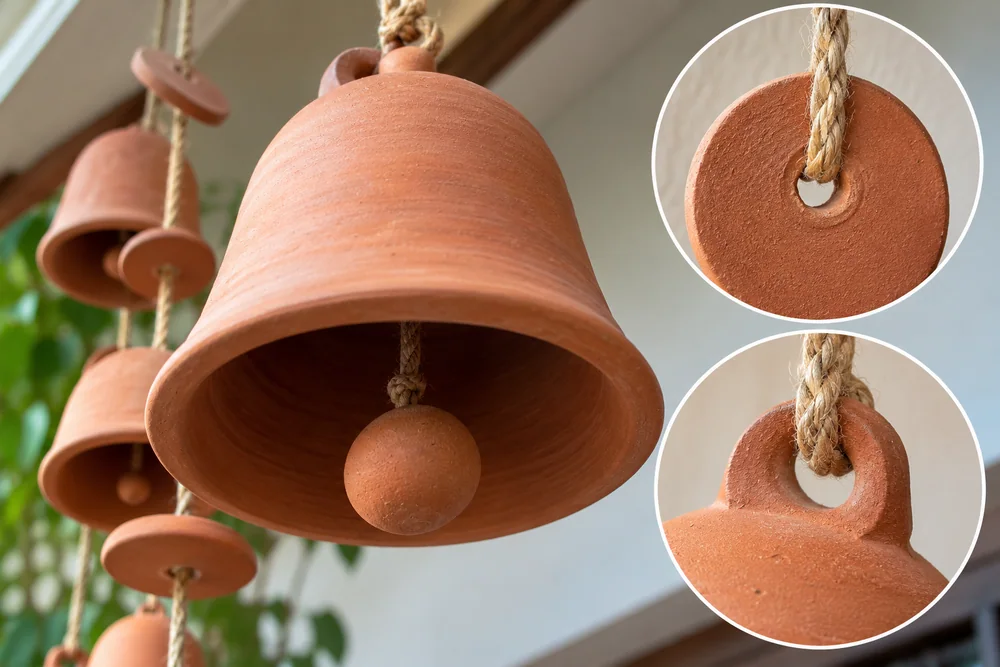
| Terracotta bell hanging | Fired-clay bell body struck by a clapper | Fragile lip, clapper connection and possible porous clay | Interior photograph, actual clapper, firing and finish |
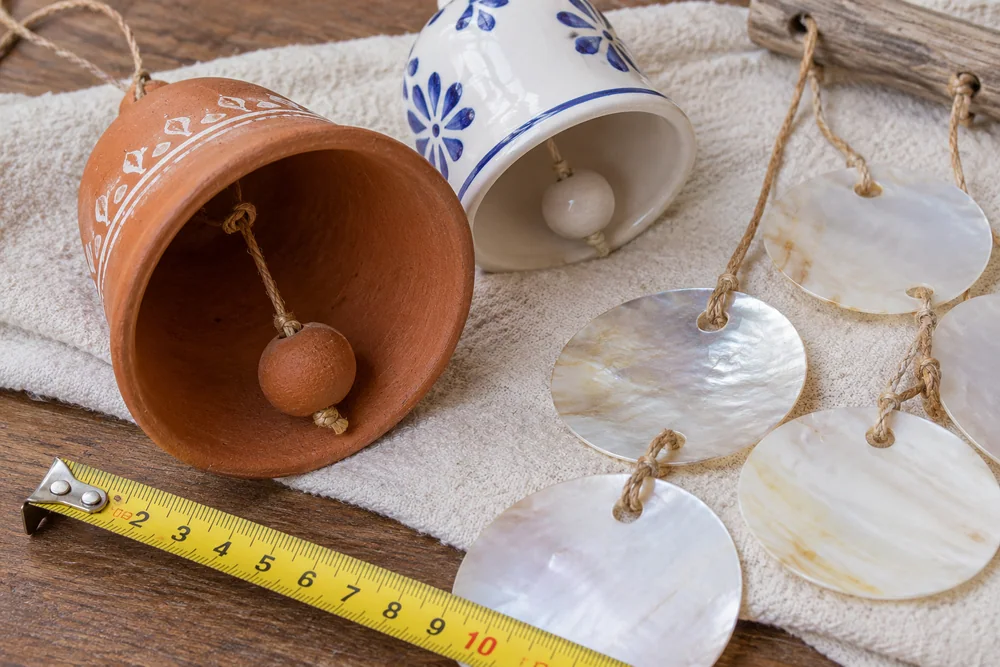
| Glazed ceramic chime | Glazed ceramic pieces struck by clapper or each other | Glaze chips, cracks, suspension holes and applied decorations | Clay body, glaze condition and true sound demonstration |
| Capiz-shell disc chime | Thin shell discs contacting in the breeze | Disc edges, drilled holes, colour coatings and fine cords | Natural shell identity, arrangement and weather limits |
| Whole-seashell hanging | Whole shells or fragments colliding, where designed to do so | Irregular shapes, drilled holes, sharp edges and weight | Shell identification, provenance and suspension |
| Silent clay or shell mobile | No designed sounding mechanism | Secure support and breakable decorative pieces | Do not market as musically tuned without evidence |
The distinction becomes particularly important when a listing uses terms such as “musical,” “hand-tuned,” “ceramic bell,” “shell chime” or “crystal shell.” Ask which exact parts are meant to ring and how that has been tested.
2. Terracotta is a type of fired ceramic, not its opposite
Terracotta is ceramic. In everyday retail descriptions the term commonly means red or earthy-coloured fired clay, often a relatively porous earthenware body with little or no glaze. By contrast, a product labelled simply “ceramic” might be glazed earthenware, stoneware, porcelain or another fired-clay construction. Presenting terracotta and ceramic as wholly unrelated categories would therefore be inaccurate.
Clay composition, firing temperature, degree of vitrification, thickness and surface treatment influence the finished object. Some low-fired earthenwares remain porous and can absorb water through unglazed areas. The University of Illinois Preservation Self-Assessment Program describes unglazed terracotta as generally coarse and porous, while the Canadian Conservation Institute warns that certain low-fired ceramics may be damaged by water and rough handling.
For a hanging bell, ask whether the clay body is fired and stable, whether it has a protective coating, and whether drilled holes and rim edges are intact. A raw-looking surface is not proof of a traditional kiln, a particular state of origin or an absence of modern finishes. Those claims require supplier information rather than visual inference.
3. What glazing changes—and what it does not
A ceramic glaze is typically a glassy coating fused to a clay body during firing. It can contribute colour, gloss, decoration and resistance to surface wetting, but the performance depends on its composition and how well it fits the underlying ceramic. Glazed earthenware can still have a porous body beneath the coating, particularly around unglazed bases, exposed holes or chipped edges.
A bright glaze is not evidence of unbreakable construction. Fine glaze cracks, commonly called crazing, can occur because of differences in expansion or contraction between glaze and clay. Some crack patterns are intentionally decorative; others signal deterioration or create paths for moisture. A photograph may not show small cracks along drilled hanging holes or inside a hollow bell.
Inspect colour details and applied ornamentation separately from the underlying ceramic. Paint, overglaze decoration, gilding, varnish or adhesive-mounted beads may be more vulnerable to cleaning than a sound fired surface. The Canadian Conservation Institute recommends assessing ceramic condition and delicate applied decoration before washing, because hard and brittle objects can chip or break during handling.
Do not use one universal cleaner for all glazed objects, and do not assume a glazed ceramic bell can be submerged when it also contains cords, metal rings, glued beads or an unknown porous interior.
4. How a terracotta or ceramic bell produces sound
A hollow fired-clay bell rings when its body vibrates after being struck, commonly by an internal hanging clapper. Shape, wall thickness, density, firing and contact point influence the audible result. A slender ceramic pendant that is tapped by another ornament can also vibrate, but not necessarily with the sustain or pitch of a carefully made bell.
Ceramic bodies are hard and brittle, so designers must balance sound production with safe contact. A clapper heavy enough to strike the rim forcefully in strong wind may damage a delicate bell. A clapper too small or improperly aligned may not sound at all. Moving parts must have room to work without repeatedly hitting a wall, glass panel or other hard fixture.
Descriptions such as “earthy,” “soft,” “rustic” and “gentle” can reflect individual listening impressions, not a universal acoustic measurement. A small terracotta bell can produce a noticeable sharp tap; a different ceramic chime may be subdued. There is no defensible claim that all terracotta chimes are quieter than all metal chimes or that red clay produces one special musical frequency.
Where an item is advertised as musically tuned, the seller should provide actual model-specific evidence. A cluster of three clay bells does not automatically correspond to three selected musical notes, and a particular earthen colour does not establish a raga, mantra or chakra tone.
5. Natural shells are biological materials, not ceramic or glass
Natural seashells are produced by molluscs and are composed mainly of calcium carbonate in mineral forms such as calcite or aragonite, along with an organic matrix. The Smithsonian National Museum of Natural History and Woods Hole Oceanographic Institution explain how animals construct these shells. This differs fundamentally from fired clay or manufactured glass.
Shell species and structures vary considerably. Some shells are thick, strongly curved and patterned; others are thin, flat and translucent. Their colour may be natural, dyed, painted or coated. A pale round disc or a pearly iridescent surface does not by itself identify the species or prove that the piece is natural shell rather than plastic or resin.
Shells may be drilled, cut and smoothed to make ornaments. Their holes and edges deserve inspection because thin shell around a cord can chip. A shell hanging may look lightweight, yet multiple pieces and metal fittings can add weight, especially when combined with beads or a wooden support.
6. What is Capiz shell?
Capiz commonly refers to the translucent shell used in decorative discs, lamps and hangings from the windowpane oyster group, especially Placuna placenta. Museum and marine research sources identify the windowpane oyster and document its use in craft. The term does not describe fired ceramic, quartz or ordinary glass.
In a Capiz chime, thin cut shell pieces are often suspended at several levels. Air movement can make the discs overlap or touch, producing light clicks or rustling rather than the long, tube-like notes of a tuned metal chime. That description is a broad construction pattern, not proof of the sound of every Capiz design.
Some Capiz discs are dyed or given decorative finishes. A strong blue, gold or rainbow colour does not always reflect the shell's natural unprocessed appearance. A supplier should distinguish real Capiz shell from “Capiz-style” plastic discs or shell-effect coatings, and identify the available sourcing information without claiming an exact species or country of origin from appearance alone.
For conservation-minded purchasing, ask about lawful and responsible sourcing where relevant. A claim that a shell product is sustainable, ethically harvested or obtained from a particular coastal community must have its own evidence. Do not infer those facts from a regional craft name.
7. Comparing terracotta, glazed ceramic and Capiz in daily use
| Consideration | Terracotta | Glazed ceramic | Capiz or thin shell |
|---|---|---|---|
| Underlying material | Fired clay, often earthenware | Fired-clay body with glaze or other finish | Natural mollusc shell, commonly calcium carbonate |
| Typical visible character | Earthy matte surface, sometimes painted or sealed | Glossy or coloured finish, varying decoration | Thin, translucent or pearly discs, sometimes dyed |
| Possible sound | Bell-like strike or short clay contact | Ringing or tapping by actual form | Light clicking or rustling through disc contact |
| Weak point | Porosity, rim chips, drilled holes | Cracks, crazing, glaze loss, hanging holes | Thin edges, split discs, pierced holes, fine strings |
| Moisture caution | Low-fired porous clay may absorb water | Glaze may protect surface but not every exposed section | Coatings, cords and connections may be weather-sensitive |
| Cleaning starting point | Dry gentle dusting pending maker guidance | Assess glaze and decorations before wet cleaning | Soft dry dusting, avoid acidic and abrasive treatments |
These are common characteristics rather than laboratory test results for a particular chime. The design, finish, firing conditions and full assembly determine appropriate use.
8. Shell chimes versus metal tubular chimes
Long metal wind-chime tubes usually ring as their metal walls vibrate after a striker hits them; tube geometry and suspension govern tone and decay. A thin shell-disc hanging may produce numerous short contacts as the breeze moves the pieces together. A clay bell may have a third sound character determined by its hollow body and clapper.
These differences make direct comparison useful. A household seeking a sustained musical note arrangement may prefer a model with documented tubular tuning. Someone wanting visual movement and occasional light clicking may prefer a shell-disc arrangement. A glazed ceramic cluster may suit a protected entrance where the owner enjoys individual bell sounds.
None of the categories automatically establishes a decibel level or musical scale. A brittle ceramic piece may require a restrained striker; shell discs can become very active in strong airflow. Choose from an authentic recording and assess the actual proposed installation rather than treating “natural” or “handcrafted” as a promise of quietness.
For a different type of sound-producing construction, explore the Metal Wind Chimes collection.
9. Indian terracotta craftsmanship and cultural context
Clay craftsmanship has a long history in India, with regional practices spanning pottery, figurines, lamps, architectural elements and seasonal decorations. Terracotta craft traditions can include hand-building, moulding, turning, drying, firing, painting and local surface treatments. They are not all identical, and the production of a specific wind chime cannot be assigned to a village or community without evidence.
Traditional fired-clay objects are associated with festivals, domestic craft and regional artisans. For example, publications from India's development and handicrafts sector document terracotta production methods, while craft-research projects describe regional earthenware techniques. This provides meaningful context for the material without pretending that every decorative bell follows one historic recipe.
A terracotta bell may carry imagery inspired by flowers, birds, auspicious motifs or temple architecture, but a modern household wind chime is not automatically an ancient ritual object. If a listing claims a particular technique, artisan origin or traditional symbolic meaning, it should say where that information comes from.
Similarly, a shell chime's marine origin and crafting method deserve accurate attribution. Decorative shellwork from different coastal traditions should not be given a made-up Indian locality simply to enhance its appeal.
10. Placement: choose shelter and adequate clearance
Terracotta, ceramic and shell chimes are best assessed as fragile moving hangings. Even if an object appears sturdy, its edges can chip in repeated collisions. A sheltered veranda or protected interior position may reduce exposure to forceful gusts, but the actual manufacturer must confirm the permitted environment for each model.
Select a sound mounting point and suitable fixings for the complete hanging, supporting surface and movement-induced loads; seek qualified installation advice if unsure. Measure the complete drop from the top loop to the lowest component and the total width. Allow for the sideways movement that occurs in real airflow. Keep ceramic bells and shell discs clear of windows, metal railings, door handles, walls, fans, fragile lamps and other hard surfaces. Avoid hanging breakable pieces over cots, seating areas or busy passages where falling fragments could injure someone.
In apartment buildings, take neighbours into account. A shell chime that makes gentle clicks in daylight may sound repetitive near a bedroom window at night. A silent bead or textile hanging can provide visual decoration when sound is unwelcome. For other types, browse Hangings & Chimes.
11. The monsoon, humidity and outdoor exposure
Indian monsoon weather introduces repeated wetting, high humidity and strong or shifting winds. Low-fired porous clay can absorb water, while cracks or unglazed areas may allow moisture behind a glazed surface. Painted finishes, strings, glues and wooden supports may react differently from the main ceramic or shell pieces. A roof does not prevent wind-driven rain or sudden lateral gusts.
Woodstock Chimes' product guidance recommends bringing certain delicate chimes indoors during severe weather and using sheltered display for vulnerable components. That recommendation reflects the maker's products, not proof that every OmmRudraksha shell or ceramic item has the same performance or weather rating.
Before the season, inspect cords and hooks and plan a safe removal method. If the product's full assembly is not verified for heavy rain or strong wind, bring it inside before severe conditions arrive, while access is safe. Never lean over a wet balcony or climb unstable furniture during lightning, storms or dangerous gusts to retrieve an ornament.
After weather exposure, look for hairline cracks, powdery or soft surfaces, peeling paint, weakened cord, opened rings, water stains and damaged drilled holes. A surface stain alone may be cosmetic, but a crack across a load-bearing hole is a reason to take the chime out of use until its safety is assessed.
12. Cleaning and care: protect fragile clay and shell surfaces
- Identify all materials. Note whether the item contains unglazed earthenware, glazed ceramic, natural shell, dye, paint, beads, timber, cord, wire or glue.
- Inspect before cleaning. Check for cracks, unstable glaze, chalky clay, loose fragments, chipped shell holes and frayed hanging lines.
- Start with gentle dry cleaning. Support each piece so it cannot collide with another and use a soft clean cloth or nonabrasive brush.
- Do not immerse an unknown mixed assembly. Porous clay, coatings, joints and threads may react differently to water.
- Avoid acidic or abrasive recipes. Natural shells contain calcium carbonate that can react with acids; acidic cleaners can also affect sensitive coatings or ceramic decorations.
- Use maker-approved damp methods only where appropriate. A stable, fully glazed modern object may permit different care from low-fired clay or fragile dyed shells.
- Dry and inspect after any permitted cleaning. Do not trap moisture in clapper attachments, drilled holes, knots or upper supports.
The Canadian Conservation Institute's guidance stresses that cleaning methods should depend on an object's body, glaze, condition and decoration. The same logic applies to modern mixed-material hangings, especially if a surface is cracked or the actual finish is unknown. Polishing cannot repair a weak ceramic rim or damaged shell hole.
13. How to store, transport and inspect fragile chimes
Pack fragile pieces so they cannot knock against one another. Support the entire hanging before removing it from the hook, then let each component settle on a soft clean surface. If the assembly is heavy or high-mounted, arrange safe access and assistance rather than reaching from unstable furniture. Do not lift a ceramic bell by its clapper or a shell disc by one fragile drilled hole. For a cluster, photograph the arrangement before disconnecting anything.
Wrap individual pieces gently with a clean, nonabrasive separator. Avoid heavy pressure on thin Capiz discs or ceramic lips. Keep cords ordered rather than pulling them into a tight knot, and place heavier supports away from delicate pieces during storage. Do not enclose a damp or recently washed assembly in a sealed package where moisture remains trapped.
Before rehanging, check every load-bearing connection. A repaired ornament may look intact but still be unsuitable for overhead moving use if its original suspension strength has not been restored. Serious cracks, missing sections or unstable fixes should prompt replacement or assessment rather than a casual glue repair in a high-risk location.
14. Vastu Shastra, Prithvi and the symbolism of natural materials
Clay is closely associated with the earth in everyday Indian thought and craft. Within the Pancha Mahabhuta framework, Prithvi refers to the earth element, while Vayu refers to air and Akasha to space. It is understandable that some contemporary Vastu-inspired decorating approaches associate clay materials with earth and a breeze-driven chime with air and sound.
Vastu Shastra, however, is a broad body of traditional architecture and spatial knowledge concerned with the organisation of dwellings, entrances, directions, light, proportions and circulation. A modern shell-disc chime or ceramic bell is not a universal classical requirement for a specific compass sector. An attractive fired-clay ornament should not be marketed as an automatic cure for architectural defects or as a guaranteed planetary or health remedy.
Chinese Feng Shui has its own five-phase interpretive framework. Its classifications of earth, metal and other phases must not be presented as identical to the Indian five great elements. If someone follows a modern placement practice, the relevant tradition should be named accurately while preserving safe mounting, weather suitability and household comfort.
For wider Indian architectural context, read the Vastu Shastra overview. In a puja space, a deliberately rung ghanta has a different function from a fragile hanging that sounds incidentally whenever the wind moves.
15. Buying checklist for terracotta, ceramic and shell chimes
- Sound mechanism: Identify actual bells, clappers, shell contacts or primarily silent decoration.
- Material declaration: Distinguish fired terracotta, glazed earthenware, other ceramic, genuine shell, Capiz-style plastic and painted substitutes.
- Maker details: Ask about construction, firing, surface treatment and truthful country or craft origin where claimed.
- Condition: Inspect rims, glaze, pierced holes, edge chips, shell discs, strings and metal loops.
- Evidence of sound: Seek an authentic recording; request specific note documentation if a musical tuning claim appears.
- Dimensions: Check full hanging drop, widest swing span and complete weight including frame and clapper.
- Exposure: Verify whether the full assembly is intended for sheltered indoor, covered outdoor or truly exposed conditions.
- Care and packaging: Request material-specific cleaning and protective packaging for fragile components.
- Purchase details: Check actual photographs, current availability and pricing, included hardware, and evidence for material or origin claims.
Frequently asked questions
Is terracotta different from ceramic?
Terracotta is a type of ceramic, commonly a fired earthenware body with an earthy appearance. “Ceramic” covers a wider range of fired-clay materials and finishes, including glazed forms.
Does glazing make a ceramic chime unbreakable?
No. Glaze affects surface characteristics and appearance, but ceramic remains hard and brittle. Glaze chips, crazing and breaks can still occur.
Can a terracotta chime stay outside in heavy rain?
Only if the exact product is suitable for that exposure. Some low-fired ceramics absorb moisture, and cords, paints and supports may be more weather-sensitive than the clay.
Is every translucent pale shell disc Capiz?
No. Real Capiz commonly comes from windowpane oyster shells, but pale or translucent craft discs may be made from other shells, glass, resin or plastic.
Do shell wind chimes sound like metal tubular chimes?
Generally not in the same way. Thin shell pieces often make light contact sounds; sustained tube notes depend on different sounding geometry. The actual model determines the final sound.
Can I clean seashell chimes with vinegar or lemon juice?
Avoid acidic cleaners as a general method. Natural shells contain calcium carbonate that can react with acids, and dyed or coated surfaces may be damaged.
Should I glue a cracked ceramic bell and hang it again?
Not automatically. A cosmetic repair does not establish safe overhead suspension or impact strength. A damaged load-bearing piece should be assessed or replaced.
Are terracotta and shell chimes necessarily environmentally sustainable?
No. Sourcing, processing, dyes, coatings, adhesives, packaging and shell-harvesting practices all matter. Specific environmental claims need supporting evidence.
Does Vastu prescribe a universal direction for these chimes?
No universal classical prescription requires every home to hang modern terracotta or Capiz-shell chimes in a specified direction. Contemporary interpretations vary and should be distinguished from Feng Shui.
Explore OmmRudraksha's Hangings & Chimes
Browse the Hangings & Chimes collection for different sounding and decorative forms, or compare construction and sound with Metal Wind Chimes. For broader Indian context, see Vastu Shastra and the Vastu collection.


