

A doorway may be marked by a small ringing bell, an Om (Oṃ) plaque, the paired words Shubh–Labh, a lotus, a pair of lamps or a handcrafted toran. For many Indian households, these are not interchangeable bits of décor: each can express a distinct welcome, remembrance, prayer or auspicious wish. But a devotional emblem is not a certificate of a particular material, and a decorative bell is not necessarily a ritual bell or a wind chime. This guide explains the symbols in their cultural context, compares common hanging formats, and shows how to choose, position, handle and care for them without inventing a universal Vastu rule or making claims about an individual product that have not been verified.
1. Understand the difference between an entrance symbol and a functional hanging
Three decisions are often mixed together: what the motif means, what the object physically is, and what the object does. An Om plaque may be a fixed wooden or metal sign; a bell may be a working sound-making object or a silent decorative cast shape; a Shubh–Labh set may consist of two separate pieces or two words fitted to a single strip. An article that combines all three is still a constructed product with real limits on width, weight and mounting.
First identify the format: horizontal lintel toran, paired vertical plaques, single central hanging, dangling bead-and-bell chain, or an ornament fitted to a wall beside the entry. Then ask which components are devotional inscriptions and which are structural. This approach makes the religious meaning easier to respect because a household can choose a motif for its own tradition while still buying a physically appropriate piece.
Do not treat the placement of the sacred name, the presence of a bell, or the colour of an inscription as a warranty of wealth, health, protection or an altered planetary condition. The genuine value of a meaningful entrance is cultural, devotional and personal; engineering claims and product quality require separate evidence.
2. Torana, bandhanwar and the welcoming threshold
Torana can describe an architectural gateway or entrance ornament in South Asian contexts; toran and bandhanwar are familiar names for doorway decorations. The Cooper Hewitt Smithsonian Design Museum records a Gujarati toran displayed above a doorway as a sign of welcome. That is useful evidence of an established practice, not proof that every modern decorative string is an exact copy of a historic artefact.
Households may dress an entrance for griha pravesha, Diwali, Navaratri, a wedding, the beginning of a business venture or a family puja. Some choose fresh mango-leaf or floral festoons for the ceremony and use a durable embroidered or metal ornament between occasions. Others use a fixed sacred inscription without any dangling decoration. A rented apartment may favour a lightweight plaque while a sheltered house veranda allows a wider textile toran.
In Vastu Shastra, the doorway is a significant transition between exterior and interior space. Contemporary advice often links a clean, unobstructed, hospitable entrance to orderly home life. That practical emphasis is useful, but it does not justify an unsupported claim that one commercially produced Om-and-bell toran must be hung at a single compass bearing in every house. Distinguish the family's lineage-based custom from a seller's modern suggestion.
3. Om: sacred syllable, written emblem and its proper context
Om—also written Oṃ, Aum and Omkara—has profound importance in multiple Indian religious and philosophical traditions. Within Hindu thought it is often called Praṇava, the sacred syllable used in recitation, meditation and invocation. Its importance is not a modern home-decoration invention. The Chandogya Upanishad discusses Om in relation to the udgitha, the chanted section of the Sama Vedic tradition. The visual glyph ॐ on a plaque represents that sacred sound; it is not itself a sound-producing mechanism.
For a household that regards Om as a sacred sign, display position and handling may matter independently of decorative taste. A plaque may be placed where the inscription is legible and not liable to scraping or casual damage. Families differ on whether they prefer sacred wording directly over a main entry, inside a puja area, or in another respectful space. Ask the household, rather than invoking an invented universally binding rule about the correct number of inches above the threshold.
Read the actual script before ordering. Fonts can stylise ॐ significantly, and an upside-down or poorly cut emblem may lose recognisability. A listing should show the face of the product clearly enough to distinguish a recognisable symbol from a vaguely similar flourish. A hanging sold as “Om” should not be described as a consecrated ritual article unless a real, documented consecration practice applies to the unit.
4. Shubh and Labh: an auspicious wish at the doorway
Shubh (शुभ) refers to what is auspicious, good or propitious; Labh (लाभ) denotes gain, benefit or profit. Together Shubh–Labh expresses a wish that benefit be accompanied by auspiciousness. The paired words appear in popular household and merchant contexts, including festive entrances and auspicious beginnings. Spellings in Latin script vary—Shubh Labh, Shubha Labha or Shubh Laabh—without necessarily signifying different products.
Some regional traditions associate the paired words with Ganesha's auspicious household and with invocations for successful beginnings; the details of related family stories vary across retellings. Avoid treating one popular narrative as a universally binding scriptural account. The practical meaning is straightforward: this is an inscription of good wishes, not a measurable financial instrument that creates profit when hung by a door.
A pair may be fixed to two side panels of the frame or arranged on one horizontal band. The writing should be readable when viewed from the intended approach. Articles on the internet sometimes prescribe opposite left/right positions because they describe the doorway from different viewpoints. If the household has a customary layout, follow it. When no custom exists, test the normal reading order as the visitor faces the doorway, and photograph the proposed arrangement before drilling.
5. Bells and ghanta: ritual associations versus a decorative sound
The Sanskrit ghaṇṭā and common-language ghanti refer to bells. Bells are important in many Hindu puja practices, where sound can mark attention, invitation and the transition into worship. Museum collections preserve devotional Indian bells; for example, the Metropolitan Museum of Art catalogues an Indian ghanti with a Hanuman-form handle and relates the object to worship at temples and household shrines. This is evidence of ritual bell use, not a specification for any modern door hanging.
A small bell on a toran may make sound when touched or moved, but that does not automatically make the whole assembly a puja ghanta. A ritual handbell typically has a graspable handle and is intentionally sounded. A hanging bell is suspended and may have a clapper that strikes when moved. A wind chime is designed to respond to moving air, often using several suspended elements. The three can overlap in appearance but differ in function, dimensions, use and care.
Some households see bell sound as an auspicious sensory cue. Others may prefer a silent inscription because they live near a sleeping child, a shared corridor or a quiet room. Respect both choices. A decorative item should not be described as chanting Om, producing a particular frequency, clearing negative energy or treating illness unless those claims have a separately demonstrated technical basis—and a religious interpretation should not be converted into a false laboratory guarantee.
6. Identify the physical bell before assessing its sound
Inspect the bell's body, hanging eye, clapper, connecting ring and the cord or chain supporting it. A body may be fabricated, cast or formed from sheet metal. Some metal bells have a moving internal clapper; some decorative bell-shaped parts are solid or deliberately muted. A bell may have a bright, dull, long or short ring depending on its shape, material, wall thickness, striking point and freedom to move.
Do not substitute a generic “healing frequency” description for an actual recording of the product. A hand-held sample in a quiet room can sound very different from the same bell mounted near a wall, across a busy road or in a narrow corridor. Where sound matters, a short unprocessed recording of the actual design is more useful than a claim that every product produces an identical note.
Confirm whether the clapper is securely retained and whether the top loop can withstand repeated vibration. A heavy bell attached to a delicate textile strip needs more than decorative thread to hold it safely. The metal body's appearance is not enough to infer weight or metallurgy. “Golden colour” means surface appearance; “solid brass” is a compositional claim that requires product-specific support.
7. Brass, copper-coated iron, plated alloy and other materials
Brass is a copper–zinc alloy, not a synonym for any yellow-coloured metal. Bronze is generally copper-based with tin or other alloying additions. An item may use plated base metal, mild steel, cast alloy, aluminium, polymer, wood, glass or a mixed assembly. Different pieces of the same hanging can be made from different materials. A manufacturer's “metal” description should be retained as such when the exact alloy has not been established.
Khamir, the Kutch craft organisation, documents the traditional ghantadi bell-making practice in which formed metal bodies are treated with brass- and copper-containing coatings. It is an instructive example of why “copper-coated bell” must not be casually rewritten as “solid copper bell.” The historical Kutch craft and the actual provenance of a retail article also must not be conflated: a copper-coloured bell is not automatically an artisan-made Kutchi bell.
For a complete hanging, request separate material declarations for bell body, clapper, link rings, motif panel, beads, thread and adhesive. If a finish is painted or electroplated, polishing advice must address the surface finish rather than just the underlying metal. Labelling such as “all brass,” “hand forged,” “panchadhatu” or “temple grade” should be used only with substantiating records for that stock item.
8. Traditional motifs beyond Om and Shubh–Labh
Lotus (padma or kamala): a prominent symbol in Hindu, Buddhist and Jain visual cultures, often associated with beauty, purity, unfolding and divine imagery. Museum collections document the lotus in representations of Lakshmi; this does not make every lotus charm a deity image or a consecrated object. Kalasha: a vessel associated with auspicious and ritual contexts; a printed kalasha outline on a toran differs from a real ceremonial water vessel.
Deepa or diya: a lamp motif can express the symbolism of light. A flat lamp-shaped decoration is not a working oil lamp. Leaves and vines: mango, Asopalav and stylised foliage may recall festive botanical decoration, but a painted leaf is not a fresh sacred leaf. Ganesha: an image of the deity may be associated with welcoming beginnings and the removal of obstacles in devotional traditions, but the actual form of image and its treatment matter to the household.
Auspicious cross-shaped signs: forms of the ancient Indian svastika remain sacred in Hindu, Jain and Buddhist contexts, while the appropriated emblem used by the Nazis carries profoundly different modern associations. These should be recognised and contextualised accurately rather than sold as a sensational decorative novelty. Cultural sensitivity matters, especially for gifts sent across regions or countries.
Not all symbols have one identical meaning across all traditions, and a retailer should not bundle them into a list of guaranteed outcomes. A practical caption can state the motif, script, material and traditional association, while inviting buyers to follow their family's observances.
9. Compare common entrance-hanging formats
| Format | What it contains | What to measure | What to verify |
|---|---|---|---|
| Horizontal bell toran | Band or chain with several bells | Overall span, deepest drop, end-loop positions | Weight, connector strength, clapper clearance |
| Om plaque | One fixed written emblem | Face width/height and mounting centres | Correct script, backing and finish |
| Shubh–Labh pair | Two plaques or characters on one band | Individual dimensions, paired spacing | Reading order and attachment method |
| Bell-and-bead vertical | Long line with decorative components | Full hanging length and swing arc | Loose small parts, knots, door movement |
| Mixed textile-and-metal toran | Fabric band, motifs and bell trim | Band width, hem, bell load and drop | Stitching, dye and metal compatibility |
| Single devotional wall hanging | One central motif beside entrance | Panel dimensions and sightline | Respectful location, durable anchor |
The right format depends on the doorway and how people use it. A large hanging across a frequently operated sliding door might be unsuitable even if its motif is attractive. A small stable plaque beside a doorway may offer the same desired expression without a swing hazard. “Suitable for entrance” is a use category, not a promise that every entrance has sufficient clearance.
10. Vastu, direction and choosing an appropriate position
Vastu-related discussions frequently give importance to the pravesha-dvara, or entrance, and to a tidy, welcoming transition. That broad idea can be applied without claiming that every Om, bell or Shubh–Labh ornament belongs in precisely the north, east, west or northwest of every property. Different traditional systems, regional practices and contemporary advisers may suggest different placements, particularly when a home's layout is complicated.
If a family has a practice of placing the inscription above the central lintel, follow it where the height and surface permit. If a pair of plaques is traditionally set on the frame, secure both pieces at a readable level without obstructing locks or hinges. A bell placed immediately against a metal door may knock or scrape every time the door moves; a slightly offset, sheltered mounting point may solve the actual problem more effectively than moving to a nominally auspicious direction.
Never drill into structural members, fire-rated doors, wiring conduits or tenancy-restricted finishes without appropriate permission and advice. The first practical test is that the entrance opens fully, visitors can pass without catching on ornaments, and the sacred item is not repeatedly struck or damaged. Ritual preference and physical safety should support one another.
11. Pairing motifs: when combinations are meaningful and when they become clutter
A combined hanging may place an Om plaque in the centre, Shubh and Labh at the sides, or bells beneath a horizontal textile. A different household may prefer a lotus or Ganesha image. Such composition choices express personal and community taste. They do not require that every symbol be placed on one overloaded product. A restrained display is often easier to read, maintain and treat respectfully.
Check the visual hierarchy: can the inscription be recognised from the approach? Are the bells so large that they obscure the script? Do the lower drops intersect the door handle, peephole, intercom, nameplate or door closer? Is a household shrine nearby, where a ritual object would be more appropriately kept than a dusty outdoor lintel? The best combination is the one the family can actually maintain.
Buying a mixed-motif item as a gift also calls for sensitivity. A recipient may welcome Shubh–Labh but not a deity image, or may prefer Om indoors rather than outside. Other families may use a different script or symbol. Ask about the household rather than assuming the motif is culturally universal.
12. Bell or wind chime: sound expectations and neighbour comfort
A suspended bell can ring when moved by a person, door vibration or wind. A tubular wind chime typically uses a striker and wind sail, and its movement may create repeated sound. A decorative toran with tiny bells may produce only incidental jingling, not a tuned melody. Product copy should say what is known: whether the bell has a clapper, whether the assembly is intentionally wind-activated, and whether an actual sound sample exists.
Before installing in an apartment, ask whether an audible ornament is compatible with the household routine and neighbouring rooms. Persistent ringing near a shared corridor, bedroom or working area can become disruptive. Shelter can reduce unwanted movement, but never place an object where wind can throw it into glass or where a moving door repeatedly catches it.
A quieter option might be a fixed metal plaque, a wooden or fabric toran, or a bell with a secured clapper if the design allows this without damaging the assembly. Do not advise modifying a valuable ritual object or a merchant's warranty-sensitive product without confirming the maker's instructions.
13. Inspect the assembly before buying
Request a clear front photo, a reverse photo, a close-up of the hooks, and a photograph that shows the scale. These reveal far more than a decorative lifestyle image. Look for consistent joining rings, secure knots, even suspension points and bell clappers that are not visibly bent or detached. A motif panel should not have sharp unfinished burrs near a cord, and a textile support should not have visible strain at its upper hem.
Ask the seller for the full width and drop, approximate weight, intended installation environment, surface finish, material of the main components, and what is actually included in the parcel. Is there a fixing kit, or are only hanging loops supplied? Is the shown stand included? Are the words separate pieces or joined? If the item is sold as handmade, what steps are actually hand-produced? If described as a specific craft from Kutch, is the claimed origin supported by the maker's records?
Do not use a universal weight or corrosion specification when there are no product data. A carefully labelled ornament can still be desirable without such claims. An incomplete description should be treated as a reason to obtain details before purchase, not an invitation to invent them.
14. Material and claim comparison: a buyer's evidence table
| Seller statement | What it really means | Evidence to request | Safer wording if unverified |
|---|---|---|---|
| “Pure brass” | A specific alloy composition claim | Manufacturer composition and component record | Gold-coloured metal |
| “Copper bell” | Could mean solid copper or a coating | Base metal and finish information | Copper-coloured or copper-coated, if confirmed |
| “Handmade in Kutch” | Origin and method claim | Maker, workshop and provenance | Kutch-inspired design, when accurate |
| “Temple bell” | Could imply ritual or institutional use | Design and actual usage provenance | Decorative hanging bell |
| “Five-metal panchadhatu” | Composition requiring verification | Actual alloy declaration | Metal alloy, composition unconfirmed |
| “Weatherproof” | Resistance to specific exposure | Maker's outdoor rating and test scope | For sheltered display, if appropriate |
| “Brings guaranteed prosperity” | Outcome promise not evidenced by ornament | No reliable retail proof of that outcome | Traditionally associated with auspicious wishes |
This distinction is especially important when a door hanging combines organic elements, paint, glass, metals and cords. A material or workmanship claim for one element should never be silently applied to every other element of the assembly.
15. Measure, mount and check clearance safely
Measure the actual opening and surrounding wall, not just the nominal door width on a building plan. Allow room for projecting hinges, a door closer, a grill gate, a security camera and decorations already installed. For a horizontal toran, record the distance between intended supports and the maximum downward extent of bells. For vertical hangings, include any tassel or loose clapper that extends below the main body. For a pair of plaques, plan their spacing and reading direction on paper.
Use anchors suitable for the substrate and total loaded weight, with an appropriate safety margin under the installer's guidance. Adhesive hooks, nails, screws and over-door hangers have different limitations; not all adhesive products work on textured walls, hot sun-exposed surfaces or humid paint. Do not attach a heavy bell assembly only to fragile plaster, a decorative arch strip or a stretched textile edge. Where in doubt, choose a lighter ornament or obtain qualified installation advice.
After installation, open and close the door slowly through its full movement. Check swinging clearance, protrusions, door handles, visitor headroom and emergency egress. Keep dangling glass, sharp metal, tiny beads and cord loops away from children and pets. Keep all combustible fibres, ribbons, dried leaves and paper from lamps, incense, open flames and hot fittings. Test again after the first few days, because knots and fasteners can settle.
16. Clean metal bells without damaging nearby materials
Different metals age differently. Brass may darken; plated components may lose their plating; copper-coated or painted metal can be damaged by aggressive abrasive polishing. Conservation guidance from the Canadian Conservation Institute emphasises that moisture, pollutants and poor handling can accelerate corrosion of metal objects. Gentle dry dusting and reducing prolonged damp exposure are generally useful starting points; specialised cleaning must match the actual metal and finish.
Before cleaning, inspect for active rust, flaking coating, loose clappers or broken links. Use a soft dry cloth or brush on sound modern objects, avoiding unnecessary force. Never soak an assembly just because the bell is metallic: its cords, beads, paper inserts, glued motifs and textile bands may fail in water. Keep metal polish, acidic household mixtures and abrasive pastes away from painted designs, glass, organic elements and sacred inscriptions unless the maker specifically approves them.
If a valuable older bell or inherited ritual article is corroding, avoid aggressive restoration that removes patina or damages inscriptions. Consult a suitable conservator or experienced craftsperson. For inexpensive contemporary goods, a replacement ring or cord may be sensible when its material and load suitability can be confirmed.
17. Mixed materials: fabric, wood, beads, mirror and painted panels
Many sacred hangings are mixed-material objects. Cloth can hold moisture; wood can respond to humidity; glass or acrylic embellishments can scratch; metallic thread and foil can separate; paint can lift from a wooden plaque. The Canadian Conservation Institute recommends a preventive approach for textiles, including reduced exposure to dirt, damaging light, moisture and unnecessary handling. These broad principles do not replace the product maker's specific instructions, but they help explain why a mixed toran should not be machine washed by default.
Dust lightly and check whether colour transfers to a clean dry cloth. Do not scrub a printed Om symbol, put brass polish on embroidered thread, or immerse an ornament with metal and glued components. For seasonal use, allow the article to dry fully before storing it. Pad sharp or protruding parts so they do not cut neighbouring fabric or scratch a mirror face in a box. A hanging that smells damp or shows visible mould should be separated from clean household textiles until it can be assessed safely.
Outdoors and semi-outdoors are not one category. A recessed, sheltered interior landing differs from an open balcony facing monsoon rain or direct afternoon sun. Ask whether the actual item is intended for either condition, rather than assuming every sacred door hanging is weather-resistant because it is photographed next to an exterior door.
18. The original construction illustration: read it as a diagram
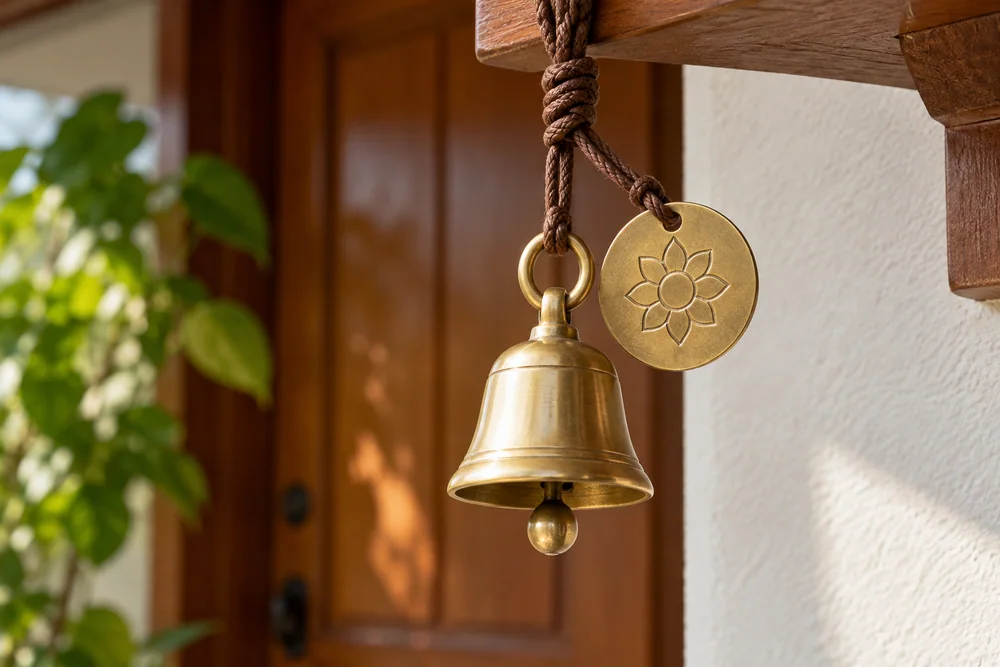
The retained illustration below shows a representative bell body, its attachment eye, a clapper, a cord join and a plain decorative disc. This helps readers identify the parts they should inspect. It does not document any physical OmmRudraksha stock unit, exact alloy, dimension, artisan or certified performance. Compare it with the real product photograph before ordering a bell-bearing hanging.
When viewing the real object, trace the mechanical path from the wall anchor through the top fixing, cord or chain, connector, motif disc, bell eye and clapper. A weakness at any one point can make the entire assembly unsafe even if the major ornament looks substantial. For a horizontally suspended piece, consider both end supports; if one fails, the remaining support may suddenly take the whole load.
19. Giving sacred hangings respectfully
A sacred inscription can be a thoughtful gift for a housewarming, family celebration or new business, but cultural fit matters. Check whether the recipient uses Om or Shubh–Labh, whether they welcome deity imagery on an external doorway, and whether their building permits drilling or audible bells. Some households prefer fresh botanical torans for a wedding or specific festival, reserving permanent signs for a different space. Ask before personalising an object with a sacred emblem.
Wrap fragile bells and mirror elements separately so they cannot strike one another in transit. Protect painted surfaces from abrasion and place instructions for safe installation and care with the gift. If the item is sold as artisan-made, include genuine maker and technique information rather than romantic anonymous claims. An accurate acknowledgement of a living craft tradition is itself a sign of respect.
The giver should not promise that the object will change business revenue, prevent misfortune, cure disease, remove a dosha or make a property compliant with Vastu. It can convey a sincere blessing and help create a welcoming threshold without being presented as a proven intervention.
20. A ten-point selection and installation checklist
1. Choose a motif the household actually welcomes. 2. Identify whether you need a fixed plaque, a pair, a horizontal toran or a vertical bell chain. 3. Request accurate dimensions including the lowest dangling point. 4. Confirm each main component's material and finish, not just its colour. 5. Decide whether a working bell is desirable and suitable for neighbours. 6. Check structural joins, clappers, rings, cords and hanging loops. 7. Choose anchors suited to the wall and total weight. 8. Keep the entry clear of people, locks, door movement, lights, flames and wiring. 9. Obtain care and storage instructions for the actual mixed-material construction. 10. Keep a record of maker, product photos, installation date and any verified special provenance.
A well-chosen devotional hanging balances mangala—the intention of auspicious welcome—with accurate product identification and responsible everyday care. The best piece is not necessarily the largest, noisiest or most elaborately labelled; it is the one whose symbols are meaningful, construction is understood, and placement is dignified and safe.
Frequently asked questions
1. Is Om the same as a bell sound?
No. Om is a sacred syllable and may be represented by the written ॐ emblem. A bell produces physical sound; some worship traditions associate ringing with sacred attention, but a bell cannot be assumed to pronounce a syllable or deliver a particular tuned note.
2. Do Shubh and Labh have to be hung on fixed compass sides?
Household and regional practices vary, and online left/right instructions often use different viewing directions. If the family has a custom, follow it; otherwise arrange the script legibly for the intended approach without asserting an absolute universal rule.
3. Does a gold-coloured bell mean it is solid brass?
No. It may be brass, coated steel, plated alloy or another material. The seller should identify the actual base metal and finish of the unit.
4. Is a small bell toran a puja bell?
Not automatically. A puja bell is intended for ritual sounding; a decorative toran may only jingle incidentally. Product purpose, construction and household ritual practice determine whether it is appropriate.
5. Can I place an Om plaque outside?
That depends on the household's practice, building permissions, weather exposure and the item's construction. A sheltered, respectful and secure location may be more suitable than a rain-exposed position.
6. Is a Shubh–Labh inscription a guarantee of financial gain?
No. It expresses auspicious wishes and associations in family or merchant customs. It is not evidence of a predictable financial or health outcome.
7. Do all metal bells ring the same way?
No. Shape, size, wall thickness, clapper, mounting and materials affect the sound. An actual sample recording is preferable when tone is important.
8. Can I attach a heavy bell toran with removable adhesive hooks?
Only when the specified hook, surface and loading arrangement are genuinely suitable according to the manufacturer's limits. A heavy or vibration-prone piece often requires a more robust, properly installed support.
9. How should I clean an Om-and-bell hanging with fabric and metal?
Start with gentle dust removal and follow verified material-specific instructions. Avoid soaking or applying metal polish to mixed-material, painted or embroidered components.
10. Which article should I read for toran sizing and seasonal care?
Measure the entrance and check the actual mounting requirements, materials and care instructions before selecting a sacred door hanging.
Explore the existing Vastu collection for related home and entrance ideas.
For broader traditional context, read the existing Vastu Shastra overview.


