

A Rudraksha hanging brings together a traditional sacred bead and a carefully built physical assembly. The bead has its own botanical identity, natural surface grooves and culturally significant mukhi classification; the hanging depends on sound thread, knots, wire, caps, rings and secure mounting. An authentic bead is not automatically proof that the entire ornament is correctly assembled, and attractive stringing does not authenticate a bead's Mukhi count.
This OmmRudraksha guide explains what a Rudraksha actually is, how five-Mukhi and other beads are described, how to treat special named forms such as Gauri Shankar accurately, and how to compare a single-bead pendant with a bead strand, wall decoration or bell hanging. It also covers authentic material evidence, origin statements, measurements, maintenance, safe installation and the spiritual importance of Rudraksha in Śaiva traditions.
1. What is a Rudraksha bead botanically?
Rudraksha is associated with trees in the genus Elaeocarpus. The widely used scientific name Elaeocarpus ganitrus appears throughout Indian botanical, agricultural and pharmacognostic literature. Kew's Plants of the World Online currently treats that name as a synonym of Elaeocarpus sphaericus, its accepted name for the relevant species. Botanical identification of an individual bead requires evidence; a change in taxonomic terminology does not change its religious identity.
The familiar hard Rudraksha “bead” is principally the stony endocarp from the fruit—a hard protective inner layer around seed contents—not a mineral gemstone, ordinary timber bead or loose botanical seed in the strict anatomical sense. Research on its anatomy documents a hard lignified shell and internal structures. The dried fruit stone may be cleaned and pierced or strung to become an ornament, while its natural rough surface and longitudinal grooves help define its appearance.
Because it is plant-derived, its care differs from quartz, glass or metal. It may show natural size variation, changes in surface tone, tiny pits, growth irregularities and differences in texture. These variations can be normal, but they do not alone establish a claimed species, provenance or special high-Mukhi identity.
Do not confuse a Rudraksha with a carved wooden imitation or a “Rudraksha-style” synthetic bead. Such decorative alternatives can be sold truthfully when identified, but should not be represented as natural Elaeocarpus fruit stones without evidence.
2. Understanding the word Mukhi and natural surface lines
Mukhi or mukha refers to a face or division in traditional Rudraksha terminology. In retail identification, it is commonly assessed through the number of natural longitudinal grooves or divisions visible around the endocarp. The faces are not decorative paint lines or arbitrary cuts made with a tool. In appropriate specimens, groove geometry may correlate with internal locules and other natural anatomy, although complicated beads require expert interpretation.
A seller claiming five Mukhi should be able to show the bead's full surface, not merely one attractive side. Photograph its circumference, the two natural poles and, when drilled, the channel region so the surface can be examined. A product image showing only three grooves on the front does not prove that the same bead is three-Mukhi; the remaining lines may be on the hidden side.
Natural-looking grooves can be copied or altered. Carving, deepening lines, filling or assembling pieces can mislead a buyer, and common float tests or casual water tests do not authenticate a Mukhi count. For a premium or unusual bead, appropriate magnified examination and well-interpreted imaging may add useful evidence, but the precise method, specimen identity and scope of any report matter.
Do not promise that every external groove will always map one-to-one to a clearly separate chamber in all natural or unusual forms. A competent laboratory assesses the whole morphology; an X-ray is evidence to interpret, not an automatic certificate of divine origin or claimed geographic provenance.
3. Common five-Mukhi beads versus specialist Mukhi choices
Five-Mukhi Rudraksha is widely used in everyday beads and japa mala arrangements. Botanical cultivation literature from India's National Medicinal Plants Board also discusses the common occurrence of five-loculed fruits. This helps explain why a simple five-Mukhi decorative strand and a rare specialist bead should not be described as identical commercial products.
Traditional Śaiva sources discuss the significance of different faces, and modern suppliers describe numerous Mukhi counts, often including 1–21 Mukhi in specialist catalogues. The existence of such classifications does not verify the count of any particular specimen or prove that every face count is equally common, easily sourced or appropriate to every household.
A multi-bead hanging might use several five-Mukhi stones as a consistent visual pattern. Another design may display one verified higher-Mukhi focal bead with separate, accurately identified smaller beads. These arrangements have different inventory, valuation and documentation requirements. State which bead is claimed to have which Mukhi count and whether the remaining stones are ordinary five-Mukhi, mixed or unverified.
A high-value Mukhi bead should not receive an identity or price premium merely because a photograph is cropped tightly or its surface appears unusually rugged. The bead's real identity, preservation, natural divisions and any laboratory report should be reviewed separately from the decorative frame.
4. Named special forms: Gauri Shankar, Ganesh and other shapes
Gauri Shankar Rudraksha is a traditional name generally applied to a naturally joined or twin-like Rudraksha form, commonly connected symbolically with Śiva and Pārvatī. The central authenticity question is whether the joined formation is natural, rather than two unrelated beads drilled, glued or bound together and then presented as a naturally grown union. An actual specimen may need detailed examination of the connecting structure.
Ganesh Rudraksha is another traditional or trade designation often used for a bead bearing a naturally formed protrusion associated visually with Gaṇeśa's trunk. A seller should explain that the association is symbolic and that an external bump does not itself authenticate the material, prove natural formation or give a guaranteed outcome.
Other named configurations, rare Mukhi categories and specialist combinations require the same care. The title on a listing is not proof of species, surface authenticity, geography or untouched condition. A certification statement must match what the laboratory actually tested and the exact physical bead being sold.
Special forms can also impose extra construction demands: a joined bead may have an irregular centre of gravity, a protruding section can catch on a cord, and an exposed irregular surface may be easier to damage in a moving hanging. A fitted holder should not compress the fragile junction or hide the exact feature being advertised.
5. What “Nepal Rudraksha” and “Indonesia Rudraksha” can mean
Rudraksha commerce frequently distinguishes beads described as Nepal-origin, Indonesia/Java-origin and India-origin. There can be broad visual tendencies in size, form and surface texture among different sources, but origin cannot be established reliably from size or colour alone. An unusually small bead is not automatically Indonesian, and a larger, deeply textured example is not necessarily from Nepal.
Origin may affect price, sourcing story and the customer's preference. It should therefore be stated accurately, using traceable supplier records and appropriate documentation rather than a blanket claim inferred from a product photograph. A gem or bead identification report may establish natural structure or Mukhi classification without necessarily proving where the fruit grew; always read the report's scope.
Mixing Nepal and Indonesian beads in one decorative hanging is not inherently improper. If the listing promises an exact origin-specific composition, however, identify the count and origin of the actual beads and avoid assigning a premium origin to an unverified entire strand because its largest focal bead appears similar.
For customer trust, clear separate fields for material identity, Mukhi count, geographic sourcing and physical construction are better than a single vague phrase such as “rare Himalayan premium energy bead.”
6. Compare the principal Rudraksha hanging designs
Some hangings are a single bead suspended from a loop; others are a vertical line of multiple beads, a wall ornament with tassels, a framed symbolic motif or a bead-and-bell arrangement. Some designs resemble a mala while others are not meant to be worn or counted during japa. The name “Rudraksha hanging” identifies a decorative family, not a standard mechanical structure.
| Format | Typical components | What must be verified |
|---|---|---|
| Single-bead suspended ornament | One Rudraksha, loop, cord or suitable cage | Actual Mukhi, drilling, bead condition, loop strength and full drop |
| Multi-bead vertical strand | Several beads, knots or spacers, cord and top ring | Each bead count/Mukhi as advertised, bore wear, knots and complete weight |
| Rudraksha-and-bell hanging | Beads with separately attached metal bell or sounding component | Bell alloy if claimed, actual sound source, attachment and collision clearance |
| Framed Rudraksha wall hanging | Frame, beads, carved or printed motif and suspension hardware | Actual bead authenticity, frame joints, wall mounting and included fittings |
| Focal special-form hanging | Higher-Mukhi or named natural form with support frame | Specific specimen evidence, unobstructed features and load-bearing retention |
| Mixed stone and Rudraksha ornament | Rudraksha with quartz, glass, metal, wood or other pieces | All material names, treatment, bead origin and care for the most sensitive part |
A hanging with 108 beads is not necessarily a properly made japa mala, and a wearable mala should not be assumed suitable to hang above a doorway. Ritual purpose, bead-count tradition and practical construction must be described separately.
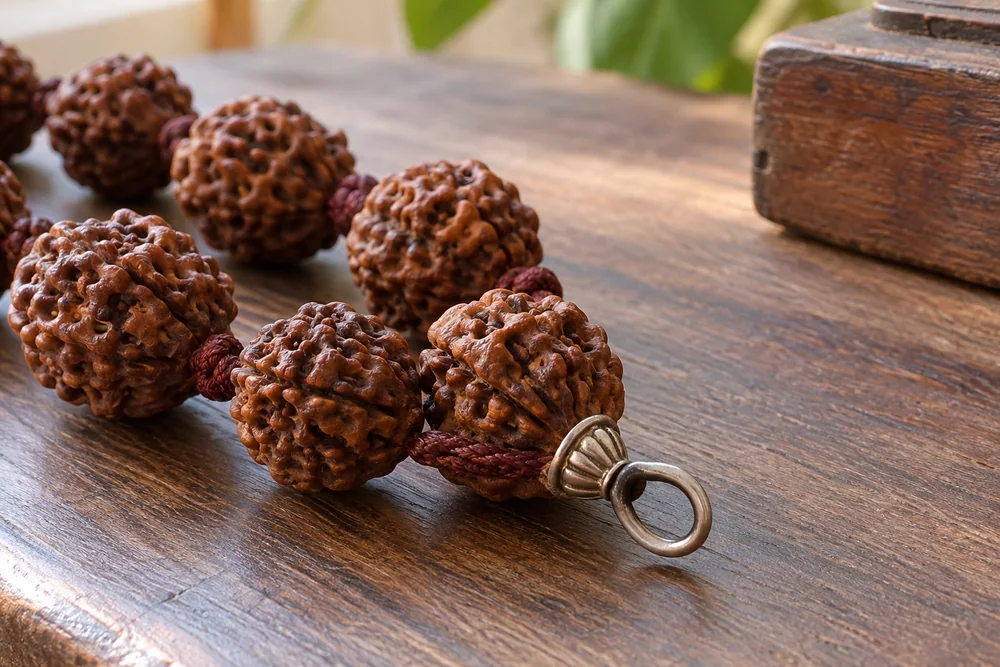
7. Drill channels, natural poles and bead preservation
Rudraksha stones may have natural structural features near their poles and may be drilled or otherwise prepared for stringing. For a decorative hanging, what matters mechanically is whether the cord or fitting can pass through or retain the stone without cracking its shell or misrepresenting its natural structure. A drill opening is not the same as a natural Mukhi groove.
Inspect the two ends of a drilled bead for rough edges, widening holes, chips, glue residue and abrasion from metal wire. A badly placed or enlarged opening can weaken the bead, and one tight metal connector can concentrate force on an organic surface. The presence of a hole is not by itself evidence that the bead is fake; stringing often requires preparation, but the exact manipulation should be disclosed when material to the authenticity claim.
Never recommend drilling a high-value specialist bead at home merely to fit an ordinary decorative cord. Even a common five-Mukhi stone can crack or shed fibres under careless pressure. Where the hole needs alteration or the bead must be mounted without piercing, a knowledgeable maker should choose an appropriate retention method.
A secure arrangement supports the bead while leaving enough of the natural grooved surface visible for honest inspection. Avoid coating or burying the entire face in decorative resin when the product's selling point is natural morphology and authenticity.
8. Thread, cord, knots and metal fittings
Natural cotton, silk and other fibres, synthetic cord, jewellery wire and chains may all appear in Rudraksha ornaments. They differ in abrasion resistance, UV behaviour, moisture response and the way they interact with bead holes. The correct material for a particular hanging depends on real dimensions, load and intended indoor or sheltered use; a thick-looking cord is not a measured load rating.
Where knots separate the beads, check whether they remain seated, whether the fibre rubs against a sharp bore and whether the end knot or crimp can slip. A smooth polished bead can concentrate pressure on its neighbours, while irregular Rudraksha surfaces can catch on woven cord. Inspect the top suspension ring and any individual connector rather than testing only the lower tassel.
Metal fittings can be plain steel, brass, copper, an alloy or plated metal; colour alone does not prove their composition. For a product described as a “copper Rudraksha hanging,” verify whether copper refers to the wire, a plated charm, an actual alloy or simply the colour of a decorative cap. Similarly, do not call a golden-coloured bell solid brass without supporting supplier data.
Use sound, closed connecting rings and keep cut wire ends tucked away from hands and fabrics. Never assume adhesive alone is sufficient to retain a heavy or uncommon bead overhead; inspect the physical load path and repair structural faults properly.
9. Caps, cages, frames and how the load is transferred
Bead caps may protect a drilled opening or contribute visual detail, but a decorative cap does not automatically grip the stone or create an approved overhead fitting. A wire cage around a focal bead should be designed so the bead cannot slide through an opening if the assembly turns, stretches or is handled. A rigid frame should resist twisting and keep corners and connectors secure.
The full load follows a sequence from the wall or ceiling attachment to the main ring, cord or chain, then to each bead and any lower ornament. A falling bell or metal charm can injure even when the organic beads are light. Check the weight and movement of all elements, not merely the count of Rudraksha beads.
When a large irregular bead is mounted, look for pressure points where metal wire bears on protrusions. A fragile Gauri Shankar junction or another natural projection should not support the entire mass by itself. A retained bead can still be damaged by over-tightened wire, so fit and strength are both important.
Show photographs of the back, top, bottom and fixing, not only the symbolic front. A product photograph that hides every connection cannot establish whether the object is safe to hang.
10. Bead size, total length and product specifications
A trustworthy listing distinguishes bead diameter from complete hanging length. The latter includes cord, knots, tassel, bell, frame and any dangling ornament. A set of five-Mukhi beads advertised as approximately a given diameter should actually be measured or specified as a verified range for the stock being sold. Natural sizes vary, so unrealistic identical-millimetre promises should be avoided unless manufacturing selection supports them.
For a fixed product, record total height, maximum width, full weight, material of the primary support, visible bead count and what is included with the purchase. For a variable handmade assortment, state the permitted variation and show the typical arrangement without pretending every item is exactly the hero photograph.
Separate ordinary beads from special focal pieces in the specification. If an item contains one verified unusual Mukhi and ten other standard beads, list those facts clearly instead of saying “eleven rare Rudraksha beads.” Similarly, a hanging with a bell should describe the bell separately, including whether its sound is a feature and whether any tuning claim has evidence.
11. Bead inspection and authentication evidence
Begin with several clear views of the actual stone: its complete surface, natural grooves, poles, any drilling or natural irregularity, and any joined feature. Magnified inspection can help identify suspicious carved lines, filled grooves, excessive polish, added coatings or joined pieces. Such observations may raise or reduce concern, but they are not a universal standalone laboratory verdict.
For an expensive or disputed Mukhi classification, a competent laboratory may use visual examination, magnification and suitable imaging to assess internal anatomy. Radiography can support an interpretation of chambers and natural divisions, but reports vary in method and coverage. Ask whether a particular report certifies the external Mukhi count, the internal construction, species or some narrower claim. Do not claim that a photograph of an X-ray establishes geographic origin or spiritual efficacy.
Water-floating, coin-rotation, burning and other simple “home tests” are not reliable methods of determining natural Mukhi identity and may damage the bead or its finish. A properly identified five-Mukhi Rudraksha should not become suspect merely because it does not pass a popular internet trick.
An expensive premium claim needs specimen-specific evidence. One generic certificate for a shipment does not necessarily authenticate every bead incorporated into an assembled hanging, and a product illustration is not laboratory proof of the physical article supplied.
12. Five-Mukhi as a straightforward decorative option
For everyday decor, a strand of properly identified five-Mukhi Rudraksha can provide a recognisable textured appearance without requiring a claim of a rare special form. Individual bead sizes and natural grooves can vary while the maker maintains a consistent overall composition. The seller should report whether every bead was counted or whether the product is an accurately labelled mixed assortment.
Traditional Śaiva literature attributes significance to Rudraksha and various Mukhi forms. A customer may choose five-Mukhi for devotional reasons, but the article should not guarantee a particular medical result or claim that the bead's face count determines whether a hanging anchor is structurally safe.
For more detail, read the existing OmmRudraksha five-Mukhi Rudraksha article.
Where a hanging is intended as a doorway decoration, use a design that keeps the organic beads away from repeated door-handle collisions and provides enough clearance for the full swing of any metal bell or tassel.
13. Rudraksha plus bells, Om symbols and other sacred motifs
A combined hanging may include an Om symbol, Śiva imagery, a trident (triśūla), ḍamaru motif, bell, knotwork, tassel or beads of another natural material. These additions can be aesthetically and devotionally meaningful, but they also change the object's weight, movement and maintenance needs.
Identify symbolism accurately and avoid claiming that each motif has a fixed, universal ritual instruction for modern home placement. A small decorative metal trident is not the same as a consecrated ritual implement, and an ornament with the syllable Om is not necessarily a prescribed japa mala arrangement.
If a bell is included, state whether it rings, where its clapper sits and whether air movement will cause sound. A Rudraksha bead should not be described as the sound-producing metal component unless the physical design actually uses it that way. Uncontrolled collisions between metal and organic bead surfaces may produce wear rather than musical tuning.
Use metal and stone names precisely. A brown wooden spacer is not automatically another Rudraksha, and a transparent crystal-looking piece may be quartz or manufactured glass; neither identity follows from a devotional theme.
14. Hanging versus wearable mala: do not conflate uses
Japa mālā describes a rosary-like string used for mantra repetition in various Indian traditions. Rudraksha malas are especially associated with Śaiva devotion, and arrangements of 108 counting beads are well known, often with a larger meru or guru bead depending on the tradition. These uses carry their own rules and meanings, which vary with lineage and practice.
A wall hanging can resemble a mala, but it is not automatically designed for repeated handling or wearing. It might have a decorative glue joint, permanently mounted frame, fragile bell or extended tassel. A wearable mala likewise may not have the secure top suspension appropriate for a moving wall or doorway installation.
If a product is genuinely intended for both use cases, both must be demonstrated by construction and clear care instructions. Do not label every 108-bead decoration as a ready-to-wear prayer mala, and do not require a silent wall ornament to follow one universal mantra-count prescription.
A specialist Siddha mala or intentional combination of named Mukhi varieties is a separate type of spiritual and commercial description; it must not be inferred from a generic collection of brown beads in a hanging.
15. Choose a safe location and fixing
A fixed interior wall, stable doorway surround or protected prayer area may suit a Rudraksha ornament when the fixing is appropriate and the complete drop does not obstruct movement. The actual anchor should be chosen for its substrate and the entire assembly's weight and motion. A small adhesive hook authorised for a stationary picture is not necessarily suitable for a heavier ornament that swings or includes a bell.
Check door swing, ventilation, cleaning access, window clearance and the location of ceiling fans. Organic beads and long cords can catch on handles or clothing. Keep detachable small beads and cords beyond children's reach, and avoid heavy or brittle objects above cots, occupied seats or busy passages where a fall would be hazardous.
For a puja room, keep the hanging away from direct diya flames, incense embers, hot lamps and splashing. A symbolically meaningful place is not automatically an appropriate physical installation point. In high-rise homes, prevent anything from being suspended where it could fall from an open balcony onto people below.
Do not assume a Rudraksha-themed item is a wind chime merely because it is displayed near airflow. If it includes a metal bell, consider whether the sound will disturb sleeping occupants or neighbours and whether the striker might strike the bead.
16. Caring for organic beads, cord and mixed components
The Rudraksha endocarp is a plant-derived hard fruit stone, so treat it differently from silica gemstones. For ordinary dust, start with a soft clean dry cloth or gentle dry brush, supporting the strand so no bead is pulled against its hole. Avoid harsh detergents, bleach, acids, abrasive powders, steam or ultrasonic equipment on an unknown assembled hanging.
Traditional maintenance practices differ. Some practitioners condition individual Rudraksha beads with specified oils or ghee, and different suppliers advise different schedules or methods. That does not justify applying oil indiscriminately to an assembled object containing glued parts, textile cords, dyed stones, plated metal or bells. A film of oil can attract dust or affect some finishes and knots; follow instructions appropriate to the actual item.
Likewise, avoid prolonged soaking of the complete ornament as a default, because natural fibres, wood elements, adhesives and metal components may respond badly to moisture. If a trusted maker permits limited cleaning of a specific loose bead, dry it carefully under its instructions. Do not transfer bathing advice for a loose bead to a multi-material wall hanging without checking every component.
Store dry and protect it from leaks, excessive condensation and prolonged direct sunlight where cords or finishes may degrade. In monsoon season, inspect for mildew, frayed thread, corrosion, cracked endocarp or signs of pests affecting organic components. If the bead begins shedding fragments or the top loop is damaged, keep people clear of the fall zone and arrange safe removal while supporting the complete weight. Seek competent help for high or heavy installations; do not rehang until repaired.
17. Shiva, Rudraksha and traditional devotional meaning
Rudrākṣa is traditionally associated with Rudra–Śiva and revered in Śaiva texts and practice. The Śiva Purāṇa contains passages on Rudraksha's greatness, its faces, wearing and using Rudraksha during mantra repetition. These are meaningful religious sources and should not be flattened into the statement that Rudraksha is merely a generic decorative wooden bead.
Traditional teachings assign varied symbolic meanings to Mukhi forms and sometimes prescribe different ways of wearing beads or conducting japa. Those descriptions should be attributed to their particular source or lineage. A modern wall hanging is a separate commercial and physical category: its presence in a doorway is not automatically the same as a consecrated japa mala worn for a specified spiritual practice.
Devotees may choose a Rudraksha hanging as an expression of bhakti, a reminder of nama-japa or an ornament for a dedicated worship space. The seller should honour that significance without claiming that a certain bead count guarantees protection from disease, financial gain, a change in planetary karma or tested electromagnetic shielding.
For families seeking Jyotisha-specific Rudraksha recommendations, an individual guidance process may be distinct from buying an ornamental wall piece. The spiritual significance of a bead does not relieve a seller of the duty to verify material authenticity, honest Mukhi information, secure assembly and safe placement.
18. Rudraksha hangings and Vastu Shastra
Indian Vastu Shastra addresses the arrangement and design of built space, including orientation, circulation, proportions, entrances and cosmological frameworks such as the Vastu Purusha Mandala. Rudraksha's primary traditional textual context belongs prominently to Śaiva devotion and the uses of sacred beads. Some contemporary Vastu practitioners include Rudraksha hangings as symbolic home accessories, but that does not create a universal classical requirement for every entrance.
Placing a Rudraksha hanging in a particular compass direction may be a family preference or a specified practitioner's recommendation. It should not be advertised as an obligatory rule from every Vastu treatise or a guaranteed correction for structural faults. Nor should it be conflated with Feng Shui objects, which belong to a distinct Chinese tradition and different conceptual background.
The practical suitability of a location should be evaluated even when the religious symbolism is important: weight, clearance, wind, moisture, fire and household movement still matter. A secure, dignified display is preferable to a hazardous position chosen solely because a generic online diagram suggested it.
For broader spatial and decorative context read the Vastu collection and the related Vastu Shastra guide.
19. Buying checklist for Rudraksha hangings
- Verify the bead material. Is it a genuine Rudraksha fruit stone from a properly identified Elaeocarpus source, or merely Rudraksha-style wood, resin or another botanical seed?
- Describe Mukhi accurately. Count natural divisions on the actual bead, including concealed sides; identify which beads are five-Mukhi or specialist types.
- Examine named forms. For Gauri Shankar or Ganesh forms, inspect natural junctions or projections and support premium claims with appropriate evidence.
- Clarify origin. Nepal, Indonesia/Java or India should be a traceable stock statement, not a guess from bead size.
- Separate all components. List Rudraksha, gemstones, wooden spacers, metal charms, thread, bell and any manufactured materials distinctly.
- Confirm counts and dimensions. Real bead number, approximate verified bead size range, total drop, widest span and full assembled weight.
- Inspect drilled holes and ends. Look for cracking, sharp bores, opened rings, slipping knots, weakened wire and exposed cut ends.
- Check the intended use. Wall ornament, doorway hanging, chime or wearable mala are different constructions and should not be conflated.
- Verify care and safe mounting. Use a suitable hook, maintain impact clearance, protect cords from dampness and follow item-specific organic-bead care.
- Check all commercial assertions. Authentic stock images, Mukhi testing/report scope, origin, exact SKU, price, publication status and included mounting hardware.
Frequently asked questions
Is a Rudraksha bead a mineral gemstone or an ordinary wooden bead?
Neither description is exact. Rudraksha is the hard stony endocarp of an Elaeocarpus fruit, a botanical material valued for its natural grooves and traditional religious significance.
Is the accepted botanical name still Elaeocarpus ganitrus?
The name remains widely used in research and Indian commerce, but Kew's current Plants of the World Online treats E. ganitrus as a synonym of accepted Elaeocarpus sphaericus.
How can I check whether a hanging contains genuine five-Mukhi beads?
Examine complete clear views of each claimed bead's natural longitudinal grooves and morphology. For higher-value claims, suitable competent laboratory assessment may help; one front photo is insufficient.
Does a drilled hole prove Rudraksha is artificial?
No. Beads can be pierced for stringing. The hole should be assessed separately from natural Mukhi grooves and checked for cracks or inappropriate alteration.
Can a Gauri Shankar Rudraksha be made by gluing two beads together?
Two glued beads can imitate a joined appearance, but they should not be sold as a naturally formed Gauri Shankar. Authenticity claims require appropriate examination of the actual specimen.
Is every Nepal-origin Rudraksha larger than every Indonesian bead?
No. Source-related tendencies do not reliably authenticate individual origin; actual size varies. Require traceable evidence for a specific geographical claim.
Is a Rudraksha hanging automatically a japa mala?
No. A decorative wall object and a wearable or countable mala can differ in design, bead count, handling strength, ritual purpose and hardware.
Can I soak an entire Rudraksha-and-bell hanging in oil or water?
Do not use a blanket soak. Bead-conditioning practices vary, and oil or moisture may harm cords, coatings, adhesives and metal fittings. Follow advice for the exact complete assembly.
Does Vastu require a Rudraksha hanging at every home's main door?
No universal classical rule requires this modern decorative accessory at every entrance. Rudraksha has important Śaiva significance; a household may choose a safe and respectful display without expecting a guaranteed outcome.
Explore OmmRudraksha beads and hanging designs
For traditional bead context, read the existing five-Mukhi Rudraksha guide. Explore the proposed Hangings & Chimes collection for decorative formats and the Vastu collection for wider home-design options. Exact Rudraksha hanging product links should be added only after material, Mukhi count, images, stock and live Smartstore URL records are verified.


