

A Rudraksha-and-metal-bell hanging combines a sacred organic fruit stone with an object made to ring—or sometimes simply to look like a bell. Its appearance can suit a doorway, puja room or quiet interior wall, but its sound depends on the bell body, suspended clapper, mounting and movement. A small bell at the end of a bead strand may ring when touched; another may respond to a breeze; a fixed decorative imitation may be silent. The word “bell” alone does not establish an alloy, pitch, ritual status or tested wind-chime performance.
This guide separates three essential questions: Is the Rudraksha genuinely and correctly identified? What is the bell actually made of, and how does it sound? Will the assembled hanging remain secure in its intended position? It examines brass, bronze, copper-coated iron and plated metals, Kutch's Ghantadi bell-making tradition, clappers, cords, bells in Indian worship, maintenance and material-specific buying evidence for OmmRudraksha customers.
1. Identify the complete object before choosing its location
A finished hanging is more than the bead and the most visible bell. It may have Rudraksha endocarps, a textile cord, knots, wooden spacers, a metal chain, copper-coloured caps, one or several bell bodies, clappers, a top hook, a framed emblem and small decorative tassels. Some pieces also add glass, gemstones or painted wood. Each item should be described by its real material and function, not assumed from the design theme.
The Rudraksha is an organic fruit stone with natural Mukhi divisions. The metal bell is a shaped resonating body; the clapper, when present, strikes it. The support system carries every part. A product might use five authentic five-Mukhi beads and one modest iron bell, while another might use one premium bead and a relatively heavy cast bronze bell. These require different sourcing evidence, weights, price descriptions and mounting decisions.
A hanging chosen for quiet devotional appearance need not ring continuously. A purchaser seeking a responsive wind chime should ask for evidence of airflow-driven motion. A person seeking a hand-rung puja bell should choose an appropriate ritual instrument rather than assuming any wall decoration serves exactly the same purpose.
2. Rudraksha's botanical identity and traditional importance
Rudraksha belongs to the fruit-stone tradition associated with Elaeocarpus trees. The name Elaeocarpus ganitrus is widespread in Indian literature, and Kew's Plants of the World Online treats it as a synonym of accepted Elaeocarpus sphaericus. The bead is fundamentally the hard, lignified endocarp from the fruit—not a metal casting, naturally occurring rock or ordinary turned wooden sphere.
Its natural longitudinal grooves are central to Mukhi classification. A hole made for stringing or the presence of a metal cap is not itself an additional Mukhi. The surface may display natural pits, growth variation, wear or irregularities, so full examination matters when a particular face count is asserted. A product photograph of the front side is insufficient to establish how many natural faces surround the complete endocarp.
Rudrākṣa has profound associations with Rudra–Śiva and with prayer and japa in Śaiva literature. The Śiva Purāṇa, for example, discusses the greatness and use of Rudraksha beads. Such religious significance is real within the tradition, but it does not automatically certify the species or Mukhi count of an individual brown bead, nor the mechanical strength of a wall hanging.
A customer choosing an ornament for devotional reasons deserves both an accurate account of that heritage and a truthful product description. A handmade imitation can be sold as Rudraksha-inspired décor where clearly identified, but not as a natural five-Mukhi Rudraksha when it is resin or carved wood.
3. Five-Mukhi, specialist types and bead counts in a hanging
Five-Mukhi Rudraksha is widely encountered in everyday beads and devotional strands. A simple hanging may use several accurately identified five-Mukhi beads or place one bead as a focal point above the bell. Where an unusual Mukhi, Gauri Shankar or another specialist form is claimed, the evidence should match the actual specimen, including natural grooves, condition, images and any appropriate test report.
A distinction often missed in product descriptions is that five Mukhi is not the same as five beads. A hanging made from five endocarps may contain five-Mukhi beads, mixed types or another arrangement. Likewise, a product title naming an eleven-Mukhi focal bead does not mean every other bead on its cord has eleven faces. Count and classify each advertised component separately.
For a premium bead, traceable identification can include clear all-around photographs, suitable expert examination and, in appropriate cases, imaging of internal structure. The scope of a report must be read: an X-ray may assist morphological interpretation but does not itself prove Nepal origin, spiritual results or the identity of every other bead in the ornament.
For background, consult the established OmmRudraksha five-Mukhi Rudraksha guide.
4. What actually makes a bell sound?
A struck bell sounds because part of its body vibrates after impact, setting the surrounding air into motion. For a common clapper bell, a suspended internal clapper contacts the bell wall. An external striker can perform a similar function in another design. The shape, metal, thickness, casting or forging, clapper material, strike location and suspension influence the sound.
A small bell may make a short high-pitched tinkle or a lower rough rattle depending on its construction; a larger bell might have a more substantial resonance, but size alone does not predict a fixed note. A poorly positioned clapper may barely reach the wall, while one that is too large or tight may dampen rather than sustain a clear sound. A bell body with a crack can sound dull or buzz.
Not every bell produces a pure musical pitch. Many bells exhibit multiple vibrating modes and audible partials. A claim of a precisely tuned scale or specific frequency should be supported by actual model testing. Counting Rudraksha beads, invoking sacred syllables or describing a bell as “temple metal” does not establish its measured hertz or acoustic performance.
When a customer wants a particular audible effect, a recording of the actual product or verified representative batch under stated conditions is more useful than a poetic claim about “perfect cosmic tones.” The assembled hanging may sound different from a loose bell held in the hand because the surrounding bead strand affects movement.
5. Brass, bronze, bell metal and copper: different words
Metal labels should identify composition rather than appearance. Brass is principally a copper–zinc alloy. Bronze generally refers to copper-based alloys, often with tin; some specialist bronzes and historical alloys have more complex compositions. Bell metal commonly refers to a relatively tin-rich bronze used for resonant cast objects, but the exact ratio is not one universal recipe for every bell marketed with that name.
Copper is an elemental metal, and a copper-coloured coating is not evidence that a bell is solid copper. A gold-coloured finish may conceal an iron or steel core; a yellow bell might be brass, brass-plated steel or a painted alloy. A bell called “antique bronze finish” may contain no cast bronze at all. The seller should distinguish body material, plating or coating and any lacquer.
Traditional Indian metalworking includes sophisticated casting and bell-metal craft, but not every modern decorative bell has the same manufacture. Cast bronze, sheet-metal-formed iron, pressed brass and coated alloys can all appear within the broad home-décor market. A story about an artisan community belongs to the actual sourced product, not automatically to every gold-coloured bell.
| Bell description | Material or process | What to verify | Care implication |
|---|---|---|---|
| Solid brass bell | Copper–zinc alloy body | Actual body alloy, casting/forming and any lacquer | Patina and corrosion behaviour depend on alloy and finish |
| Cast bronze or bell-metal bell | Copper-rich casting, often tin-bearing | Real casting, composition when specifically claimed, clapper and cracks | Protect historical or intentional patina; avoid blind polishing |
| Copper-coated iron bell | Iron/sheet-metal body with a copper-rich surface treatment | Coating, base metal, construction and actual artisan attribution | Protect from corrosion if coating is worn or moisture enters seams |
| Plated steel or mixed-alloy bell | Less costly base metal and decorative finish | Honest body/finish disclosure and coating condition | Abrasives can remove plating; exposed steel may rust |
| Bell-shaped decorative charm | May be hollow or solid, various metals or nonmetals | Presence of clapper and whether it actually rings | Do not promise acoustics or outdoor durability without evidence |
General alloy definitions and conservation guidance help frame the questions, but they do not determine the composition of OmmRudraksha's unsampled inventory. An exact alloy percentage, “pure copper” statement or claim of pañcaloha composition needs relevant supplier or material evidence.
6. The special case of Kutch Ghantadi bells
Kutch in Gujarat maintains a notable tradition of handmade metal bells, often known locally as Ghantadi. Khamir, an organisation documenting and supporting Kutch crafts, explains how metal bell making developed from the practical need to identify livestock by their sound. The bells have become popular in chimes, home accessories and decorative doorway designs as well.
Research by the design education project D'source describes the shaping of iron sheet, application of powdered metals, covering with a mud-based mixture, heating and subsequent fitting or tuning of a clapper. Craft histories also describe joined sheet-metal parts rather than the mould-based casting associated with some solid bronze bells. A handmade Ghantadi can therefore have a copper-coloured exterior while the structural body is iron.
Depending on the specific artisan process, a wooden clapper may be used; other documented variants include wire-mounted clappers. The exact material and movement of the clapper should be checked on the real item. Bells are tuned individually through craft adjustments, but that does not establish that any arbitrary retail bundle forms an exact Western musical scale.
A Rudraksha-and-Kutch-bell combination can be an attractive juxtaposition of two Indian craft and devotional references. However, do not call a generic imported bell “handmade in Nirona” or “authentic Kutch Ghantadi” merely because it has a rustic copper finish. A reliable origin claim requires supporting artisan or supplier records for that product.
7. Indian metal bell craft is not one uniform technique
Bell making across India includes casting, forging, hammered sheet-metal forming, engraving, turned components and other metalworking methods. The materials and techniques of Odisha's kāṃsā or bell-metal traditions, Kutch's sheet-metal bells, and assorted temple bells cannot be collapsed into one universal recipe. Geography, craft tradition and manufacturing method should be connected to the actual object.
A larger cast bell can have thick resonating walls and a substantial internal striker, while a lighter hammered bell may be made from shaped sheet and tuned by modifying its body. Some bells have decorative deity handles or rims, whereas others are small plain livestock bells repurposed for household ornaments. Their intended uses influence construction and sound.
Buying directly from artisans or traceable craft groups can support traditional skills, but provenance must be true. A seller should also be cautious about unverified claims such as “ancient 5-metal alloy,” “all handmade from recycled scrap” or “certified temple bell” when the documentation is absent. A genuine small workshop product can still include purchased hardware, modern cord or machine-produced attachments.
For the combined hanging, document both sides of the story separately: the natural Rudraksha's sourcing and Mukhi evidence, and the bell maker's actual metal, coating and craft process. Devotional presentation is most credible when those material statements are specific.
8. Clapper types and why sound changes
A clapper is the moving piece that contacts the internal wall of a bell. It may be wooden, iron, another metal, a hard nonmetal or a part of a proprietary design. In a handmade copper-coated iron livestock-style bell, wood may create a different attack and timbre from a hard metal clapper; the sound is influenced by how each component contacts the bell.
The clapper should hang at a suitable position and move freely without rubbing continuously. A tightly wedged clapper may silence the bell, while an overly long one can strike the wrong region. The loop or wire holding it can wear, corrode or open, causing the clapper to fall even if the main bell remains securely hung.
Inspect the top suspension separately from the clapper attachment. An ornament can have a strong external hook but a weak internal striker wire. A short sound demonstration may not reveal future wear, so the assembly needs accessible inspection and suitable care.
Do not claim all wood-clapper bells are silent or all metal-clapper bells are loud. Size, wall thickness, material, impact speed, damping and the surrounding room affect what is heard. Actual sound should guide a buyer who has particular acoustic preferences.
9. Rudraksha-and-bell formats: fixed décor or working chime?
Several arrangements share a similar aesthetic but behave differently. A single bead with a bell may be intended to move only when lifted. A hanging bunch of bells can ring in airflow if they contact clappers or one another. A doorway strand may sound mainly when a door opens, and a wall-mounted ornament may remain entirely still.
| Hanging format | Intended behaviour | Important physical check |
|---|---|---|
| Single Rudraksha above one bell | Decorative or occasional hand-moved sound | Bead hole, cord, top ring, actual clapper movement |
| Multiple bead strands with bell ends | Several small sound sources when moved | Individual joins, tangle risk and complete combined weight |
| Hand-forged Kutch-style bell mobile | Rustic hand-tuned bells activated by motion or breeze | True origin, base metal, coating, clapper and swing clearance |
| Doorway hanging | May ring when door or people disturb the assembly | Door swing, clearance, reachable height and snag prevention |
| Fixed puja-room wall ornament | Predominantly visual; sound need not occur | Stable attachment, separation from flames and intentional rituals |
| Bell cluster with sail or striker | Designed for more regular wind response | Airflow, movement, noise, structural wind load and actual tuning |
| Decorative bell-shaped charm | May be silent | Do not market as tuned chime without operating mechanism |
For people who want a consistently quiet room, a fixed ornament may be preferable. For those wanting gentle sound, a short actual recording and realistic explanation of wind dependence are useful. A product description should not promise continuous ringing under still air or a particular musical raga simply because it has several bell-like objects.
10. Sound of a temple ghaṇṭā versus a home ornament
The Sanskrit term ghaṇṭā refers to a bell, and bells have significant roles in varied forms of Hindu ritual practice. The Metropolitan Museum of Art, for example, catalogues Indian ritual bells used by priests in worship. Their handle, clapper, ritual setting and method of use can differ from a light decorative object hung at a household entrance.
In many household and temple settings, a ghanti or ghaṇṭā may be sounded during forms of pūjā, ārati and devotional offering. Specific procedures, mantra associations and bell-handling conventions differ by tradition. A modern wall ornament with a Rudraksha strand is not automatically consecrated as a ritual implement or guaranteed to satisfy one temple's liturgical requirement.
Likewise, the nāda associated with devotional sound has a cultural and philosophical significance deeper than a measured frequency on a retailer's tag. A consumer bell may produce a pleasant chime without being a validated sacred “healing tone.” Cultural description and acoustic measurement are different types of statements.
A family can choose a visually respectful Rudraksha-and-bell hanging for a worship area, provided it does not obstruct movement, interfere with rites or become unsafe near a lit diya or incense. If the family specifically needs a hand-held puja bell, the design and intended use should be chosen for that purpose.
11. Rudraksha and Śaiva symbolism without unsupported promises
The Rudraksha tradition carries specific devotional meaning associated with Rudra–Śiva. The Śiva Purāṇa discusses wearing and using Rudraksha in japa and worship. This context differs from a universal claim that a decorative bead-and-bell arrangement is required in every home or guarantees the correction of a person's astrological difficulties.
The bell is itself meaningful in worship, but attaching it to Rudraksha does not create one uniform classical prescription for a five-Mukhi, eleven-Mukhi or specialist bead. A particular lineage may use different mantras or objects during worship. The appropriate respectful description is to name the tradition and any known source, rather than treating a modern shop combination as an identical ancient ritual rule.
When the ornament includes Om, a triśūla, Śiva image, ḍamaru motif or other devotional iconography, describe it accurately and avoid making it an unverified claim of consecration. A decorative sacred motif is not automatically a certified temple object, and its spiritual significance is not a substitute for safe physical construction.
Statements that bell sounds are personally calming or that devotees value them as auspicious may be expressed as perceptions or traditions. They should not be turned into promises that any particular hanging prevents illness, removes airborne contaminants or ensures financial gain.
12. Mukhi count, metal origin and sound need separate evidence
Three claims may appear side by side on a premium listing: authentic seven-Mukhi Rudraksha, solid brass handmade bell and precisely tuned tone. None proves the others. A bead identification report concerns a particular natural endocarp and the methods documented. A bell-alloy description needs material and production information. A tuning claim needs appropriate sound verification.
A generic laboratory logo placed next to a product image does not show whether the whole hanging was tested. A report on one focal bead does not authenticate the accompanying five-Mukhi beads or bells. Conversely, a legitimate craft-origin certificate for the bell does not verify the Rudraksha species, face count or origin.
Maintain clear stock records for each advertised premium element. Capture pre-assembly bead images where caps hide the natural lines; record actual bell type, coating, clapper and dimensions; retain traceable maker information when naming a region; and record what any sound demonstration represents.
If an assertion cannot be established, describe the product conservatively. “Antique-brass-colour metal bell with natural Rudraksha-style beads” may be accurate where facts are limited, but only if the true materials match that wording. Do not use specialist labels to raise perceived value without support.
13. Follow the whole load path from hook to bell
A metal bell is often one of the heavier components in a combined hanging. Its mass and movement can place repeated stress on a narrow cord passing through a Rudraksha endocarp. The load path begins at the wall or ceiling fixing, then passes through the main loop, frame or chain, the knots and any rings, before reaching the bell and its clapper. Every junction is important.
Inspect the bell's upper eye for sharp corners and the bead's drilled hole for cracking or widened edges. A thin textile cord may abrade over time against a hard metal loop; a metal connector can cut organic fibre if its end is exposed. A decorative open spiral may look attractive while failing to retain the bell securely when twisted.
Use appropriate closed rings, mechanically secure terminations and hardware suited to the actual suspended weight and intended movement. A heavy moving bell may impose greater forces than a small stationary wall decoration. An adhesive picture hook cannot be assumed safe for every combination simply because it held the item once.
When a connector is spreading, a thread is fraying or an endocarp is cracked, keep people clear of the fall zone and arrange safe removal while supporting the full weight. Seek competent help for high or heavy installations. The right repair may require replacement of a ring or a complete restrung assembly rather than an application of ordinary glue or a quick tightening with pliers.
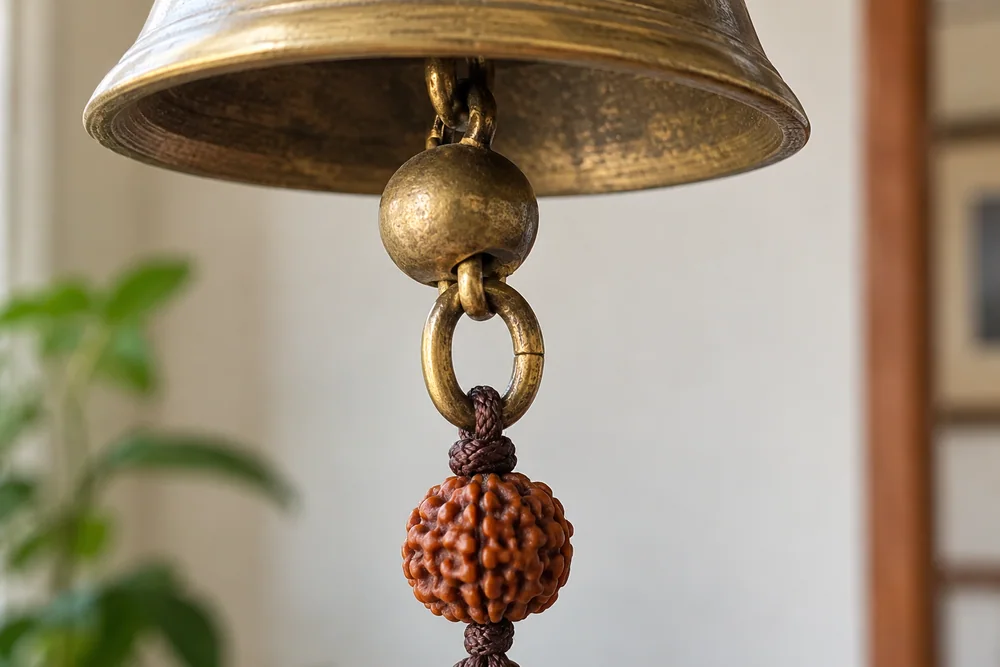
14. How to inspect the clapper and the main bell loop
The original illustration in this guide shows the kinds of connections that need attention: the bell's clapper, a closed jump ring and a knot next to the organic bead. It is a representative educational image, not proof of the alloy, Mukhi or hardware quality in one stocked product. Inspect the real article from all sides before trusting its connections.
First check that the clapper is present, seated correctly and able to reach the bell wall. It should not be held by a frayed textile or a nearly open loop. A wooden clapper can wear or crack; a metal one can corrode or develop a loose attachment. Test the sound gently with the hanging supported so that neither the bell nor beads can fall if a weak connector gives way.
Then inspect the main ring, connector and knot. A bell can remain physically intact when its supporting loop has opened. Loose knots may shift under vibration, and a long cord can start twisting as multiple bells swing. A cosmetic bead cap may hide damage near a drilled Rudraksha pole.
Sound testing should not require shaking a valuable organic bead violently, striking the bell against another mineral or pulling the whole assembly by its bottom component. Gentle, controlled movement is sufficient to learn whether the design rings as intended.
15. Entryway installation: door swing, movement and safety
At an entrance, a good location allows both the object and the household to move safely. Measure the complete drop and swing span, including the top loop, bead strand, bell, clapper tail and tassel. Check the door's entire opening motion, not just the narrow space visible when it is closed. Repeated contact can damage a Rudraksha, chip a small painted ornament or open a ring.
A single bell in a protected indoor alcove may be suitable where it can be seen and heard occasionally. An exposed balcony or outside gate introduces wind load, driven rain and possible noise for neighbours. High-rise apartments require particular caution with any suspended metal object that could fall onto people below.
Do not hang heavy bells, pointed metal motifs or detachable small beads above cots, occupied seating or busy passages. Long cords and small components should be out of children's and pets' reach. Keep the assembly clear of ceiling fans, window glass, heat sources and electrical fixtures.
Use a fixing appropriate to the actual substrate—timber, masonry, concrete or another surface—and the measured load. Where the installation is uncertain or inaccessible, a competent installer is preferable to repeated home experimentation.
16. Puja-room placement and comfortable sound
A devotional space may benefit from a dignified position near other household sacred objects, but the hanging should not obstruct āsana, offerings or japa. Position it far enough from a lit diya, incense embers and hot lamps to avoid scorching thread, damaging coatings or creating fire risk. A metal bell can become hot if placed near a flame; its decorative location should not compromise the rituals being performed.
Choose the desired amount of sound according to real use. In a bedroom or shared apartment, a freely moving bell might ring more than expected near an open window. A fixed ornament or smaller controlled bell can be preferable where quiet is important. An ornament with several bells may produce overlapping sounds but should not automatically be sold as a tuned set.
If the object is intentionally used during prayer, note whether it can be rung comfortably and safely by hand or whether it was designed only to hang. Do not turn a fragile decorative structure into an improvised ritual bell if doing so stresses its Rudraksha cord or support.
Respectful household practice is a personal or lineage-specific decision. No universal rule requires a Rudraksha-and-bell hanging at a single compulsory compass point in every home.
17. Material care: organic Rudraksha and metal finishes differ
The combined ornament should be treated according to its most sensitive material. Rudraksha is organic; cords may be cotton, silk, nylon or other fibres; the metal body may be solid brass, bronze, coated iron, plated steel or another alloy. A solution suitable for polishing bare solid brass can damage a lacquer, copper coating, bell clapper, stained wood or bead fibre.
The Canadian Conservation Institute's brass and copper care guidance stresses knowing the existing patina and coatings. Decorative surface colour can be intentional, and abrasives can remove thin finishes. A greenish or brown patina is not automatically a problem requiring removal; active powdery corrosion, on the other hand, calls for assessment. Do not apply harsh metal polish, vinegar, lemon juice or acidic cleaner to the complete mixed-material hanging.
Start with gentle dry dusting while the item is supported on a clean padded surface. A soft cloth may be sufficient for a smooth bell body, and a soft brush can reach a sound Rudraksha's surface without scraping its grooves. Stop if coating flakes, fibres loosen or metal corrosion powder appears. When actual supplier care guidance is available, use it for the specific finish and assembly.
Traditional practices sometimes oil or otherwise condition loose Rudraksha. Such advice should not be transferred automatically to a combined item with metal coatings, dyed cords, glued caps or a wooden clapper. Oils can attract dust, stain thread or affect the appearance of particular finishes; a ritual or devotional preference is not an all-purpose conservation procedure.
18. Monsoon exposure, corrosion and storing bells
During humid or rainy weather, moisture can enter the gaps between coated iron sheet, rings and fittings. The base metal of a bell matters: exposed iron or steel can rust, while brass and bronze can form different corrosion products or develop stable surface patinas. Lacquer and plating can affect how water reaches the underlying material. A bell advertised as copper-coated is not necessarily immune to rain.
A protected indoor display is the prudent default for a mixed Rudraksha-and-bell hanging whose full construction and outdoor suitability are unknown. In an exposed veranda, a sudden gust can swing the bell hard against the wall, damage the bead cord or disturb neighbouring homes. Do not infer permanent outdoor readiness solely from a craft photograph taken in an open setting.
Before the monsoon, check the top hook, rings, bore edges, knots, bell coating, clapper attachment and any wooden parts. Remove vulnerable objects to a dry place while conditions are calm rather than attempting retrieval from an open balcony during a storm. After any accidental wetting, follow maker instructions and inspect the complete assembly; do not assume that a dry surface proves a corroded connection has regained its strength.
For storage, protect the bell and bead separately from other heavy objects, avoid crushing a hand-forged shell and keep sharp metal edges from contacting textile cord. Do not seal a damp assembly in a plastic bag. Photograph the configuration before disassembly so bead counts and clapper placement can be restored accurately.
19. Craftspeople, responsible sourcing and real-stock photography
The craft story of a bell can add lasting value when it is true. Khamir and D'source document traditional handmade metal bells in Kutch, including processes associated with pastoral communities and modern decorative uses. If a product is genuinely made by an artisan from that tradition, name the source or workshop when supported; avoid attributing a generic pressed bell to a village, craft family or regional heritage without records.
For Rudraksha, the analogous requirement is traceability of the physical bead and any premium Mukhi or origin claim. A larger dark bead is not automatically Nepal origin; a small bead is not necessarily Indonesia origin. An identification report can examine natural divisions without necessarily proving geographic provenance. These distinctions matter in a combined product sold at a premium.
Actual-stock photographs should show the whole assembly, front and rear, a close-up of the bell body and clapper, the upper hook, the Rudraksha surface and the knots. Provide a verified size and complete weight rather than copying a generic measurement. Include a sound sample if acoustic performance is central to the listing, and disclose if samples vary because bells are individually made.
The original figure in this article is illustrative and should remain labelled that way. It cannot substitute for proof of the individual merchandise, maker or metal composition sold to a customer.
20. Vastu Shastra, bells and household symbolism
Vastu Shastra is a substantial Indian tradition concerning the planning and arrangement of built space, including entrances, proportion, orientation and concepts such as the Vastu Purusha Mandala. Rudraksha belongs prominently to Śaiva sacred-bead traditions, while bells have important roles in worship. Their combination in a contemporary decorative hanging should not be treated as one universally mandatory rule in every historical Vastu treatise.
A family may value a bell as an auspicious sound and a Rudraksha as a visible reminder of devotion. Some modern practitioners may recommend a particular placement within their own approach. Such symbolism can be discussed fully and respectfully without promising that the bell sterilises air, removes electrical radiation, prevents accidents or guarantees health and prosperity.
Do not merge Indian ghaṇṭā, Rudraksha, japa and pūjā traditions indiscriminately with Chinese Feng Shui wind-chime-sector advice. These are distinct systems with different historical and ritual contexts, even if modern household décor draws ideas from more than one.
For broader context see Vastu Shastra and the existing Vastu collection. A practical safe placement still depends on sound, mounting, airflow, family needs and the actual materials of the product.
21. Ten checks before buying a Rudraksha-and-bell hanging
- Identify genuine Rudraksha. Confirm botanical endocarp material and the natural Mukhi count of each specially advertised bead.
- Check true bell material. Distinguish solid brass, cast bronze, copper-coated iron, plated steel or another correctly named construction.
- Verify craft origin. A Kutch/Ghantadi or named-artisan claim should match actual supplier records, not just a rustic appearance.
- Check the clapper. Confirm whether it is present, wood or metal as advertised, moves freely and is securely attached.
- Understand the sound. Is it a silent decoration, occasional hand-moved bell, door-activated ornament or breeze-responsive chime?
- Measure the assembly. Confirm the complete drop, bell and bead dimensions, full weight and movement span.
- Inspect every connection. Check hook, loop, ring, knot, Rudraksha hole, bell eye, striker wire and any sharp edges.
- Assess real placement. Check door clearance, household noise preference, humidity, outdoor exposure, pets, children and fall risks.
- Confirm care by finish. Protect organic bead and cord; do not assume solid-metal polish suits coatings, plating or coated iron.
- Verify the sale details. Check actual-item photos, availability, Mukhi evidence, alloy and maker claims, price and included hardware.
Frequently asked questions
Does every Rudraksha-and-bell hanging ring in the wind?
No. Wind response depends on how the bell and clapper move, the suspension and real airflow. Some designs ring only when touched or may be primarily decorative.
Is a gold-coloured bell necessarily solid brass?
No. Its body might be brass, coated iron, plated steel, bronze or another material. The actual base metal and finish need verification.
Are Kutch Ghantadi bells cast from solid copper?
Traditional Kutch Ghantadi bells are often made from shaped iron sheet with copper-rich surface treatment, not necessarily cast solid copper. Check the construction of the specific bell.
Does a wooden clapper mean a bell cannot sound clearly?
No. Handmade bells can use wooden clappers, and sound depends on the complete shape, tuning, clapper and movement. It should be evaluated from the real item.
How can a five-Mukhi Rudraksha bead be identified in a hanging?
Assess the actual fruit stone's natural longitudinal divisions around its entire surface, including hidden areas. A front photograph or unrelated certificate is insufficient.
Can a hanging with three bells be claimed to play three specific musical notes?
Only if the real model's bells have been appropriately tested and tuned for those notes. Counting bells alone does not establish pitch or a particular raga.
Should I polish a copper-coated iron bell with harsh brass cleaner?
No general recommendation supports that. A product can have a thin coating, patina or lacquer that an abrasive cleaner may damage. Begin with gentle dry care and follow finish-specific guidance.
Is a wall hanging the same as a ritual temple ghaṇṭā?
Not automatically. Both may use bells, but a hand-held ritual instrument has a different intended use, construction and devotional context from ordinary hanging décor.
Does Vastu require a Rudraksha-and-metal-bell hanging at every main entrance?
No universal classical requirement applies to all homes. A household may value its devotional symbolism, while honest material identification and safe physical placement remain essential.
Explore related OmmRudraksha collections
Read the existing five-Mukhi Rudraksha article for bead context, browse the Hangings & Chimes collection for decorating styles, or visit the broader Vastu collection for Indian home and entrance accessories. Confirm the actual bead, metal, sound and mounting hardware before ordering.


