

Pyrite and red jasper create a striking combination of metallic gold-like shine and opaque earthy red, but they are different mineral materials with different vulnerabilities. Pyrite is iron disulfide, FeS₂, often forming brassy cubic or other crystalline surfaces. Red jasper is a fine-grained silica-rich ornamental material whose colour commonly comes from iron oxides, especially hematite. Neither stone should be identified from colour alone, and a decorative hanging needs a safe construction irrespective of the stones' appearance.
This OmmRudraksha guide explains the mineral differences, the meaning of “fool's gold,” why pyrite's sensitivity to humidity deserves special attention, how polished jasper differs from rough mineral specimens, and what to inspect in wire cages, beads, hooks and fittings. It also places contemporary prosperity and grounding symbolism in its proper cultural context without making unsupported medical, financial or astrological promises.
1. Compare real material identity before choosing colour
A golden-looking object is not necessarily gold, copper or brass, and an opaque red bead is not necessarily red jasper. A photograph can be altered by lighting, coating, dye or a different mineral with a similar appearance. Responsible retail descriptions distinguish the actual material from the visual effect it creates.
Pyrite is an iron sulfide mineral. It is often brassy yellow with metallic lustre, and well-formed crystals can show recognisable cubic faces. Red jasper is a commercial and geological name usually applied to opaque, impure fine-grained silica or chalcedony/chert-like material with iron-rich inclusions. Unlike a single mineral species with a strict chemical formula, the jasper name can cover variable silica-rich rock textures and impurity content.
| Property | Pyrite | Red jasper |
|---|---|---|
| General composition | Iron disulfide, FeS₂ | Predominantly fine-grained silica, with iron oxides and other inclusions |
| Common appearance | Brassy gold-like metallic lustre, sometimes cubic or clustered | Opaque red, rusty red or red-brown; may show bands and mottling |
| Approximate Mohs hardness | 6–6.5 | Quartz-rich material often around 6.5–7; variable impurities |
| Approximate mineral density | About 4.8–5.0 g/cm³ for pyrite specimens | Usually notably lower than pyrite, varying with composition |
| Distinctive concern | Some specimens oxidise in humid conditions and can deteriorate | Possible dye/coating, cracks and bead-drilling wear; generally less prone to pyrite-type oxidation |
| Usual hanging forms | Rough cubic cluster, polished bead, tumbled or enclosed piece | Polished round beads, pendant, carved form or drilled slab |
| Care starting point | Keep dry; inspect for powdering, corrosion, unstable surfaces | Gentle dry cleaning for a mixed pyrite-and-jasper assembly |
These are mineral-family observations, not certified measurements of any individual stocked piece. Real weight, quality, treatment, stone identity and permitted outdoor use must be checked separately before appearing in product specifications.
2. Pyrite: iron disulfide and the “fool's gold” name
Pyrite is widely called fool's gold because its warm metallic colour can resemble gold in the field. The United States Geological Survey explains this familiar confusion and describes physical distinctions between actual gold and pyrite. The nickname should not be used to suggest the stone contains measurable gold, or that the metal-looking surface is pure gold or a brass alloy.
Pyrite can grow in cubes, pyritohedra and combinations of other forms. Many pieces exhibit sharp edges, striated crystal faces or intergrown clusters. A polished pyrite bead can look quite different from a rough cubic specimen; a coated resin or metallic glass ornament can resemble either one. Real mineral identification is a separate claim from a colour description.
Mindat records pyrite's FeS₂ composition, hardness around 6–6.5 and relatively high density. A substantial pyrite cluster can therefore be heavier than a similarly sized decorative stone or resin object. For a hanging, that affects the top loop, wire cage, cord and substrate fixing. The density figures should not be converted into an asserted item weight without measuring the actual complete ornament.
Pyrite does not become gold because of its shine, and its nickname does not make it worthless. It can be appreciated for natural geometry, mineralogical interest and dramatic metallic colour. The truthful way to present it is as pyrite, with separately supported information about origin, finish and treatment where relevant.
3. Pyrite and marcasite are not interchangeable
Marcasite has the same FeS₂ chemical composition as pyrite but a different crystal structure. Mineralogists call the two polymorphs. Pyrite has a cubic crystal system, whereas marcasite has an orthorhombic one. The names therefore identify distinct minerals despite the shared formula.
Historic jewellery trade language sometimes uses “marcasite jewellery” for small sparkling pyrite stones, so a retail label does not automatically identify the mineralogical species. Likewise, a brassy crystal cluster should not be called pyrite solely because it looks like a photographed specimen. Obtain the actual mineral identity when it matters to the sale and avoid basing a certificate or source claim on trade terminology alone.
Some pyrite- and marcasite-bearing specimens are susceptible to oxidation, especially in unsuitable environments. Their susceptibility can depend on texture, impurities and history; the mere name does not establish the exact condition of a particular ornament. The buyer should check the surface and the maker's care guidance rather than assuming identical storage performance.
4. Red jasper: opaque, fine-grained silica with iron-rich colour
Red jasper is usually placed within the broad family of fine-grained silica materials that includes chalcedony and chert. Mineral references describe jasper as opaque or nearly opaque silica containing substantial fine inclusions, notably iron oxides or hydroxides and sometimes clay minerals. GIA's geological discussion of jasper also notes that some commercial “jasper” names cover other kinds of decorative rock.
The familiar red and red-brown colour is commonly associated with hematite or related iron-rich phases dispersed through the material. Natural pieces can show cloudy patches, veins, layered zones, small lighter areas or uneven saturation. Such variations are part of the visual character, not proof of a particular mine or a named premium grade.
Because jasper is typically opaque, its appeal in a hanging often comes from reflected colour and polished pattern rather than transmitted light. A red jasper bead does not automatically create a rainbow when hung at a window. If a product includes a glass prism or metallic bell, the listing should explain which separate part produces a rainbow or audible ring.
The word “jasper” is not enough to establish that a red bead is untreated, naturally coloured, from India or has precisely a stated silica percentage. Dyed stone, glass, ceramics and other decorative materials may imitate its look. For an exact product, identify actual stone composition and any treatment honestly.
5. What a real pyrite-and-red-jasper hanging can contain
Different constructions may combine a pyrite cluster with a red jasper bead strand, place a polished red stone below a metallic pyrite-style ornament, or use both materials as smaller elements in a larger hanging. Some designs may also contain glass, wooden beads, brass-tone charms, thread, synthetic cord or other stones. The whole assembly is not necessarily made of the two featured minerals.
Ask which element is pyrite, which is jasper and which parts are decorative fittings. A gold-coloured metal spacer is not necessarily pyrite; a matte red bead need not be jasper; and a visually cubic surface could be another mineral or a manufactured shape. Identify each mineral component rather than copying one prominent product name across all parts.
Unlike a conventional wind chime with tuned tubes or a working bell, a stone-only hanging is usually an ornamental pendant or mobile. Two hard stones occasionally touching each other do not justify a claim of documented musical notes or a particular sacred frequency. If a separate sounding element exists, describe that mechanism independently.
For wider mineral decoration types see the Crystal & Gemstone Hangings category. Check material descriptions, actual photographs and availability before ordering.
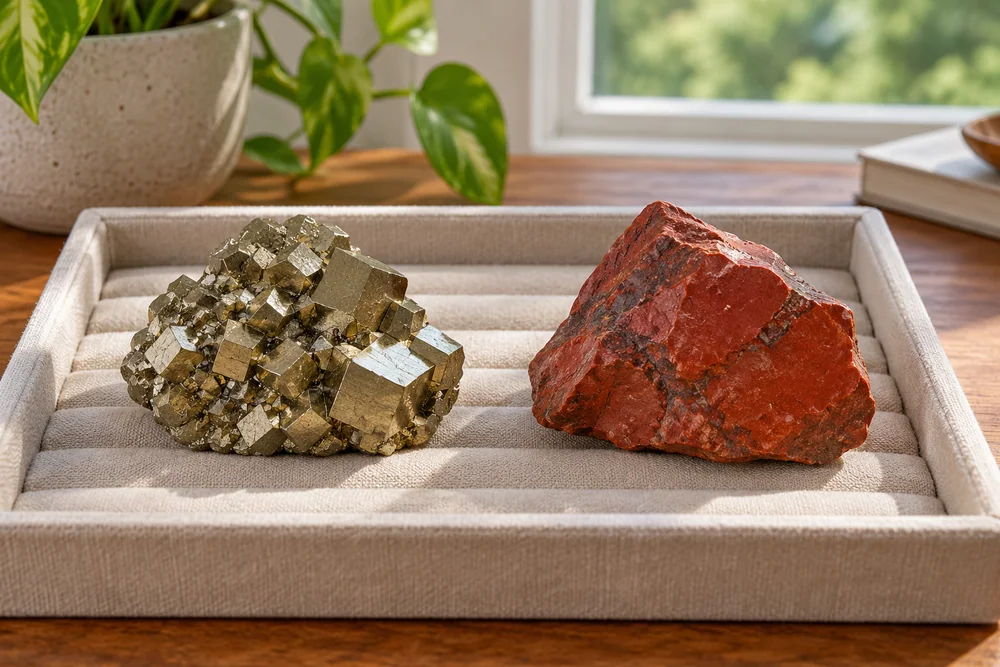
6. Pyrite oxidation: why humidity deserves serious attention
Pyrite contains iron and sulfur, and some pyrite specimens are vulnerable to oxidation in the presence of moisture and oxygen. Museums sometimes call severe progressive deterioration pyrite disease or pyrite decay. The American Museum of Natural History and Canadian Museum of Nature describe how oxidation can produce sulfate compounds and other reaction products, which may expand, crack or crumble a vulnerable specimen.
This does not mean every polished pyrite bead or stable cubic crystal will suddenly disintegrate at ordinary room temperature. Mineral texture, prior alteration, contamination, storage conditions and moisture exposure can affect susceptibility. Nonetheless, the risk is sufficiently documented that a permanently damp balcony, bathroom or exposed monsoon location is a poor default choice when the actual material has not been assessed.
In severe cases deterioration can produce powdery or crusty deposits, cracking, dulling and material loss. Oxidation products may be acidic and can damage other items stored nearby. The Institute of Conservation and museum preventive-conservation guidance therefore recommend appropriate dry conditions, isolation of actively deteriorating specimens and specialist advice. Do not touch or brush unknown decay powder into the air, inhale dust or attempt chemical treatment with household cleaners. Keep children and pets away and seek professional conservation advice.
A newly purchased stable ornament may need only conservative handling, a dry display location and periodic inspection. If a specimen shows significant progressive powdering, swelling or a strong unusual odour, remove it from normal display and consult a qualified mineral or conservation professional. Do not claim that a decorative varnish, oil, incense smoke or saltwater ritual is a proven way to stop pyrite disease.
7. Relative humidity and practical Indian-home placement
High humidity is a concern in many Indian climates, particularly during monsoon periods and in poorly ventilated rooms. Museum preservation guidance sometimes uses stringent relative-humidity targets for vulnerable pyrite specimens, but those conservation specifications are not universal household guarantees and should not be copied as a product's certified tolerance. The key principle is to avoid prolonged dampness and prevent condensation wherever a pyrite-containing hanging is kept.
Choose a dry, accessible indoor location rather than leaving unidentified pyrite outdoors in direct rain. Keep it away from leaking walls, wet plant pots, open bathrooms, humidifiers and places where the piece is frequently splashed. A covered balcony can still become damp from driven rain, salt spray or condensation; an ornamental photo on a terrace is not proof of all-weather suitability.
Ventilation and sensible indoor storage can help limit damp conditions, but they do not guarantee that a vulnerable pyrite specimen will never oxidise. If the actual material begins to show deterioration, stop treating it as an ordinary decor-maintenance issue. Assess the stone and the upper connection before using it above any occupied area.
Do not relocate a heavy hanging during an active storm by leaning over a balcony or standing on unstable furniture. Plan safe removal while the weather is calm and the fixing can be reached securely.
8. Why red jasper is usually the more stable-looking companion
Red jasper's fine-grained silica material does not undergo the same characteristic iron-disulfide oxidation mechanism as pyrite. That makes the pair asymmetric in practical care: the jasper may remain polished and apparently unchanged while the pyrite component requires more careful humidity control and inspection. The combined hanging should be cared for according to its most sensitive part.
However, jasper should not be treated as indestructible. A polished bead can chip, a drilled hole can develop a crack and a large carving can break when dropped or struck. Dyed material or applied surface coatings can be more sensitive to cleaning chemicals than an untreated silica-rich specimen. Some “red jasper” trade names may also describe other rocks with different compositions.
For a mixed arrangement, use dry dusting as the normal starting point rather than deciding that the entire hanging can be soaked because jasper is relatively robust. Clean the fittings cautiously and keep metal-polishing compounds away from the pyrite and any unidentified red treatment.
Where the actual items are individually documented and removable, separate component care may be possible, but it should follow the maker's guidance and should not compromise the original load-bearing construction.
9. Wire-wrapped pyrite clusters and smooth jasper beads
The two materials have different typical forms that create different suspension challenges. A rough pyrite cluster may have angular projections and a nonuniform outline. A rounded jasper bead may be smooth but relatively heavy for the size of its upper connector. Neither shape is automatically retained by a loose decorative wire spiral.
| Hanging element | Principal risk | What to inspect |
|---|---|---|
| Rough cubic pyrite cluster | Sharp corners, brittle projections, irregular weight and possible unstable surface | Retaining cage beneath the cluster, smooth wire ends, real specimen condition and complete weight |
| Polished pyrite bead | Possible treatment, abrasion at drilling and concealed cracks | Material identity, drill-hole edges, cord strength and bead separation |
| Red jasper round bead | Cracked bore, excessive strain on one strand or clasp | Hole quality, knots or crimps, actual count and complete assembly mass |
| Red jasper slab or carving | Off-centre weight, thin carved projections or drilled-edge damage | Balanced bail or frame, crack inspection and protection from hard impacts |
| Combined pyrite and jasper strand | Hard pieces contacting, weak connectors and pyrite powder contaminating neighbours | Spacing, secure terminations, dry care and periodic inspection |
| Metal frame, chain and upper hook | Opening rings, corroded hardware or mounting mismatch | Actual materials, joined load path, fixing suitable for substrate and movement |
Do not treat an attractive metal wire colour as proof of solid copper, sterling silver or a particular tested alloy. The exact fittings, whether plated or uncoated, must be disclosed when relevant. “Handmade” is a manufacturing statement, not an independently verified safety rating.
10. Load, sharp edges and safe mounting
Follow the full load path from the top hook through the hanging loop, rings, cord, wire and each stone setting. Dense pyrite can contribute more weight than expected; polished jasper beads and any metal frame add to the total. The correct rating for a hanging point depends on the installed substrate and the dynamics of the item, not simply on the look of the hook.
A hook suitable for a stationary lightweight picture may not be appropriate for a heavier suspended mineral assembly, especially where movement or vibration occurs. Choose manufacturer-approved hardware for the actual surface and obtain qualified help if mounting into masonry, concrete, ceilings or an unknown partition. Avoid relying on exposed adhesive pads for an outdoor or moving installation unless the specific manufacturer authorises that exact use.
Allow enough clearance that the stones cannot strike windows, door handles, railings, fans or one another in a breeze. Keep sharp pyrite corners and detachable beads beyond children's reach. Do not hang dense, fragile stones directly above cots, occupied seating or busy passages where a support failure could cause injury.
Inspect the full assembly from the back and underside. A wire cage must actually retain a stone if it rotates or slips downward; decorative loops cannot be assumed to withstand years of use. When a connector opens, a drill hole cracks or mineral material sheds, keep people clear of the fall zone, arrange safe removal and have the faulty part assessed or replaced.
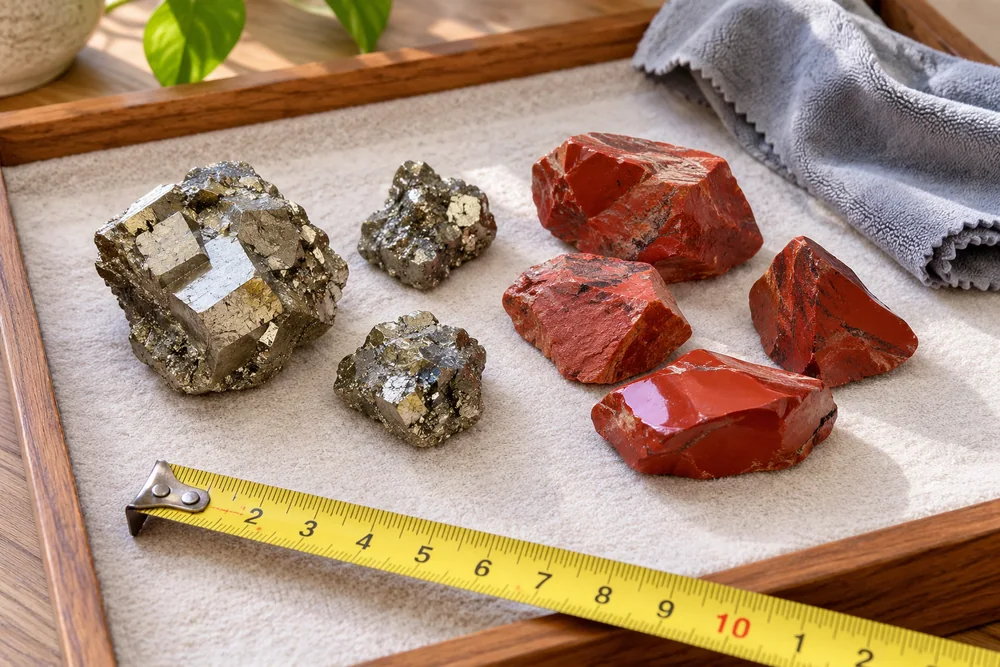
11. Dry cleaning: avoid water, acids, salts and metal polish
For an unidentified pyrite-and-jasper hanging, start with a soft clean dry cloth or a very gentle dry brush while the piece is supported over a padded surface. Do not vigorously scrape a rough pyrite cluster or loosen mineral grains and wire connections. Dusting is not a substitute for investigating progressive corrosion or powdering.
Do not soak pyrite in saltwater or acidic mixtures as a general “cleansing” method. Water exposure can worsen the risks that conservation guidance identifies for vulnerable pyrite, and salts or acid residues may affect both mineral and hardware. Household vinegar, lemon juice, bleach, ammonia, abrasive metal polish and perfumed sprays are not suitable universal treatments for a mixed mineral object.
Some well-characterised stones may tolerate limited cleaning methods individually, but this does not make them suitable for the complete hanging. Wetting a beaded assembly may also harm cord fibres, lacquer, adhesives or unknown coloured components. If a pyrite surface has already changed or appears unstable, isolate the item and obtain mineral-conservation advice instead of rubbing away the evidence of deterioration.
For routine care, check appearance, dry environment, support integrity and collision clearance. A visible layer of fine ordinary dust can be managed differently from new yellowish, whitish or rusty crusts, splitting and unusual progressive surface changes. Where in doubt, do not handle or disperse unknown powder unnecessarily.
12. Storage and travel: protect both specimens
When removing a hanging for storage, support the weight before unhooking it and photograph the arrangement so the original order and spacers can be preserved. Separate rough pyrite and polished jasper pieces with clean soft barriers. Prevent metal components from striking delicate mineral faces and keep sharp crystal corners from cutting the storage material.
Store in a dry, appropriately clean environment, protected from leaks, condensation, direct wet contact and unsuitable wooden or acidic storage materials where relevant. Museums use controlled display cases and dry microclimates for certain vulnerable geological specimens; a consumer should not assume that placing one packet of desiccant beside a permanently damp ornament guarantees stability.
Do not put a wet hanging into a sealed bag and trap water against the pyrite. If an individual specimen is actively deteriorating, keep it away from other mineral objects and seek suitable professional care because its degradation products may damage nearby materials. Reinspect the item before rehanging, particularly if it has experienced a monsoon season or long-term storage.
For transport, use a rigid box with separated padded supports rather than dangling an ornament loose from its fragile top loop. A heavy pyrite cluster can crush smaller jasper beads or bend a wire frame during an impact.
13. Retail identification, treatments and supplier evidence
Pyrite may be sold as a rough natural-looking mineral cluster, a polished bead or a coated decorative object. Red jasper can be natural-coloured, dyed or imitated by other silica-rich stones, ceramics and glass. The listing should distinguish genuine material, treatment and product construction, not collapse them into a broad “100% natural crystal” statement unsupported by evidence.
If a product claims a named mine, exact country of origin, untreated status, laboratory report, artisan origin, complete weight or number of beads, that information must come from actual stock records. A generated educational illustration cannot identify a supplier's individual stone or certify its material. Where natural mineral shape is the central selling point, real item photographs or a clear representative-specimen policy are particularly important.
Distinguish pyrite from gold and gold-tone plated beads. Ask whether a “pyrite-style” component is resin or metal and whether a red bead is genuinely jasper. A verified generic material description is more useful than an unsupported premium mineral claim.
Before purchase, check the actual stone composition, availability, price, measurements, care instructions and manufacturer. Do not assume that an item is safe outdoors or carries a laboratory certificate.
14. Traditional associations, Vastu Shastra and prosperity claims
Pyrite is sometimes marketed in contemporary crystal-decorating practice as a symbol of prosperity, confidence or abundance, while red jasper is commonly associated with steadiness, vitality or grounding. Individuals may value these meanings as personal symbolism, and minerals have long been appreciated in cultures for beauty, ornament and ritual use. Such beliefs should be described in their proper interpretive context rather than as objectively guaranteed outcomes.
Vastu Shastra is a substantial Indian architectural tradition concerned with orientation, entrances, circulation, space, light, proportion and concepts such as the Vastu Purusha Mandala and Pancha Mahabhuta. A modern pyrite-and-jasper hanging is not a universal classical requirement for any particular direction, and a decoration does not automatically substitute for building design, a prescribed ratna or personal Jyotisha consultation.
Some contemporary advice mixes Indian Vastu language with Chinese Feng Shui “wealth corner” ideas. These are different traditions and should not be presented as one ancient textual instruction. Where a practitioner uses a modern symbolic placement approach, say so and consider the actual hanging's humidity exposure, safety and household comfort as well.
Pyrite's iron-sulfide chemistry does not establish that it attracts money; the red colour of jasper does not guarantee protection from illness or a change in planetary karma. Likewise, mineral hardness, density and electrochemical properties are physical descriptions, not evidence that a hanging can alter a bank balance or provide a clinical effect.
For broader Indian architectural and spiritual context, see Vastu Shastra and the wider Vastu collection. Cultural meaning and mineral science can both be respected while keeping their respective claims distinct.
15. Buying checklist for pyrite and red jasper hangings
- Verify the actual materials. Confirm pyrite as iron disulfide and the red component as appropriately identified jasper or silica-rich ornamental stone.
- Separate colour from identity. Metallic lustre does not prove gold or pyrite; a red opaque bead is not automatically jasper.
- Check specimen condition. Examine pyrite for unusual powdering, splitting, corrosion or unstable crystals and jasper for chipped edges or cracks.
- Request treatment details. Ask about coatings, dyes, stabilisation, resin, drilled pieces and any manufactured substitutes.
- Confirm hanging construction. Check a real retaining cage, crimp, knot, jump ring, bail or drilled connection, not just visual wire decoration.
- Measure the complete object. Full drop, widest swing span, actual mineral sizes, weight and bead count for the physical stock.
- Assess the installation space. Prefer a dry location, adequate clearance, a reachable mounting point and hardware suitable for the actual load and movement.
- Confirm safe care. Avoid habitual pyrite wetting, saltwater and harsh cleaners; request material- and finish-specific instructions.
- Check authenticity documents. Treat a report, origin, artisan claim or specification as valid only when it matches the supplied item or traceable lot.
- Check purchase details. Confirm actual photos, price, availability, included hardware, packaging and care instructions.
Frequently asked questions
Is pyrite the same as gold?
No. Pyrite is iron disulfide, FeS₂, and is called “fool's gold” because of its brassy appearance. The colour does not make it native gold.
Is every metallic golden bead genuine pyrite?
No. Plated metal, glass, resin, other sulfides and decorative finishes can resemble pyrite. Mineral identity needs suitable evidence.
What makes red jasper red?
Red jasper is generally a fine-grained silica-rich material whose red to brown colour commonly relates to iron oxides, including hematite. Actual composition varies.
Can pyrite be damaged by damp air?
Yes. Some specimens are susceptible to oxidation and “pyrite decay” in humid conditions. Susceptibility varies; dry display and inspection are sensible precautions.
Will all pyrite specimens crumble when displayed?
No. Many specimens remain stable, while some are vulnerable to progressive oxidation. The condition and environment of the actual piece matter.
Can I soak a pyrite-and-jasper hanging in saltwater?
Avoid doing so. Pyrite has documented moisture-related deterioration risks, and the fittings, cord, treatments and other components may also be affected.
Does a pyrite cluster need a stronger hook than a jasper bead?
Not automatically. The installed support must suit the actual complete weight and movement of the particular hanging; pyrite is dense, but dimensions and total construction determine the load.
Is pyrite a musically tuned wind chime material?
Not by itself. A stone-only hanging is usually decorative; a claimed wind chime needs a real sounding mechanism and verified tuning if specific notes are promised.
Does hanging pyrite guarantee financial prosperity?
No. Contemporary prosperity associations are symbolic beliefs, not a scientifically established product performance guarantee or a universal classical Vastu rule.
Explore related OmmRudraksha stone hangings
Explore the Crystal & Gemstone Hangings collection and the parent Hangings & Chimes collection for other materials and constructions. Read Vastu Shastra for the wider Indian architectural framework. Confirm mineral identity, price and availability before ordering.


